






High on the windswept quartzite ridges of South Africa’s Transvaal grasslands, tucked securely into natural stone crevices, thrives a miniature botanical marvel: Frithia pulchra. In its harsh natural habitat, this delicate succulent contracts almost entirely beneath the arid ground during dry winter spells, exposing only the optical lens-like 'windows' at its leaf tips to catch the sunlight. Brought into our living spaces, this magnificent evolutionary adaptation becomes one of the most mesmerizing yet unforgiving treasures of any houseplant collection.
Many passionate growers confuse Frithia with its close relative Fenestraria rhopalophylla (commonly known as 'Baby Toes'), subjecting it to winter irrigation and inadvertently sentencing the plant to systemic rot. Unlike Fenestraria, Frithia is a true summer-grower that retreats into deep winter dormancy, only to awaken in warm weather with brilliant magenta, daisy-like blossoms sporting luminous yellow-white centers. In this master guide, we will unpack the precise physiological mechanics of Frithia, walking you through professional nursery protocols designed to prevent root hypoxia, leaf splitting, and collar rot.
1. Botanical Biology and Physiological Foundations
The genus Frithia belongs to the diverse family Aizoaceae (Mesembryanthemaceae) and is morphologically categorized as a specialized 'window succulent.' At the flattened apex of its cylindrical, club-shaped leaves lies an intricate layer of translucent, chlorophyll-free epidermal cells known as 'optical windows.' To shield its delicate photosynthetic machinery from the scorching ultraviolet radiation of the highveld, the plant conceals its green chloroplasts deep inside the subterranean lower leaf tissue. These apical epidermal facets act as organic fiber optics, diffusing and refracting intense overhead solar rays downward to sustain CAM (Crassulacean Acid Metabolism) photosynthesis while buffering inner cells against thermal degradation.
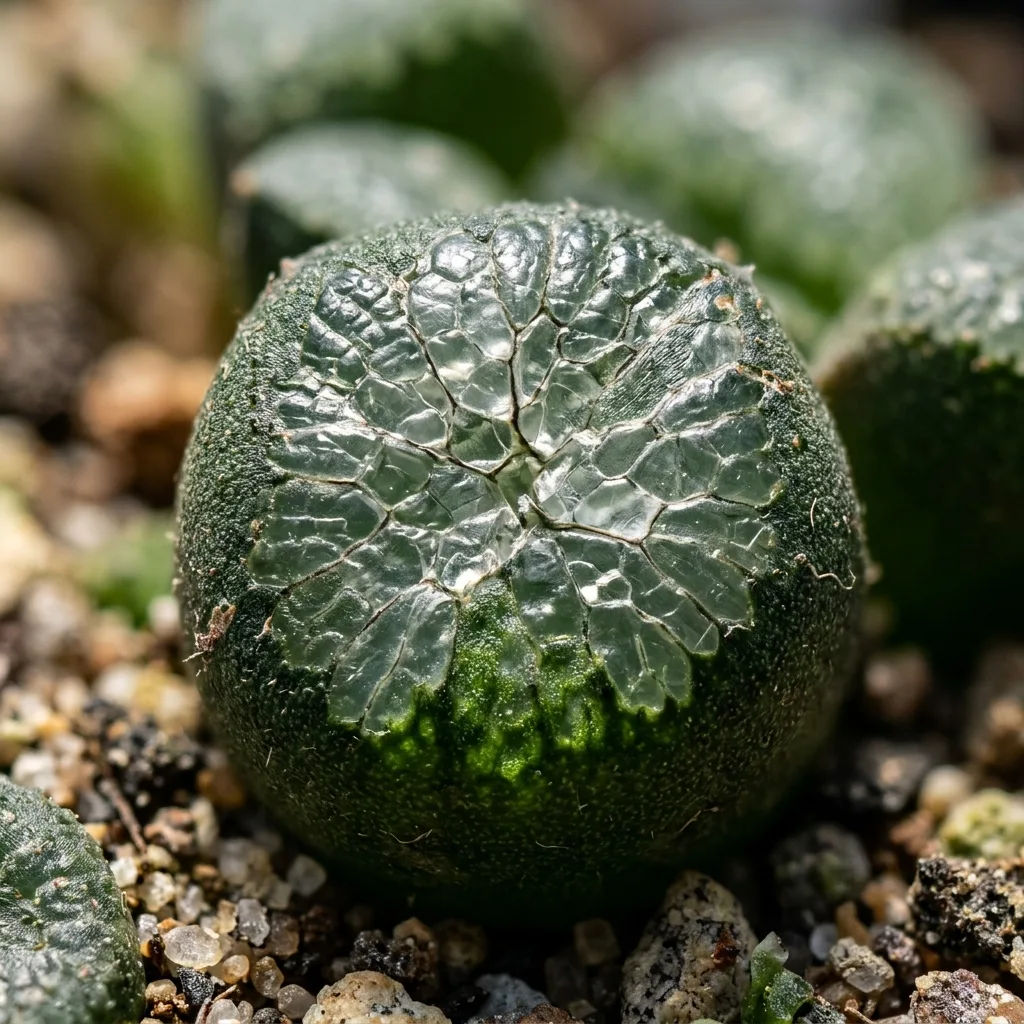
Its cellular water-storage parenchyma boasts an extraordinary retention capacity; however, this requires delicate hydrostatic turgor management by the grower. When Frithia receives excessive irrigation, its cell walls cannot withstand the internal hydraulic pressure, leading to longitudinal epidermal rupturing (leaf splitting). Furthermore, Frithia anchors itself via a fragile network of fine capillary feeder roots that require substantial oxygen exchange within their xylem vessels. In standard moisture-retentive potting soils, root-zone oxygen deprivation (hypoxia) triggers opportunistic colonizations of Pythium and Fusarium pathogens within 24 to 48 hours.
2. Accurate Diagnosis and Indicators of Plant Need
Cultivating a flourishing Frithia requires tuning into its silent cellular language. When this miniature succulent experiences dehydration or root-drowning, it exhibits unmistakable physical distress signals:
- Physiological Thirst (Turgor Depletion): The cylindrical leaves develop delicate horizontal wrinkles along their shafts, and the apical windows sink slightly inward, forming concave depressions. To the touch, the foliage feels slightly pliable rather than turgid like a ripe grape. This visual depression is your safest indicator that irrigation is required.
- Excess Hydrostatic Turgor and Leaf Rupturing: Fissures developing across the translucent apical windows or vertical splits cleaving the leaf shafts indicate that the roots have taken up water faster than cell walls can accommodate, causing hydrostatic cell wall blowout.
- Root Hypoxia and Collar Rot: The basal leaf junctions turn pale, translucent, and turn to a mushy, gelatinous consistency, detaching at the slightest touch. This is definitive evidence of root asphyxiation followed by fulminant fungal rot.
- Etiolation (Photonic Deprivation): Leaves stretch upward, becoming abnormally slender, pale green, and weak. The compact subterranean rosette unravels and the apical windows turn dull and opaque as cells desperately elongate toward the light source.
3. Step-by-Step Cultivation Protocol
Replicating the mineral dynamics of South African quartzite outcrops in a container environment is the absolute secret to thriving Frithia. Follow this systematic, professional cultivation protocol:
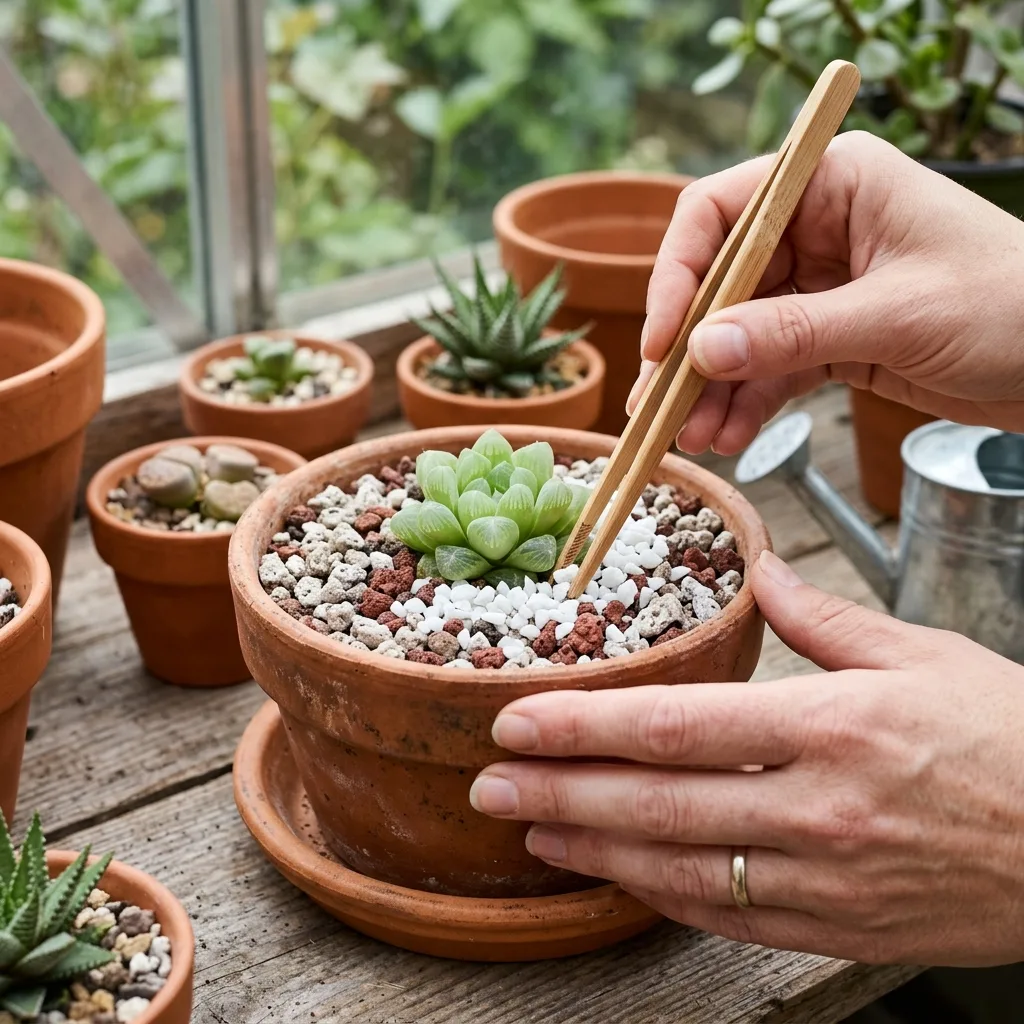
- Container Selection: Always use unglazed terracotta pots equipped with large, unobstructed drainage apertures. Terracotta’s porous clay walls facilitate evaporative side-wicking of moisture, cooling the root zone and providing essential rhizosphere aeration. Keep pot depth between 8 and 10 cm; Frithia develops a spreading fibrous root system rather than a long taproot.
- Blending the Aerated Inorganic Substrate: Prepare a gritty mix containing at least 80% to 85% porous, inert mineral aggregates (pumice, crushed lava rock, zeolite, coarse quartz grit). The remaining 15% should consist solely of finely screened, low-salinity coco coir or mature, sifted leaf mold.
- Collar Protection Top-Dressing: When potting, spread the roots throughout the mineral substrate, but keep the basal rosette crown elevated. Fill the top 1 to 2 cm around the leaf necks with coarse quartz gravel or pure horticultural zeolite. This inert gravel collar ensures that delicate basal tissues never touch damp organic soil.
- The Cyclical Turgor-Responsive Watering Method: During the active summer growing phase (from mid-spring to early autumn), water deeply only when the leaf shafts display slight horizontal wrinkling and the window facets dish inward. Always empty the drainage saucer within 10 minutes; never let the pot sit in standing water.
- Winter Dormancy Regimen: From late autumn through early spring, as ambient temperatures settle between 8°C and 12°C, suspend watering entirely. If the leaves shrivel into extreme contraction, apply a few teaspoons of water around the pot rim once a month on a mild morning simply to keep the micro-feeder root tips viable.
4. Essential Cultivation Parameters and Material Specifications
Frithia’s specialized physiology thrives within tight environmental margins. The following baseline specifications summarize ideal cultivation parameters:
| Parameter / Material | Target Specification | Physiological Objective |
|---|---|---|
| Inorganic Mineral Ratio | 80% – 85% (Pumice, Zeolite, Lava) | Rhizosphere oxygenation; eliminates moisture stagnation |
| Organic Fraction | 15% (Screened Coco Coir) | Minimal cation-exchange capacity and gentle nutrient delivery |
| Light Exposure | 5–6 hours of filtered/direct sunlight daily | Saturates CAM photosynthesis; arrests etiolation |
| Thermal Range | Active: 20°C – 30°C / Dormant: 8°C – 12°C | Honors seasonal dormancy and metabolic enzyme regulation |
| Potting Vessel | Unglazed Terracotta (8–10 cm depth) | Rapid evaporative drying; prevents root-zone heat buildup |
| Water Quality (pH) | pH 6.0 – 6.5 (Rainwater or low-mineral) | Prevents mineral crusting over apical leaf windows |
5. Five Critical Cultivation Pitfalls and Emergency Rescues
Even seasoned succulent growers encounter setbacks with Frithia. Here is how to diagnose and rectify the five most widespread cultivation errors:
- Mistake 1: Treating Frithia as a Winter Grower (Confusing with Fenestraria): Watering in mid-winter disrupts the plant's metabolic dormancy; cold, wet roots fail to uptake moisture and disintegrate from anaerobic rot.
Emergency Rescue: Unpot the plant immediately, shake away wet particles, inspect and prune black roots, let the root crown dry on absorbent paper towels for 4 days in a warm, shaded area, then repot into bone-dry pure pumice until spring. - Mistake 2: Overhead Sprinkler or Misting Irrigation: Water pooling in the center of the dense rosette causes fungal crown rot or acts as a prism, burning the leaves under high light.
Emergency Rescue: Expel trapped water droplets between leaves using a mechanical rubber air bulb or the corner of a paper towel. Always bottom-water or water the perimeter of the pot. - Mistake 3: Relying on Pre-Bagged Commercial 'Cactus Soil': Standard commercial mixes consist primarily of dense peat that turns hydrophobic when dry and suffocatingly waterlogged when wet.
Emergency Rescue: Gently wash the compacted peat off the root mass with tepid water, trim bruised roots, and replant into an 85% mineral mix graded to a 2–4 mm particle size. - Mistake 4: Heavy Watering Under Low-Light Conditions: In low-light interiors, the plant’s photosynthetic rate drops; cellular water uptake slows, causing extreme hydrostatic turgor pressure that bursts the window membranes.
Emergency Rescue: Halt all irrigation and incrementally acclimatize the plant toward an unshaded east- or south-facing window sill that receives bright morning sun. - Mistake 5: Failing to Apply an Inorganic Basal Top-Dressing: Allowing the leaf collars to sit directly on damp substrate creates a primary vector for fungal infection.
Emergency Rescue: Carefully scoop out the top 1.5 cm of soil around the crown with a spoon and backfill the void with dry, coarse quartz gravel or crushed zeolite to lift the rosette base above moisture.
6. Seasonal Phenology and Long-Term Specimen Development
Frithia pulchra lives by a precise seasonal calendar. As spring unfolds (late March into April) and temperatures reliably cross 18°C, its fine capillary root hairs emerge from their slumber. Delivering your first thorough drench at this juncture jumpstarts cell division and metabolic activity. Throughout the peak summer growth window (May through August), the plant produces dazzling magenta flowers with vibrant yellow centers emerging right from the heart of the leaf clusters. A single, quarter-strength application of a balanced, low-nitrogen, high-potassium liquid fertilizer in midsummer encourages vibrant, enduring blooms.
When autumn arrives and nighttime temperatures begin to drop (September to October), water must be tapered off systematically. This gradual reduction encourages cell sap concentration, thickening the cellular fluids with natural sugars to protect against cold damage. Throughout the winter, house your Frithia in a bright, crisp room maintained between 8°C and 12°C, completely dry. By faithfully following this annual rhythm, your Frithia will gradually offset new clumping rosettes year after year, eventually forming a breathtaking, jewel-like cushion of living crystal windows.


Reader Reviews & Comments 3 Reviews
Julian Vance
Marcus Sterling
Clara Higgins
Leave a Review & Rating
Share your plant care tips, experiences, or questions with our succulent community.