






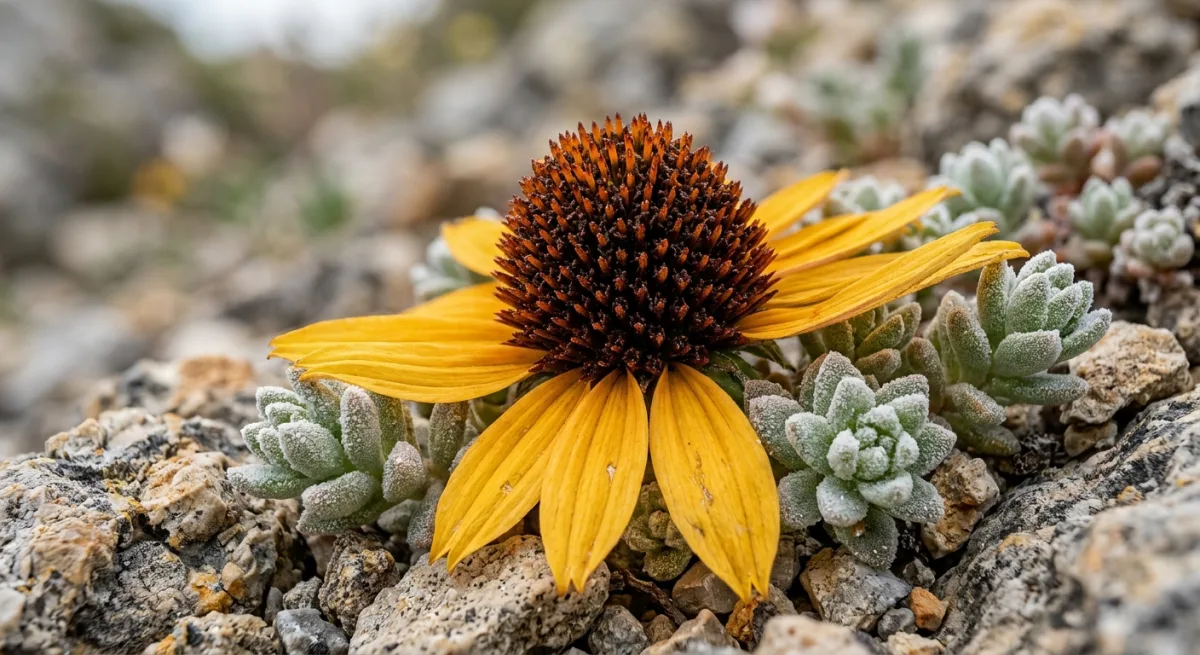
High in the limestone glades of North America's Ozark Mountains, braving the blistering heat of midsummer, a true botanical anomaly emerges from fractured stone fissures to reach toward the open sky: the Yellow Coneflower (Echinacea paradoxa), widely cherished by native plant enthusiasts as Bush's Purple Coneflower. In the horticultural community, it is famously known as the 'coneflower paradox' for good reason; while nearly every other member of this iconic genus displays varying shades of rose, purple, and magenta, this ancient species defies genetic expectation with brilliant, chrome-yellow ray florets encircling a stately dark chocolate cone. Recreating this wild, rugged limestone glade ecosystem within an open glass vessel is far more than a decorative centerpiece—it is an exercise in applied micro-geology and precision plant physiology.
Contrary to popular indoor gardening tropes, enclosed glass vessels are lethal death traps for prairie and steppe flora. The non-negotiable rule when cultivating taprooted perennials alongside xeric succulents under glass is to utilize wide-mouthed, open glass vessels that facilitate uninterrupted air movement. A closed terrarium rapidly accumulates saturated relative humidity that asphyxiates the deep taproots of Echinacea paradoxa and the cellular tissue of fleshy companion leaves within hours, quickly surrendering porous structures to opportunistic fungal pathogens. An open glass vessel maintains critical gas exchange and passive oxygen diffusion through the root xylem, closely mimicking the arid micro-breezes that define the plant's native stony ridges.
Successful plant keeping is the art of translating ecological field conditions to the indoor space. Drenching drought-hardy plants frequently is never an act of care; it starves root tissues of vital oxygen and triggers quiet cellular collapse. By honoring the mineral-rich, sharply draining, alkaline substrate preferences of Echinacea paradoxa through careful engineering, you can effortlessly sustain a living slice of the Ozark prairie right on your desk.
1. Drainage Layer Engineering & Hydraulic Mechanics
The single greatest hazard of cultivating xerophytic plants in undrilled glass vessels is gravity: excess water naturally pools at the vessel floor with no outward exit. When unmanaged water stagnates against organic matter, anaerobic bacteria proliferate exponentially, synthesizing toxic hydrogen sulfide gas and triggering irreversible root rot. Preventing this biological failure demands a rigorously calibrated physical and hydraulic barrier.
The foundation relies on ultra-porous, kiln-fired expanded clay pebbles (hydroton) combined with coarse volcanic lava rock. This lower stratum functions as an isolated reservoir, preventing standing water from moving back upward into the delicate root zone through capillary action. Directly above this aggregate, a distributed layer of acid-washed activated horticultural charcoal pellets adsorbs dissolved organic volatile compounds, eliminates sour odors, and inhibits the proliferation of fungal spores within the glass vessel's microclimate.
2. Compatible Species Selection & Biotopical Companion Rules
In habitat, Echinacea paradoxa populates shallow, alkaline limestone glades and rocky barrens under relentless full sun. Companion plants must share an identical physiological tolerance for drought, low ambient humidity, high mineral substrates, and intense photosynthetic radiation. Moisture-loving tropical species such as nerve plants (Fittonia) or delicate ferns must never enter this arid setup.
To counterbalance the slender, upright vertical architecture of the Yellow Coneflower, introduce low-growing, rosette-forming, calciphilic (lime-loving) saxicolous succulents. These complementary companions form a biologically cohesive community:
- Sedum album & Sedum rupestre (Stonecrops): These hardy creeping perennials replicate rock-fissure vegetation and provide a protective moisture buffer around the central crown without harboring dampness.
- Sempervivum calcareum (Houseleek): Naturally adapted to high-calcium, alkaline stone beds; its tight, chalky blue-green rosettes with tipped burgundy points offer a striking architectural counterpoint to upright coneflower stems.
- Orostachys boehmeri (Chinese Dunce Cap): Displays powdery silver-lavender rosettes that harmonize effortlessly with coneflower foliage. Remember that the delicate farina (epicuticular wax) coating these leaves serves as the plant's natural cellular sunscreen—handle leaves exclusively by their bases using soft planting forceps to avoid wiping away this protective barrier.
- Delosperma cooperi (Hardy Ice Plant): Features crystalline, light-refracting leaf cells that accentuate the raw mineral feel of the foreground while withstanding intense lighting.
3. Substrate Profile, Layer Depths & Material Specifications
Assuming a standard open glass cylinder or bowl with a vertical depth of 20 to 25 cm, the subterranean profile must be meticulously proportioned. Each layer carries a distinct biomechanical mandate:
| Stratum Level | Recommended Depth | Composition / Aggregate Grade | Biomechanical Function |
|---|---|---|---|
| 1. Drainage Reservoir | 3.0 - 4.0 cm | Coarse Horticultural Pumice & 8-16 mm Volcanic Lava Rock | Isolates gravitational drain water safely beneath the root zone |
| 2. Purification Stratum | 0.5 cm | Granular Activated Horticultural Charcoal | Adsorbs anaerobic organic wastes; neutralizes stagnation odors |
| 3. Geotextile Membrane | 0.1 cm (Single Sheet) | Woven Landscape Geotextile / Inert Micro-Mesh | Prevents fine mineral media from migrating into aggregate voids |
| 4. Engineered Glade Substrate | 6.0 - 9.0 cm | 30% Zeolite, 30% Fine Pumice, 10% Perlite, 20% Low-Humus Peat, 10% Crushed Limestone Grit | Ensures macroscopic aeration while buffering pH at an alkaline 7.2-7.8 |
| 5. Dry Top-Dressing Mulch | 1.0 - 1.5 cm | Crushed Dolomite Limestone Screenings & Coarse River Quartz | Shields root crowns from dampness and balances surface evaporation |
4. Step-by-Step Glade Construction & Planting Protocol
Constructing a thriving open glass glade terrarium demands deliberate, sterile precision. Before assembly, thoroughly wash the glass vessel using mild natural soap and warm water, followed by a light wipe-down with 70% isopropyl alcohol, allowing it to dry completely streak-free.
- Install the Water Reservoir: Spread an even 3 to 4 cm layer of rinsed lava rock and coarse pumice across the flat bottom of the vessel. Scatter granular activated charcoal evenly across the stones.
- Fit the Permeable Barrier: Cut your geotextile fabric roughly 1 cm wider than the internal diameter of the vessel. Seat the fabric firmly, curling the edges slightly up against the perimeter glass to form a complete seal.
- Sculpt Topography & Root Mounding: Pour the engineered mineral substrate into the vessel. Rather than creating a flat horizon, build an intentional subterranean ridge or raised knoll toward the rear or center. This architectural mound delivers critical vertical clearance for the coneflower's deep taproot.
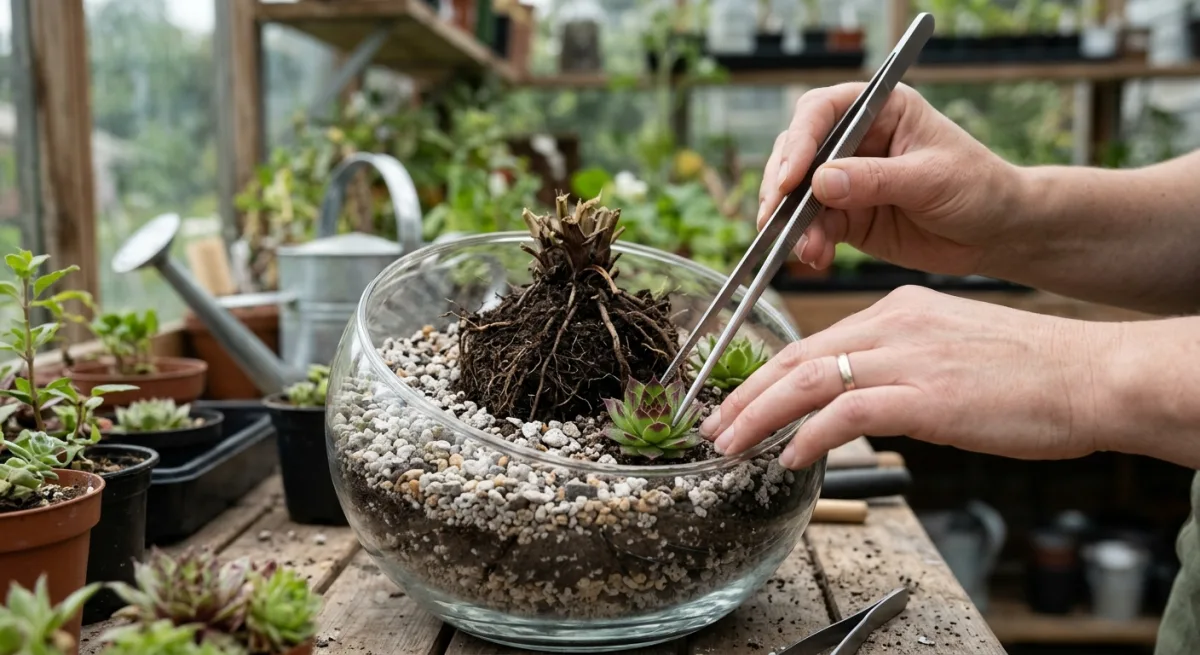
- Root Preparation & Central Installation: Gently wash away any heavy organic greenhouse peat from the root mass of your juvenile Echinacea paradoxa using room-temperature water. Excavate a generous vertical cavity into the peak of your soil mound. Carefully guide the straight taproot downward without bending or snapping the main tip, firming the dry mineral mix securely around the root collar.
- Position Companion Succulents: Arrange your creeping stonecrops and rosette succulents along the sloping shoulders of the mound toward the glass perimeter. Anchor fine fibrous succulent roots into the gritty matrix using angled planting forceps.
- Crown Isolation with Limestone Mulch: Never permit organic potting soil to remain in direct contact with the transitional crown stems. Distribute a 1 to 1.5 cm layer of washed crushed limestone chips across the entire surface, effectively cradling and isolating the root crowns within completely dry, mineral stone.
5. Geological Hardscaping: Weathered Stone, Driftwood & Sand Accents
To establish an authentic slice of wild, sun-drenched topography, artificial resin figurines and neon-dyed sands should be completely avoided. The native bedrock of Echinacea paradoxa consists of weathered dolomite and calcium-rich limestone. Incorporating naturally pitted, pale gray or cream limestone rockwork produces an understated sculptural focal point while naturally releasing trace calcium carbonate during bottom-watering, effectively safeguarding the alkaline soil chemistry required by glade-dwelling flora.
If you wish to introduce aged woody accents, select exclusively dense, rot-resistant, heat-sterilized mopani or desert ironwood branches. Avoid soft, moisture-retentive deciduous woods that inevitably mold under indoor conditions. Thin, deliberate lines of raw silica or washed river sand worked between stone crevices mirror natural alluvial sediment channels carved by post-storm runoff, instilling authentic visual depth.
6. Precision Hydration Protocol & Photonic Energy Management
The long-term vitality of an open glass prairie terrarium hinges on two indispensable cultural pillars: saturation-level photon density and strictly disciplined hydration. Echinacea paradoxa is an obligate full-sun perennial evolved under intense irradiance. Situate the display where it enjoys at least 5 to 6 hours of unobstructed, direct southern or western sunlight daily. During low-light winter months, position a 6500 Kelvin, high-CRI full-spectrum LED horticultural light 20 to 30 cm above the open vessel for 12 hours daily to prevent unsightly etiolation (stem stretching and structural weakening).
When it comes to watering, abandon overhead watering cans and standard spray misters entirely. Surface misting collects water droplets within the rosette leaf bases, which strip away protective epicuticular farina waxes and invite bacterial soft rots. Instead, utilize a narrow-nozzle laboratory wash bottle or a graduated syringe. Deliver measured amounts of water exclusively through the stone mulch along the inner perimeter of the glass, completely bypassing root crowns and foliar nodes. During active spring and summer growth, hydrate only after the mineral mix has remained bone-dry for 4 to 5 consecutive days. As cooler autumn temperatures trigger seasonal dormancy, scale back watering to once a month, keeping moisture minimal until fresh basal growth resumes in spring.


Reader Reviews & Comments 3 Reviews
Julian Vance
Clara Sterling
Markus Albright
Leave a Review & Rating
Share your plant care tips, experiences, or questions with our succulent community.