






Reaching from the limestone crevices of the dry, spiny forests of southwestern Madagascar all the way to your living room windowsill, Xerosicyos danguyi (commonly known as the Silver Dollar Vine, Dollar Succulent, or Penny Plant) captures the hearts of succulent connoisseurs at first glance. Unlike conventional rosette-forming succulents, this extraordinary climbing member of the cucurbit family (Cucurbitaceae) exhibits a striking vertical architecture adorned with perfectly circular, discoid green leaves resembling minted coins and delicate, inquisitive tendrils. However, successfully cultivating this botanical marvel over decades hinges upon a precise physiological understanding of how it survives in harsh, drought-prone scrublands.
Far too many indoor gardeners mistake this climbing beauty for a common tropical vine, smothering its root system in moisture-retentive peat moss or drenching it on an arbitrary schedule. Pouring water indiscriminately on a succulent is never an act of care; it is an accidental path to cellular suffocation. The root system of Xerosicyos is a highly oxygen-dependent capillary network wired to support a specialized cellular reservoir within the leaf parenchyma that holds water for months on end. In an indoor setting, preventing root decline while encouraging vigorous vines to climb several meters with thick, succulent discs is entirely achievable when you apply a rigorous, science-backed approach.
1. Botanical Biology and Physiological Foundations
Xerosicyos danguyi has evolved extraordinary cellular adaptations to withstand extreme environmental aridity. Its survival strategy rests on three primary physiological pillars:
- Discoid Water Storage Parenchyma: The plant's flattened, coin-shaped leaves are not an aesthetic coincidence. Geometrically, this circular and compressed morphology optimizes the surface-area-to-volume ratio, substantially reducing transpiration-driven moisture loss. The inner leaf mesophyll tissue is packed with highly specialized storage vacuoles with exceptional osmotic potential, expanding during hydration and contracting safely during drought stress.
- CAM (Crassulacean Acid Metabolism) Photosynthesis: To prevent dehydration under scorching sun, the Silver Dollar Vine keeps its stomata sealed tightly throughout the day. Under the cover of night, its stomata open to harvest carbon dioxide, fixing and storing it as malic acid within cellular vacuoles. As daylight returns, the plant metabolizes this stored acid to complete the Calvin cycle. Consequently, this vine demands cool nocturnal air exchange combined with high diurnal photon flux.
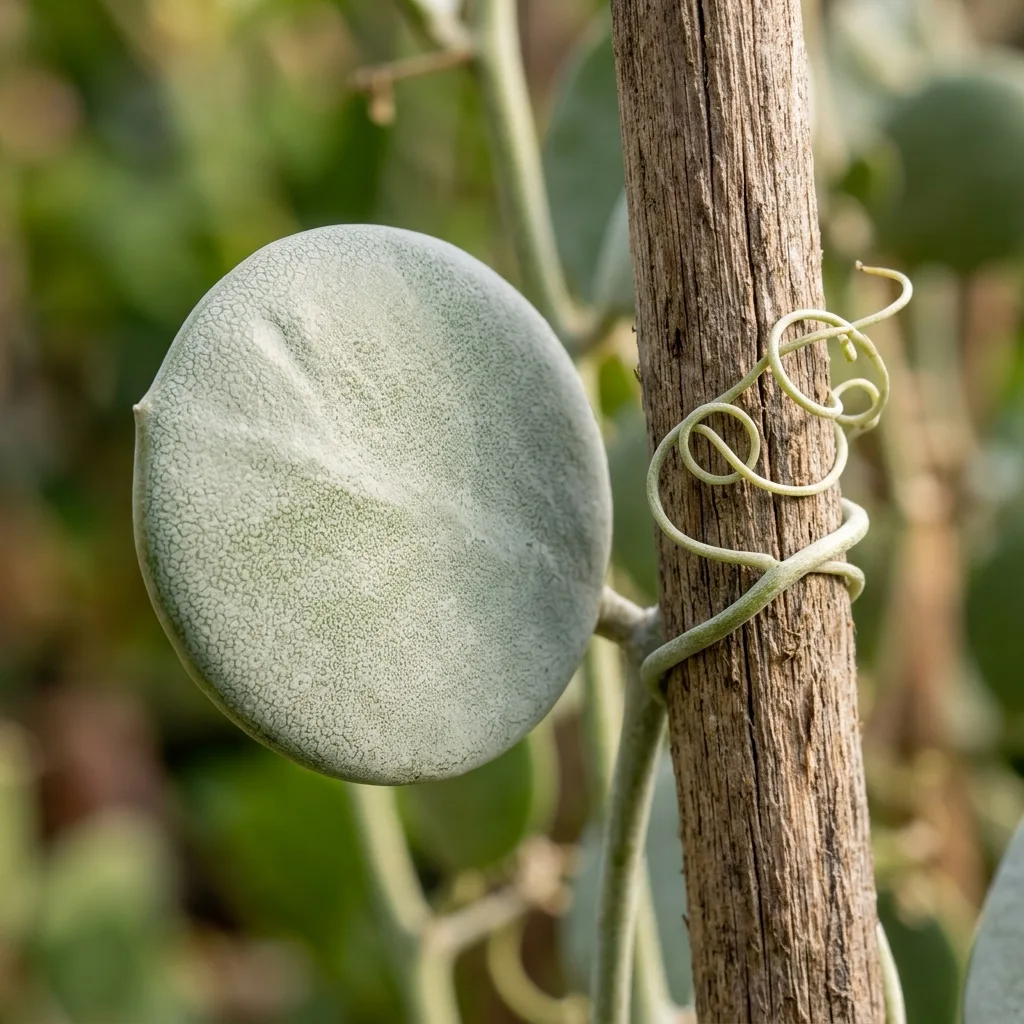
- Tendril Biology and Thigmotropism: Slender tendrils emerge opposite the leaf axils, displaying acute mechanical sensitivity (thigmotropism). When left suspended in mid-air, these tendrils remain limp; however, the moment they make contact with a physical substrate, they rapidly curl and lignify over subsequent months to support the heavy vine. Enabling vertical climbing stimulates apical dominance, prompting the plant to generate significantly larger, thicker, and more succulent foliage.
2. Diagnostics and Physiological Stress Indicators
The Silver Dollar Vine communicates microclimatic stress through unmistakable physiological responses. Learn to read your plant's symptoms with botanical precision:
- Puckering, Thinning Leaves: When the fleshy discs lose their plumpness and develop fine surface wrinkles, the internal vacuolar water reserves have been drawn down. If the substrate is completely dry throughout the root zone, this is your definitive signal to irrigate thoroughly.
- Translucent, Yellowing, Dropping Leaves: Cellular rupture caused by prolonged saturation and oxygen deprivation (hypoxia). This is the hallmark symptom of basal and capillary root rot. Cease watering immediately and inspect the subterranean root tissue.
- Elongated Internodes and Misshapen Leaves (Etiolation): A clear symptom of photon starvation. Unable to capture sufficient light, the vine redirects its energy away from foliar thickness into desperate stem elongation. The iconic coin shape becomes distorted into thin, elongated ovals.
- Basal Lignification and Bark Formation: The base of the primary stem gradually turns corky, brown, and woody over time. This is not a fungal infection or disease; it is the natural formation of secondary xylem and a pseudo-caudiciform base designed to structurally anchor the heavy, ascending biomass.
3. Step-by-Step Cultivation Protocol
To cultivate a vigorous, structural, and densely foliaged Xerosicyos danguyi, follow this disciplined four-step protocol:
- Light Positioning: Position the plant in a south- or west-facing exposure where it receives direct early-morning sun or dappled, bright afternoon light. A minimum of 5 to 6 hours of intense light daily (ideally 20,000 to 35,000 lux) is essential to preserve internodal compactness and circular leaf thickness.
- Soak-and-Dry Irrigation Technique: Never water on a calendar schedule. Wait until the entire root column has dried completely down to the base of the pot. When irrigating, drench the root ball thoroughly with room-temperature water until it flows freely from the drainage holes. Discard any residual water from the saucer within 10 minutes. In winter, or whenever temperatures dip below 15°C (59°F), reduce watering frequency to once a month or only when foliar wrinkling appears.
- Trellis and Vertical Support Setup: While the Silver Dollar Vine can be kept as a cascading plant in a hanging basket, giving it a vertical structure (such as a sturdy bamboo stake, jute twine, or a circular wire trellis) unlocks its true morphology. Gently guide the tender tendrils toward the framework; within days, they will coil tightly and begin their upward climb, triggering foliar hypertrophy.
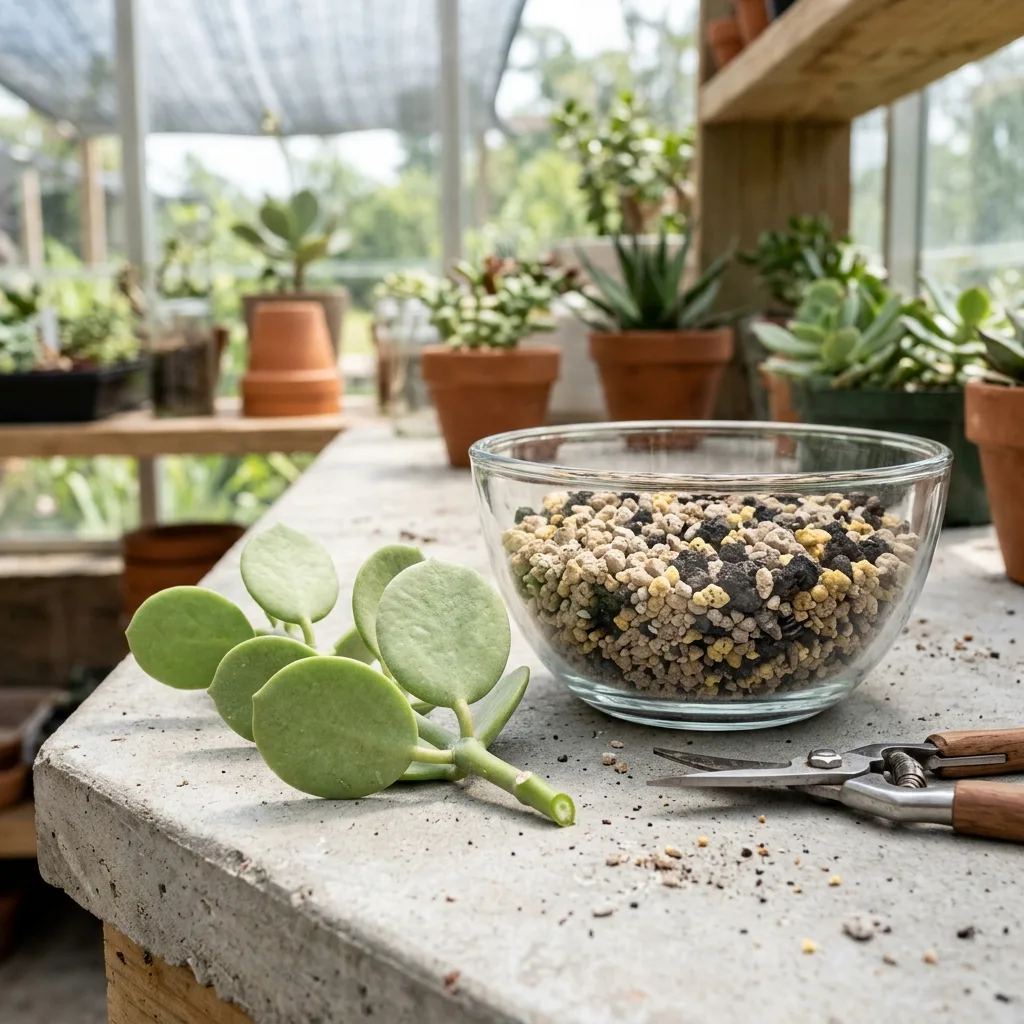
- Stem Cutting Propagation: During late spring or early summer, use a sterilized pruning shear to take a 10–15 cm (4–6 inch) semi-lignified stem cutting containing at least 3 to 4 mature leaf nodes and active tendrils. Allow the cut surface to callus over in a warm, shaded, well-ventilated location for 4 to 6 days. Insert the base 2–3 cm deep into an inorganic, slightly moistened pumice-perlite substrate. Root initiation typically occurs within 4 to 6 weeks.
4. Substrate, Equipment, and Environmental Parameters
Planting a Silver Dollar Vine in generic potting compost is a surefire recipe for root decline. The subterranean meristem demands rapid gas exchange and instant drainage. Maintain the following cultivation parameters:
| Parameter / Component | Recommended Standard / Ratio | Physiological Objective |
|---|---|---|
| Substrate Formulation | 40% Pumice (3–5 mm) + 25% Crushed Lava Rock + 15% Zeolite + 20% Coconut Coir (or fine peat) | Zero waterlogging, maximal gas exchange for root hairs, and complete prevention of anaerobic pathogens. |
| Container Material | Unglazed terracotta with generous drainage holes | Permeable clay walls accelerate evaporative drying, keeping the subterranean zone cool, aerated, and dry. |
| Light Intensity | 6–8 hours daily at 20,000–40,000 Lux (or full-spectrum horticultural LED) | Maintains compact internodes and drives the photosynthetic engine required for thick, succulent discs. |
| Thermal Range | Vegetative phase: 20°C–32°C (68°F–90°F) / Winter rest: 12°C–18°C (54°F–64°F, Absolute Min: 10°C/50°F) | Prevents thermal shock and ensures seamless nocturnal CAM acid decarboxylation. |
| Nutrient Supplementation | Low Nitrogen, High Potassium formulation (e.g., NPK 4-8-12) at 1/4 strength | Builds rigid cell walls and dense cuticles rather than watery, weak, rot-prone growth (Monthly in summer). |
5. Five Critical Mistakes and How to Correct Them
- Leaving the Plant Suspended Without Climbing Support: In hanging baskets, gravity sends inhibitory signals to the apical meristem, resulting in thin, weak vines with diminishing foliage size. Rescue: Introduce a hoop trellis or bamboo framework and secure the vines loosely. Within a month, newly expanding leaves along the climbing tip will emerge significantly larger.
- Watering by the Calendar: An unyielding 'every Sunday' watering regimen is a primary cause of succulent mortality, failing to account for ambient humidity, seasonal shifts, and temperature. Rescue: Use a wooden skewer inserted to the bottom of the container. Water only when the wood emerges completely dry and clean from top to bottom.
- Using Heavy, Humus-Rich Potting Mixes: Peat-heavy soils hold water for weeks, starving root tissues of oxygen and inducing hypoxia. Rescue: Unpot the plant immediately, wash the old media away from the roots, excise any darkened or necrotic root segments with sterile shears, and repot into an inorganic, mineral-rich pumice matrix.
- Positioning Above Winter Radiators or Forced-Air Vents: Blasts of arid, heated air accelerate foliar moisture loss while the dormant root system cannot replenish it, resulting in massive leaf drop. Rescue: Relocate the plant at least 1.5 meters away from active heat sources into a bright, cool, well-ventilated room.
- Hesitating to Prune Leggy Stems: Bare, elongated vines sap vitality without contributing photosynthates. Rescue: In early spring, prune bare stems roughly 1 cm above a healthy leaf node. The wound will quickly stimulate dormant axillary buds, triggering multiple fresh, compact branches.
6. Seasonal Management and Long-Term Outlook
Aligning your care protocol with the natural phenological rhythm of Xerosicyos danguyi ensures that your specimen will thrive for decades, eventually becoming a treasured family heirloom:
- Spring (Active Awakening): From late March onward, systematically reintroduce moisture as new tendrils unfurl. Perform repotting if the roots have outgrown the container. Restructure trellises and apply a dilute, low-nitrogen succulent fertilizer once a month.
- Summer (Peak Photosynthesis & Heat Management): When temperatures exceed 32°C (90°F), the vine may enter a temporary summer resting state (estivation). If growth stalls, space out waterings slightly and provide sheer filtration against scorching midday sun. Cross-ventilation is vital.
- Autumn (Tissue Hardening): Discontinue all fertilizing by September. Gradually taper watering frequency to prompt the vine to harden its vascular bundles and thicken its epidermal layers for winter resilience. Bring outdoor plants inside well before night temperatures fall below 12°C (54°F).
- Winter (Dormant Rest): Maintain the plant in a bright, cool location (12°C–16°C / 54°F–61°F). Water sparingly—perhaps once every 3 to 4 weeks—only when the foliage shows subtle puckering. Keep the subterranean root zone nearly dry to preserve root hair integrity.
By respecting the evolutionary adaptations of this dry-forest climber, your Xerosicyos will reward you with a sculptural trunk base, hundreds of shimmering silver-green coin leaves, and an extraordinary architectural presence that transforms your living space into a living botanic showcase.


Reader Reviews & Comments 4 Reviews
Eleanor Vance
Dr. Julian Thorne
Marcus Sterling
Sophia Campbell
Leave a Review & Rating
Share your plant care tips, experiences, or questions with our succulent community.