






Hailing from the windswept, subalpine rock fissures of the European mountains, Sempervivum arachnoideum subsp. tomentosum stands as one of the most resilient and visually captivating gems in the succulent universe. Cloaked in a dense, silvery web of modified trichomes bridging leaf tip to leaf tip, this alpine perennial bridges extreme botanical endurance with geometric perfection.
For dedicated growers and alpine collectors alike, mastering Woolly Cobweb Houseleek care requires calibrating moisture, luminous full-spectrum sunlight, and an ultra-porous mineral substrate that honors its high-elevation origin. Whether nested in an outdoor alpine trough, a drought-tolerant rockery, or a shallow terracotta pan, understanding its Crassulacean Acid Metabolism (CAM) and specialized morphological shields will ensure your colonies flourish for decades.
Botanical Identity and Morphological Marvels
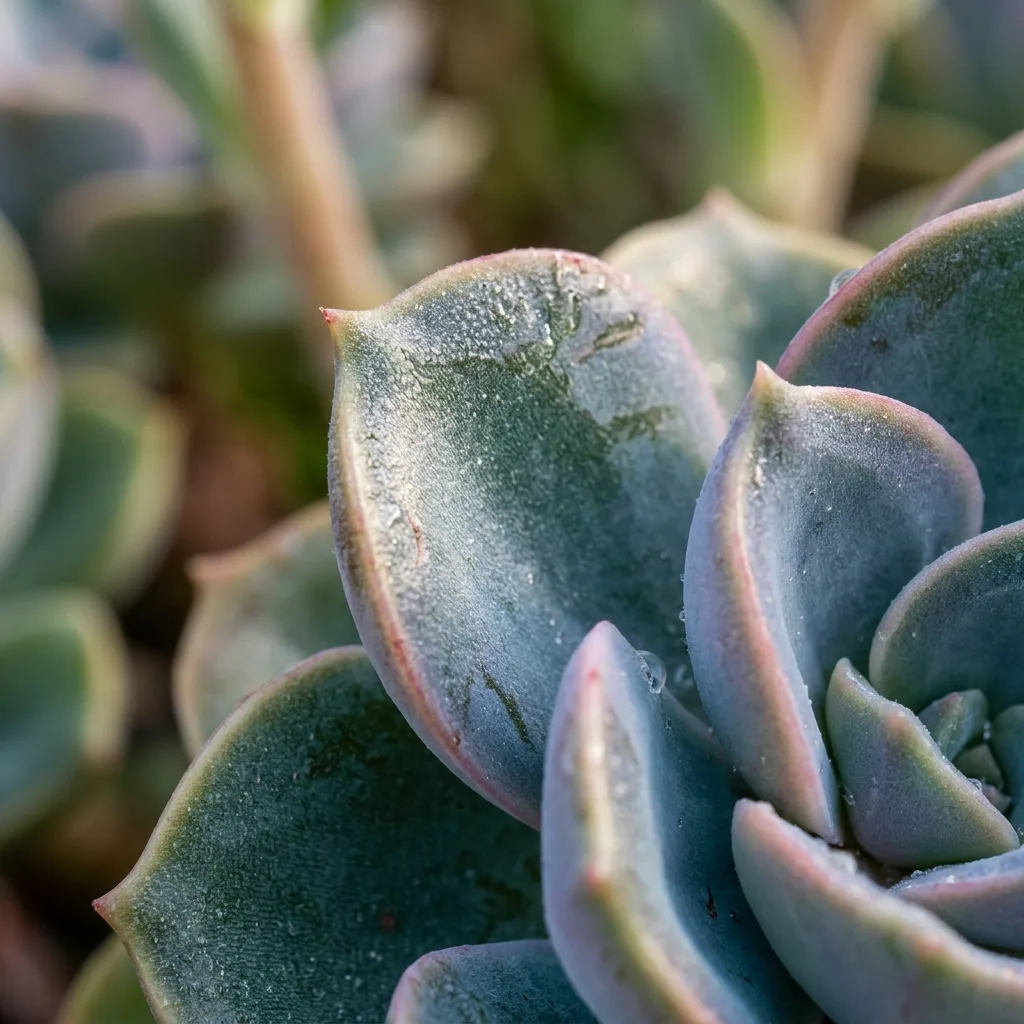
Belonging to the stonecrop family (Crassulaceae), the specific subspecies tomentosum is distinguished from the type species by its noticeably denser, woollier coverage that forms a continuous snowy carpet across mature rosettes. Far from being an ornamental anomaly, this 'cobwebbing' represents an ingenious evolutionary shield composed of elongated, multicellular leaf-tip hairs (trichomes). In high-altitude alpine habitats, these modified fibers reflect harsh ultraviolet radiation, dramatically suppress transpirational water loss caused by desiccating mountain winds, and form a microclimatic boundary layer that buffers the delicate growth center against late-season frost.
Field Diagnostic Tip: Novice growers often mistake the natural cobwebbing for early spider mite webbing or mealybug infestations. Authentic Sempervivum trichomes weave strictly from apex to apex in a symmetrical, architectural grid, feel completely dry and non-sticky, and emanate directly from the epidermis of the plant tissues.
Light Requirements and Outdoor Microclimates
Cobweb Houseleeks are strictly adapted to open alpine summits and require an abundance of intense, direct sunlight. When cultivated in partial shade or kept as indoor specimens, the rosettes quickly suffer from etiolation: central stems elongate, leaves flatten and lose their turgidity, and the characteristic woolly crown thins dramatically as the plant frantically stretches for light.
Position your plants where they can receive at least 6 to 8 hours of direct, unfiltered outdoor sunlight each day. Under exposure to cool night temperatures combined with generous UV rays, the outer foliage often blushes with deep crimson, copper, or purplish hues—an adaptive response driven by anthocyanin accumulation that protects cellular structures against photochemical damage.
Hydration Protocol: Mimicking Alpine Snowmelt
Like its alpine relatives, Sempervivum arachnoideum subsp. tomentosum thrives under a strict 'soak and dry' philosophy. Its fleshy leaves house cellular mucilage reserves capable of sustaining the rosette through extended alpine droughts; however, its root system is exceptionally sensitive to prolonged moisture retention and anaerobic stagnation.
- Spring and Summer (Active Vegetative Phase): Water thoroughly only when the entire potting medium has dried completely. Always apply water directly to the soil substrate around the base rather than pouring it directly over the rosette centers, as stagnant droplets trapped in the dense wool can provoke fungal rot under warm conditions.
- Autumn Transition: Gradually reduce watering frequency as day lengths decline, prompting the plant to thicken its cell sap with natural cryoprotectants in preparation for freezing temperatures.
- Winter Dormancy: Plants kept outdoors under cold conditions require zero supplemental watering; atmospheric moisture, intermittent rain, or natural snow cover provides all the hydration they can safely handle.
Custom Mineral Substrate and Potting Architecture
Standard commercial potting mixes or peat-dominant soils will quickly prove fatal to Cobweb Houseleeks. To cultivate robust, compact colonies, formulate an open, fast-draining substrate modeled after alpine talus and glacial scree.
| Component | Volume Ratio | Functional Botanical Role |
|---|---|---|
| Pumice or Coarse Perlite | 40% | Provides internal macroporosity, aerates roots, prevents soil compaction. |
| Crushed Granite / Lava Grit | 30% | Anchors structural root network and ensures instantaneous gravity drainage. |
| Coarse Horticultural Sand | 10% | Improves water percolation and replicates gravelly rock crevasses. |
| Aged Organic Loam / Fine Bark | 20% | Supplies minimal background cation-exchange capacity and base nutrients. |
Select wide, shallow containers crafted from porous, unglazed terracotta or cast stone with generous drainage holes. Because houseleeks exhibit shallow, fibrous root systems that branch horizontally rather than plunging deeply, shallow pans encourage the expansive stoloniferous growth that yields symmetrical, multi-headed colonies.

Winter Hardiness and The Outdoor Imperative
One of the most remarkable virtues of Sempervivum arachnoideum subsp. tomentosum is its profound cold tolerance. Rated securely down to USDA Hardiness Zone 4 (-30°C / -20°F), this species requires a sustained winter chill to regulate its annual hormonal cycles. Stashing this plant inside a heated living room during winter deprives it of vital vernalization, resulting in premature decline, pale growth, and loss of woolly density.
Leave your specimens outdoors year-round. When buried under snow, the rosettes enter a profound, protective metabolic stasis; the insulating snowpack shields them from subzero wind chill while preserving root hydration until the spring thaw awakens new offsets.
The Monocarpic Cycle and Offset Propagation
Sempervivums are classical monocarpic plants—each individual rosette flowers once at the zenith of its multi-year life cycle and subsequently dies. In midsummer, mature rosettes (typically 2 to 3 years old) will dramatically elevate their central growing point into a leafy, erect cyme laden with starry, rose-pink blossoms that provide abundant nectar for native pollinators.
While the blooming 'hen' will naturally senesce post-anthesis, the colony remains perpetual through asexual reproduction. Throughout its life, the mother rosette generates numerous stolons (lateral runners) terminating in juvenile rosettes ('chicks'). To propagate:
- Allow the juvenile stolon to form a distinct, compact rosette with small basal root nubs.
- Using a sterile scalpel or shears, sever the stolon runner 1 to 2 cm away from the offset.
- Place the chick onto moist, gritty mineral substrate and keep it under bright, indirect light for 10 to 14 days until new roots anchor firmly into the soil.


Reader Reviews & Comments 4 Reviews
Julianna Reed
Eleanor Vance
Marcus Thorne
Callum Bennett
Leave a Review & Rating
Share your plant care tips, experiences, or questions with our succulent community.