






Across nature’s untamed landscapes—from the sheer limestone escarpments of Oaxaca to the windswept dunes of Namaqualand—no succulent ever makes its home inside a closed-bottom ceramic bowl. Roots delve meters deep through rock fissures, tracking gravitational pulls and oxygen gradients; excess rainwater filters immediately into subterranean depths without lingering for even a heartbeat. When cultivating succulent and cactus collections at home, the most insidious danger is rarely dehydration, but rather roots suffocating in oxygen-deprived, enclosed vessels. It is precisely here that one of botany’s most profound design concepts emerges: completely open-bottomed, air-pruning 'bottomless plant containers' (bottomless pots).
The greatest physical hazard created by conventional enclosed pots is the 'perched water table' phenomenon. Even if a pot possesses drainage holes at its base, an equilibrium forms between gravitational pull and capillary action, leaving the bottom few centimeters of soil saturated like a sodden sponge. The bottomless pot or open cylinder concept eliminates this stagnant zone entirely by removing the base or perching the vessel upon an air-permeable grid, permitting water to drain unhindered under gravity. When root tips reach this open floor, they encounter dry air, naturally cease longitudinal elongation (air-pruning), and respond by generating dozens of secondary feeder rootlets that transform the root system into a biological powerhouse. Showering succulent roots with constant water is not an act of devotion; it inadvertently deprives them of oxygen and drowns them. In this comprehensive guide, we dissect the container microclimate, gaseous diffusion pathways, and the delicate balance of mineral substrates down to the finest detail.
1. Comparative Analysis of Inorganic Mineral Components
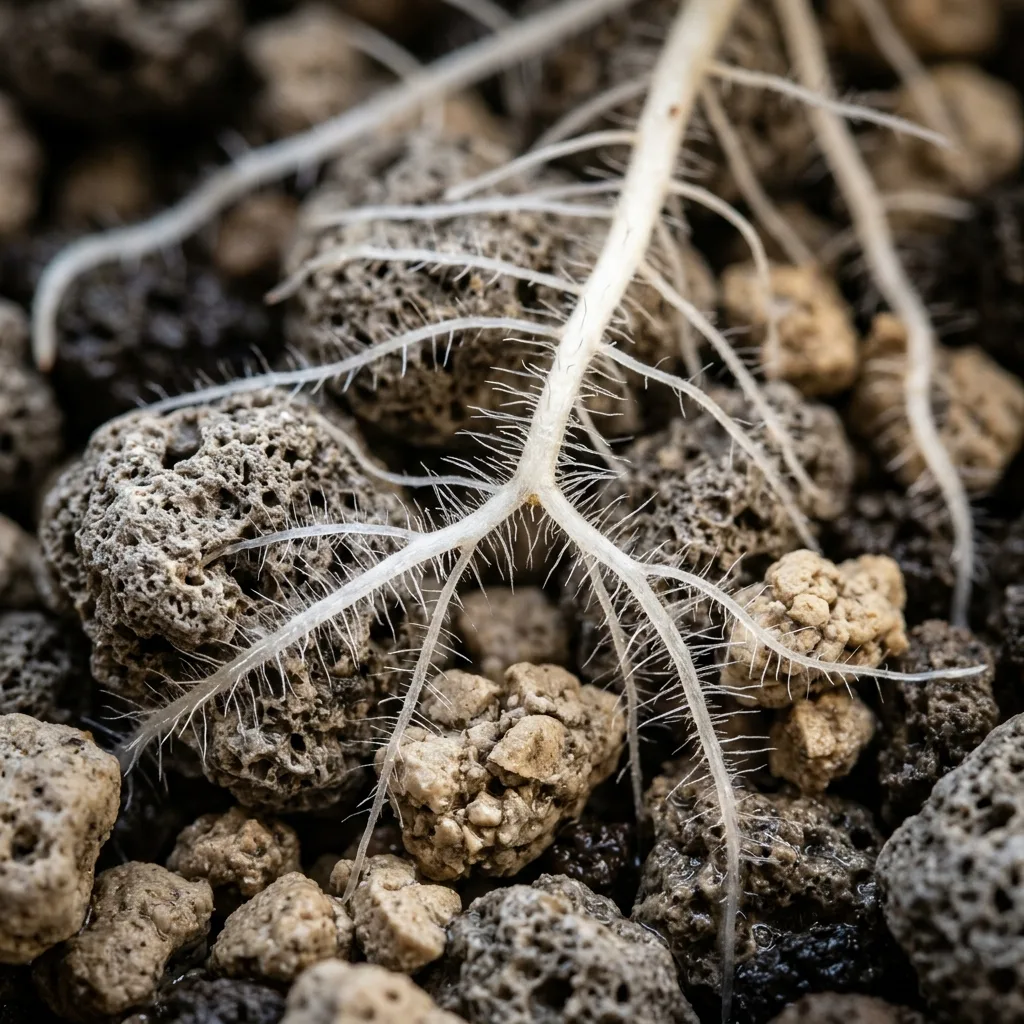
The secret to thriving specimens in bottomless containers and high-drainage artisanal pots lies in substrate particle size distribution (granulometry) and the internal pore architecture of inorganic minerals. Traditional garden soil slumps into an anaerobic mud when watered, obliterating critical macropores; succulent root systems, conversely, require at least 30% to 40% air porosity to sustain vital gas exchange and cellular respiration.
Chief among these inorganic building blocks is pumice, characterized by closed and semi-open micro-vesicles formed during the flash cooling of volcanic gases. Sifted to a 3–6 mm fraction, pumice provides mechanical anchoring while expelling gravitational water within seconds. Lava rock (volcanic scoria), heavier and more angular than pumice, grants exceptional anchorage while releasing steady trace amounts of iron, magnesium, and potassium over extended weathering cycles.
Another indispensable mineral, zeolite (clinoptilolite), boasts a remarkably high Cation Exchange Capacity (CEC). It adsorbs ammonium and potassium ions dissolved in the soil solution, buffering them against leaching and releasing them on metabolic demand. Zeolite also establishes an inhospitable barrier against pathogenic soil fungi. Meanwhile, calcined clay (such as akadama or ceramic clay granules) absorbs moisture internally while retaining its structural integrity, creating enduring oxygen highways for tender roots.
2. Calibrating Organic Matter: Peat, Coco Coir, and Compost
While inorganic aggregates furnish the skeletal framework of the pot, organic materials provide buffer capacity and moisture retention essential for metabolic cycles. However, in succulent horticulture, organic content must be strictly regulated within precise thresholds.
Sphagnum Peat Moss: Its mildly acidic pH (5.5–6.5) matches the evolutionary nutrient uptake preferences of many succulent species. However, once thoroughly desiccated, peat becomes distinctly hydrophobic—meaning it actively repels water. Rehydrating bone-dry peat without disturbing the root ball is notoriously difficult. Consequently, peat should never be used alone, but rather blended sparingly in coarse, fibrous grades within a mineral-heavy matrix.
Coconut Coir and Fibers (Coco Peat): An outstanding, sustainable alternative to peat moss. Coco coir does not exhibit extreme hydrophobicity upon drying and re-wets effortlessly. Due to its elevated lignin content, it resists microbial degradation far longer than peat, avoiding rapid structural compaction. In bottomless setups, coarse coir fibers create a natural capillary mesh that prevents fine minerals from tumbling through the open bottom.
Aged Compost / Worm Castings (Vermicompost): Succulents detest raw, nitrogen-heavy composts. Immature organic matter burns fragile root hairs and promotes cellular bloating that leaves fleshy leaves susceptible to opportunistic fungal outbreaks. If incorporated, utilize only fully stabilized, finely sifted worm castings, restricting the volume strictly between 5% and 10% of the total substrate.
3. Tailored Substrate Recipes for Diverse Genera and Climates
Every succulent lineage has evolved unique root anatomies adapted to specific aridity levels. For instance, Haworthia species produce thick, fleshy contractile roots that pull the rosette close to the ground, whereas mesembs like Lithops persist in virtually pure decomposed granite and mineral grit. The following volumetric ratios serve as reliable benchmarks for both bottomless sleeves and perforated pots:
| Genus / Plant Group | Inorganic Ratio (% Vol) | Organic Ratio (% Vol) | Recommended Granular Components | Ideal pH Range |
|---|---|---|---|---|
| Haworthia & Gasteria | 70% | 30% | 40% Pumice (3–5mm), 20% Zeolite, 10% Scoria + 20% Coir, 10% Worm Castings | 6.0 - 6.8 |
| Echeveria & Sedum | 65% | 35% | 35% Pumice, 20% Scoria, 10% Perlite + 25% Coarse Peat, 10% Aged Compost | 6.2 - 7.0 |
| Desert Cacti (Mammillaria, Ferocactus) | 85% | 15% | 50% Pumice, 20% Scoria, 15% Zeolite + 15% Coco Coir | 6.5 - 7.2 |
| Lithops & Mesembs (Living Stones) | 95% | 5% | 60% Pumice (2–4mm), 20% Zeolite, 15% Coarse Quartz Grit (2mm) + 5% Fine Peat | 6.8 - 7.4 |
4. Container Material Selection: Terracotta, Unglazed Ceramic, and Bottomless Cylinders
Root health depends not only on the potting mixture but equally on the gas permeability of the surrounding container walls. Consider the botanical performance of traditional versus progressive vessels:
Bottomless Plant Containers (Raised Sleeves & Bottomless Pots): These open-ended cylindrical or conical sleeves lack a sealed base entirely. Typically stationed on raised drainage grids, wire mesh benches, or open gravel trays, they allow taproots to grow downward without constraint. As root tips contact open air at the bottom aperture, they undergo air-pruning, stimulating vigorous branching of lateral feeder roots higher up the column. Because water cannot physically accumulate at the base, the risk of a perched water table drops to zero.
Terracotta and Unglazed Ceramic: Thanks to its microporous walls, unglazed terracotta permits water vapor and air to move bilaterally through the sides of the pot. Often celebrated as 'breathing pots,' they dissipate excess core moisture through evaporative cooling, preventing anaerobic fungal pockets. They are indispensable for growers in humid, maritime microclimates.
Plastic and Glazed Ceramic: Completely non-porous, these containers allow gas and moisture exchange solely through the upper soil surface and standard bottom holes. When growing in plastic or glazed vessels, increase the inorganic grit ratio by 15% to 20% and extend intervals between waterings considerably to protect root integrity.
5. Step-by-Step Repotting and Root Pruning Protocol
Repotting is far more than providing a larger home; it presents an invaluable opportunity to rejuvenate the root system, clear out senescence, and restore active root respiration. Early spring, coinciding with the break of dormancy, represents the ideal physiological window.
- Unpot When Soil Is Bone-Dry: Cease watering 5 to 7 days before unpotting. Desiccated soil separates cleanly from delicate roots without mechanical tearing, whereas wet, heavy soil clings and shears off fine feeder root systems.
- Mechanically Clear the Root Ball: Gently tease apart the root mass using your fingers or a sterilized wooden chopstick. Thoroughly remove dense nursery peat plugs compressed around the root crown to prevent localized moisture traps.
- Inspect and Air-Prune: Excise dark, mushy, or hollow roots using a flame-sterilized scalpel. For specimens transitioning into bottomless containers, trimming overlong, spiraling taproots slightly stimulates a vibrant burst of lateral feeder roots.
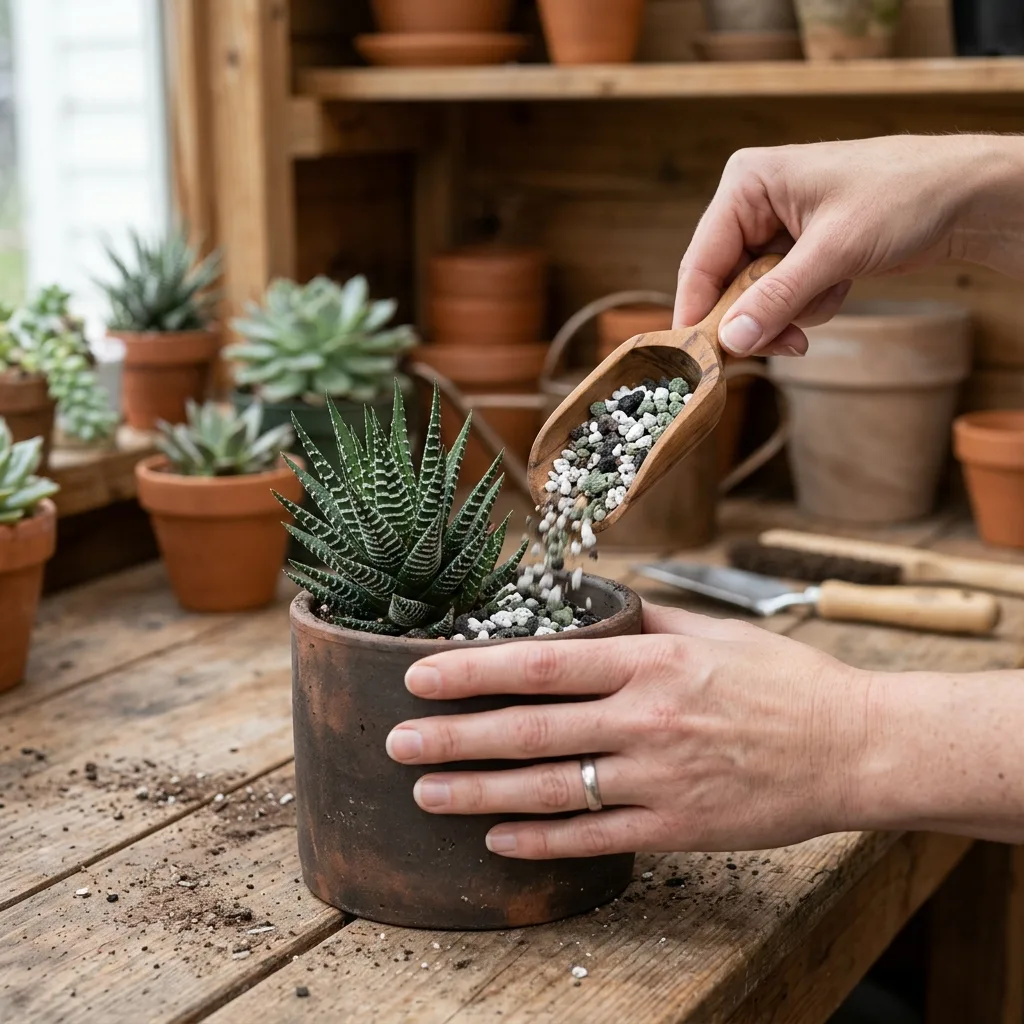
- Positioning and Granular Backfill: Center the specimen inside the bottomless sleeve or perforated pot, ensuring the sensitive root-to-stem transition zone (root collar) sits level with the rim. Gradually backfill your dry granular mix, gently tapping the pot walls to settle particles into air pockets without forcefully packing the soil with your fingers.
6. Post-Repotting Care: The Absolute 'Dry-Rest' Rule
The single most destructive practice following repotting is immediately drenching the container with water. While customary for tropical foliage, this is a lethal sentence for succulents and cacti. During root untangling and pruning, microscopic tears inevitably rupture fragile epidermal tissue. If these open lesions encounter damp soil laden with saprophytic fungi and bacteria, pathogens easily infiltrate the vascular xylem, initiating basal stem rot.
Enforce a strict 5 to 7 day dry-rest period following repotting. During this grace period, wounded root tips suberize and form a protective callus. Keep the plant in bright, indirect, dappled light and shield it strictly from intense solar radiation. When you execute the first watering, avoid soaking the substrate; apply a measured ring of water around the perimeter of the root collar to gently stimulate newly awakened feeder roots.


Reader Reviews & Comments 4 Reviews
Julian Vance
Marcus Sterling
Clara Higgins
Elena Rostova
Leave a Review & Rating
Share your plant care tips, experiences, or questions with our succulent community.