






Rising through jagged stone fissures under the unrelenting sun of South Africa's arid Karoo plateau and rugged fynbos grasslands, Gazania krebsiana—fondly known as the Terracotta Gazania for its deep copper-toned ray florets and bronzed petal bases—stands as one of nature’s most sophisticated architectural triumphs against drought. While its expansive, sun-worshiping floral crowns unfold exclusively beneath bright, unfiltered rays, beneath the soil surface lies a delicate, succulent-fibrous root system locked in an ongoing battle for equilibrium. Many plant enthusiasts, mesmerized by its radiant blossoms, make the grave mistake of potting it in heavy, peat-dense nursery soil as if it were a generic bedding annual; the immediate, silent crisis those roots face is acute oxygen starvation.
Much like all botanical wonders evolved with succulent and semi-succulent root adaptations, the cortical cells of Gazania krebsiana rely on constant gas exchange within pore spaces to breathe, assimilate micronutrients, and process metabolic outputs. When compacted, poorly drained substrates retain stagnant moisture, free oxygen is forcefully expelled; the protective root cuticle disintegrates into anoxia, and the plant rapidly loses its capacity to hydrate its leaves. Flooding succulents with water is not an act of love—it is an unwitting suffocation of their root biology. In this master horticultural guide, we unpack the biomechanics of root respiration, inorganic mineral science, the transpiration dynamics of unglazed terracotta, and foolproof substrate recipes tailored for prolonged vigor.
1. Comparative Analysis of Inorganic Mineral Substrates
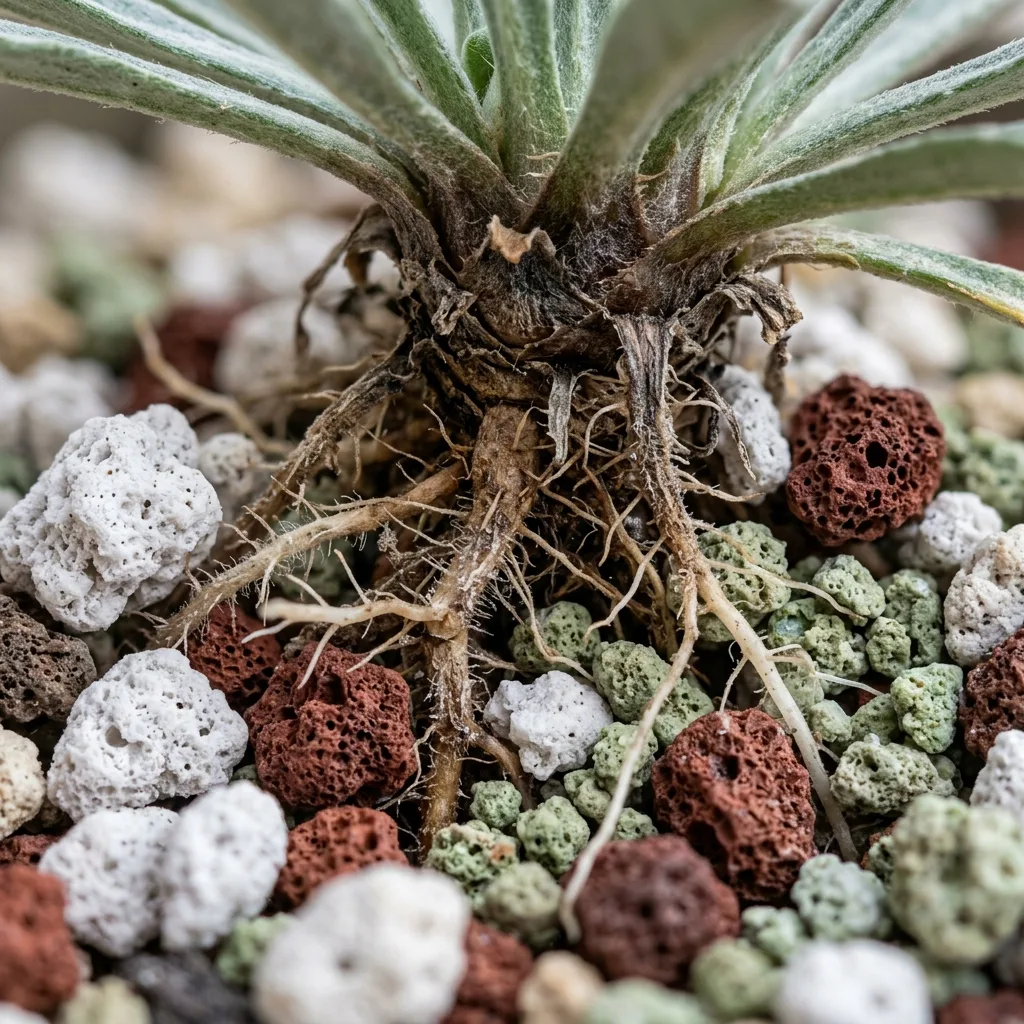
For xerophytic flora adapted to desert screes and arid grasslands, the foundational rule of root vitality is ensuring that the substrate consists of at least 60% to 70% coarse, porous inorganic minerals. Using the correct particle grading (grain size: 3–6 mm) creates uninterrupted subterranean air channels that prevent fungal biofilm stagnation. Here are the core mineral components:
- Pumice: This pale volcanic rock is an absolute staple. Lightweight yet non-buoyant, its countless microscopic pores provide superior root zone oxygenation while buffering vapor moisture without waterlogging. It maintains a stable neutral pH and effectively prevents the formation of anaerobic root zones.
- Lava Rock (Scoria): Dense, jagged, and rich in iron and magnesium, crushed scoria acts as structural ballast, anchoring the root system securely inside the pot. It replicates the naturally rocky crevices where wild Gazania anchors its crowns.
- Zeolite (Clinoptilolite): A porous crystalline aluminosilicate with an exceptional Cation Exchange Capacity (CEC). Zeolite acts as a slow-release mineral buffer, absorbing excess fertilizer salts and free ammonium, releasing them gradually only when osmotic pressure warrants.
- Quartz Grit and Perlite: While perlite offers emergency porosity, it tends to float upward and degrade into dust over time. Coarse horticultural quartz grit, conversely, adds weight and stable micro-drainage channels; however, fine, silt-like builder's sand must strictly be avoided as it cements pores shut.
2. Organic Matter Balance: Peat, Coco Coir, and Compost
Because the Terracotta Gazania naturally thrives along scree slopes and sandy, calcareous plains, an excess of rich organic matter can prove rapidly fatal. The total organic fraction within the container must never exceed 30% to 40% by volume.
Standard commercial sphagnum peat moss gradually breaks down, acidifying the root microbiome and turning hydrophobic when bone-dry, yet transforming into a soggy, airless bog when saturated. Instead, horticulturalists should opt for aged, washed coconut coir (coco peat) with a neutral pH (5.8–6.5) or finely screened, sterilized leaf mold. Coir disperses among the sharp mineral grains as resilient micro-fibers, fostering fine root hair development and maintaining gentle capillary moisture without pooling free water around the vulnerable crown.
3. Precision Substrate Recipes Across Species and Climates
Your potting mix should be fine-tuned based on your ambient relative humidity and microclimate. The comparative chart below outlines the optimal ratio of inorganic air space to moisture-retentive media calibrated for physiological resilience:
| Plant Group / Species | Inorganic Mineral % | Organic Fraction % | Ideal Substrate Formula (By Volume) |
|---|---|---|---|
| Gazania krebsiana (Terracotta Gazania) | 70% | 30% | 35% Pumice, 20% Scoria (Lava Rock), 15% Zeolite, 30% Coarse Coco Coir |
| Haworthia Species | 75% | 25% | 40% Fine Pumice, 20% Hard Akadama, 15% Lava Rock, 25% Coco Coir |
| Echeveria Cultivars | 60% | 40% | 30% Pumice, 20% Perlite, 10% Scoria, 40% Blonde Fibrous Peat |
| Desert Cacti | 85% | 15% | 40% Coarse Pumice, 30% Scoria, 15% Coarse Quartz Grit, 15% Coco Coir |
| Lithops (Living Stones) | 90% | 10% | 40% Pumice, 30% Zeolite, 20% Lava Rock, 10% Sterilized Sifted Compost |
4. Container Material Selection: Terracotta, Glazed Ceramics, and Plastic
As its common name suggests, Gazania krebsiana shares a profound affinity with unglazed earthenware (terracotta). The gas permeability and evaporative cooling properties of your pot directly dictate root metabolism:
- Unglazed Terracotta: Produced by firing natural clay at low temperatures, genuine terracotta remains filled with millions of microscopic interconnected pores. Moisture is not only expelled via bottom drainage holes; it actively wicks through the pot walls and evaporates into ambient air. The entire substrate cylinder breathes 360 degrees, drastically minimizing the window for root rot.
- Unglazed Stoneware / Ceramic: Possesses moderate porosity, though dense ceramic walls tend to retain chill in cold winter months, which can shock tender root systems.
- Plastic and Fully Glazed Pots: Entirely non-porous. Water can escape only through bottom drainage holes and surface evaporation. If plastic pots must be used, increase the inorganic mineral ratio to at least 80% and extend intervals between waterings significantly.
5. Step-by-Step Repotting Protocol and Root Pruning
Repotting Gazania krebsiana is ideally performed in early spring, just as ambient daylight increases and before peak flushes of flower buds emerge:
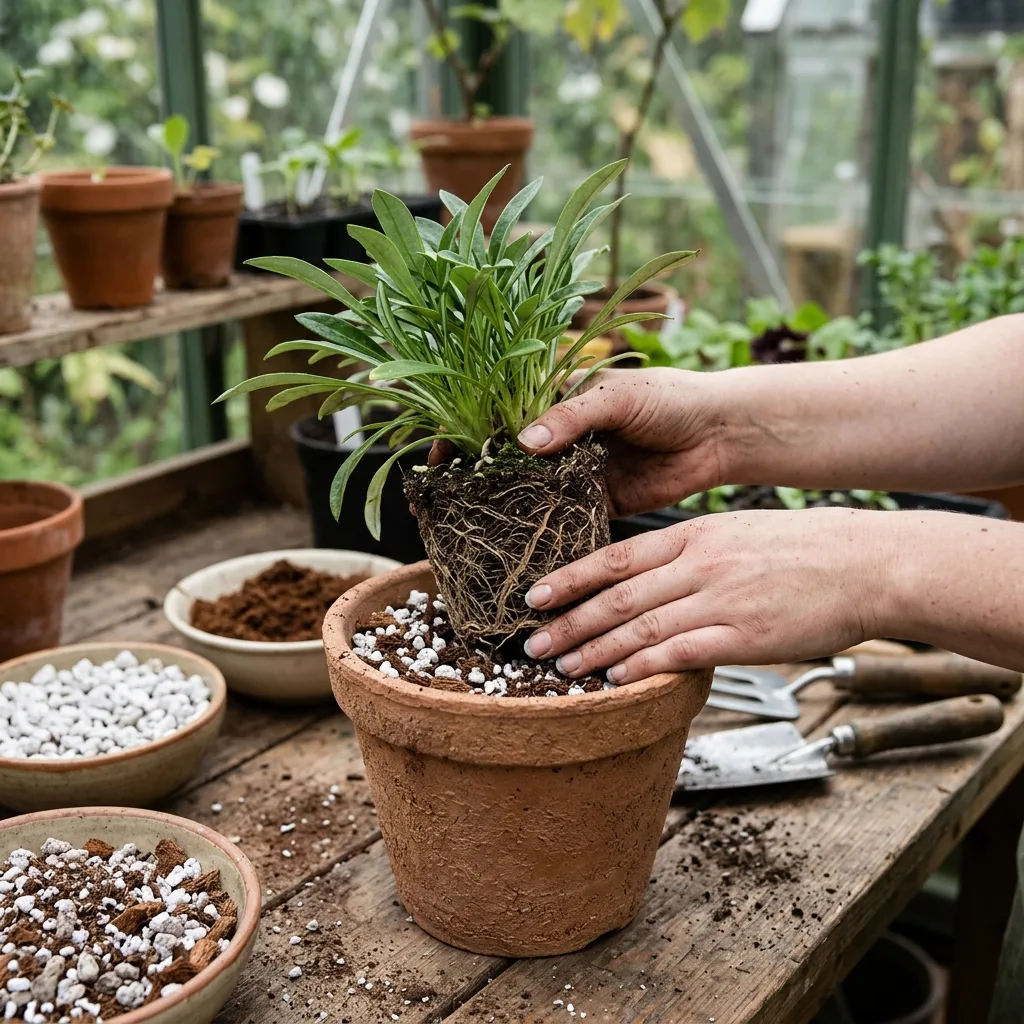
- Extraction & Soil Cleansing: Gently remove the root ball from its previous container. Carefully tease out and uncoil the compacted root ball using your fingertips or a sterilized blunt wooden chopstick to dislodge exhausted, compacted substrate.
- Surgical Root Pruning: Inspect the vascular architecture. Prune away blackened, softened, or hollow, desiccated strands using sterilized shears or a scalpel. Leave the central taproot intact, but shorten outer fibrous lateral roots by roughly one-third to trigger fresh root-meristem development.
- Drainage Foundation: Cover the large drainage hole of your unglazed terracotta container with a non-corrosive mesh screen. Line the bottom with a 2–3 cm layer of coarse pumice or lava chunks to ensure clean vertical runoff.
- Centering & Potting: Add a bed of your prepared 70/30 granular substrate. Suspend the plant so its crown sits approximately 1.5 cm below the container rim. Fill surrounding voids with the mineral blend. Never compress the dry mix forcefully with your thumbs; instead, tap the sides of the pot firmly on your potting bench to let the granules settle naturally without compacting pore spaces.
6. Post-Repotting Recovery: The Non-Negotiable 'Dry Rest' Rule
The single most catastrophic mistake succulent growers make is immediately saturating the soil with a heavy 'settling watering' right after repotting. Unlike soft herbaceous annuals, fleshy xerophytic roots sustain microscopic cellular abrasions during handling and pruning.
Keep the plant completely dry for a minimum of 5 to 7 days post-repotting. During this critical dry latency phase, wounded root tissues form a suberized protective callous layer, effectively sealing off vascular bundles against opportunistic water molds and bacterial rot. Place the pot in a warm location with bright, filtered light—safely protected from scorch. Provide the first full, soaking drench only after this healing window has elapsed, ensuring water streams freely from the drainage hole, and then allow the entire root zone to dry thoroughly before wetting again.


Reader Reviews & Comments 3 Reviews
Julian Vance
Eleanor Higgins
Marcus Sterling
Leave a Review & Rating
Share your plant care tips, experiences, or questions with our succulent community.