






Picture a botanical marvel enduring across millennia upon the rust-red, arid coastal dunes of the Namib Desert, subsisting on dense rolling sea fog sweeping in from the Atlantic: Welwitschia mirabilis. As the most extraordinary gymnosperm on Earth and the revered crown jewel of succulent connoisseurs owing to its fleshy, drought-adapted foliage, this living relic produces a mere two true leaves throughout its entire life. These twin foliage ribbons emerge perpetually from a basal meristem, frayed and weathered into serpentine ribbons by harsh desert gales.
For many dedicated collectors, cultivating a Welwitschia feels akin to hosting a living sculpture from deep geological antiquity on a sunny windowsill. Yet coaxing this ancient desert survivor to thrive in a domestic setting or hobby greenhouse demands dismantling standard succulent routines entirely. Routine shallow dish planting or casual surface drenching will serve as an immediate death sentence for this species.
In this master guide, we delve into the deep taproot architecture, unique continuous foliar growth physiology, and the scientifically validated sub-irrigation and containment protocols required to nurture this living fossil without rot for decades to come.
1. Botanical Biology and Physiological Foundations
Welwitschia mirabilis stands alone as the sole extant representative of the ancient order Welwitschiales within the division Gnetophyta. While its leathery foliage and xerophytic constitution outwardly evoke standard desert succulents, its underlying vascular anatomy and reproductive coning align it genetically with gymnosperms. The prime physiological concept one must grasp when growing this plant is its basal meristem growth mechanism.
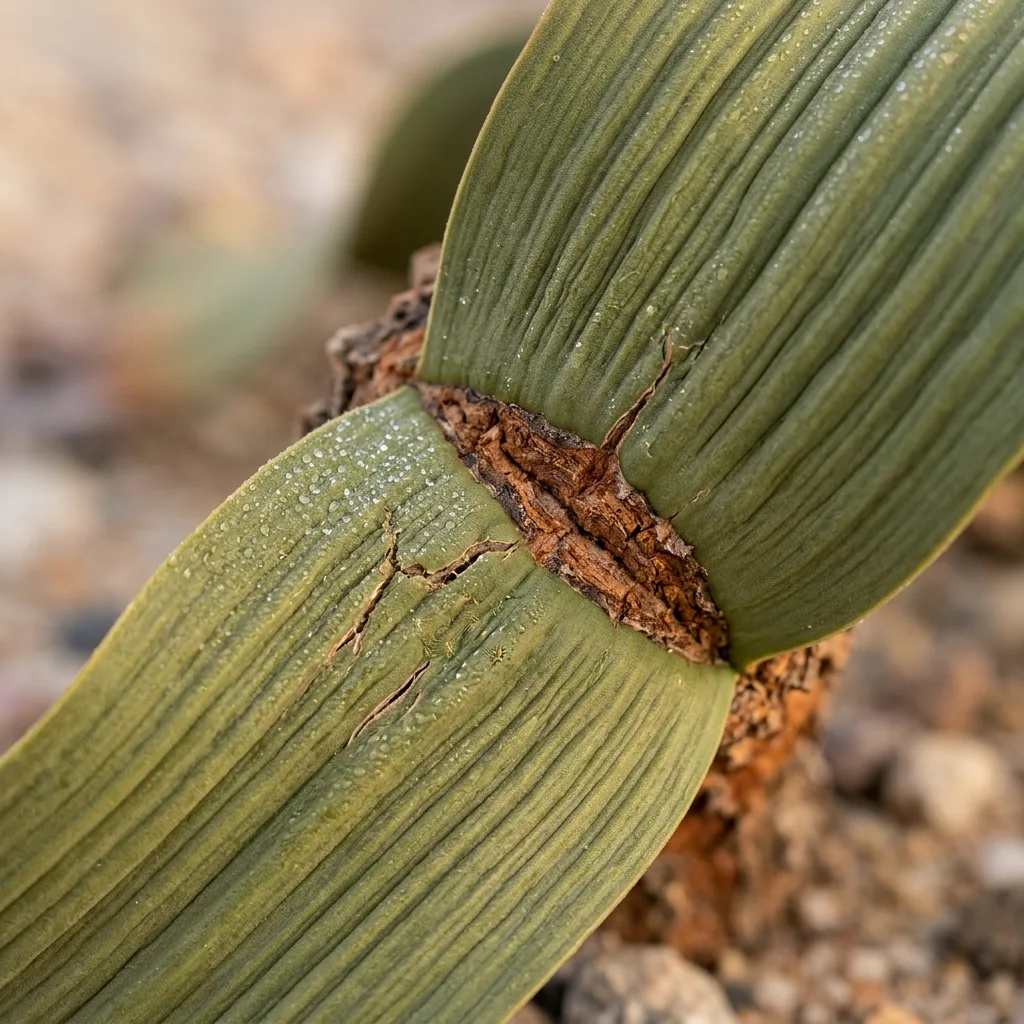
While conventional plants produce fresh leaves from apical growing tips or lateral nodes, Welwitschia possesses just two solitary, permanent leaves destined to grow continuously for centuries. Growth does not occur at the distal leaf tips; instead, tissue is continuously pushed outward from an active meristematic groove situated atop the crown of the woody, obconical stem. Consequently, drying and crisping of the leaf extremities does not signify illness or death; it is the natural, inevitable wear-and-tear of desert life. What remains indispensable is keeping the fleshy, emerald meristematic tissue at the base pristine and free of fungal stagnation.
The second decisive adaptation is its taproot architecture. Within mere weeks of germination, a seedling Welwitschia plunges a vertical taproot downward to depths dozens of times the height of its emergent cotyledons. In habitat, this specialized root seeks out subterranean groundwater tables. When constrained in a standard shallow container, this root hits bottom, coils, experiences severe hypoxia (oxygen starvation), and suffers irreversible xylem collapse. While the distal root tip demands ambient subterranean moisture, the subterranean root collar and exposed crown insist on strict, dry conditions.
2. Accurate Diagnosis and Plant Signals
Attuned observation is the only reliable shield against catastrophic loss when cultivating Welwitschia. The plant does not communicate verbally, but shifts in foliar turgor and crown coloration provide definitive biological signals:
- Meristem Softening and Blackening (Critical Emergency): Dark brown or black lesions appearing in the basal groove where the leaves emerge, accompanied by localized softening or liquification, indicate a virulent fungal infection (commonly Fusarium or Phytophthora), virtually always triggered by top-watering.
- Foliar Flaccidity and Turgor Collapse: When the midsection of the leathery leaves loses rigidity and turns unusually pliable or wrinkled, the deep taproot is failing to take up moisture. This stems either from complete substrate hydrophobic compaction or, inversely, from hypoxic root rot terminating vascular water transport.
- Taproot Impaction Symptoms: If foliar elongation stalls completely while the leaf bases bulge upward and buckle against the soil surface, the taproot has struck the bottom of the container and begun self-strangling spiral growth.
3. Step-by-Step Cultivation Protocol
Sustaining Welwitschia mirabilis indoors or in a greenhouse environment requires a blend of patient observation and rigorous horticultural engineering. Follow this protocol meticulously to grant your specimen the conditions for centuries of growth:
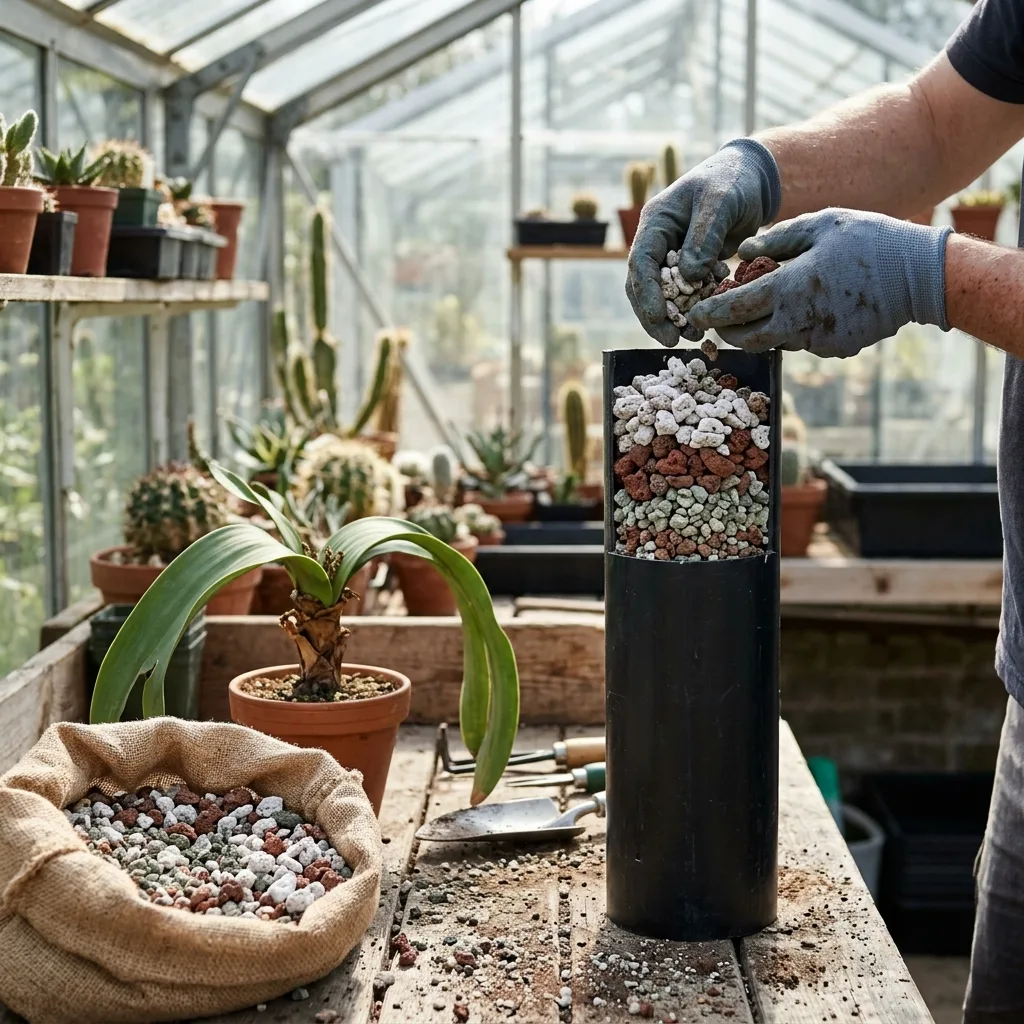
- Engineered Pot Geometry: Discard standard, shallow nursery pots. Secure an extra-deep container—such as heavy-gauge PVC pipe or specialized deep forestry tree tubes—measuring at least 40 to 60 cm in depth with generous bottom drainage perforations. Vertical depth takes precedence over lateral width.
- Install a Coarse Inorganic Base Layer: Fill the bottom 10 cm of the pipe with large-grade volcanic scoria, pumice, or gravel. This prevents the delicate taproot terminal from resting in stagnant perched water tables and maintains vital gas exchange at the root tip.
- Formulate a Mineral-Dominant Substrate: Organic components must never exceed 10% by volume. Combine coarse pumice, horticultural zeolite, coarse quartz grit, and decomposed granite to produce a hyper-porous, structurally stable blend that retains vapor without staying saturated.
- Shield the Vulnerable Root Collar: Top the uppermost 4 to 5 cm of the planting column with pure, coarse quartz gravel or grit. The crown and emerging leaf bases must never make direct physical contact with moisture-retentive organic matter.
- Implement Sub-Irrigation Exclusively: Overhead top-watering is fatal over time. Water by bottom immersion—allowing only the lowest third of the tall tube to absorb moisture by capillary rise—or install a dedicated vertical sub-irrigation tube alongside the inner wall to deliver water directly to the root zone at the bottom of the pot.
4. Essential Equipment, Substrates, and Cultivation Metrics
Choosing proper materials marks the distinct line between successful multi-decade cultivation and sudden failure. The matrix below outlines the optimal physicochemical parameters required to maintain Welwitschia in cultivation:
| Parameter / Material | Recommended Standard | Physiological Function & Significance |
|---|---|---|
| Container Type & Depth | Deep PVC pipe / Tree pot (Min. 45–60 cm) | Enables unhindered vertical taproot descent; prevents root coiling and suffocation. |
| Inorganic Soil Fraction | 40% Pumice + 30% Zeolite + 20% Coarse Silica Grit | Maximizes structural macroporosity and constant root-zone oxygenation. |
| Organic Soil Fraction | 10% Sifted, sterile coco coir (pith) | Holds minimal capillary vapor reserves without harboring pathogenic soil fungi. |
| Light Intensity (PAR / DLI) | Full sun or 400–600 µmol/m²/s via horticultural LED | Drives rapid photosynthesis, preventing basal meristem etiolation and thinning. |
| Irrigation Rhythm | Deep sub-irrigation every 10–14 days (summer); monthly (winter) | Maintains active taproot hydration while leaving the stem crown entirely dry. |
| Air Circulation | Continuous gentle airflow (Dedicated mini fan) | Disperses stagnant ambient humidity from the basal groove, deterring spore germination. |
5. 5 Common Pitfalls and Emergency Recovery Protocols
- Error 1: Overhead Watering Like an Ordinary Succulent.
Recovery: If water pools in the central crown cleft, dry it immediately using an absorbent lint-free swab or gentle compressed air. Shift the plant into enhanced convective airflow and treat the meristem with a dilute, systemic, copper-free organic fungicide spray. - Error 2: Using Standard Peat-Based Cactus Compost.
Recovery: Standard peat hardens like concrete when dry and remains soggy for weeks when wet, quickly destroying the taproot. Perform a careful emergency extraction: without breaking the root core, tease away the dense peat and transplant into an open, inorganic pumice and zeolite mix. - Error 3: Snapping or Coiling the Taproot During Potting.
Recovery: Welwitschia displays acute intolerance to root manipulation. If the distal root tip suffers mechanical damage, dust the injury immediately with elemental sulfur powder, dry-shade the plant for 24 hours, pot up in completely dry pumice, and withhold all moisture for 10 days to encourage callusing. - Error 4: Exposure to Cold, Damp Winter Conditions.
Recovery: Metabolic root uptake ceases when temperatures plunge below 10°C (50°F). Cold, moist substrate triggers root collapse within hours. Immediately raise environmental temperatures to 18–22°C (64–72°F), provide bottom heat via a thermostatic seedling mat, and keep the substrate completely dry. - Error 5: Trimming Aesthetically Imperfect Foliage Tips.
Recovery: Novices often snip brown ends off the leaf strips for cosmetic neatness. Cease all cutting immediately. Unless fungal rot is visibly advancing, allow these ends to naturally weather; in habitat, these desiccated foliage sections shield the succulent caudex from harsh solar radiation.
6. Seasonal Management and Long-Term Trajectory
Cultivating Welwitschia is an enduring horticultural journey. Harmonizing your care schedule with the plant's seasonal rhythm yields robust, steady growth:
- Spring (Awakening & Root Elongation): As daytime ambient temperatures consistently top 20°C (68°F), gradually increase the frequency of sub-irrigation. Apply a highly diluted (quarter-strength), low-nitrogen fertilizer once every eight weeks. Watch for the basal groove to turn a lighter, vibrant green as the leaves advance several millimeters per week.
- Summer (Peak Meristem Activity): Welwitschia thrives in sustained, bright warmth. Provide 6 to 8 hours of unfiltered sunlight or intense full-spectrum LED light. Mist the outer leaf surfaces lightly after sunset. Ensure the lowest sector of the deep root column retains a hint of moisture vapor without turning anaerobic.
- Autumn (Metabolic Hardening): Begin spacing out bottom-watering intervals by late October. Cease all supplemental fertilization entirely. Maintain steady cross-ventilation to help foliage tissues harden against cooler, shorter days.
- Winter (Semi-Dormancy & Crown Protection): Maintain temperatures safely above 15°C (59°F). Apply only enough moisture to the lowest drainage tray once a month to prevent the deepest root tip from completely dehydrating, keeping the crown and upper substrate completely dry.
Adhering to this disciplined cultivation protocol transforms Welwitschia mirabilis from a fragile oddity into a resilient botanical heirloom capable of outliving its caretaker. Honoring the evolutionary adaptations of this ancient gymnosperm brings the quiet, primordial endurance of the Namib straight into your living space.


Reader Reviews & Comments 3 Reviews
Julian Vance
Clara Hensley
Markus Thorne
Leave a Review & Rating
Share your plant care tips, experiences, or questions with our succulent community.