






High on the arid limestone hills of San Luis Potosí, Tamaulipas, and Querétaro in Mexico, beneath the swirling dust of desert winds, live miniature living sculptures that blend seamlessly into the bare rock. At first glance, you might mistake them for weathered gravel or limestone pebbles; yet these botanical marvels belong to Turbinicarpus, one of the most distinguished and specialized genera within the Cactaceae family. In habitat, these resilient geophytic cacti survive protracted droughts by pulling their stems down almost entirely beneath the soil line—an astonishing morphological defense. With their diminutive size and deceptively massive, delicate flowers, they represent the absolute pinnacle of refined indoor collector plants.
While novice growers often get caught in the trivial 'Is it a succulent or a cactus?' debate, Turbinicarpus is unambiguously a true miniature cactus possessing specialized succulent tissues. It develops an enlarged, swollen tuberous taproot (napiform root) that serves as an underground reservoir, utilizing Crassulacean Acid Metabolism (CAM) photosynthesis to seal every water molecule away like liquid treasure. Sharing your living space with a Turbinicarpus is one of the most elegant exercises in botanical patience and respect for natural rhythms.
1. Botanical Identity and Morphological Characteristics
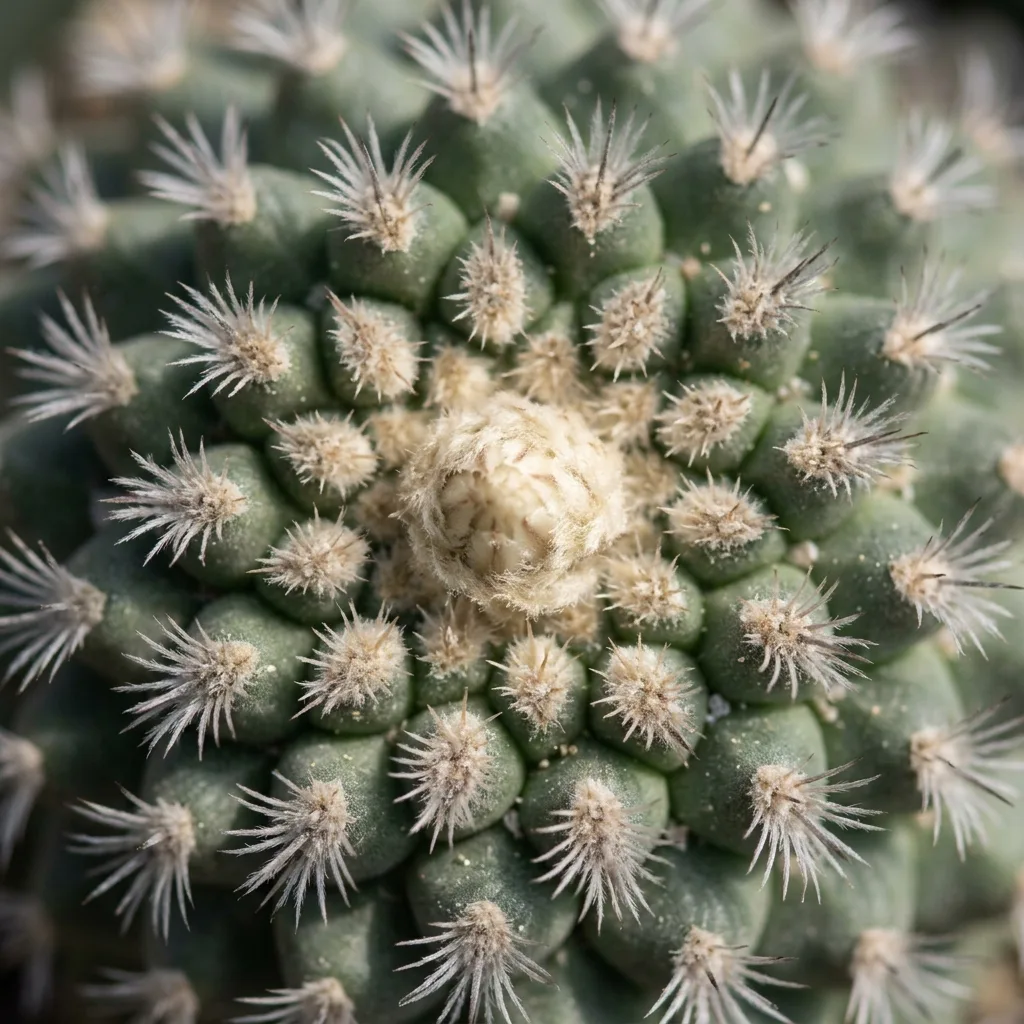
Members of the genus Turbinicarpus rarely exceed 2 to 5 centimeters in stem diameter. What sets these plants apart from conventional cacti is their astonishing spine architecture: rather than being rigid, needle-sharp defenses, their spines are frequently papery, flexible, plumose, corky, or sponge-like. For instance, Turbinicarpus valdezianus resembles an exquisite pinecone enveloped in soft white down, whereas Turbinicarpus schmiedickeanus features curved, leathery, ribbon-like spines that look hand-carved by a master sculptor.
The stem epidermis is sculpted into pronounced tubercles (wart-like raised podaria). This geometric morphology scatters incident solar radiation, dramatically reducing thermal stress on the photosynthetic tissue. Below ground, the substantial napiform taproot can easily reach two to three times the total volume of the aerial stem. This root does far more than anchor the plant: as moisture levels diminish, the elastic root tissues contract like an internal spring, retracting the plant flush with or below the gravel surface to slash transpiration losses.
2. Light Requirements and Indoor Positioning
Turbinicarpus flourishes under brilliant, unfiltered morning sunlight. Adapted to high-elevation Mexican plateaus, it requires abundant ultraviolet (UV) radiation to maintain compact, natural growth. The development of those signature thick, twisted, papery spines is directly determined by the spectral quality and intensity of light the plant absorbs.
When cultivating indoors, position your plant on a south- or southeast-facing windowsill that receives at least 5 to 6 hours of direct, unobstructed sunlight daily. Inadequate light inevitably triggers etiolation—an unnatural, elongated growth habit where the spherical stem stretches into a weak, pale-green cylinder, irreparably ruining its morphology. A crucial word of caution: if you transition a Turbinicarpus straight from dark winter rest into scorching July midday sun, the epidermal tissue will suffer irreversible necrotic sunburn (chloroplast destruction). Always acclimatize plants gradually in early spring using light shade cloth or sheer curtains.
3. Watering Discipline: The 'Soak and Dry' Protocol
As a devoted succulent grower, your guiding maxim should always be: Watering frequently is never an expression of love; it merely deprives root tissues of vital oxygen, suffocating them underground. For species with fleshy, subterranean taproots like Turbinicarpus, this rule is doubly vital. Excess substrate moisture rapidly lyses parenchyma cells in the root cortex, unlocking the door for lethal fungal pathogens such as Fusarium and Phytophthora.
Your irrigation schedule must rigorously follow the 'soak and dry' philosophy:
- Active Growth Period (Spring & Autumn): Once the potting medium has dried completely to the very bottom of the pot, drench thoroughly until water runs freely through the drainage holes. Empty the catch tray immediately; never leave the pot standing in runoff.
- Summer Dormancy (July - August): During extreme heatwaves, Turbinicarpus suspends vegetative growth (aestivation). Curtail watering significantly; provide only light sips during cooler evening hours to prevent excessive dehydration of root caps.
- Winter Rest (November - February): Plants require a cool dormancy period between 5°C and 10°C (41°F - 50°F). Keep the potting medium strictly bone-dry. A single ill-timed winter watering under low temperatures can kill a specimen within hours.
4. Ideal Soil Substrate and Pot Selection
Turbinicarpus will not survive in standard, peat-heavy, organic potting mixes. These plants evolved tucked inside narrow limestone fissures amidst pure mineral debris. To maintain essential oxygen diffusion to root xylem tissues, the substrate must boast exceptionally low water retention and stellar aeration.
Below is the proven, high-mineral substrate formula I have perfected over decades in my greenhouse, reducing root rot instances to virtually zero:
| Substrate Component | Ratio (%) | Botanical Function |
|---|---|---|
| Coarse Pumice (2-4 mm) | 40% | Maximum macro-porosity, root aeration, and swift drainage |
| Lava Grit / Zeolite (1-3 mm) | 25% | Trace mineral cation-exchange capacity and physical stability |
| Crushed Limestone / Calcitic Grit | 15% | Replicates natural habitat chemistry with a slightly alkaline pH (7.5 - 8.2) |
| Coarse Quartz Sand / River Grit | 10% | Provides an open mineral skeleton, preventing compaction |
| Sifted Mature Cactus Leaf Mould or Bark Fines | 10% | Minimal organic matrix to sustain root-hair microflora |
Regarding containers: unglazed terracotta or high-fired breathable clay pots are unequivocally superior to plastic. Plastic containers lock in residual humidity, creating a hazardous anaerobic environment around the sensitive taproot. Furthermore, because of Turbinicarpus's elongated geophytic root system, always opt for narrow, deep pots rather than shallow pans, allowing the taproot to descend naturally without circling or cramping.

5. Step-by-Step Propagation Techniques
Propagating Turbinicarpus is a deliberate, methodical process requiring patience, yet it offers immense horticultural satisfaction. Propagation is achieved primarily through seed or, in caespitose species, through the careful removal of basal offsets.
Growing from Seed (The Gold Standard)
- Seedbed Preparation: Prepare an inorganic substrate of finely graded pumice powder and calcined clay. Sterilize thoroughly via heat treatment (oven or microwave) and fill into shallow, transparent seed trays.
- Sowing: Turbinicarpus seeds are exceptionally fine. Sow them evenly across the pre-moistened surface. Never bury them under soil; they are photoblastic and require light exposure to break dormancy and trigger germination.
- Humidity and Temperature: Bottom-water the container with distilled water and seal inside a clear propagation dome or ziplock bag. Maintain a diurnal temperature fluctuation of 22-26°C (72-79°F) during the day and 16-18°C (61-64°F) at night to stimulate germination.
- Ventilation: Seedlings typically emerge within 7 to 20 days as microscopic emerald spheres. After several weeks, crack the enclosure open to gradually harden the seedlings off to ambient humidity.
Grafting (Accelerated Development Alternative)
On their own roots, Turbinicarpus species are notoriously slow growers, expanding merely a few millimeters each year. Collectors frequently graft delicate seedlings onto vigorous rootstocks like Trichocereus, Echinopsis, or Pereskia to accelerate growth and induce precocious flowering. However, grafted specimens often lose their natural, highly prized flattened shape, becoming bloated and unnatural. Purist botanists universally favor plants grown naturally on their own roots.
6. Common Pests, Diseases, and Treatments
While Turbinicarpus displays extraordinary natural resilience, suboptimal environmental parameters can leave it susceptible to several critical threats:
- Root Rot: The most catastrophic affliction. The base of the stem turns dull brown, soft, and translucent. If caught early, unpot the specimen, excise every trace of necrotic tissue with a sterile scalpel back to clean green vascular tissue, dust the wound thoroughly with powdered sulfur, allow it to callus in a dry, shaded location for 10 to 14 days, and replant in pure dry pumice.
- Mealybugs (Pseudococcidae): Often lurking within the convoluted tubercles and woolly crown areoles as white, cottony masses. Subterranean root mealybugs feast invisibly on taproot reservoirs. Treat systemically with specialized insecticides (such as Imidacloprid or Acetamiprid where permitted) or apply localized spot treatments using a cotton swab dipped in 70% isopropyl alcohol.
- Spider Mites (Tetranychidae): In environments characterized by stagnant, hot, low-humidity air, spider mites attack tender apical tissue, creating rusty, bronze scarring. Mitigate outbreaks through improved air circulation and targeted acaricide applications.
7. Seasonal Care Calendar and Horticultural Notes
Respect your Turbinicarpus's innate biological chronometer, and you will be rewarded each spring with magnificent white, cream, magenta, or striped flowers that often surpass the stem itself in width:
- Spring (March - May): The vernal awakening. In mid-March, administer an initial light watering with lukewarm water. As flower buds form along the crown in April, resume standard 'soak and dry' cycles. Apply a low-nitrogen, high-potassium mineral fertilizer diluted to 1/4 strength once.
- Summer (June - August): Summer aestivation. Ease back on watering frequency during intense heat spells. Ensure continuous, active ventilation; still, humid air is a primary catalyst for fungal rot.
- Autumn (September - October): Secondary vegetative push. The plant replenishes cellular moisture reserves before the onset of cold weather. Taper irrigation gradually throughout September, ceasing all watering entirely by the end of October.
- Winter (November - February): Absolute dormancy. Place in an exceptionally bright, cold (5-10°C / 41-50°F), and totally dry room. This critical vernalization period is non-negotiable for inducing floral bud primordia.


Reader Reviews & Comments 3 Reviews
Julian Vance
Marcus Thorne
Claire Sterling
Leave a Review & Rating
Share your plant care tips, experiences, or questions with our succulent community.