






When walking across a forest floor, the crunch of fallen English oak acorns (Quercus robur) and resinous Calabrian pine cones (Pinus brutia) beneath our boots reveals some of the most impeccable structural architectures nature has to offer. Every autumn and winter in the Sukulentler.com greenhouse, we gather these sculptural forest treasures and combine them with living hens-and-chicks (Sempervivum) and plump sedum rosettes to curate wreaths that are not merely decorative, but breathe and grow for months on end. Bringing together a handful of foraged pine cones with stem cuttings from your own cactus and succulent collection onto a circular frame is truly the most elegant way to welcome botanical vitality to your front door.
Unlike conventional dried wreaths, embedding living succulent rosettes directly between the woody textures of acorns and pine cones requires establishing a delicate ecological balance between hygroscopic, lignified materials and water-storing succulent tissue. While pine cones naturally open and close their scales according to ambient atmospheric humidity, hardy species such as Sempervivum tectorum and Sedum album will readily establish roots within a modest sphagnum moss base, maintaining their plump, hydrated vigor for months. Let us explore, step by step, the practical botanical craft that brings forest elegance straight to your porch.
1. Botanical Profile and Morphological Characteristics
Pine cones, which form the structural skeleton of this natural wreath, serve as the female reproductive structures of Gymnosperm plants. Their woody scales (bracts), which harden as they dry, create microscopic moisture-trapping niches thanks to their fibrous cellular matrix. Acorns, on the other hand, are the single-seeded, hard-shelled fruits of Quercus species; their cup-like caps (cupules) boast a high tannin content that offers extraordinary natural resistance against microbial rot and fungal decay.
The primary living succulent species that energize this woody tapestry belong to the Crassulaceae family, specifically Sempervivum tectorum (commonly known as Houseleek or Hens-and-Chicks) alongside creeping cultivars like Sedum spurium. Sempervivum is an evolutionary masterpiece, adapted to survive in freezing Alpine rock crevices with virtually no substrate. Its thick leaf cuticle layer combined with CAM (Crassulacean Acid Metabolism) photosynthetic machinery allows it to conserve its cellular water reserves and thrive on a minimalist sphagnum moss foundation for months without desiccation.
2. Light Requirements and Optimal Positioning
A living pine cone and succulent wreath is not suited for dim, poorly lit interior hallways or dark foyers. To prevent the succulents from losing their tight, symmetrical rosette geometry and stretching uncharacteristically toward light sources (a condition known as etiolation), the wreath requires ample bright, filtered sunlight.
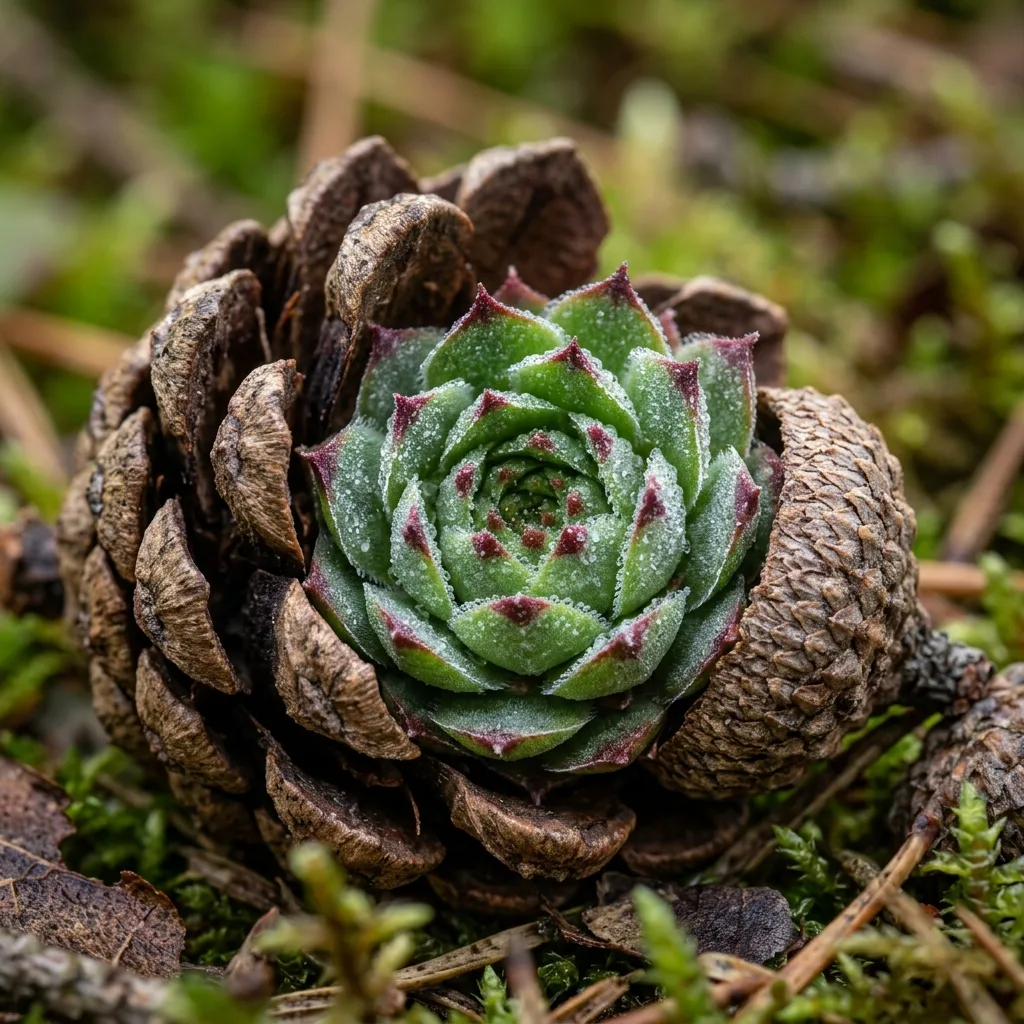
The ideal location is an exterior entry door that receives direct morning sunlight, a well-ventilated enclosed sunroom, or a sheltered porch. A minimum of 3 to 4 hours of indirect or soft direct morning sun each day stimulates the production of protective anthocyanin pigments, keeping the ruby-red and burgundy tips of Sempervivum leaves rich and vibrant. Avoid hanging the wreath directly exposed to torrential rainstorms; a semi-sheltered overhang or covered eave is ideal.
3. Irrigation Discipline: The 'Soak and Fully Dry' Method
Remember that this arrangement is not an inert decoration; it contains dynamic living tissues. However, if pine cones remain submerged or wet for too long, their scales will close tightly, creating a humid, stagnant interior environment prone to mold. Meanwhile, the fine adventitious roots of the living succulents need brief hydration to absorb water from the sphagnum core.
Every 7 to 10 days, unhook the wreath and lay it horizontally on a flat, clean surface. Using a fine spray bottle, mist the mossy crevices at the base of each succulent rosette, or place the back of the wreath in a shallow water tray for 2 to 3 minutes so only the sphagnum base draws up moisture through capillary action. Afterwards, let the wreath rest horizontally in a shaded, airy location for 3 to 4 hours to drain and dry before returning it to its vertical position. Overwatering succulents is not an act of kindness; it suffocates root tissue and invites swift fungal collapse.
4. Substrate Layering and Framework Construction
Standard potting mix should never be used for a hanging wreath; loose soil particles will continually sift out of the vertical frame. Instead, a clean, fibrous foundation of sterile sphagnum moss blended with coarse volcanic minerals provides ideal water retention without mess. If you are packing a standard wire wreath frame, the following mineral and organic blend will support your succulents for 1 to 2 years:
| Component | Ratio (%) | Botanical Function |
|---|---|---|
| Sterile Sphagnum Moss | 45% | Fibrous moisture retention and root anchoring matrix |
| Fine Pumice (2–4 mm) | 25% | Aeration in root zones, preventing stagnation and rot |
| Aged Coconut Coir (Coco Peat) | 15% | Lightweight organic nutrient and moisture distribution bridge |
| Fine Lava Grit (Scoria) | 15% | Structural ballast and micro-mineral leaching |
5. Step-by-Step Assembly and Propagation Techniques
Follow this systematic greenhouse protocol to build your own long-lasting natural pine cone, acorn, and living succulent wreath:
- Oven Baking and Botanical Sterilization: Foraged pine cones and acorns frequently harbor sub-bark boring beetles, fungal spores, or insect eggs. Arrange your collected cones and nuts on a baking sheet and heat them at 100°C (212°F) for 45 minutes. This crystallizes sticky exterior tree sap into an attractive sheen while reliably eradicating any unwanted stowaways.
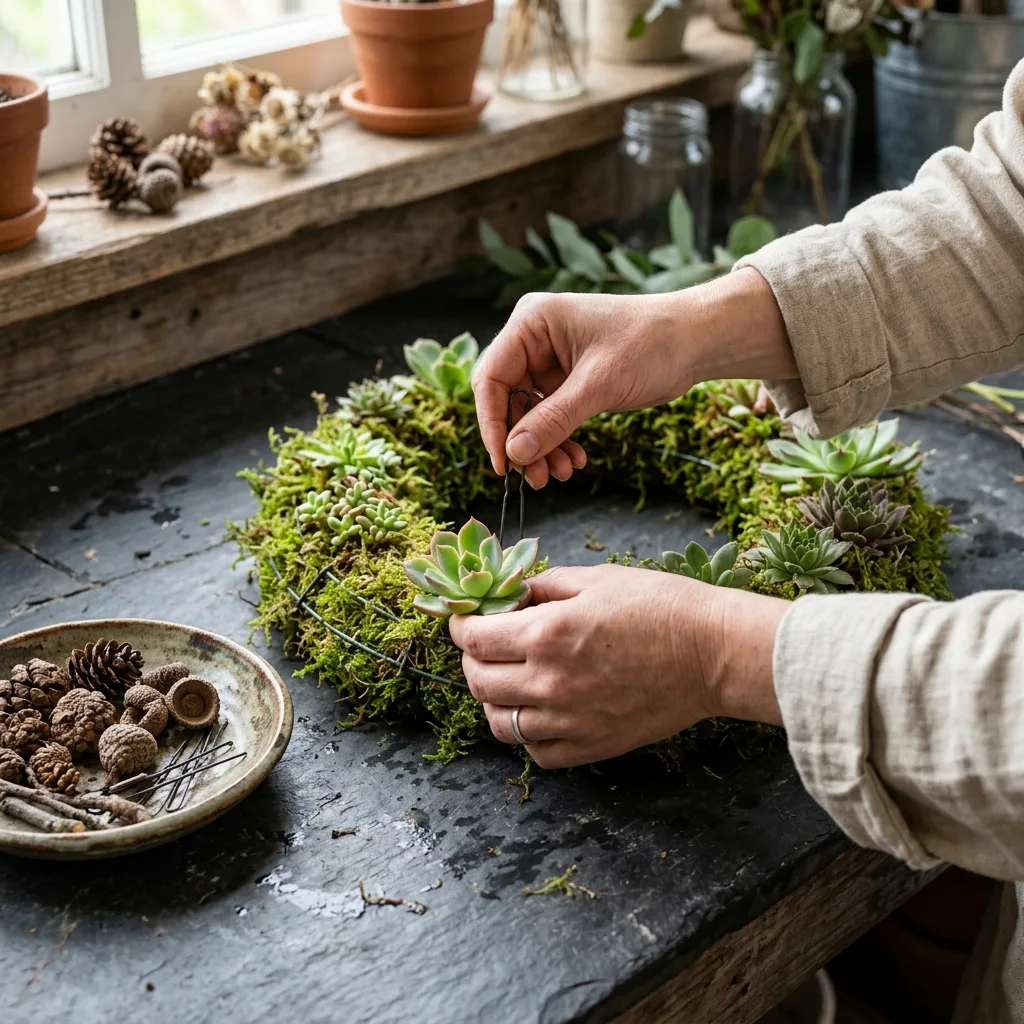
- Building the Sphagnum Ring: Take a 25–30 cm (10–12 inch) circular wire wreath frame and firmly pack it with pre-moistened sphagnum moss. Wrap the moss securely with thin, green florist wire to create a tight, sausage-shaped wreath ring.
- Attaching the Woody Botanicals: Using a craft hot-glue gun or florist binding wire, secure your baked pine cones and acorns onto the frame in natural, balanced asymmetrical clusters. Apply glue strictly to the woody bases of the cones and cups, ensuring you leave open pockets of exposed moss where succulents can be planted.
- Integrating Living Succulents: Prepare clean cuttings of Sempervivum or Sedum by gently plucking off lower leaves to reveal a bare stem of approximately 1–2 cm. Use a wooden skewer to poke planting holes into the exposed moss pockets, insert the stems, and secure each rosette gently with a U-shaped florist pin (greening pin).
- Establishment and Rooting: Keep the wreath lying flat in a bright, shaded room for the first 5 to 7 days. Under these conditions, the rosettes will develop fine capillary root hairs into the sphagnum fibers within 7 to 10 days, securing them firmly in place.
6. Common Pests, Diseases, and Preventative Care
The most frequent pest challenge on natural wreaths is the insidious Mealybug (Pseudococcidae). The narrow crevices between pine cone scales offer ideal nesting shelters. If you spot cottony white tufts, spot-treat them directly using a cotton swab dipped in 70% isopropyl alcohol, followed by a gentle misting of diluted cold-pressed neem oil across the foliage.
The second primary issue is Stem and Crown Rot (Fusarium oxysporum), caused by excessive moisture trapped around foliage. If the basal leaves of a rosette become mushy, translucent, or brown, stop watering immediately. Carefully extract the compromised rosette using tweezers, dust the remaining moss pocket with ground cinnamon (a natural antifungal), and insert a fresh, dry succulent cutting.
7. Seasonal Maintenance Calendar and Expert Care
- Spring: As photoperiods lengthen, Sempervivum rosettes break dormancy and produce lateral stolons (offsets or 'chicks'). You can gently snip these offsets and transplant them into miniature decorative planters or fill empty gaps on the wreath.
- Summer: Protect the arrangement from intense, scorching midday sun. Because warm breezes dry out sphagnum quickly, increase gentle misting to twice a week.
- Autumn: An ideal window for seasonal rejuvenation: tuck in newly fallen, sterilized acorns, remove spent dried leaves with tweezers, and tidy up the overall form.
- Winter: Hardy Sempervivum cultivars can comfortably tolerate freezing temperatures down to -15°C (5°F). You can display your wreath on an outdoor front door all winter; cool weather intensifies the deep crimson anthocyanin pigmentation of the leaves, creating a breathtaking seasonal display.


Reader Reviews & Comments 3 Reviews
Eleanor Vance
Clara Higgins
Marcus Sterling
Leave a Review & Rating
Share your plant care tips, experiences, or questions with our succulent community.