






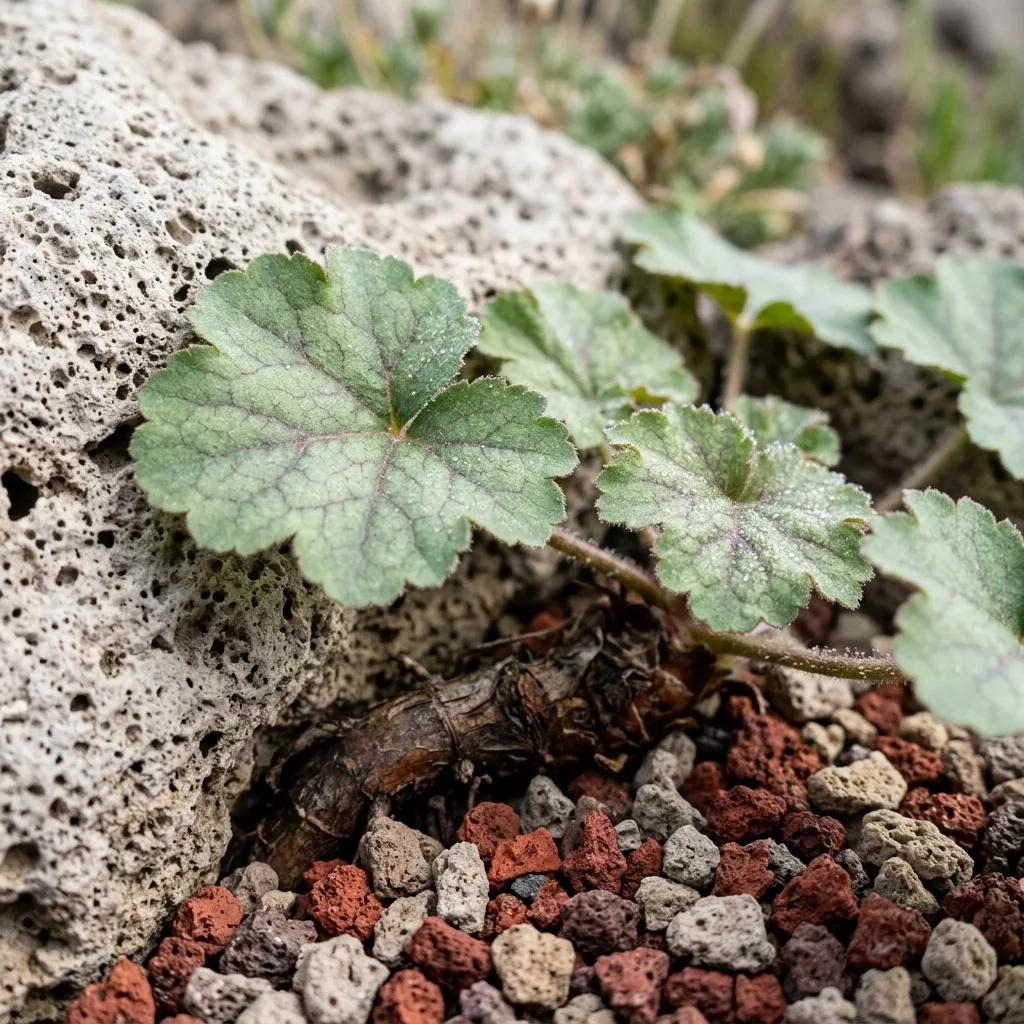
Clinging tenaciously to sheer granite fissures at 8,200 feet (2,500 meters) in California's rugged San Gabriel Range, subjected to freezing winter winds and blistering alpine summer UV, Heuchera abramsii (commonly known as San Gabriel Alumroot) stands as one of nature's most enchanting testaments to botanical resilience. Bearing thickened, woody caudex-like rhizomes that store precious water reserves at the base of petiole sheaths, tightly clustered lobed scalloped leaves, and charming pink bell-shaped flowers nodding throughout midsummer, this rare alpine gem demands a home far beyond the confines of standard nursery pots. Translating the centuries-old cliffside choreography of alpine lithophytes directly into your living space is not a mere repotting session; it Is the Thumb Cactus? Mammillaria Matudae Care and Blooming Guide">Is the Orange Snowball Cactus? Botanical Care Tips for Growing Rebutia">is the deliberate construction of a living rock sculpture.
The centuries-old art of trough and tufa carving mimics nature's fractured microclimates, supplying root systems with continuous gaseous exchange and oxygen saturation. While plants with crowns hyper-sensitive to stagnant moisture—such as Heuchera abramsii—frequently succumb to fungal root rot (Pythium and Phytophthora) in ordinary plastic or glazed ceramic containers, the intricate capillary network of porous volcanic tufa acts as a natural biomechanical shield against pathogenic fungal stagnation. In this master horticultural guide, you will learn step-by-step how to chisel and bore raw volcanic rock into a living miniature canyon sanctuary worthy of this Californian treasure.
1. Required Materials, Tools, and Safety Precautions
Working with natural stone demands patience, deliberate technique, and proper tooling. Rather than dense, impenetrable granite, opt for soft, cellular volcanic tufa (tuff) or aerated autoclaved concrete blocks. Gather the following materials before beginning your build:
- Raw Volcanic Tufa Block: A stable piece approximately 10 to 12 inches (25–30 cm) in diameter with a naturally balanced base that sits securely without wobbling.
- Carving and Shaping Implements: Narrow and wide flat-head cold chisels, a shock-absorbing rubber mallet, and a rotary hammer drill fitted with a 1/2 to 5/8-inch (12–16 mm) masonry bit to expedite rough stock removal.
- Drainage and Barrier Materials: A square of woven stainless steel mesh to bridge the drainage portal, complemented by coarse horticultural pumice (1/4 to 5/16-inch) for the basal drainage reservoir.
- Specialized Lithophytic Alpine Substrate: High-grade calcined pumice, crushed scoria (lava rock), horticultural zeolite, and a modest touch of twice-sifted aged leaf mold.
- Botanical Specimens: One healthy, mature Heuchera abramsii specimen, complemented by accent stone mosses or micro-cuttings of companion lithophytes like Sedum spatulifolium.
- Personal Protective Equipment (PPE): An FFP2/N95 rated particulate respirator to prevent inhaling free crystalline silica, impact-resistant safety goggles, and vibration-dampening, non-slip work gloves.
2. Technical Material & Dimensional Specifications
A flourishing alpine tufa planting requires interior cavity volume and drainage capacity precisely engineered to the root architecture of cliff-dwelling saxifrages. The dimensional thresholds below have been established to sustain the deep, vertical tap-rhizome of Heuchera abramsii over decades of cultivation:
| Design Parameter / Component | Recommended Value / Dimension | Horticultural Function & Botanical Rationale |
|---|---|---|
| Interior Cavity Depth | 3.2 – 4.0 inches (8 – 10 cm) | Accommodates descending tap-rhizomes and provides a cool thermal mass for fragile feeder root hairs. |
| Cavity Aperture (Diameter) | 4.0 – 4.75 inches (10 – 12 cm) | Affords ample clearance for compact foliar rosettes to cascade gently over the rock perimeter. |
| Primary Drainage Borehole | 0.6 – 0.8 inches (15 – 20 mm) | Facilitates instantaneous gravitational water evacuation, preventing perched water tables. |
| Substrate Inorganic Fraction | 75% (Pumice + Crushed Scoria + Zeolite) | Maximum macroporosity, air-filled porosity (AFP > 35%), and perpetual root oxygenation. |
| Substrate Organic Fraction | 25% (Aged, sifted pine bark/leaf mold) | Mildly acidic microbial foundation, nutrient buffering capacity, and trace moisture retention. |
| Pre-Plant Leaching & Soaking | 24 Hours (Submerged freshwater bath) | Flushes loose volcanic dust fines and equalizes internal capillary moisture dynamics. |
3. Step-by-Step Carving and Assembly Procedures
Transforming an unrefined boulder of volcanic tufa into a functional, sculptural botanical habitat unfolds across four precise procedural phases:
- Topographical Analysis and Centerline Siting: Place your tufa stone on a sturdy, level workbench and inspect it from multiple perspectives. Identify its most dynamic natural ridges, weathering pockets, and natural planes. Using carpenter's chalk, outline an organic, asymmetrical circular planting zone that respects the rock's natural grain and contours.
- Rough Excavation (Rotary Masonry Relief Drilling): Chuck a 1/2-inch (12 mm) masonry bit into your drill. Bore a series of closely spaced, vertical relief holes to a uniform depth of 3.2 inches (8 cm) inside your chalk perimeter. This drilling matrix weakens the internal stone core, allowing quick material removal without risking catastrophic fracture of the external walls.
- Chiseling and Naturalistic Relief Contouring: With a light hammer and cold chisel held at a 45-degree angle, gently knock out the webbed bridges between drill holes. Shape the walls outward, mimicking a naturally eroded granite pocket rather than an artificial bowl. From the bottom of this newly formed basin, bore a dedicated 3/4-inch (18 mm) drainage channel straight through to the underside of the rock.
- Hydraulic Purging and De-ionization Bath: Blast the hollowed tufa vessel with a hose nozzle to evacuate all internal rock dust and sediment that could otherwise choke capillary pores. Submerge the carved stone entirely in a large tub of clean water for 24 hours to dissolve residual mineral salts and stabilize surface chemistry, then allow it to dry to a damp state in the shade.
4. Planting and Stabilizing Lithophytes in Stone
Planting lithophytic cliff-dwellers differs fundamentally from typical potting methods. With Heuchera abramsii, positioning the root crown precisely is crucial; setting it even slightly below grade will invite devastating bacterial and fungal decay.
Begin by cutting a small circle of stainless steel wire mesh to cover the bottom drainage hole, preventing substrate migration. Layer 0.6 inches (1.5 cm) of coarse pumice chips (1/4-inch grade) across the floor to establish an aerated drainage basin. Spoon in a base layer of your 75% inorganic gritty alpine substrate mix. Remove your Heuchera from its nursery container with extreme care, teasing away all peat-based soil with a soft brush and wooden stylus to bare-root the specimen without tearing delicate lateral root hairs.
Lower the plant into the pocket, positioning the woody caudex so that the foliar crown sits perfectly level with—or elevated roughly 1/8 inch (2–3 mm) above—the stone rim. Using fine tweezers and a narrow potting spoon, work the gritty volcanic particles in and around the root system, tapping the sides of the stone gently to settle the substrate without compacting it. Finally, apply a 3/8-inch (1 cm) top-dressing of angular crushed granite and volcanic scoria directly beneath the leaves, creating a pristine barrier that keeps tender foliage dry and isolated from moist soil.

5. Watering Regimens and Microclimatic Maintenance
Volcanic tufa is inherently hygroscopic, acting like a porous lung that absorbs, distributes, and transpires moisture across its entire surface area. This physical property simplifies moisture management when guided by sound cultural techniques:
- Bottom-Up Capillary Soaking: Place your tufa vessel into a shallow saucer filled with 1 inch (2.5 cm) of rainwater or reverse-osmosis water for 10–15 minutes. The tufa's capillary matrix pulls moisture upward into the lower root zone without wetting the vulnerable crown foliage.
- Top Watering via Precision Gooseneck Spout: When top watering, direct a gentle stream exclusively onto the top-dressed gravel perimeter using a narrow-spouted watering can. Never splash water directly into the center of the foliar rosette.
- Visual Stone Moisture Diagnostics: Wet tufa displays a deep charcoal or rich mocha hue; as moisture depletes, the exterior lightens into an ashen, chalky gray. Do not irrigate until this pale gray tone returns and the stone exterior loses its cool-to-the-touch feel.
- Seasonal Moisture Rhythm: During active vegetative development in spring and early summer, water thoroughly once the medium approaches dryness. As winter dormancy sets in, reduce watering to an occasional splash once or twice a month, matching the dry cold conditions of its native peaks.
6. Long-Term Durability and Seasonal Care
Carved tufa stone miniature alpine gardens can endure and thrive for generations. Observing these three seasonal cultural rules will ensure the long-term vitality of your display:
Frost-Heave Management: Saturated tufa exposed to hard freezes (sub-25°F / -4°C) risks internal micro-fracturing as trapped pore water expands into ice. If your miniature garden is displayed outdoors year-round in cold climates, transition the stone beneath a covered porch eaves before persistent late-autumn rainstorms saturate the rock.
Patina and Bryophyte Colonization: Over time, the shady, damp micro-crevices of the tufa will naturally develop a verdant velvet of micro-mosses and lichen symbionts. This development elevates the rock's wild, ancient aesthetic. Should moss encroachment overwhelm the succulent rosette, remove it by gently brushing the perimeter with an old soft toothbrush moistened with clean water—never use household detergents or algaecides.
Nutritional Management: High-altitude granitic screes are naturally oligotrophic, containing virtually no free nitrogen. Feeding Heuchera abramsii rich houseplant fertilizers will prompt loose, leggy growth vulnerable to fungal attacks. Limit fertilization to a single spring application of balanced, low-nitrogen cactus/succulent fertilizer diluted to 1/4 strength, enriched with micronutrients to bolster dense crown growth and robust summer flower spires.


Reader Reviews & Comments 4 Reviews
David Sterling
Eleanor Vance
Julian Miller
Claire Robinson
Leave a Review & Rating
Share your plant care tips, experiences, or questions with our succulent community.