






Journeying from the rocky slopes of Madagascar to the sunlit corners of our living rooms, few succulents rival the ethereal grace of Kalanchoe 'Pink Butterflies'. Commonly known as the Pink Mother of Thousands, this breathtaking cultivar looks as though hundreds of tiny, glowing pink butterflies have landed softly along the serrated margins of its leaves. Highly sought after by succulent collectors and commercial growers alike, its variegated foliage—flushed with olive green, mauve, and luminous fuchsia—elevates it from a simple fleshy houseplant to a living botanical jewel.
Yet behind this fairy-tale exterior lies a delicate cellular balance and a unique physiology. While standard Mother of Thousands varieties propagate with aggressive, almost invasive ease, the 'Pink Butterflies' cultivar demands a far more nuanced horticultural discipline due to its delicate constitution and partial chlorophyll deficiency. As if we were chatting among friends on a quiet morning in a greenhouse, let us explore the cellular secrets of this captivating specimen and uncover the exact steps required to keep it thriving for years to come.
1. Botanical Identity and Morphological Characteristics
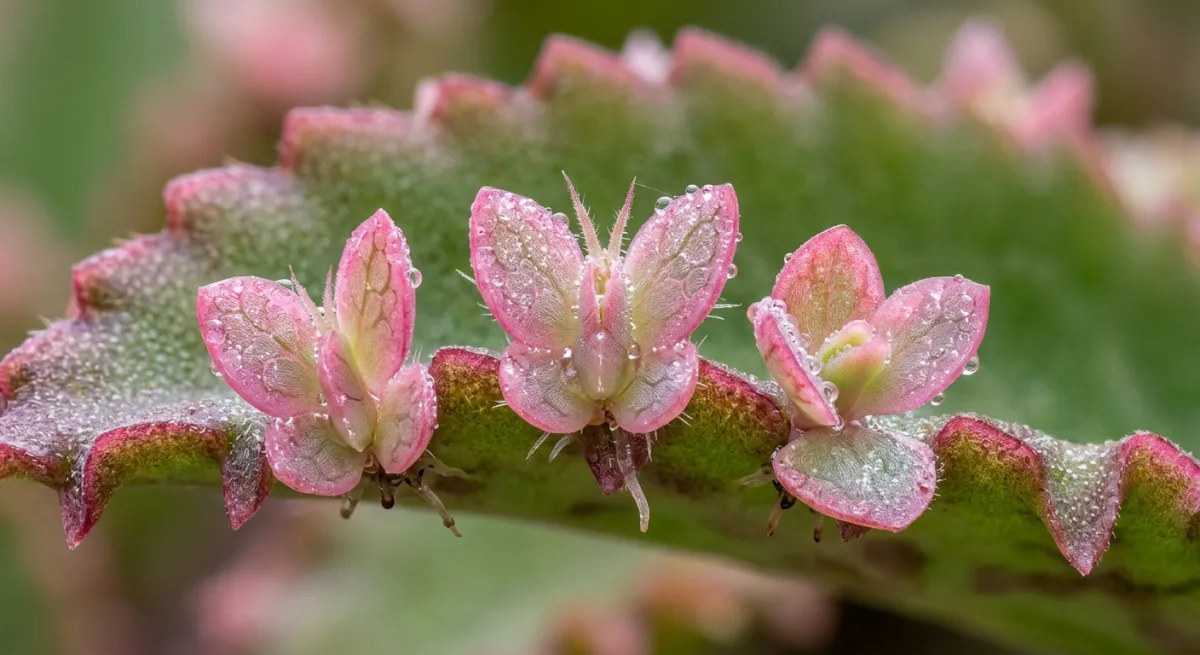
In taxonomic classification, Kalanchoe 'Pink Butterflies' belongs to the stonecrop family (Crassulaceae). As referenced in the scientific archives of Kew Plants of the World Online, it is a variegated, chlorophyll-mutated cultivar of the complex hybrid Kalanchoe × houghtonii (a deliberate cross between Kalanchoe daigremontiana and Kalanchoe delagoensis). The plant develops an upright, semi-woody, cylindrical stem adorned with opposite, boat-shaped, lanceolate leaves. While the primary leaf blade displays mottled olive-green and brownish-purple speckles, the adventitious plantlets formed along the crenate leaf margins through vivipary are a striking, neon pink.
The vivid coloration of these miniature plantlets is the result of suppressed chlorophyll synthesis combined with an elevated concentration of protective anthocyanin pigments. Because these tiny bulbils completely lack functional chloroplasts, they are incapable of autonomous photosynthesis and depend entirely on the mother leaf for vital carbohydrates and moisture. In the succulent hobby, frequent watering is never an act of love—it merely deprives root tissues of oxygen and causes fatal asphyxiation. Similarly, understanding that these ornamental pink 'butterflies' are biologically dependent on the parent plant is the cornerstone of your entire care strategy.
2. Light Requirements and Indoor Placement
To sustain its vibrant fuchsia hues and compact architectural form, Kalanchoe 'Pink Butterflies' requires an abundance of bright, filtered sunlight. When relegated to low-light environments, the plant quickly undergoes severe etiolation: internodes stretch unnaturally, stems become weak and floppy, and the signature pink plantlets lose their brilliance, turning dull before dropping prematurely.
Indoors, an unobstructed south-facing or east-facing windowsill provides an ideal microclimate. During overcast winter months or inside dimmer office spaces, positioning the plant beneath a full-spectrum LED grow light for 12 to 14 hours daily is essential to prevent stretching and preserve the structural integrity of the foliage.
3. Watering Discipline: The 'Soak and Dry' Protocol
Like its wild ancestors, 'Pink Butterflies' utilizes Crassulacean Acid Metabolism (CAM photosynthesis). It opens its stomata exclusively at night to capture carbon dioxide, drastically minimizing daytime transpiration while storing abundant moisture within the large parenchyma cells of its leaves and stems. Consequently, while the plant displays remarkable drought tolerance, it possesses an acute, fatal vulnerability to stagnant moisture.
The golden rule of irrigation is the strict 'Soak and Dry' protocol. Never apply water until the root ball and potting substrate have dried out completely from top to bottom. Test this by inserting a wooden skewer or moisture probe at least 4 to 5 centimeters deep into the pot. If the skewer emerges with even the slightest trace of cool dampness, postpone watering. When completely dry, soak the soil thoroughly until water runs freely from the drainage holes. Always discard any runoff accumulated in the saucer immediately; standing water quickly clogs root xylem vessels with fungal spores, initiating rapid, irreversible root rot.
4. Ideal Soil Substrate and Pot Selection
For the delicate feeder roots to respire and absorb minerals without rotting, the substrate must feature low moisture retention, exceptional porosity, and rapid drainage. Heavy garden loam or standard peat-based potting soils act like waterlogged sponges, suffocating root hairs within days. A customized mineral blend enriched with porous volcanic aggregates is non-negotiable.
| Substrate Component | Ratio (%) | Botanical Function |
|---|---|---|
| Pumice (3–5 mm) | 35% | Provides structural macro-pores, continuous aeration, and prevents soil compaction. |
| Lava Rock or Zeolite | 20% | Stabilizes substrate architecture and supplies trace minerals while buffering excess moisture. |
| Coarse Horticultural Perlite | 15% | Keeps the blend ultra-lightweight and maintains open internal drainage channels. |
| High-Grade Coconut Coir | 20% | Forms an airy, moisture-retentive organic anchor that rewets easily without clumping. |
| Worm Castings / Aged Leaf Compost | 10% | Delivers gentle, slow-release micro-nutrients that will not burn tender root tips. |
When selecting a container, always choose an unglazed terracotta pot equipped with generous drainage openings. The natural microporosity of fired clay allows moisture to evaporate laterally through the pot walls, lowering root-zone humidity and cutting the risk of subterranean fungal infections by half compared to glazed ceramic or plastic vessels.
5. Step-by-Step Propagation Techniques
Growers familiar with common, wild-type Mother of Thousands know that fallen plantlets root aggressively wherever they land. However, with Kalanchoe 'Pink Butterflies', nature presents an entirely different biological reality—and this is precisely where most enthusiasts encounter heartbreak.
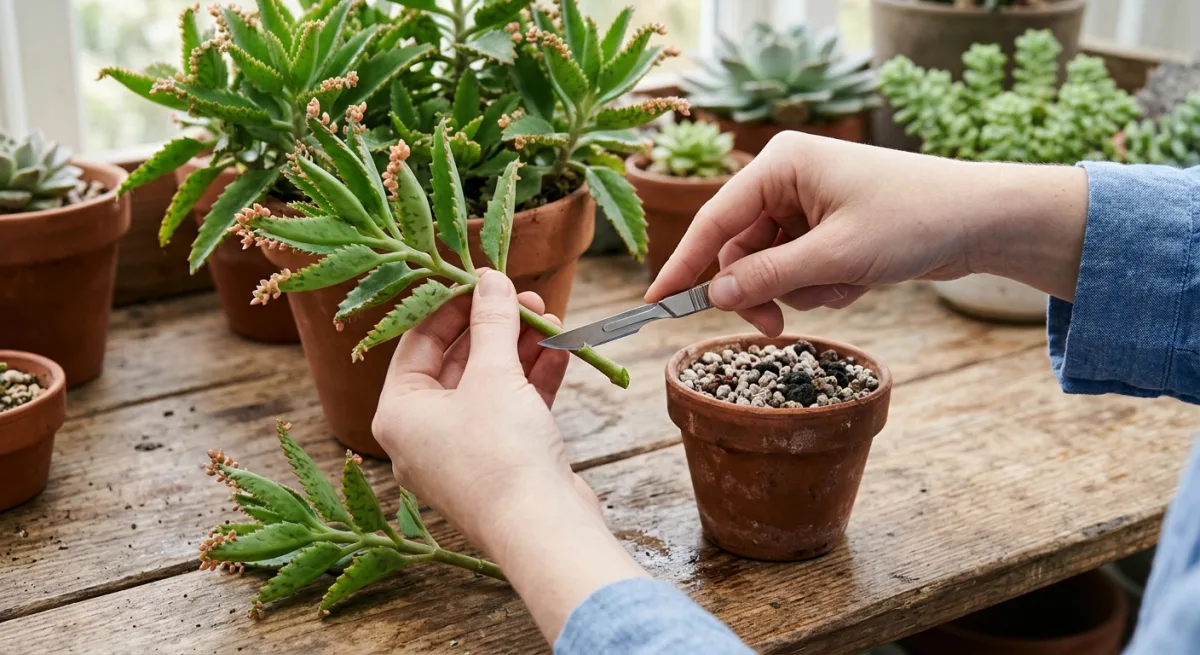
The only dependable, scientifically sound method to propagate this rare cultivar is via terminal stem cuttings:
- In mid-spring or early summer, select a robust, healthy apical stem cutting measuring roughly 8 to 10 cm in length, with tight, compact internodes.
- Using a sterile, surgical-grade scalpel or razor, make a clean cut just beneath a leaf node.
- Gently remove the bottom 2 to 3 leaves to expose clean stem tissue that will anchor into the substrate.
- Place the cutting in a warm, dry, shaded room with gentle air circulation for 3 to 5 days, allowing a tough, protective callus layer to form over the wound.
- Insert the callused cutting approximately 2 cm deep into the dry mineral substrate described above.
- Refrain from watering for the first 7 to 10 days. Afterward, introduce light moisture around the stem base to trigger root formation. Vigorous root systems will develop within 3 to 4 weeks.
6. Common Pests, Pathogens, and Corrective Treatments
While Kalanchoe 'Pink Butterflies' is resilient under proper cultural care, environmental missteps can leave it vulnerable to pests and opportunistic diseases:
- Mealybugs (Pseudococcidae): These sap-sucking pests congregate in protected leaf axils and beneath the clusters of pink bulbils, resembling miniature cotton tufts. Remove early infestations manually using a cotton swab dipped in 70% isopropyl alcohol. For widespread outbreaks, spray the entire plant with an organic cold-pressed neem oil solution during twilight hours.
- Root and Stem Rot (Phytophthora / Fusarium): The predictable consequence of overwatering and poorly draining soil. The base of the stem turns soft, dark, and translucent. Immediately unpot the plant, excise all mushy tissue back to healthy green vascular bundles, let the healthy stem callus, and re-root in sterile mineral mix.
- Leaf and Bulbil Drop: Sudden temperature drops, cold drafts, or severe underwatering trigger protective abscission, causing leaves and pink plantlets to drop en masse. Stabilize ambient temperatures and review moisture consistency.
Important Toxicity Advisory: As documented by the ASPCA Animal Poison Control, species within the genus Kalanchoe contain cardiac glycosides (specifically bufadienolides). Ingesting any part of this plant can cause severe gastrointestinal distress, cardiac arrhythmias, and lethargy in dogs, cats, and small children. Display your specimen safely on elevated plant stands well out of reach of curious pets.
7. Seasonal Care Calendar & Commercial Greenhouse Insights
Aligning your horticultural practices with the natural seasonal rhythms of the plant ensures long-term vigor and compact growth:
- Spring (Active Growth): Metabolic activity surges. Increase watering frequency according to the 'Soak and Dry' method, and apply a balanced, nitrogen-light succulent fertilizer diluted to quarter-strength once a month. This is the optimal window for taking stem cuttings.
- Summer (Mid-Season Heat): During extreme heat waves, the plant may enter a semi-dormant state to conserve moisture. Ensure substrate dries thoroughly between waterings and maximize ventilation to prevent fungal heat stress.
- Autumn (Tonal Peak): As evening temperatures dip, gradually taper off watering. The wider day-to-night temperature differential combined with crisp autumn light dramatically deepens the iridescent pink hues of the bulbils.
- Winter (Dormancy): Protect the plant from temperatures dipping below 50°F (10°C) and absolute frost. Reduce watering to a bare minimum—once or twice a month is typically sufficient to keep leaf cells turgid.


Reader Reviews & Comments 1 Review
No comments yet. Be the first to share your succulent experience!
Leave a Review & Rating
Share your plant care tips, experiences, or questions with our succulent community.