






A remarkable botanical journey stretching from the windswept, sun-drenched semi-desert plateaus of South Africa straight to the windowsills of passionate succulent growers: meet Piaranthus geminatus. Tucked beneath gravelly talus and sheltered by the sparse shade of dwarf desert scrub in its native Great Karoo basin, this captivating stem succulent might resemble humble green knolls at first glance. Yet, when autumn arrives, it undergoes an astonishing metamorphosis, unfurling miniature, velvety star flowers that stand as true marvels of evolutionary craftsmanship.
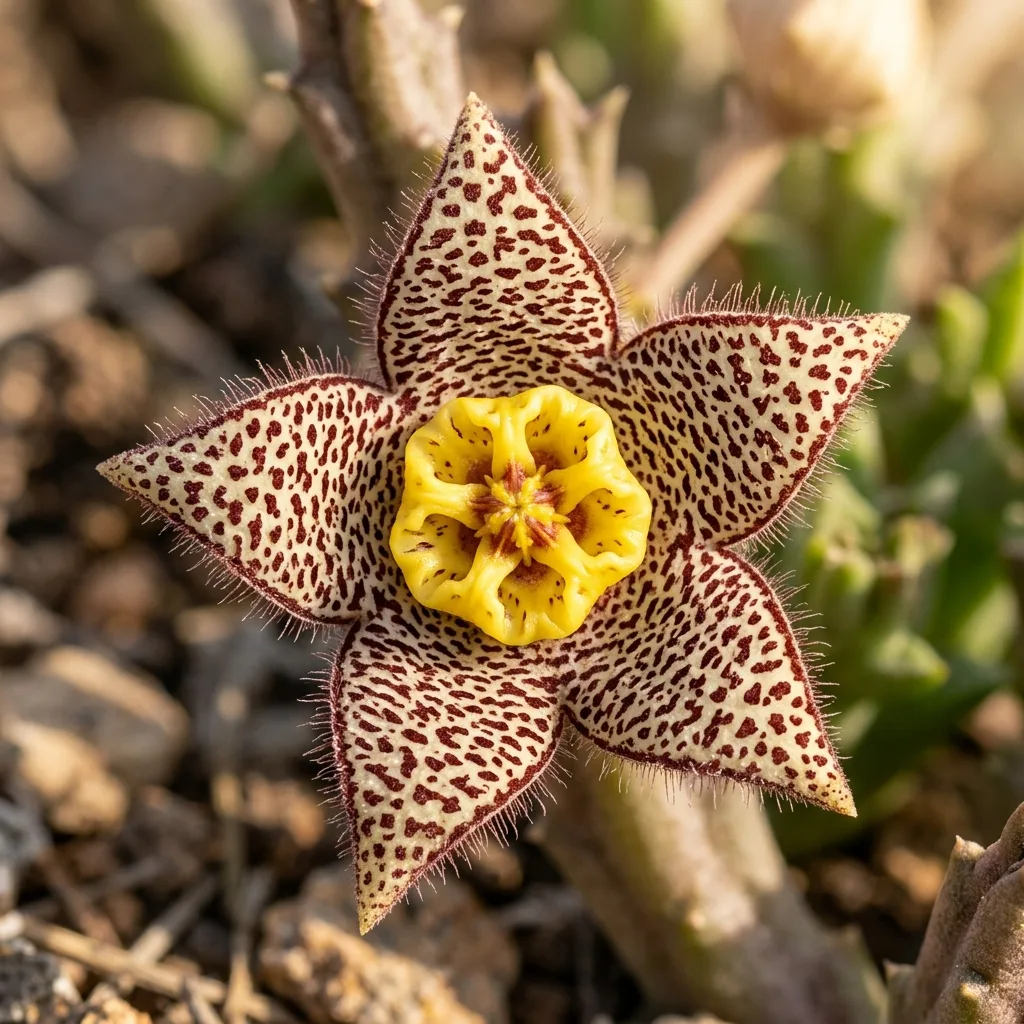
Belonging to the tribe Stapeliinae within the Apocynaceae (Dogbane) family, this species is frequently misidentified as a Stapelia or Orbea. However, it boasts a much more compact, tidy, and house-friendly constitution. Its procumbent stems branch profusely to carpet the soil in dense clusters, while its flowers—adorned with delicate trichomes and stippled in warm yellow, maroon, and russet patterns—evoke the intricacy of fine micro-mosaics.
If you are yearning to enrich your succulent collection with a resilient botanical gem that is both morphologically intriguing and a guaranteed conversation starter when autumn flowering commences, Piaranthus geminatus is the ancient desert heirloom you have been looking for. Let us walk together through every facet of its care, exploring its unique cellular dynamics, optimal potting media, and seasonal rhythm.
1. Botanical Identity and Morphological Characteristics
Piaranthus geminatus is a perennial, leafless (aphyllous) stem succulent. Devoid of true functional foliage, the plant conducts photosynthesis exclusively through the chloroplast-dense outer cell layers of its fleshy stems via Crassulacean Acid Metabolism (CAM photosynthesis). The stems typically measure between 2 and 5 cm in length and 1 to 2 cm in thickness, composed of 4- to 5-ribbed, heavily tuberculated (toothed) segments. Under balanced light, their epidermis displays an attractive pale green to silvery-olive hue, shifting to rich maroon-bronze under deliberate solar stress.
The defining feature separating this species from related genera lies within its specific epithet: geminatus, meaning 'paired' or 'twin-born.' Arising primarily in pairs from terminal growth points, the pedicels yield five-pointed, star-shaped flowers coated in subtle micro-trichomes that impart a distinct velutinous sheen. The central coronal structure glows vibrant golden-yellow, framed by petals mottled with burgundy, chestnut, or brick-red spots against an ivory ground. While it does produce an organic scent to attract dipteran pollinators in habitat, the aroma is remarkably faint compared to giant carrion flowers—undetectable across a room and noticeable only upon very close inspection.
2. Light Requirements and Indoor Positioning
Accustomed to dappled sunlight filtering through thorny nurse bushes in the wild, Piaranthus geminatus thrives indoors in bright, semi-filtered light. Unshielded, scorching summer noon sun can easily solarize and bleach chloroplast tissue, leaving permanent, pale corky scars across the epidermis. Conversely, light starvation leads to unsightly etiolation—where stems stretch into weak, pale pencils—and completely aborts seasonal flower bud initiation.
The optimal domestic position is an unobstructed east-facing windowsill that welcomes gentle morning sun, or a south- or west-facing exposure softened by sheer curtains. The subtle purple-bronze blush your plant develops in generous light is a protective anthocyanin pigment barrier—not a symptom of distress, but a healthy sun-kissed badge of vigor.
3. Watering Discipline: The 'Soak and Dry' Protocol
Frequent watering is never an expression of love for desert flora; it simply suffocates the root rhizosphere by expelling vital interstitial oxygen. In stem succulents like Piaranthus geminatus, which rely on delicate, fibrous root systems, chronic dampness invites soil-borne oomycetes and fungal pathogens like Fusarium and Pythium to rapidly invade and ascend the vascular cylinder.
Adhere strictly to the golden 'Soak and Dry' protocol:
- Never apply water until the potting substrate has dried out completely down to the very base of the container. Insert a wooden skewer to the bottom of the pot; if it emerges completely dry without adhering soil particles, the root zone is ready for hydration.
- When watering, soak the substrate thoroughly around the pot perimeter, keeping moisture away from stem joints and central crowns. Empty runoff saucers within 15 minutes—never allow the pot to sit in stagnant water.
- Throughout the winter dormancy period, when temperatures settle between 12 and 15°C (54–59°F), reduce watering frequency drastically to once a month, or withhold water entirely until the stem segments show mild, supple wrinkling.
4. Ideal Substrate Formulation and Pot Selection
Piaranthus geminatus roots crave generous air exchange. Dense, peat-laden commercial potting soils that retain moisture are lethal for this species. Success requires an open, highly porous, gritty mix where water passes through instantaneously while maintaining structural aeration.
When it comes to containers, shallow, unglazed terracotta bowls are unexcelled. Terracotta's porous walls allow water vapor to escape laterally, dramatically speeding dry-down intervals. Because Piaranthus develops shallow root networks and naturally spreads into wide, carpeted mats via lateral stem segments, wide, shallow dish-pots support its authentic growth habit best.
| Component | Ratio (%) | Horticultural Function & Benefit |
|---|---|---|
| Pumice (3–6 mm) | 40% | Creates stable air pores, prevents compaction, and keeps roots oxygenated. |
| Lava Grit / Crushed Scoria | 25% | Porous volcanic aggregate that holds micronutrients and ensures rapid drainage. |
| Zeolite (Clinoptilolite) | 15% | Provides superior cation exchange capacity (CEC), buffers salts, and suppresses fungi. |
| Quality Succulent Soil / Odorless Worm Castings | 20% | Supplies essential organic matter and gentle, slow-release bio-available nitrogen. |
5. Step-by-Step Propagation Techniques
Propagating Piaranthus geminatus is exceptionally satisfying and enjoys a remarkably high success rate. Over time, mother clumps produce numerous jointed segments ready for separation.
- Select the Right Season: Propagate during active vegetative growth in late spring or early summer, when warmth and daylength accelerate rooting.
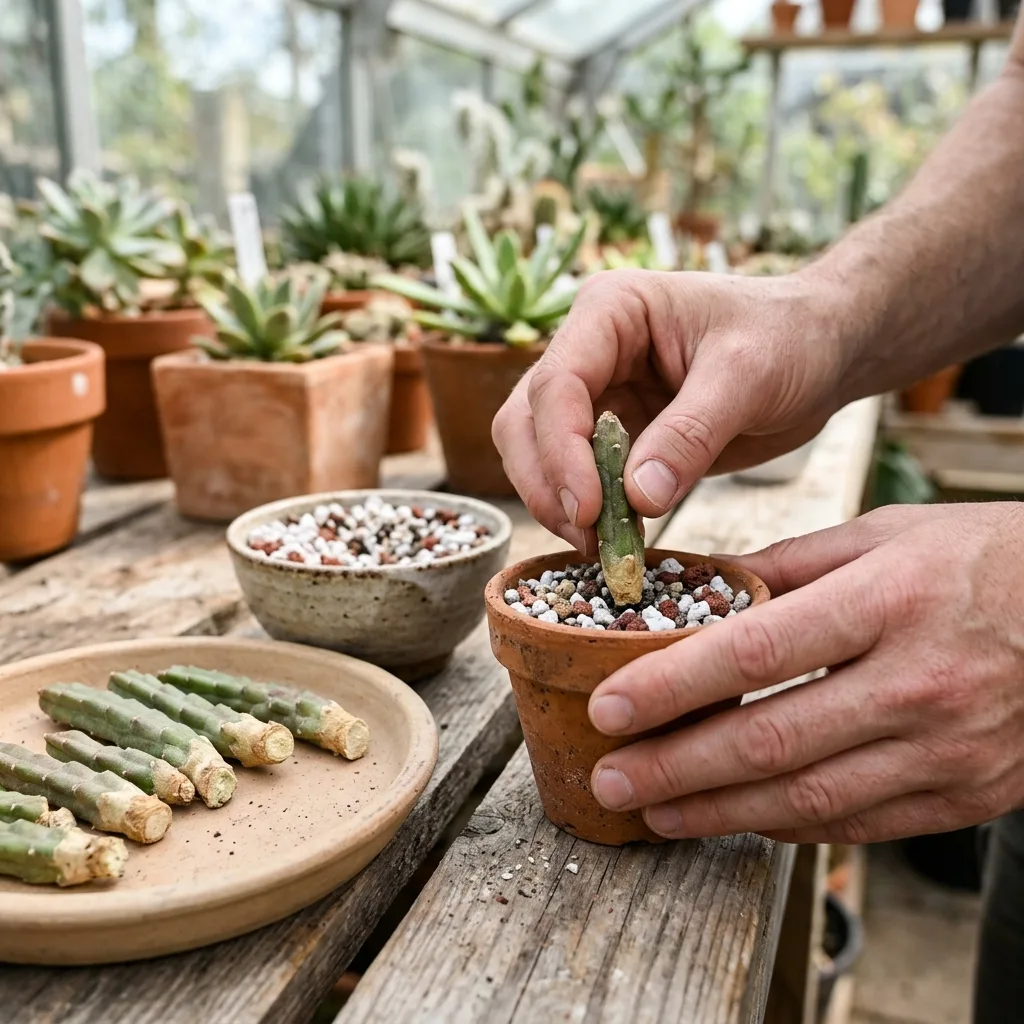
- Harvest the Segment: Using a sterile scalpel or razor blade, sever a plump, mature segment cleanly at the narrow joint where it connects to the parent stem. Often, a gentle lateral twist with your fingers snaps the segment off cleanly without tearing tissue.
- Allow Callus Formation: Never plant freshly cut cuttings into damp medium! Place the segments in a dry, shaded, and well-ventilated spot for 3 to 5 days until the cut surface seals with a firm, grayish-white callous. This preventative step averts nearly all fungal decay.
- Dry Potting: Press the calloused cutting upright about 1 cm into the gritty mineral substrate outlined above, or secure it horizontally against the surface using a small nursery pin.
- The Rooting Phase: Keep the pot dry for the first 7 to 10 days. Afterward, begin lightly misting the surface media around the base. Within 3 to 4 weeks, fresh, white adventitious roots will anchor the segment into the grit.
6. Common Pests, Diseases, and Management
Despite its arid toughness, Piaranthus geminatus can fall victim to specific pests and cultural mismanagement:
- Mealybugs (Pseudococcidae): These pervasive sap-suckers nestle in the crevices between stem segments and around the root collar, shrouding themselves in protective white cottony filaments. Dab isolated colonies with a cotton swab soaked in 70% isopropyl alcohol; manage widespread outbreaks with a systemic soil drench or horticultural cold-pressed neem solution.
- Root Mealybugs: If you detect chalky, white deposits and stunted growth during repotting, root mealybugs have taken hold. Wash all old soil away entirely, submerge the bare root system in a mild insecticidal bath, let it dry completely, and replant in fresh, sterile substrate.
- Black Stem & Root Rot: The combined consequence of prolonged saturation and cold drafts. Immediately excise all compromised, darkened tissue with a sterile blade until you reveal clean, green vascular rings. Dust cut surfaces with sulfur or cinnamon powder, allow them to recuticularize, and re-root the remaining healthy segments.
7. Seasonal Care Calendar and Expert Tips
Tuning into your plant's internal biological clock is the secret to an abundant autumn display of star-shaped flowers:
- Spring: The vernal awakening. Gradually step up your watering cadence as growth resumes, confirming the mix dries out completely between events. Feed bi-monthly with a diluted low-nitrogen, high-potassium/phosphorus cactus fertilizer.
- Summer: During extreme midsummer heat waves (above 35°C / 95°F), the plant enters partial dormancy (estivation) to protect cellular moisture. Scale back watering slightly and ensure shelter from midday sun.
- Autumn: Peak blooming season! As photoperiods shorten and day-to-night temperatures fluctuate by 8–10°C (15–18°F), Piaranthus initiates terminal flower buds. Maintain steady, careful moisture to prevent bud drop, never letting the pot sit desiccated for weeks.
- Winter: Quiescent dormancy. Protect the specimen from frost, keeping ambient temperatures above 8–10°C (46–50°F). Relocate to a luminous, cool spot and suspend watering almost entirely. This crisp rest period is an essential physiological trigger for subsequent floral budding.


Reader Reviews & Comments 4 Reviews
Julian Vance
Marcus Sterling
Hannah Abbott
Clara Higgins
Leave a Review & Rating
Share your plant care tips, experiences, or questions with our succulent community.