






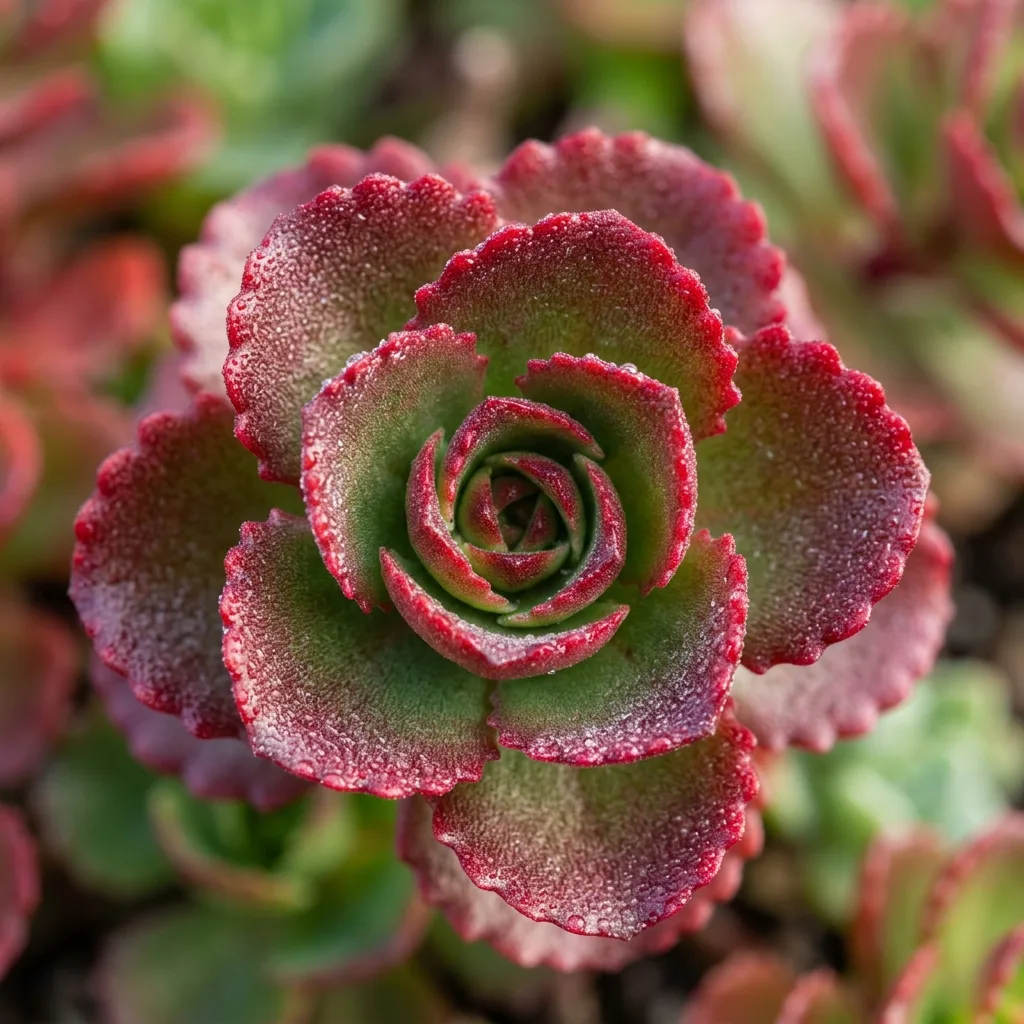
Imagine a relentless survivor that has thrived for millennia across the craggy, wind-whipped slopes of the Caucasus Mountains, anchoring into the narrowest fissures of bare rock: Phedimus spurius 'Dragon's Blood'. Widely cherished by succulent enthusiasts as the 'Dragon's Blood Stonecrop', this mesmerizing groundcover succulent captures the dance of the seasons upon its succulent leaves. Waking in early spring with margins of fresh emerald green, it transforms beneath the scorching summer sun and freezing winter frosts into deep ruby and rich burgundy, breathing life into the mythical name it bears.
Traditionally classified as Sedum spurium and subsequently placed by modern plant taxonomists into the genus Phedimus within the family Crassulaceae, this alpine perennial boasts an extraordinary cellular cold-hardiness mechanism that scoffs at sub-zero temperatures—unlike its tender, frost-sensitive succulent cousins. A staple in both contemporary rockeries and shallow alpine dish planters, this resilient specimen brings the unyielding minimalism and untamed elegance of wild summits straight to our living spaces.
Many plant parents mistakenly perceive succulent care as a precarious tightrope walk; however, 'Dragon's Blood' is one of the most forgiving, low-maintenance horticultural companions available once foundational principles are respected. In return for mindful placement, it rewards you with a dazzling display of rich crimson foliage. Let us decipher the botanical secrets of this crimson gem and explore step-by-step how to help it flourish in your collection.
1. Botanical Identity and Morphological Characteristics
Phedimus spurius (formerly Sedum spurium) is a mat-forming, evergreen (or semi-deciduous in sub-zero winter zones) perennial stem succulent belonging to the family Crassulaceae. The cultivar 'Dragon's Blood' (originally selected in Germany as 'Schorbuser Blut') is distinguished by its crenate, scalloped leaf margins and the dense accumulation of anthocyanin pigments within its epidermal and sub-epidermal tissues. These anthocyanins function as an evolutionary defense mechanism—serving simultaneously as organic cellular sunscreen against harsh UV radiation and a cryoprotective antifreeze solute mitigating cellular freezing damage.
The plant spreads through decumbent, creeping stoloniferous stems. Whenever a stem node makes contact with loose, mineral soil, it immediately issues adventitious root initials, weaving an interlocking living carpet across the ground. The leaves are obovate and fleshy, storing water during prolonged droughts as mucilaginous, hydro-retentive polysaccharides within the mesophyll cells. From mid to late summer, dense terminal corymbose inflorescences emerge above the foliage, showcasing clusters of star-shaped, vibrant pink-to-crimson flowers that provide an abundant nectar source for local native bees and butterflies.
2. Light Requirements and Indoor Positioning
Members of the genus Phedimus are obligate sun-worshippers that will not tolerate prolonged shade. Maintaining their photosynthetic machinery through a flexible hybrid balance of Crassulacean Acid Metabolism (CAM) and C3 pathways, these plants require a bare minimum of 6 hours of unfiltered, direct sunlight daily. In low-light settings, the plant quickly exhibits severe 'etiolation'—stems become spindly and fragile, internodes elongate unnaturally, and the iconic crimson pigmentation fades into a washed-out, dull chartreuse.
If you intend to cultivate this noble specimen indoors, an unobstructed south-facing windowsill devoid of sheer curtain filtration is imperative. A western exposure serves as a solid alternative. On east- or north-facing windows, preserving its compact, dense rosette structure is virtually impossible; in such conditions, you must supplement natural light with a full-spectrum LED grow light (delivering balanced cool white and red wavelengths) for 12 hours a day. When grown outdoors in patio containers, balcony troughs, or rockery crevices, feel free to position it directly under full, unshaded midday sun.
3. Watering Discipline: The 'Soak and Dry' Method
The single most destructive pitfall among succulent growers is watering on a frequent, shallow calendar schedule. Frequent sips do not show affection; they asphyxiate the delicate root hairs by maintaining permanent saturation in the rhizosphere. The gold standard for Phedimus spurius is the 'Soak and Dry' protocol.
When hydrating, water thoroughly and generously until moisture runs freely from the container's bottom drainage holes, and immediately empty any drainage water that collects in the saucer. Before you even consider watering again, the potting substrate must dry out completely from the surface down to the very base of the pot. The most reliable way to monitor this is to insert a wooden skewer deep into the soil column or judge the physical weight of the container. If the skewer emerges bone-dry and the pot feels featherlight, it is time to hydrate. During winter dormancy, reduce watering drastically; if planted outside under natural precipitation, supplemental watering must be suspended entirely.
4. Ideal Substrate Mix and Pot Selection
The native montane habitats of the Caucasus consist of nutrient-depleted, weathering rock screes that are exceptionally rich in mineral aggregates and structural air pockets. Phedimus spurius requires a porous, sub-acidic to neutral growing medium (pH 6.0–7.5) with immediate percolation and high oxygen diffusion capacity.
When choosing a container, prioritize surface width over depth. The root architecture of 'Dragon's Blood' is naturally fibrous and shallow, rarely penetrating deeper than 10–12 cm, but expands aggressively horizontally. Unglazed terracotta pots are superior because their micro-porous ceramic walls facilitate three-dimensional moisture evaporation, protecting sensitive roots from stagnation. If plastic or glazed ceramic containers are utilized, you must ensure drainage holes are generously sized and unobstructed.
| Substrate Component | Ratio (%) | Functional Horticultural Role |
|---|---|---|
| Pumice (3–6 mm) | 35% | Enhances structural macropores, resists compaction, maximizes aeration |
| Crushed Lava Rock (2–5 mm) | 25% | Supplies trace minerals, anchors shallow roots, promotes sharp drainage |
| Clinoptilolite Zeolite | 15% | Improves Cation Exchange Capacity (CEC), buffers salts and excess toxins |
| Coarse Commercial Succulent Soil | 20% | Provides essential organic matter and initial structural anchorage for root hairs |
| Coarse River Sand / Coarse Perlite | 5% | Maintains open micro-capillary drainage pathways |
5. Step-by-Step Propagation Techniques
Multiplying 'Dragon's Blood' stonecrop is an effortless way to witness natural vegetative regeneration. Thanks to its sprawling habit and active nodal growth points, rooting success rates are near 100%.
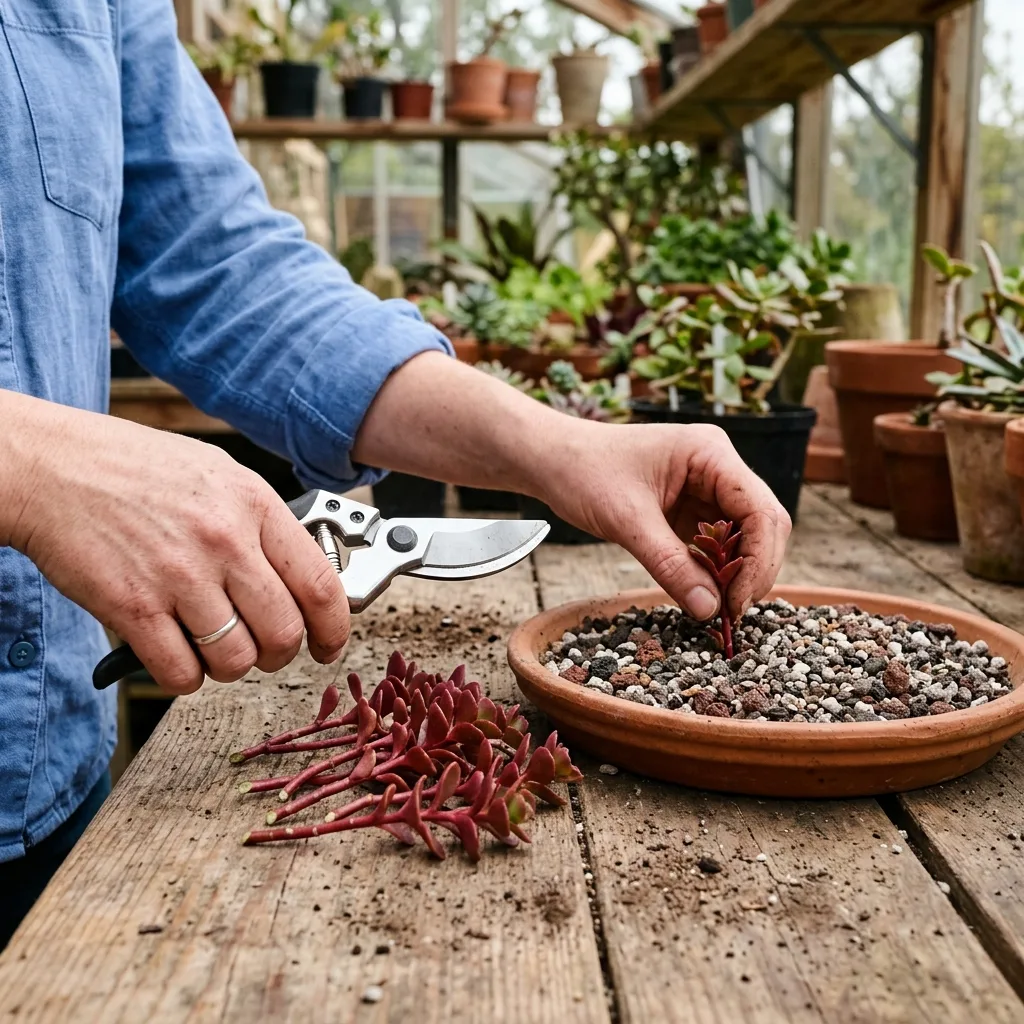
- Stem Cuttings (The Fastest Method): In mid-spring or early summer during peak vegetative growth, use a sterilized, razor-sharp scalpel to harvest 7–10 cm terminal stem cuttings from vigorous shoots.
- Callus Formation: Strip the leaves from the bottom 2–3 cm of the cutting stem. Rest the prepared cuttings in a dry, shaded, well-ventilated spot for 48 to 72 hours. This drying period allows the severed vascular bundle to form a firm suberized callus, creating an impenetrable barrier against soil-borne fungal pathogens.
- Dry Potting: Insert the callused cuttings into the completely dry mineral substrate outlined above. Do not water immediately; wait at least 5 days to stimulate root-seeking hormonal pathways.
- Rooting Phase: Within 2 to 3 weeks, fine adventitious feeder roots will emerge from the buried nodes. Give the stem a very gentle tug; if you detect firm anchorage resistance, root development is complete, and regular watering cycles can commence.
- Division of Rooted Stems: When repotting in spring, gently sever naturally layered stolons that have rooted in the parent pot using clean pruning shears, then transplant them directly into independent containers.
6. Common Pests, Diseases, and Curative Solutions
Despite being exceptionally hardy, poor cultural practices can leave Phedimus spurius vulnerable to opportunistic pests and fungal invaders.
Mealybugs (Pseudococcidae): When kept in stuffy, dry indoor environments with poor airflow, mealybugs congregate in the leaf axils as cottony white clumps. They tap the vascular system, extracting nutrient-rich sap and causing leaf chlorosis and distortion. Dab individual colonies with a cotton swab soaked in 70% isopropyl alcohol, followed by a targeted spray of cold-pressed neem oil or potassium insecticidal soap.
Stem and Root Rot (Rhizoctonia & Phytophthora): The predictable consequence of dense peat-based soils and chronic overwatering. Basal stems turn translucent, soften, and collapse into black decay. The intervention must be surgical: amputate healthy top rosettes at least 2 cm above visibly infected tissues, allow the fresh cuts to callus over, and root them into dry, sterile mineral mix. Discard the rotted root mass and soil immediately.
Slugs and Snails: In outdoor garden beds and alpine borders, the tender, water-rich foliage is an attractive target during damp spring nights. Establish an abrasive perimeter around your plants using food-grade diatomaceous earth or finely crushed eggshells to form a natural mechanical deterrent.
7. Seasonal Care Calendar and Expert Protocols
Synchronizing your maintenance routines with the biological rhythms of this alpine succulent guarantees vigorous vigor and sustained color year after year.
- Spring (Awakening & Vegetative Growth): Starting in March, gradually step up watering frequency as new shoots push out. To promote compact, firm growth without lankiness, apply a balanced low-nitrogen, high-potassium succulent fertilizer (such as NPK 5-10-10) diluted to quarter strength once every four weeks.
- Summer (Inflorescence & Deep Ruby Foliage): Basking under full outdoor sunshine, your stonecrop develops its deepest, most saturated ruby tones and opens its star-like blossoms. During intense heatwaves (exceeding 35°C), the plant may temporarily throttle its transpiration rate; apply water exclusively in the cool dawn hours to prevent root boiling.
- Autumn (Acclimation & Hardening Off): Suspend all fertilizer inputs as daytime temperatures decline, and space out watering sessions. Crisp autumn night chills will trigger peak anthocyanin accumulation, turning the entire mat into a breathtaking sea of wine-red rosettes.
- Winter (Freeze Tolerance Challenge): 'Dragon's Blood' is rated for USDA Hardiness Zones 3 through 9, effortlessly tolerating freezing temperatures down to -30°C (-22°F). A protective blanket of outdoor snow will not harm it. However, if kept in containers, never wet the substrate when freezing temperatures are imminent; frozen, waterlogged roots will suffer irreversible cellular collapse.


Reader Reviews & Comments 3 Reviews
Marcus Thornton
Eleanor Vance
Julianna Hayes
Leave a Review & Rating
Share your plant care tips, experiences, or questions with our succulent community.