






When seeking to introduce whispering, wind-swept movement and luminous, light-filtering textures among the sculptural, fleshy silhouettes of a succulent rockery or container garden, nature offers one of its most delicate brushstrokes: Pennisetum alopecuroides 'Little Honey' (commonly cherished as Little Honey Dwarf Fountain Grass). Inheriting its genetic resilience from the open meadows and rocky slopes of East Asia, this miniature ornamental grass erupts from a dense crown like a miniature cascade of light, flaunting cream-white variegated ribbons running down vibrant emerald foliage.
For growers searching to break up the monolithic, architectural density of cactus and succulent beds, this dwarf cultivar delivers an immaculate aesthetic balance within both container compositions and naturalistic gravel gardens. When situated beside Agaves, groundcover Sedums, or towering Euphorbias, it introduces a dynamic softness that accentuates their rigid structural forms. Let us explore the botanical nuances of this variegated jewel and examine how our greenhouse protocols can guide you in cultivating it to absolute perfection.
1. Botanical Identity and Morphological Characteristics
An elite member of the Poaceae (grass) family, Pennisetum alopecuroides 'Little Honey' originated as a stable genetic sport mutation of the celebrated dwarf cultivar 'Little Bunny'. This plant exhibits a compact, densely tufted clumping habit (tussock), reaching a mature height and spread of merely 25 to 30 cm (10–12 inches)—making it an authentic miniature fountain. A vivid creamy-white longitudinal stripe bisects each slender leaf blade, contrasting dramatically with rich forest-green margins.
In late summer, the crown gives rise to miniature, bottlebrush-like cylindrical spikelets (inflorescences) brushed with smoky amber and bronze bristles. Operating through the cellular C4 photosynthetic pathway, Little Honey retains superior carbon-fixation efficiency even during intense summer heat. However, because its variegated leaves possess reduced chlorophyll density compared to standard non-variegated grasses, its overall photosynthetic engine is slightly more delicate, demanding a carefully calibrated solar balance.
2. Light Requirements and Microclimate Positioning
To sustain its signature fountain-like silhouette, 'Little Honey' demands abundant, high-intensity light. Providing at least 6 hours of direct, unfiltered sunlight daily ensures erect, arching leaf turgidity. In deficit lighting, the foliage undergoes etiolation: stems become frail and lax, the creamy central variegation fades into a dull monochrome green, and the crown splays outward, losing its compact architectural integrity.
If you are integrating this grass into a succulent rock garden, southeastern or sheltered western exposures yield the best results. For balcony and terrace cultivation, select an airy position where ambient breezes circulate freely. Airflow does not merely enhance its kinetic ornamental appeal; it evaporates lingering moisture around the crown, significantly lowering susceptibility to fungal pathogens.

3. Watering Discipline: Xylem Dynamics and Moisture Balance
While mature botanical Pennisetum species exhibit notable drought tolerance, 'Little Honey'—by virtue of its dwarf stature and reduced photosynthetic tissue—cannot tolerate protracted desiccation. When co-planted with succulents and xerophytic specimens, its hydration regime requires deliberate zoning. The golden rule is to allow the top 3–4 cm (1.5 inches) of soil to thoroughly dry out, followed by a deep, saturating soak that flushes cleanly through the drainage holes.
Persistent overwatering suffocates root cortex tissues, inducing hypoxic conditions that invite Rhizoctonia and Pythium crown and root rot. Incipient water stress presents as longitudinal inward curling of the blades accompanied by a dull, grayish cast. To foster a resilient, deeply probing root system, utilize slow drip irrigation or targeted sub-canopy soaks rather than frequent surface misting.
4. Substrate Engineering and Container Selection
Little Honey thrives in loose, granular, and structurally stable substrates that facilitate gas exchange around its fine root system. Heavy, unamended clay soils strangle root respiration, whereas 100% nutrient-devoid coarse sand fails to support healthy blade turgor. A tailored growing medium must unite high hydraulic conductivity with sufficient cation-exchange capacity.
| Substrate Component | Ratio (%) | Horticultural Function |
|---|---|---|
| Pumice (3–6 mm) | 35% | Pore matrix stability, root zone oxygenation, and moisture buffering |
| Lava Rock (Scoria) | 20% | Mineral ballast, trace element release, and physical structural integrity |
| Coarse River Sand / Zeolite | 15% | Fibrous root anchorage and micro-toxin filtration |
| Sterile Peat / Leaf Compost | 30% | Humic acid retention and gentle, baseline moisture reserves |
For container cultivation, unglazed terracotta or high-fired breathable stoneware with ample drainage openings is non-negotiable. Non-porous plastic pots absorb solar heat, elevating root zone temperatures to dangerous levels during hot summer afternoons.
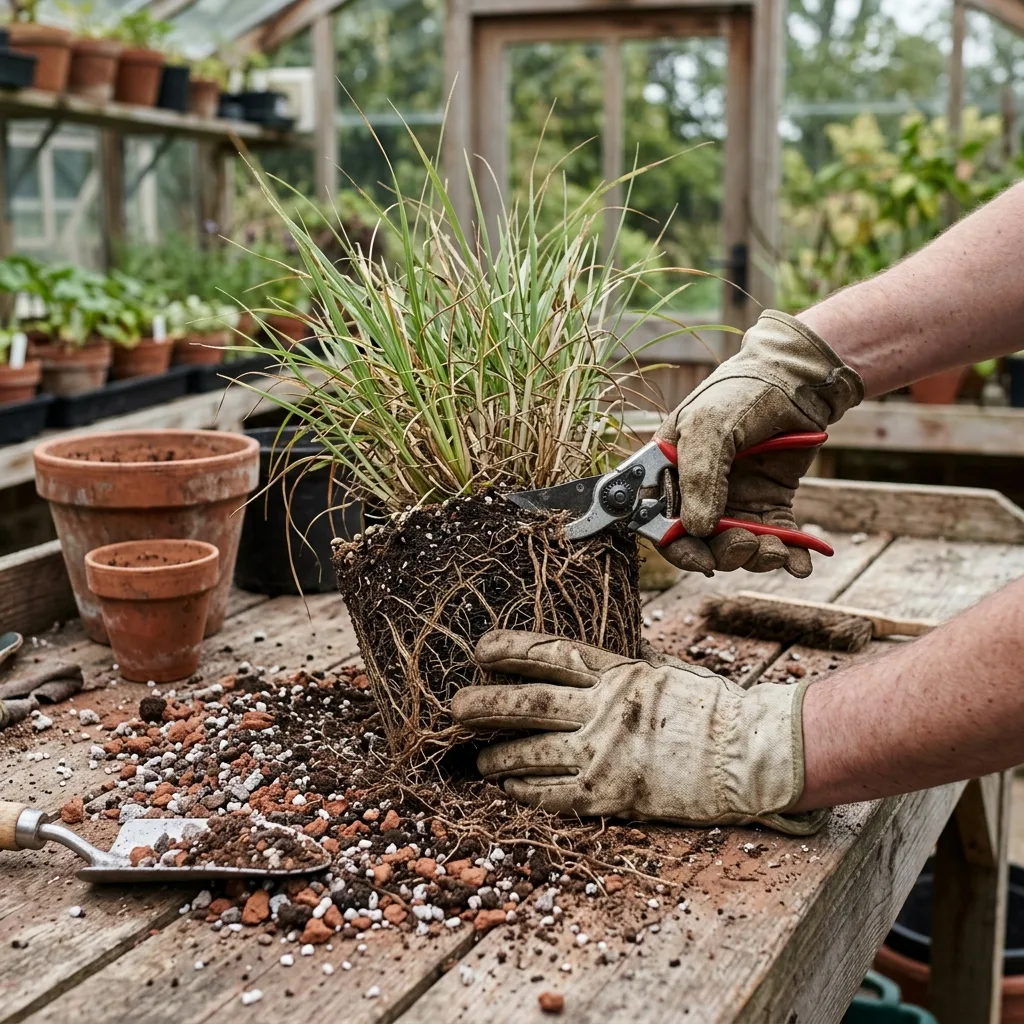
5. Step-by-Step Propagation Techniques
Because Pennisetum alopecuroides 'Little Honey' is a chimeral sport mutation, it does not come true from seed; seedlings routinely revert back to standard, non-variegated green forms. Consequently, the only reliable method to clone this plant is through early spring crown division.
- Timing: Perform the procedure in early spring (March or April), precisely as overwintering dormancy breaks and the first fresh green shoots emerge from the basal crown.
- Excavation: Gently lift the entire tussock from its container or garden border using a clean spade, taking care to preserve the fine fibrous root architecture.
- Division: Using a sterilized horticultural knife or razor-sharp bypass shears, slice through the crown, ensuring that every divided segment retains at least 3–4 vigorous green growth points and an intact cluster of feeder roots.
- Wound Desiccation: Dust all cut root surfaces with activated wood charcoal powder or sublimed sulfur to suppress latent soil-borne spores.
- Re-establishment: Pot the divisions immediately into the recommended granular substrate mix, setting the crown at its original soil depth, and supply a light settling irrigation.
6. Common Pathogens, Pests, and Cultural Remedies
While 'Little Honey' demonstrates natural vigor, environmental stress can trigger typical physiological and pest challenges:
- Root and Crown Rot (Oomycetes): Triggered by poorly aerated, waterlogged soil. Foliage yellows from the crown outward, turning mushy at the base. Immediately cease watering, excise necrotic root tissue, and repot into fresh, ultra-draining mineral substrate.
- Spider Mites (Tetranychidae): Thriving in hot, dry, stagnant microclimates, these pests weave fine webbing along the underside of blades and cause chlorotic speckling. Treat the canopy during evening hours with cold-pressed neem oil or a horticultural soap solution.
- Rust (Puccinia spp.): Manifests as raised orange-amber pustules on the variegated leaf blades during humid, airless spells. Increase ambient air circulation and promptly excise affected foliage at ground level.
7. Seasonal Maintenance Calendar and Expert Protocols
Spring: Shear back desiccated straw foliage to roughly 5–7 cm (2–3 inches) above the crown before vigorous new shoots emerge. Top-dress with well-decomposed organic matter or apply a dilute, balanced liquid fertilizer.
Summer: Monitor moisture consistency as plumes emerge. Apply a top-dressing mulch of pure volcanic pumice or washed pea gravel around the collar to shield the root zone from excessive thermal spikes.
Autumn: Celebrate the transformation as plumes mature into golden-bronze seedheads. Refrain from late-season pruning; the persistent foliage provides architectural interest and insulates the dormant crown against freeze-thaw cycles.
Winter: In regions subject to harsh frosts, apply a dry pine-bark mulch blanket across the root plate. If sustained winter temperatures plunge below -10°C (14°F), relocate containerized specimens into an unheated, bright cold-frame or sheltered veranda.


Reader Reviews & Comments 3 Reviews
Eleanor Vance
Julianna Ross
Marcus Sterling
Leave a Review & Rating
Share your plant care tips, experiences, or questions with our succulent community.