






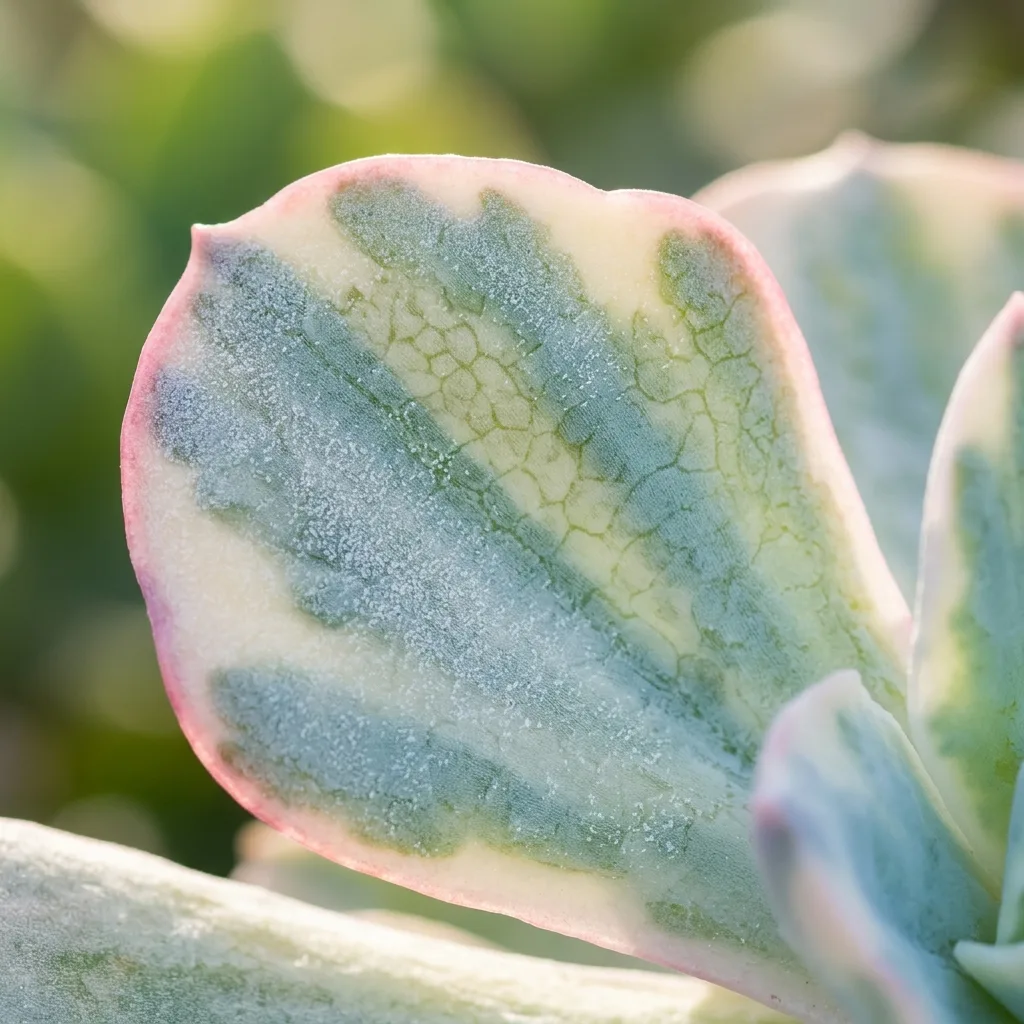
Echeveria 'Flying Cloud' represents one of the most exquisite horticultural achievements bridging wild Mexican limestone cliffs and the refined greenhouses of modern succulent collectors. Known affectionately among connoisseurs for its variegated leaves that resemble ethereal brushstrokes swept across an open sky, this exceptional cultivar displays an elegance far surpassing common succulents. Soft pastel waves of cream, lavender, and silvery pink grace its leaf margins, bringing the subtle, shifting hues of a sunset sky straight into your living space.
Yet behind this breathtaking aesthetic lies a delicate cellular architecture. Because of its chlorophyll-deficient chimeric tissues, Echeveria 'Flying Cloud' demands a far more precise equilibrium of light, moisture, and airflow than its solid green counterparts. From the xylem vessels nourishing its core to the outermost epicuticular wax layer shielding its foliage, every single cell is an example of nature's fragile perfection. Caring for this botanical cloud at home is a rewarding art form—one that flourishes when guided by scientific insight and thoughtful observation.
1. Botanical Identity and Morphological Characteristics
Echeveria 'Flying Cloud' is a highly prized variegated hybrid selection belonging to the genus Echeveria within the stonecrop family, Crassulaceae. The plant forms a compact, geometric rosette composed of fleshy, spoon-shaped leaves that taper to a subtle tip. Coating the foliage is a layer of 'farina'—botanically classified as an epicuticular wax. This silvery, powdery bloom acts as a natural barrier to minimize cellular transpiration and serves as an organic ultraviolet shield against intense solar radiation.
What truly defines 'Flying Cloud' is its chimeric tissue configuration. Chlorophyll-free (white-to-cream) cell sectors run parallel to chlorophyll-rich (glaucous blue-green) tissue. Under deliberate environmental stress—specifically high diurnal temperature swings (crisp nights combined with warm, brightly lit days)—protective anthocyanin pigments activate, blushing the creamy segments into shades of sweet lavender-pink. A mature specimen achieves a rosette diameter of approximately 10 to 15 cm (4 to 6 inches), maintaining a monopodial, tight growth habit close to the substrate level.
2. Light Requirements and Indoor Positioning
Due to its variegation, Echeveria 'Flying Cloud' possesses a reduced photosynthetic capacity. Because the white and cream portions lack chlorophyll pigments entirely, the remaining green sectors must work with maximum efficiency to synthesize the sugars required for healthy growth. This means the plant requires abundant, high-quality, filtered sunlight.
Indoors, your best placement is right behind a sheer curtain on an unobstructed East- or South-facing windowsill, where it can enjoy 5 to 6 hours of bright, indirect light alongside gentle early morning sun. Caution is essential: if the chlorophyll-free white tissues are exposed to harsh, scorching midday sun (particularly during hot summer afternoons), they will quickly burn, resulting in irreversible cellular collapse (necrosis). Conversely, chronic light deficiency forces the stem to elongate awkwardly (etiolation), separating the closely spaced leaves and ruining its compact, cloud-like rosette form.
3. Watering Discipline: The 'Soak and Dry' Method
Echeverias are quintessential CAM (Crassulacean Acid Metabolism) plants native to arid and rocky environments. They keep their stomata tightly closed throughout hot days to conserve moisture, opening them during cooler nights to conduct gas exchange. In 'Flying Cloud', the variegated leaf margins are particularly sensitive to moisture imbalances compared to wild-type species.
The golden rule for this succulent is the strict 'Soak and Dry' method. Never water on a whim; ensure the substrate has dried out completely from the top layer all the way to the drainage hole. When watering, direct a narrow-spout watering can onto the soil around the rim of the pot until water runs freely through the drainage holes. Never pour water into the center of the rosette. Trapped water standing in the leaf axils of an indoor plant will rapidly trigger crown rot, destroying the specimen in a matter of days.
4. Ideal Soil Formulation and Pot Selection
Maintaining continuous oxygen circulation around the root zone is the only surefire way to protect delicate feeder roots from fungal decay. Off-the-shelf, peat-heavy commercial cactus soils retain far too much moisture for this sensitive cultivar. Instead, you need an inorganic, highly porous mineral substrate that drains rapidly while retaining just enough ambient moisture for root uptake.
Container choice is equally pivotal. Unglazed, porous terracotta pots are optimal because their breathable clay walls allow excess water to evaporate evenly, cooling and aerating the root ball. If you opt for plastic or glazed ceramic containers, compensate by increasing the grit percentage in your mix and ensuring the drainage holes are wide and unobstructed.
| Substrate Component | Ratio (%) | Botanical Function |
|---|---|---|
| Pumice (3-5 mm) | 35% | Exceptional porosity, aeration pockets, superior structural drainage |
| Lava Rock / Zeolite | 25% | Micronutrient reservoir, prevents soil compaction around roots |
| Sterile Coarse Perlite or Horticultural Grit | 15% | Accelerates water percolation and keeps the aggregate lightweight |
| Quality Coconut Coir (Coco Peat) | 20% | Provides clean organic matter and root anchorage without caking |
| Worm Castings (Vermicompost) | 5% | Inoculates beneficial microbes and supplies gentle, slow-release nutrients |
5. Step-by-Step Propagation Techniques
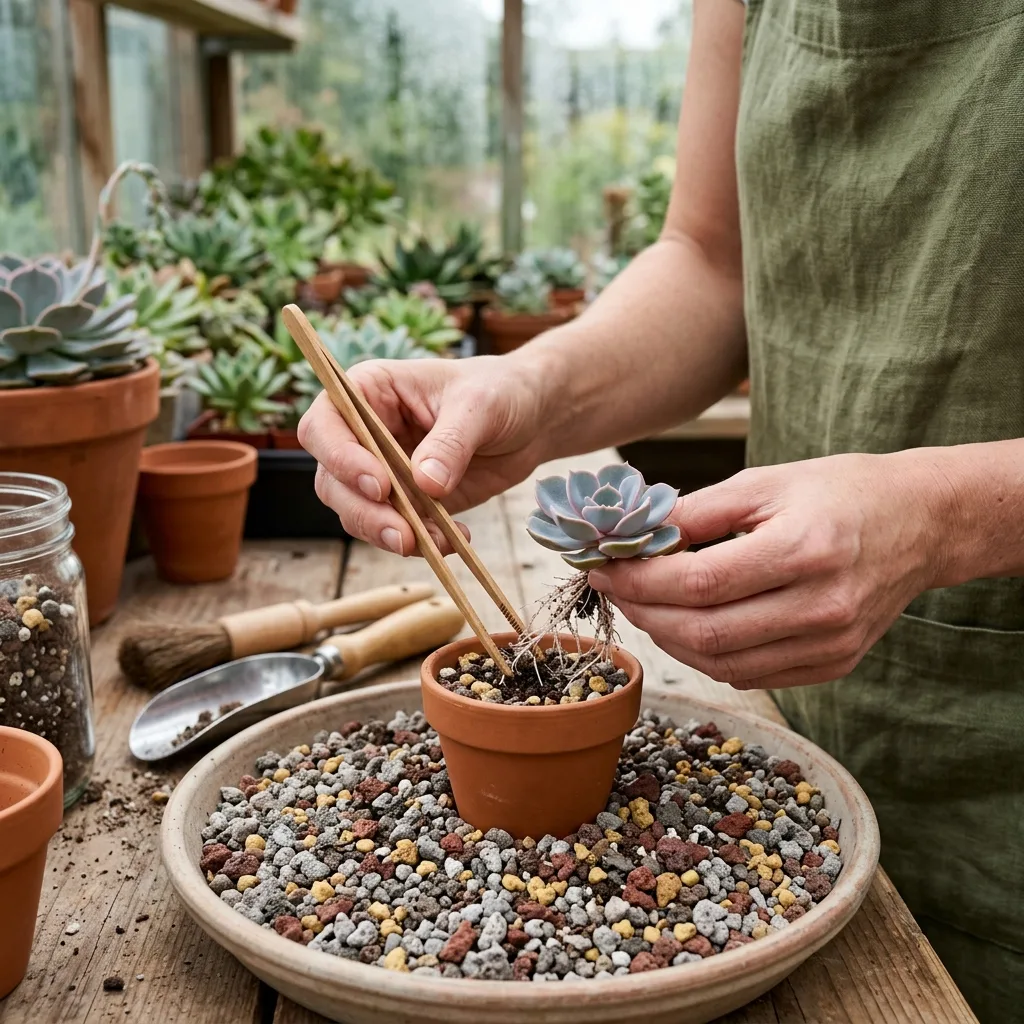
Propagating variegated succulents requires botanical patience and precise technique. Growing 'Flying Cloud' from single-leaf cuttings is notoriously unpredictable: the chimeric cell mutation often fails to pass uniformly into leaf-derived adventitious buds, producing plantlets that are either entirely green (reverted) or purely white (albino, lacking chlorophyll and unable to survive independently). For genetic fidelity, beheading (stem cuttings) or harvesting natural basal offsets (pups) are the most reliable methods.
- Harvesting Basal Offsets: When an offset developing at the base of the main stem has formed at least 3 to 4 distinct leaves and initiated its own fine roots (ideally in early spring), sever its connection to the mother plant using a sterilized scalpel.
- Callus Formation: An open wound invites bacterial and fungal pathogens. Never plant a freshly cut offset immediately into moist soil. Rest the cutting in a dry, well-ventilated, shaded spot for 3 to 4 days until a firm, dry callus develops over the cut. Dusting the cut surface with activated charcoal powder or organic cinnamon acts as an effective natural fungicide.
- Dry Potting and Root Initiation: Set the callused cutting atop the gritty, dry potting medium outlined above. Withhold all water for the first 10 to 14 days until tiny pink root nubs appear. At that stage, begin lightly misting the surface of the gravel to draw the new roots downward.
6. Common Pests, Diseases, and Treatments
The primary adversary of Echeveria 'Flying Cloud' is the mealybug (Pseudococcidae). These cryptic pests tuck themselves deep into the narrow crevices between lower leaves, piercing tender tissues to siphon phloem sap. Variegated leaves react to sap loss swiftly, showing premature puckering and localized yellowing.
To treat an infestation, dip a cotton swab into 70% isopropyl alcohol and directly touch every visible mealybug to dissolve its protective waxy coat. For widespread issues, apply a cold-pressed neem oil emulsion during late evening hours; never spray oils during the day, as sun exposure on oily foliage causes severe phototoxic burns. If overwatering leads to fungal root rot (typically caused by Fusarium or Pythium species), immediately unpot the plant, excise all black or mushy tissue back to healthy white stem tissue, allow it to dry thoroughly, and re-root the remaining viable crown.
7. Seasonal Care Calendar and Horticultural Notes
Spring to Early Summer (Active Vegetative Phase): This is the plant's peak metabolic window. Water thoroughly whenever the substrate dries out completely. Once a month, feed with a low-nitrogen, high-potassium liquid fertilizer formulated for succulents, diluted to quarter or half strength. Avoid excessive nitrogen, which causes weak, watery growth and can cause the variegation to revert to plain green.
Autumn (Color Enhancement Phase): When night temperatures drop toward 12-15°C (54-59°F) while daytime highs linger around 22-25°C (72-77°F), 'Flying Cloud' enters its most striking visual period. This temperature differential triggers anthocyanin production, illuminating the foliage with vivid pink and soft lilac accents.
Winter (Rest and Dormancy): Maintain ambient temperatures above 8°C (46°F). As metabolic activity slows, reduce watering significantly—watering only once a month or when the lower leaves display subtle dehydration wrinkling. Keep the plant away from drafty window seams and direct heating vents, which sap ambient humidity without providing beneficial airflow.


Reader Reviews & Comments 3 Reviews
Clara Higgins
Eleanor Vance
Marcus Sterling
Leave a Review & Rating
Share your plant care tips, experiences, or questions with our succulent community.