






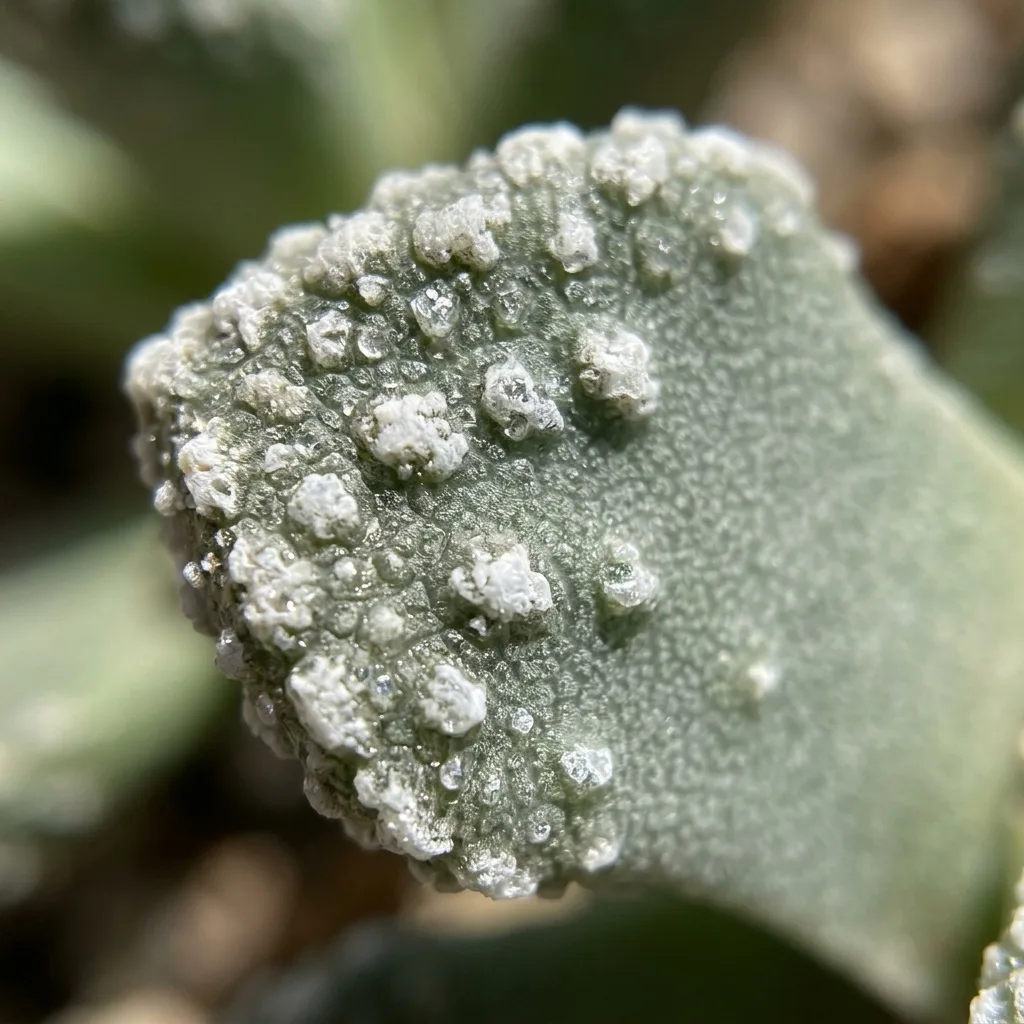
Deep in the heart of South Africa's arid Karoo plateau—sculpted by fierce winds and enriched with dense limestone and calcium deposits—hides a genuine geological jewel among the fractured stones: Aloinopsis malherbei, affectionately celebrated among collectors as the Giant Jewel Plant. At first glance, its curved leaf tips resemble miniature, calcified seashells, edged with a glistening crest of white, textured tubercles. This dramatic natural architecture is not merely an aesthetic triumph; it is a brilliant evolutionary fortress forged across millions of years to withstand punishing desert extremes.
Welcoming this delicate marvel into your indoor sunroom or outdoor collection requires a fundamentally different botanical approach than caring for standard foliage succulents. The single most catastrophic error succulent enthusiasts commit is treating it like an opportunistic summer-grower. In reality, Aloinopsis malherbei is an inverted-cycle opportunist: it awakens with the crisp arrival of autumn and cool winter days, retreating into profound dormancy (estivation) when scorching summer heat peaks. While its thick, woody tuberous taproot (caudex) waits quietly anchored beneath the soil matrix, the surface rosettes harness every stray photon of sunlight through their crystallized leaf margins.
Whether you have recently acquired this rare 'living stone' relative or you are frantically trying to decipher why your specimen's foliage has turned uncharacteristically soft, you have arrived at the definitive compendium. As a botanist and greenhouse cultivator, I have distilled the intricate science of CAM cellular hydraulics and rhizosphere gas exchange into practical, foolproof steps you can master right on your windowsill.
1. Botanical Identity and Morphological Traits
A distinguished member of the family Aizoaceae (commonly known as mesembs), Aloinopsis malherbei shares taxonomic kinship with Lithops and Titanopsis, yet it distinguishes itself immediately through its distinctive structural habit. The plant forms compact, stemless rosettes of flattened, spatulate leaves arranged in a fan-like disposition. The defining morphological hallmark is the band of prominent, hard, chalky-white bumps—known botanically as tubercles—crowded along the distal margins. These tubercles act as specialized optical prisms and physical armor, reflecting blistering solar radiation while buffering delicate internal tissue against extreme desiccation.
Below the substrate surface lies the true epicenter of its survival engine. Aloinopsis develops an exceptionally massive, succulent taproot that can dwarf the visible vegetative rosette above. In its native habitat, this subterranean reservoir penetrates deeply into calciferous rocky crevices, caching water reserves and mineral nutrients through prolonged periods of extreme drought. In late winter or early spring, silky, daisy-like blossoms ranging from soft lemon-yellow to rich amber, bronze, or salmon unfurl from the center of the rosettes, converting this rugged desert fortress into a breathtaking floral showpiece.
2. Light Requirements and Indoor Placement
Aloinopsis malherbei is an unabashed sun worshipper. To power its Crassulacean Acid Metabolism (CAM) cycle—wherein stomata open primarily at night to capture carbon dioxide with minimal transpirational water loss—and to preserve its tight, sculptural geometry, this succulent demands a minimum of 5 to 6 hours of strong, unobstructed direct sunlight or very lightly filtered light daily. In inadequate illumination, the plant quickly undergoes severe etiolation: the internodes stretch, the spatulate leaves become elongated and floppy, the iconic white tuberculate edges lose their brilliance, and the compact architectural dignity is permanently compromised.
For indoor growing, prioritize unobstructed southern or southwestern window sills. However, an essential environmental nuance must be observed: while the plant relishes intense winter sunshine and brisk spring light, it requires strategic shelter during scorching midsummer heatwaves exceeding 32°C (90°F). During high summer estivation, its photosynthetic machinery powers down; leaving dormant rosettes exposed to blazing midday ultraviolet rays behind untreated glass panes can induce irreversible photo-oxidation and cell blanching. During July and August, transition your plant into bright, indirect light accompanied by excellent, continuous ambient ventilation.
3. Watering Protocol: The 'Soak and Dry' Discipline
The swiftest route to destroying an Aloinopsis is administering frequent sips of water in the name of 'routine care.' In the succulent realm, excessive hydration is not an act of kindness—it is a suffocating death sentence that deprives root hairs of life-giving oxygen. The massive underground tuber and dense leaf parenchyma function as hyper-efficient hydraulic reservoirs. Consequently, your watering regime must strictly mirror physiological cues and soil dryness rather than calendar dates.
The foundational protocol is the tried-and-true 'Soak and Dry' method. When the plant is in active growth and calls for moisture, saturate the pot thoroughly until water flows abundantly from every bottom drainage hole; then, do not reach for the watering can again until the substrate has completely, thoroughly dried all the way to the base of the container. Watch for morphological indicators: when the outermost baseline leaves begin to deflate slightly, soften, and show delicate longitudinal wrinkles, the cell vacuoles have depleted their water stores and the plant is receptive to a drink. If the leaves remain rock-hard, firm, and fully pressurized, leave your watering can on the shelf!
4. Ideal Soil Mix and Pot Selection
The sensitive root system of Aloinopsis malherbei cannot tolerate standard potting soil, garden loam, or peat-dense commercial succulent blends. To safeguard the subterranean vascular tissues from pathogenic root rot, the potting substrate must possess immediate hydraulic conductivity, coarse particle stability, and rapid aeration. Your blend must be formulated with at least 75% to 80% inorganic, porous minerals by volume.
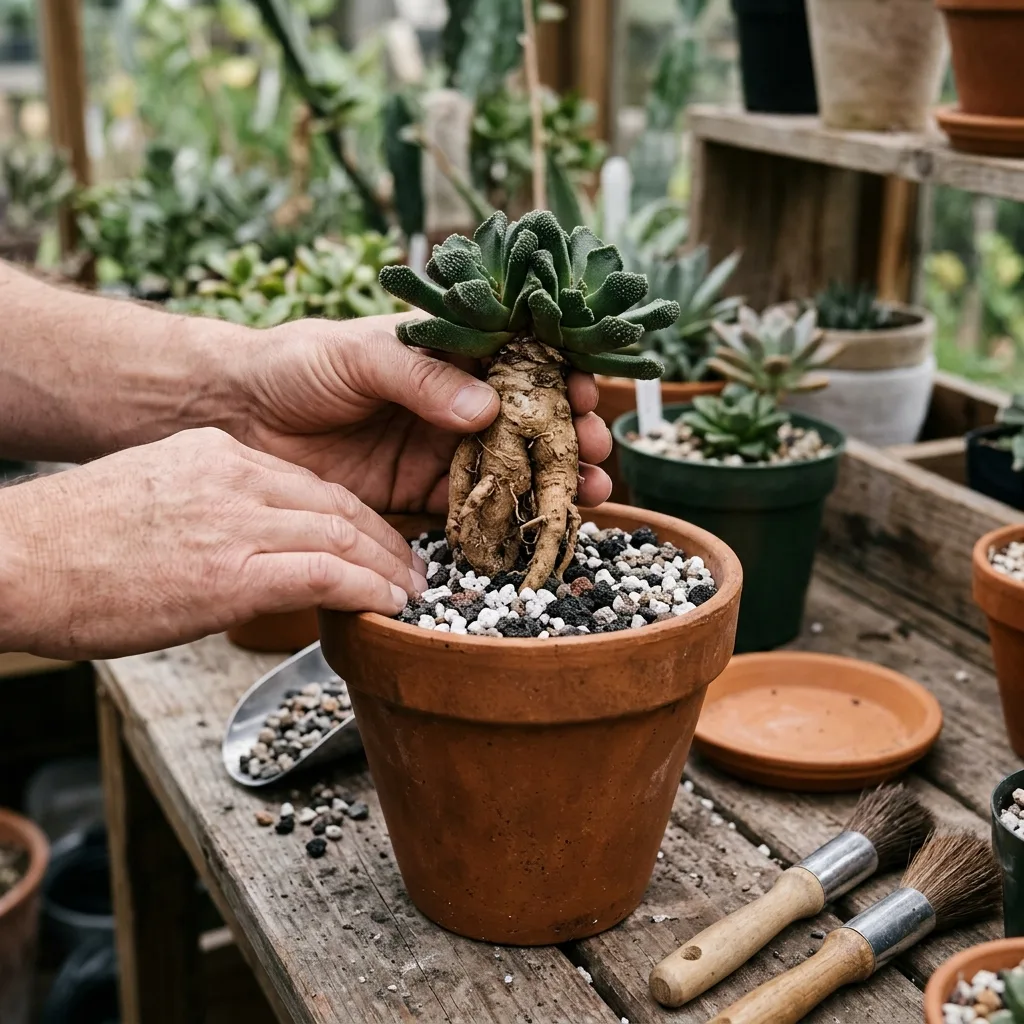
When choosing a container, observe two golden rules: Depth and Material. While the rosette above ground may measure only a few inches across, the vertical taproot requires adequate vertical clearance; shallow bonsai dishes or wide succulent pans will quickly crimp and rot the caudex. Opt for deep, tapered containers. Unfinished, unglazed porous terracotta pots remain the absolute gold standard, as their breathable clay walls allow moisture to evaporate laterally, accelerating critical root zone drying.
| Substrate Component | Ratio (%) | Botanical Function |
|---|---|---|
| Pumice (3-5 mm grade) | 40% | Maximum root aeration, internal microporosity, and root rot prevention |
| Lava Rock / Zeolite | 25% | Stable mineral release, structure preservation, and substrate compaction prevention |
| Coarse Quartz / Horticultural Grit | 15% | Replicates native sandy Karoo limestone gravel matrices |
| Screened Coir or Organic Cactus Peat | 20% | Minimal organic binder for essential cation-exchange capacity and nutrient uptake |
5. Step-by-Step Propagation Techniques
Propagating Aloinopsis malherbei via individual leaf cuttings is virtually impossible; isolated leaves lack the necessary meristematic nodal tissue required to generate an adventitious stem or root system. Successful reproduction is achieved through careful basal crown division of mature clumps or propagation from seed.
- Crown Division: On mature, multi-headed specimens exhibiting distinct lateral offsets, unpot the entire root ball in early autumn at the onset of active growth. With a sterile, surgical scalpel, cleanly sever a side rosette ensuring that an adequate section of the shared, established taproot tissue remains firmly attached to both pieces.
- Callus Formation: Dust the severed wound surfaces immediately with sulfur powder or ground cinnamon to inhibit opportunistic fungal spores. Set the divided plant parts in a warm, dry, shaded location with gentle air circulation for 3 to 5 days, allowing the wounded vascular tissue to form a tough, impenetrable callus.
- Dry Potting & Acclimation: Plant the callused division directly into the ultra-mineral substrate blend described above. Keep the potting medium completely bone-dry for the first 7 to 10 days to allow micro-tears on fine roots to heal. After day 10, initiate light perimeter watering to trigger active root emergence.
- Growing from Seed: Sow fresh seeds in autumn or early spring across a pre-moistened, sterilized mineral bed. Maintain temperatures between 18°C and 22°C (64°-72°F) under a bright, high-humidity humidity dome. Germination typically takes place in 10 to 20 days. Once seedlings emerge, ventilate promptly to avert damping-off fungus.
6. Common Pests, Diseases, and Clinical Remedies
Maintained in high-porosity mineral substrate under generous light, Aloinopsis malherbei exhibits remarkable pest and disease resistance. Nonetheless, common indoor pitfalls must be vigilantly monitored:
- Tuberous Caudex & Crown Rot (Pythium / Phytophthora): The catastrophic aftermath of chronic overwatering or inadequate ventilation. Leaves turn translucent, develop a jelly-like texture, and detach under the slightest touch. Emergency intervention: Unpot the plant immediately, amputate all discolored or mushy caudex tissue with a flame-sterilized blade until only pristine white, firm vascular tissue remains, dust the cut surface with activated charcoal, air-dry bare-root for 7 days, and replant into completely dry pure pumice.
- Mealybugs (Pseudococcidae): These pervasive sap-suckers nestle tightly between the crowded leaf bases and deep within the protected root collar. Spot-treat white, cottony colonies using a cotton swab dipped in 70% isopropyl alcohol. For extensive infestations throughout the root system, drench the roots during the active autumn cycle with a systemic insecticide like imidacloprid.
- Spider Mites: Proliferate in hot, dry, stale indoor air, causing silvery stippling and micro-webbing between rosette centers. Enhance ambient air currents with a small circulation fan and administer light, targeted applications of diluted horticultural soap or cold-pressed neem oil emulsion during evening hours.
7. Seasonal Care Calendar & Botanical Strategy
Thriving long-term with Aloinopsis malherbei relies upon synchronizing your care practices with its inverted Southern Hemisphere phenology:
- Autumn (September - November): The awakening season. As nighttime temperatures begin to drop into the 12°C–18°C (54°–64°F) range, steadily increase watering frequency. Provide prime sunny exposure. Supplement once per month with a low-nitrogen, high-potassium liquid succulent fertilizer diluted to quarter-strength.
- Winter (December - February): Prime active growth and bud initiation. Maximize direct light exposure. Protect the plant from wet freezes, keeping ambient temperatures above 5°C (41°F) for potted specimens (established plants can endure brief dry dips down to 0°C / 32°F). Water deeply whenever the substrate dries completely and outer leaves lose turgor.
- Spring (March - May): Floral display and growth wind-down. Enjoy the radiant blooms and remove spent flower stems to prevent fungal rot. As ambient temperatures consistently climb above 25°C (77°F), progressively extend intervals between waterings.
- Summer (June - August): Peak estivation (dormancy). Growth halts, leaves become tightly compressed, and inner reserves are conserved. Pull back from harsh, scorching noon sun into a well-ventilated, bright partially shaded environment. Withhold routine water; provide only an occasional modest nighttime perimeter splash once a month to prevent root dieback.


Reader Reviews & Comments 3 Reviews
Clara Higgins
Julian Vance
Marcus Sterling
Leave a Review & Rating
Share your plant care tips, experiences, or questions with our succulent community.