






Hailing from the sheer limestone cliffs and arid canyon ridges of Mexico to our indoor windowsills, Pachyphytum succulents capture nature’s sculptural grace with unmatched, porcelain-like smoothness. Affectionately known as 'Moonstones' or 'Jeweled Succulents,' this genus is celebrated among collectors for its astonishingly plump, pebble-shaped leaves. Yet this captivating fullness comes with a catch: without well-aerated roots and disciplined watering, that plush tissue can rapidly succumb to fatal root rot.
Frequent watering is never an expression of love for succulents; rather, it suffocates delicate root systems by stripping them of oxygen. Pachyphytum species have evolved such sophisticated cellular water storage that they weather prolonged droughts as if shielded by living armor. In this guide, we will delve into replicating Mexico’s rugged microclimate right on your windowsill, ensuring your moonstones thrive in tight, vibrant clusters without losing their sculptural silhouette.
1. Botanical Biology and Physiological Foundations
Belonging to the Crassulaceae family, the genus Pachyphytum earns its name directly from the ancient Greek words for 'thick plant.' At the core of their survival strategy is Crassulacean Acid Metabolism (CAM) photosynthesis. To prevent catastrophic water loss under scorching daytime heat, these plants seal their stomata tightly throughout the day. Only under the cool relief of night do the pores open to absorb and store carbon dioxide. This nocturnal gas exchange scientifically explains why watering during hot daylight hours disrupts their delicate osmotic balance and transpirational rhythm.
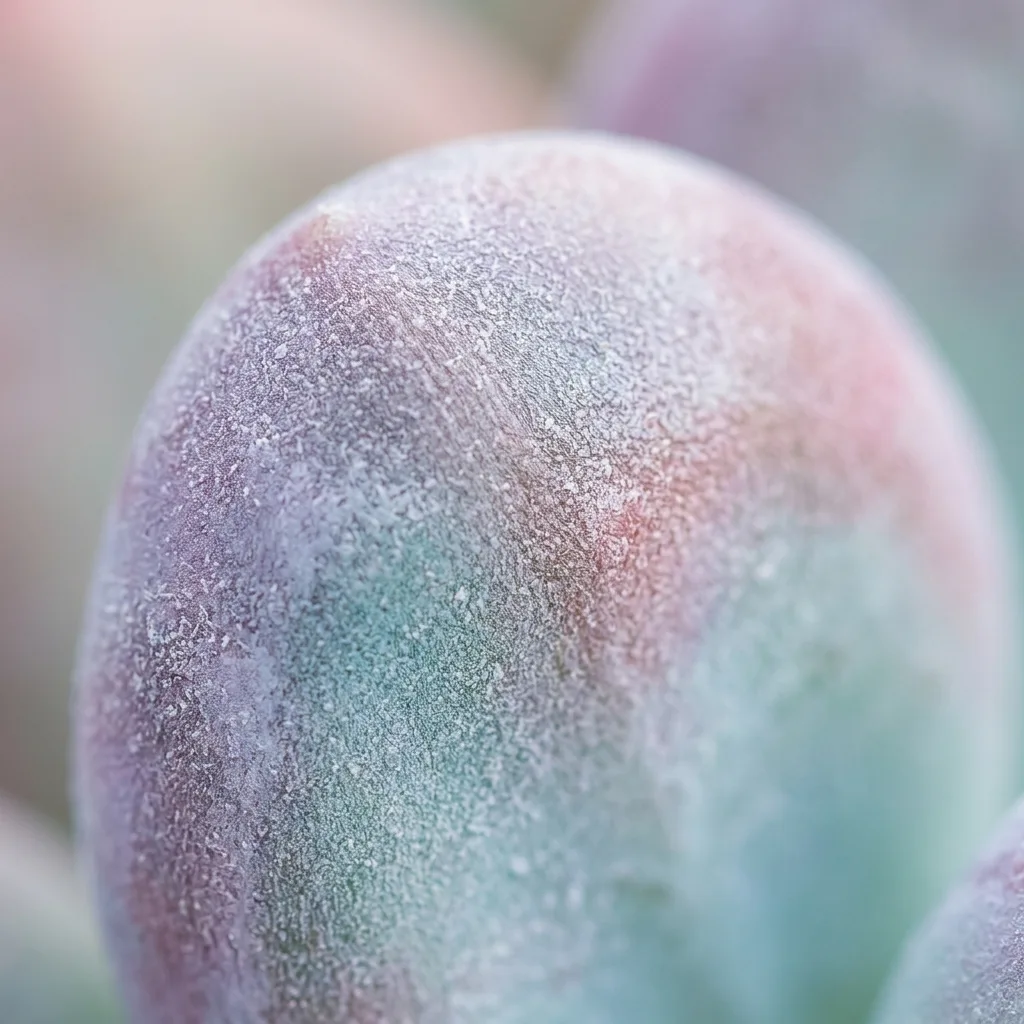
The matte, powdery silver-blue coating dusting each leaf is far more than mere ornamental powder; botanically, it is known as farina (an epicuticular wax layer). This powdery silver farina acts as your plant's self-made sunscreen—never wipe it away or leave bare fingerprint smudges. This crystalline wax reflects harsh ultraviolet radiation to shield sensitive interior mesophyll cells from cellular scorch while minimizing cutaneous moisture loss. Once rubbed away through rough handling or overhead moisture, the farina will never regenerate on that specific leaf; the plant can only synthesize it anew on fresh, emerging growth.
2. Accurate Diagnosis and Signs of Distress
Maintaining pristine form and preventing irreversible tissue damage requires an attentive eye for visual and tactile signals:
- Loss of Turgor Pressure and Wrinkling: When a gentle squeeze of the lowest leaves reveals a soft, pliable feel accompanied by fine horizontal wrinkles, the mesophyll cells have depleted their internal reservoir. This subtle deflated texture is the only dependable biological indicator that it is time to irrigate.
- Etiolation (Stretching from Light Starvation): A loosening rosette, widening gaps between consecutive leaf nodes, and a stem visibly craning toward ambient light demonstrate a deficit in usable photon flux. A flourishing Pachyphytum must always display tightly overlapping, chubby, marble-like leaves stacked in a compact globose mound.
- Translucency and Jelly Texture: Lower leaves shifting to a glassy, pale yellowish, waterlogged consistency signal that cell walls have ruptured under excessive osmotic uptake (cellular lysis). Anaerobic rot has already taken hold within the substrate.
- Farina Dissolution and Dullness: Accidental overhead misting or contact with chemical pesticides dissolves the delicate epicuticular wax. Stripped of this barrier, the exposed leaf is immediately vulnerable to sunburn lesions and opportunistic fungal pathogens.
3. Step-by-Step Cultivation Protocol
Pachyphytum roots are naturally shallow yet extraordinarily sensitive to stagnant moisture and poor gas exchange. Adhere strictly to this protocol to sustain compact form and robust health:
- Select the Right Container: Always choose an unglazed terracotta clay pot equipped with generous drainage holes. Plastic and glazed ceramic vessels trap residual moisture against the root ball, impeding the vital gas exchange Pachyphytum roots demand.
- Build an Inorganic-Dominant Substrate: Standard potting soil or straight peat moss is lethal to this genus. Formulate a gritty matrix dominated by porous pumice, volcanic scoria (lava rock), and zeolite, ensuring organic matter does not exceed 15–20% of the total volume.
- Gradual Acclimatization: Never place a newly purchased nursery plant directly under blazing afternoon sun. Begin by offering gentle early morning sun in a filtered location for the first week, systematically transitioning the plant over three weeks until it absorbs at least 5 to 6 hours of bright, direct sunlight daily.
- Root Crown Isolation: Following repotting, topdress the surface around the plant's neck with a 1 cm layer of coarse lava grit or washed river gravel. This inert mulch barrier prevents lower leaves from resting against damp compost during watering, averting fungal crown infections.
- The 'Soak and Dry' Irrigation Method: Water exclusively when the foliage displays subtle deflation. Saturate the pot thoroughly until water flows out freely from the drainage hole, and empty the catch tray completely within 10 minutes. Direct water straight to the soil level, taking care not to wet the tightly packed leaves.
4. Required Equipment, Materials, and Cultivation Metrics
To maximize success in growing specimen-grade Pachyphytum, adhere to the optimal physical and chemical parameters detailed below:
| Component / Parameter | Recommended Standard / Ratio | Physiological Objective |
|---|---|---|
| Inorganic Mineral Fraction | 40% Pumice + 25% Lava Rock + 15% Zeolite | Maximizes root-zone aeration and rapid drainage velocity |
| Organic Fraction | 20% Premium Succulent Peat or Coco Coir | Supplies essential micronutrient exchange and basal root hydration |
| Light Intensity (Photon Flux) | 15,000 – 25,000 Lux (6–8 hours daily) | Maintains compact internodes and promotes dense farina synthesis |
| Container Material | Unglazed Terracotta (Clay) | Accelerates substrate drying via porous sidewall evaporation |
| Watering Frequency | Spring/Autumn: Every 10–14 days; Winter: Every 25–35 days | Prevents root rot and mirrors natural CAM dormancy rhythms |
| Optimal Temperature Range | 16°C – 26°C / 60°F – 79°F (Winter minimum: 5°C / 41°F) | Ensures peak metabolic enzyme efficiency and photosynthetic health |

5. 5 Common Mistakes and Rescue Protocols
- Mistake 1: Touching Leaves and Wiping Away Farina.
Rescue Protocol: The lost wax cannot regenerate on compromised leaves. Move the plant away from harsh midday rays for a few days to prevent tissue scorch, and channel your attention into protecting emerging center growth. - Mistake 2: Sticking to a Fixed Calendar Schedule.
Rescue Protocol: A rigid 'water every Sunday' habit will quickly drown succulents. Always probe the bottom of the pot with a wooden skewer to confirm bone-dry conditions, and wait for subtle signs of leaf deflation before offering water. - Mistake 3: Over-Fertilizing Under Moderate Light.
Rescue Protocol: Nitrogen-heavy fertilizers create weak, bloated, watery cells prone to splitting and pathogen entry. Apply only a low-nitrogen, high-potassium cactus fertilizer diluted to quarter-strength during active spring growth. - Mistake 4: Planting in Drainage-Free Glass Terrariums.
Rescue Protocol: Pachyphytum species will rapidly deteriorate in stagnant glass enclosures. Unpot the plant immediately, trim any waterlogged or necrotic roots, allow the root system to air-dry in the shade for 48 hours, and repot into breathable terracotta. - Mistake 5: Overlooking Basal Stem Rot Until It Spreads.
Rescue Protocol: If the lower stem darkens and softens, surgical beheading is the only remedy. Using a sterilized blade, slice through the stem at least 1 cm above any discolored vascular tissue. Dust the clean cut with sulfur powder or ground cinnamon, allow a protective callus to form over 5 days, and reroot on dry pumice.
6. Seasonal Rhythm and Long-Term Expectations
Pachyphytum species experience their most energetic flushes of vegetative growth during the mild temperatures of spring and autumn. During peak summer heat—especially when ambient temperatures exceed 32°C (90°F)—the plant enters a protective semi-dormancy (estivation) to conserve water. Hydration uptake slows down considerably during this window, making it imperative to reduce watering frequency. In winter, safeguard your plant from freezing drafts and provide a cool, brightly illuminated resting spot between 5°C and 10°C (41°F–50°F).
With thoughtful cultivation, your moonstones will develop dense clusters of plump rosettes over 1 to 2 years, shifting from soft chalky white to shades of lilac, lavender, and muted coral-pink under bright light. Come spring, graceful inflorescences will rise from between the fleshy leaves, bearing delicate bell-shaped blossoms tipped with deep red petals—the ultimate horticultural reward for your patience and care.


Reader Reviews & Comments 3 Reviews
Eleanor Vance
Marcus Thorne
Clara Higgins
Leave a Review & Rating
Share your plant care tips, experiences, or questions with our succulent community.