






Along the arid coastal ridges of Chile's Pacific shoreline lies the Atacama Desert, widely regarded as one of the most formidable biotopes on our planet. In rocky fissures where rain may not fall for consecutive years, an ancient silhouette emerges: Copiapoa. This extraordinary genus stands as living testament to how nature crafts magnificent resilience out of extreme scarcity. Surviving in a geography where measurable precipitation is virtually zero, Copiapoas owe their persistence to dense morning sea fogs (known locally as the Camanchaca) and the profound water reserves stored within their massive, tuberous taproots.
When we decide to cultivate a Copiapoa in our homes or greenhouses, we are not simply potting up an ornamental succulent; we are inviting millions of years of extreme hyper-arid evolution into our living spaces. The most tragic misstep in caring for these plants is treating them like standard houseplants or conventional succulents. Frequent watering is never an expression of affection; it suffocates the root zone by stripping away vital oxygen. Respecting the cellular rhythm of a Copiapoa requires understanding its innate mineral substrate demands, its unquenchable thirst for unfiltered solar radiation, and its fundamental biological need for completely dry roots between waterings.
1. Botanical Biology and Physiological Foundations
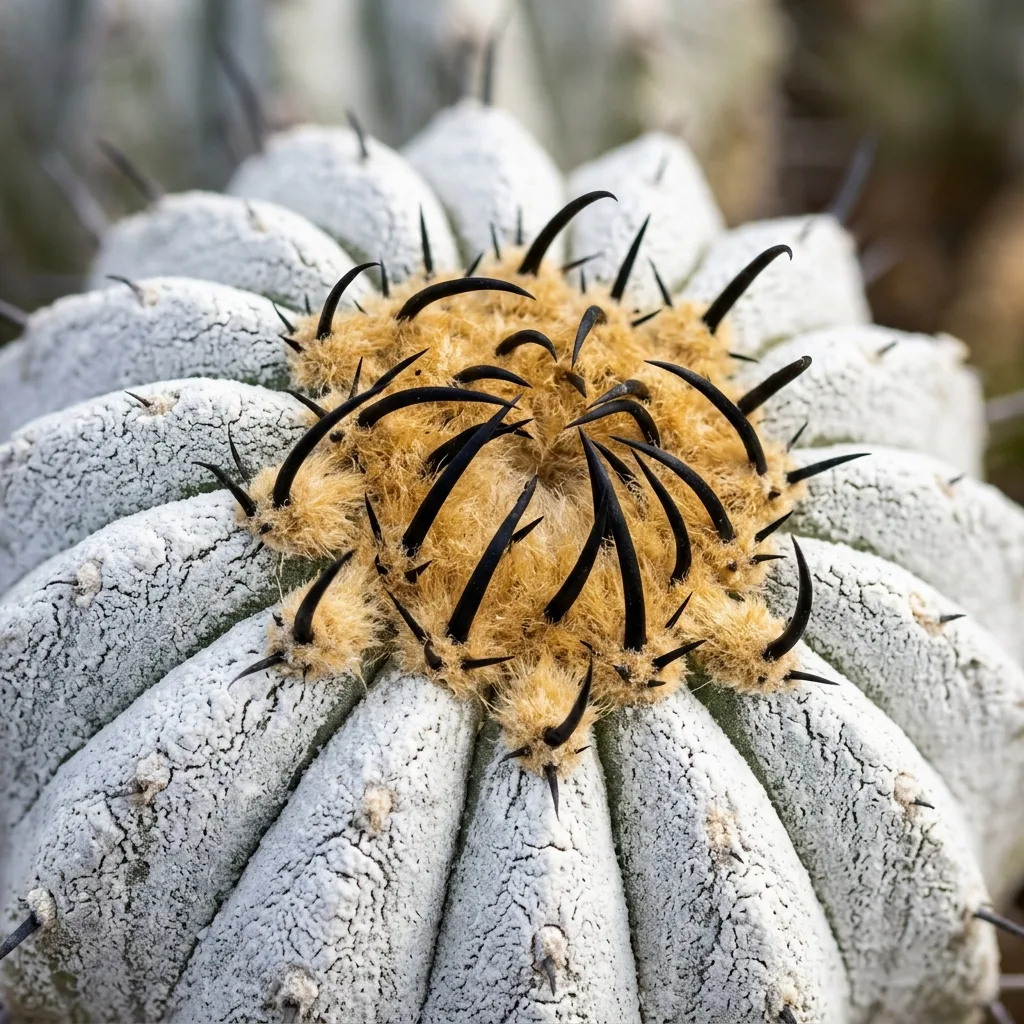
The physiological architecture of the genus Copiapoa is entirely engineered around two imperatives: extreme moisture conservation and radiation defense. The body is enveloped by a thick, waxy cuticle, and in several iconic species (most notably Copiapoa cinerea), an extraordinary chalky white epicuticular wax (farina) acts as a physical mirror reflecting harsh ultraviolet radiation. This powdery, silver farina is the plant's self-synthesized sunscreen; never wipe it away or handle the epidermis carelessly, as removing this protective shield leaves the delicate epidermal cells exposed to severe photo-oxidation, sunburn, and irreversible tissue necrosis.
Metabolically, these cacti carry out Crassulacean Acid Metabolism (CAM) in its strictest operational form. Throughout the blistering daytime, stomata remain hermetically sealed to eliminate transpirational water loss. Only during the cool desert night do these microscopic pores open, capturing carbon dioxide and sequestering it within cellular vacuoles as malic acid. Beneath the surface, the root system exhibits two specialized adaptations: a superficial network of fine feeder roots designed to quickly absorb moisture from morning condensation, and a massive, fleshy, tuberous taproot that serves as the primary reservoir for water and starch. In dense, moisture-retentive, organic-heavy commercial potting soils, this taproot quickly suffers from cellular hypoxia (oxygen starvation) and falls victim to devastating crown and root rot pathogens, particularly Phytophthora and Fusarium. Uninterrupted gas exchange and rapid substrate dry-down are the immutable laws of Copiapoa cultivation.
2. Diagnostics and Morphological Stress Indicators
Learning to read the subtle morphological signals of a Copiapoa is the only foolproof way to avoid irreversible plant loss. Your specimen will communicate its physiological state through distinct micro-reactions:
- Light Starvation (Etiolation): The apex narrows into a conical shape, the ribs lose their tightly compressed structure, new growth turns pale yellowish-green, and spine development becomes sparse and weak. The loss of its naturally depressed, globose architecture signals cellular weakening and excessive elongation.
- Substrate Hypoxia and Overwatering (Root Suffocation): Yellowing, browning, and softening at the base of the stem. When touched gently, the epidermis feels squishy like a water balloon—an unmistakable sign that the vascular xylem vessels of the taproot have collapsed from systemic fungal decay.
- Chronic Dehydration: The epidermis turns dull, the intercostal rib spaces deepen dramatically, and the entire plant contracts, pulling itself downward toward or beneath the soil line. If observed during active spring or autumn growth, this indicates the plant is ready for a controlled, thorough bottom-watering.
- Solar Shock (Photo-oxidation): Sudden exposure to intense, unshaded outdoor sun without prior acclimation results in bleached white, yellow, or bronze necrotic patches across the exposed epidermis.
3. Step-by-Step Cultivation Protocol
To cultivate Copiapoa species with their signature compact, globose architecture, heavy farina, and intense, jet-black spines, follow this precise operational protocol:
- Container Selection: Avoid shallow succulent bowls. Choose deep, breathable unglazed terracotta or high-fired ceramic containers equipped with generous drainage holes. The taproot requires ample vertical depth to extend straight down without cramping or bending.
- Basal Drainage Foundation: Cover the bottom of the pot with a 2–3 cm layer of coarse pumice or crushed volcanic scoria. Place a small mesh screen over the drainage hole to prevent fine mineral particles from washing out.
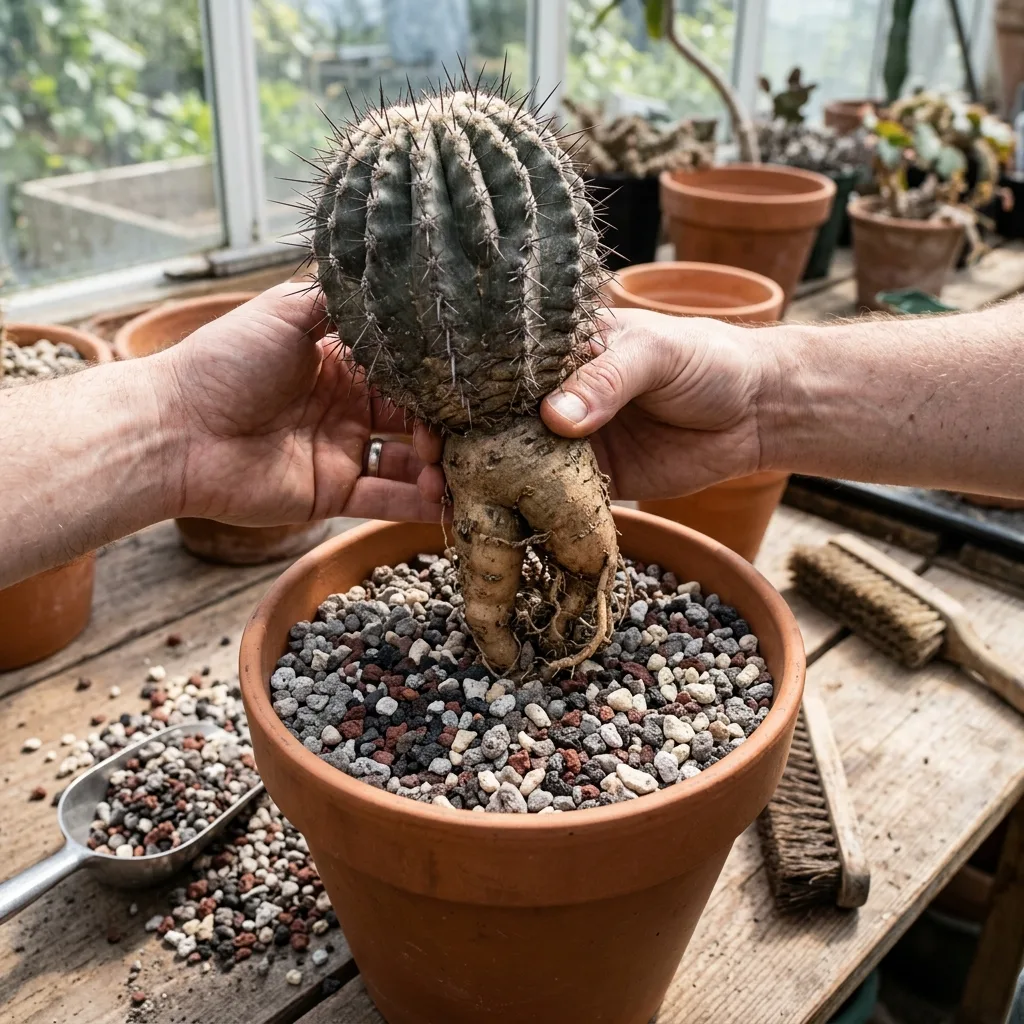
- Substrate Installation: Fill the pot halfway with an almost exclusively inorganic mineral blend. Suspend the Copiapoa's taproot centrally and vertically, taking care not to fold or damage the delicate root tips. Sift the mineral mix gently around the root network, tapping the sides of the pot to eliminate hidden air pockets.
- Crown Collar Protection: The subterranean transition zone where the stem meets the taproot is hypersensitive to trapped moisture. Never bury this collar in organic material. Instead, top-dress the upper 1–2 cm with coarse volcanic lava grit or zeolite granules to ensure lightning-fast drying around the crown.
- Quarantine and Withholding Water: Immediately following repotting, keep the cactus completely dry in a bright, shaded, well-ventilated spot for at least 10 to 14 days. This mandatory dry rest period allows micro-fissures on the root system to fully suberize and develop protective wound callus before any moisture is introduced.
4. Substrate Blueprint, Materials, and Cultivation Metrics
Peat-heavy commercial soil is fatal to Copiapoa roots. The following predominantly inorganic mineral formulation accurately replicates the hyper-arid, decomposed granitic and rhyolitic soil profiles found throughout the Atacama Desert:
| Component / Parameter | Recommended Proportion | Physiological Function |
|---|---|---|
| Coarse Horticultural Pumice (3–6 mm) | 40% | Internal micro-porosity guarantees optimal root zone aeration and prevents fungal stagnation. |
| Crushed Volcanic Scoria (2–5 mm) | 25% | Heavy, sharp-edged mineral grit that provides structural ballast, drainage, and iron/trace minerals. |
| Clinoptilolite Zeolite (2–4 mm) | 15% | Enhances cation-exchange capacity (CEC), buffers excess salts, and regulates moisture release. |
| Coarse Silica / River Sand (Washed, Lime-Free) | 10% | Stabilizes substrate density, mimics natural sediment, and prevents root compaction. |
| Fine Horticultural Sifted Compost or Coco Coir | 10% (Maximum) | Provides a trace organic anchor for micronutrient uptake; never exceed this threshold. |
| Substrate pH | 6.0 – 6.8 | Slightly acidic to near-neutral environment maximizes trace mineral bioavailability. |
| Light Intensity Benchmark | 25,000 – 45,000 Lux | Triggers dense, protective farina synthesis and robust, black spine formation. |
5. 5 Common Pitfalls and Emergency Rescues
- Mistake 1: Relying on Pre-Bagged Commercial Cactus Soil: Peat becomes hydrophobic when dry, but once saturated, it stays soggy for weeks, suffocating the roots. Rescue: Immediately unpot the cactus, gently wash away all organic residue from the taproot with lukewarm water, allow the roots to dry in a shaded, warm room for 5 days, and replant in a 90% mineral substrate.
- Mistake 2: Winter Watering at Normal Room Temperature: Warm, indoor winter watering without intense summer sun forces weak, deformed, etiolated tissue that easily rots. Rescue: Cease watering entirely from November through March. Relocate the plant to a cool (8–12°C / 46–54°F), exceptionally bright sunroom or south-facing windowsill.
- Mistake 3: Excessive Fertilization Under Moderate Light: High-nitrogen fertilizers cause the cells of slow-growing Copiapoas to swell rapidly and burst, leaving deep epidermal fissures. Rescue: Only fertilize during the active spring surge using a low-nitrogen, high-phosphorus/potassium formula diluted to one-quarter (1/4) strength, applying it no more than once or twice a year.
- Mistake 4: Stagnant, Enclosed Air: Copiapoas thrive on oceanic coastal breezes; stagnant air creates an ideal breeding ground for root and woolly mealybugs (Pseudococcidae). Rescue: Introduce a small circulating fan to create consistent, gentle air movement. Manually remove visible pests with cotton swabs dipped in 70% isopropyl alcohol.
- Mistake 5: Touching and Damaging the Epicuticular Farina: Physical handling wipes away the irreplaceable white waxy layer, exposing the plant to solar burns. Rescue: Handle plants using soft foam strips or cushioned silicone tweezers during repotting, avoiding direct hand contact with the epidermal ribs.
6. Seasonal Phenology and Long-Term Results
Cultivating Copiapoa is an exercise in mindful patience. Expanding by only a few millimeters per year, these resilient botanical jewels thrive best when their biological calendar aligns with natural climatic shifts:
Spring (March – May): The awakening phase. Once ambient temperatures reliably surpass 18–20°C (64–68°F), introduce the first controlled watering or nighttime misting. Fresh, glistening black spines will begin to emerge from the apical wool at the crown.
Summer (June – August): During prolonged heatwaves (above 35°C / 95°F), Copiapoas frequently enter estivation (summer dormancy) to conserve moisture, slowing down active water uptake. Restrict watering to cool summer evenings, only when the pot is bone-dry, and maintain maximum ventilation around the clock.
Autumn (September – October): The second active growth window. As solar angles soften, the plant undergoes a secondary growth cycle before winter. Taper watering significantly as October comes to a close.
Winter (November – February): Absolute dormancy. Maintain cool temperatures around 8–12°C (46–54°F), completely withhold water, and maximize direct winter sunlight. This cool, dry resting period concentrates the cellular sap, preventing winter stretch and initiating the formation of delicate, silky yellow flowers from the crown areoles come spring.


Reader Reviews & Comments 4 Reviews
Julian Vance
Clara Davenport
Markus Thorne
Elena Rostova
Leave a Review & Rating
Share your plant care tips, experiences, or questions with our succulent community.