






On the captivating botanical journey that brings succulents from Mexico's sun-drenched limestone hillsides right onto our brightest indoor windowsills, nothing shatters a grower's peace quite like a tiny speck of white fluff. While savoring your morning coffee and admiring the crown jewel of your collection—be it the geometric rosette of an Echeveria, a trailing Burro's Tail (Sedum morganianum), or the spines of a pincushion cactus (Mammillaria)—that seemingly harmless powdery speck nestled in the stem or areole is rarely just household dust. It is the unmistakable calling card of mealybugs (family Pseudococcidae), among the most persistent and insidious pests in the botanical realm, fully capable of collapsing cellular water reserves in mere days.
The precious sap stored within succulent parenchymal tissues enables these wonders of the plant kingdom to endure prolonged arid droughts; unfortunately, it also makes them an irresistible banquet for parasitic piercing-sucking insects. Just as your succulents produce a delicate, silvery layer of protective epicuticular wax (farina) to reflect searing radiation, mealybugs secrete a hydrophobic, powdery wax coating that renders standard water rinses and mild insecticidal sprays utterly useless. Do not despair: armed with the patience of a passionate nurseryman and the precise intervention protocols of botanical science, eradicating this infestation right down to the root tips is well within your grasp.
1. Taxonomic Identity, Areole Architecture, and Spine Morphology
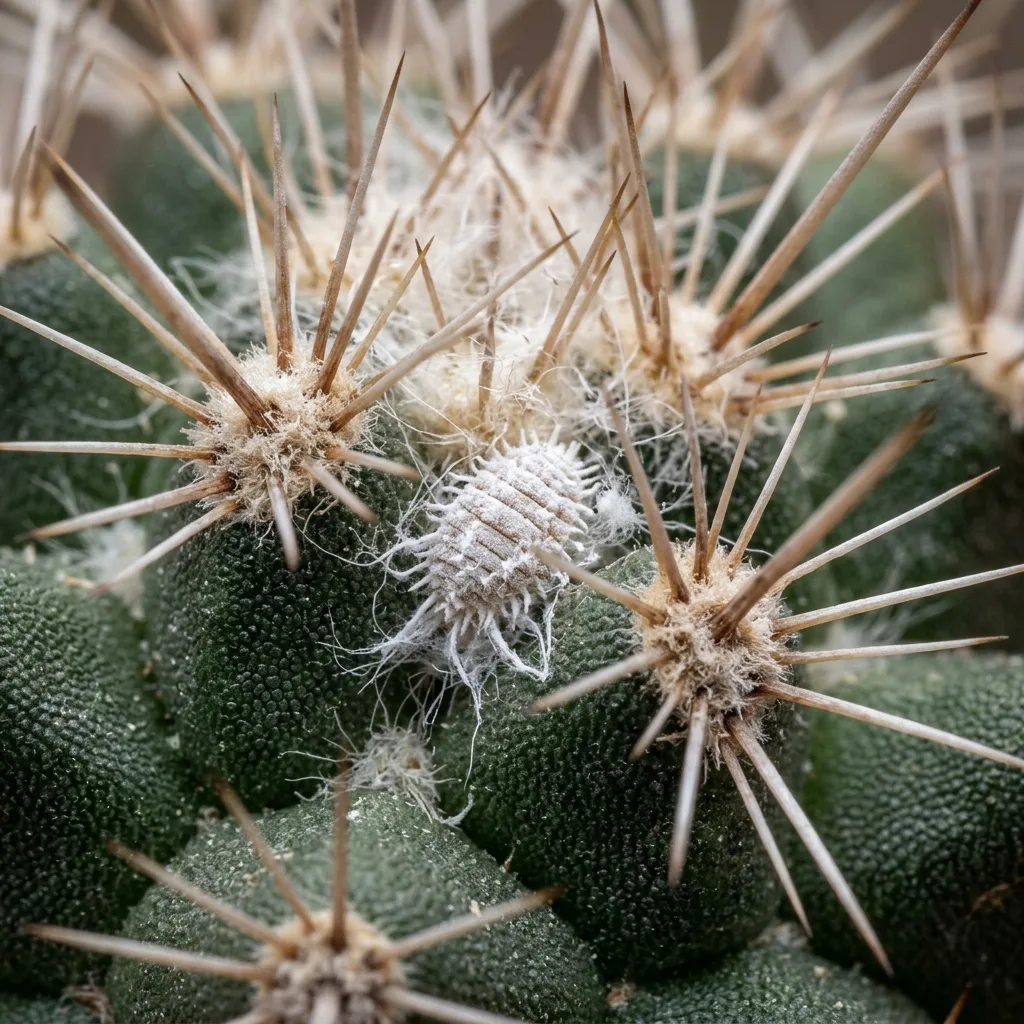
Commonly referred to as 'mealybugs' and classified within the taxonomic family Pseudococcidae, these diminutive insects are phytophagous members of the order Hemiptera (true bugs). Within arid plant collections, the two primary culprits are the citrus mealybug (Planococcus citri), which attacks aerial tissues, and subterranean root mealybugs (Rhizoecus spp.), which wage covert war beneath the substrate surface. Adult females are wingless, oval-bodied creatures that continuously exude white, hydrocarbon-based filament clusters to insulate themselves against desiccation. What appears to the naked eye as harmless 'cotton' is, in reality, a protective ootheca (egg sac) sheltering hundreds of developing embryos.
In cactus anatomy, areoles represent highly reduced, modified lateral vegetative buds. These specialized micro-cavities—from which spines, floral buds, and trichomes (cacti hairs) emerge—offer ideal tactical shelter for mealybug colonies. In species characterized by dense, silvery-white pilosity such as the Old Man Cactus (Cephalocereus senilis) or the Powder Puff Cactus (Mammillaria bocasana), pest secretions blend seamlessly with the plant's own structural trichomes. Utilizing needle-like piercing-sucking stylets, they penetrate the phloem tissue, draining essential photoassimilates and derailing internal hydrostatic pressure.
2. Light Requirements, Solar Intensity, and Ventilation Standards
Mealybug outbreaks rarely occur in a vacuum; they almost universally take hold in microclimates where host plants are physiologically compromised. When succulents receive insufficient Photosynthetically Active Radiation (PAR), cellular walls lose structural rigidity, turgor pressure drops, and the epidermal cuticle thins significantly. Etiolated plant tissues—stretched, pale, and desperate for light—present minimal mechanical resistance, making them exceptionally easy targets for stylet insertion.
Stagnant, unventilated air creates warm, sheltered pockets where mealybugs thrive and multiply unhindered. Cultivate your cacti and succulents in microclimates enjoying 6 to 8 hours of bright, indirect to direct sunlight daily, paired with continuous passive air circulation. Positioning a small oscillating fan near crowded plant shelves disrupts the static 'boundary layer' of humid air on leaf surfaces, drastically deterring female crawlers from settling and ovipositing.
3. Irrigation Dynamics and the Crucial Dormancy Phase
Overwatering succulents is never an expression of love; it is an effective way to asphyxiate roots and saturate sensitive tissues. Waterlogged plants experience hyper-hydration, causing cell walls to swell and balloon. This engorgement dilutes and enriches internal sap streams, turning stems into an irresistible all-you-can-eat buffet for hemipteran pests. Conversely, severely desiccated plants kept in chronic drought outside their natural rhythms exhaust their metabolic reserves, rendering them unable to synthesize protective secondary metabolites (such as phenols and tannins).
During winter dormancy, when ambient temperatures drop to the 8–12°C (46–54°F) range, irrigation must be dramatically curtailed or paused entirely. However, warm indoor heating paired with dry winter air can transform dormant, dormant areoles into prime overwintering dens for mealybugs. Even when your watering cans are retired for the season, conduct weekly, meticulous checks of stem axils, leaf undersides, and apical growth using an LED jeweler's loupe.
4. High-Mineral Substrates and Container Remediation
The most devastating frontline in the war against mealybugs lies subterranean. The root mealybug (Rhizoecus cacticans) establishes dense colonies along the root zone, encasing delicate feeder roots in chalky, powdery white wax secretions. Dense, peat-heavy, and organic potting soils provide the perfect damp, friable labyrinth for these pests to reproduce unseen. Conversely, a porous, gritty, predominantly mineral substrate accelerates dry-out times and physically restricts pest locomotion.
| Substrate Component | Ratio (%) | Botanical Function & Root Defense |
|---|---|---|
| Pumice (3–6 mm) | 40% | Promotes structural aeration, prevents water retention, and blocks mealybug burrowing pathways. |
| Lava Rock (Scoria) | 25% | Heavy, sharp volcanic mineral that stabilizes roots and creates an abrasive environment for pests. |
| Zeolite (Clinoptilolite) | 15% | Enhances Cation Exchange Capacity (CEC), buffers harmful toxins, and provides natural antifungal support. |
| Coarse Horticultural Grit / River Sand | 10% | Creates immediate drainage conduits, eliminating moisture stagnation around the sensitive root flare. |
| Screened, Sterile Low-Peat Humus | 10% | Delivers minimal organic nutrients (must be heat-sterilized to prevent introducing dormant root aphids/pests). |
5. Blooming Energy Demands and Balanced Nutrition
The ultimate reward of an unburdened succulent collection is a breathtaking burst of blooms. However, the formation of floral scapes coincides with peak pest vulnerability. Mealybugs possess a keen affinity for tender meristematic zones and carbohydrate-rich floral nectaries, frequently swarming emerging buds before petals can unfurl, causing premature bud abortion.
During active growth, strictly avoid high-nitrogen synthetic fertilizers. Excess nitrogen fosters excessively rapid, tender, and hydric cellular growth with weak cell walls—a welcome invitation for feeding pests. Instead, opt for low-nitrogen, high-phosphorus, and high-potassium formulations supplemented with bioavailable silica. This fortifies cellular pectin matrices, creating a physical barrier against mechanical stylet penetration.
6. Propagation Sanitation, Pruning, and Curative Treatment Protocols
Taking stem cuttings or leaf pulls from a compromised mother plant is the quickest route to spreading an infestation across an entire collection. Never propagate from a specimen until it has been declared completely clean. If an irreplaceable mature plant suffers a catastrophic, irreversible systemic infestation, saving clean apical tissue via surgical decapitation is your best salvage strategy.
Step-by-Step Eradication and Treatment Protocol:
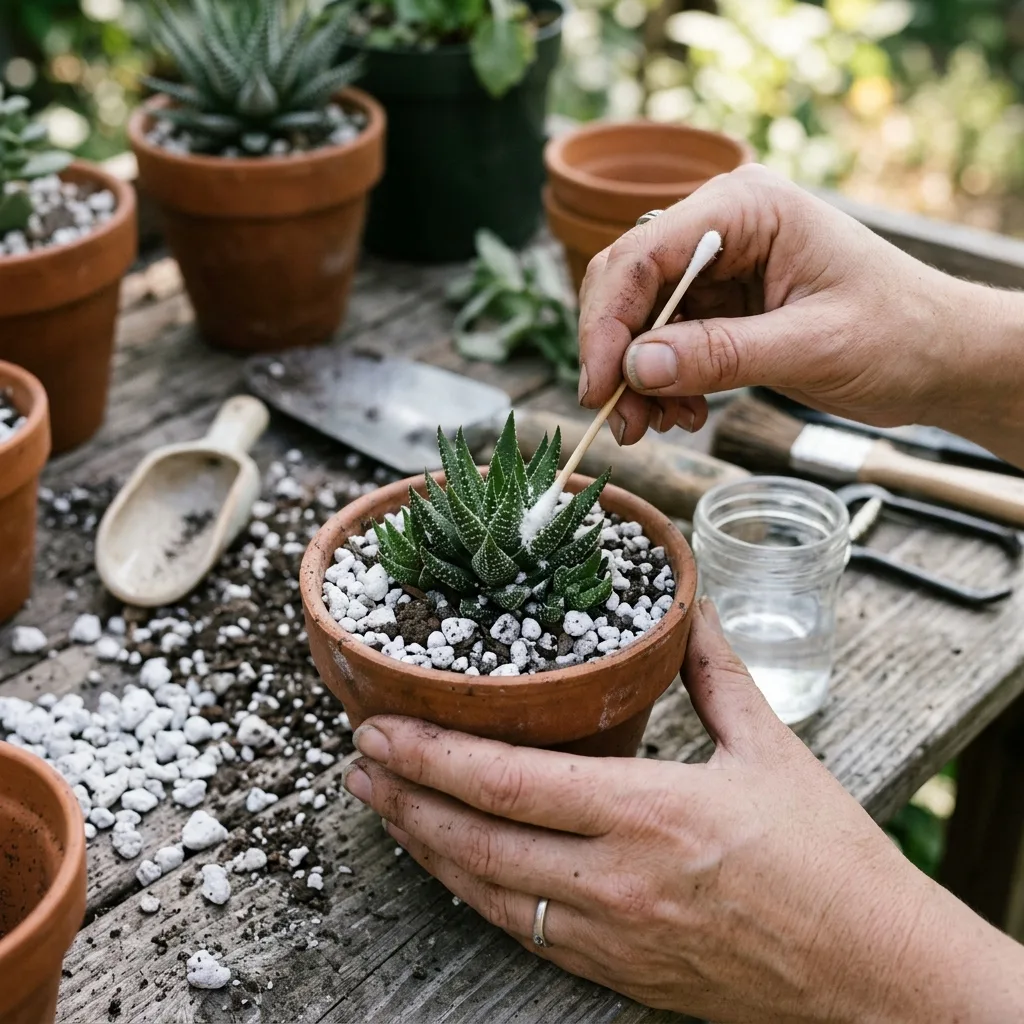
- Strict Quarantine & Spot Eradication: Relocate the infested plant at least 3 meters (10 feet) away from other succulents. Saturate a cotton swab with 70% isopropyl alcohol and directly touch every visible mealybug and egg sac. The alcohol dissolves their hydrophobic wax on contact, instantly dehydrating and neutralizing the insect.
- Organic Emulsified Botanical Wash: Blend 1 teaspoon of pure potassium horticultural soap (or castile soap) and 1 teaspoon of cold-pressed neem oil into 1 liter of lukewarm, settled water. Agitate thoroughly into an emulsion and mist the entire plant thoroughly at dusk, ensuring the spray penetrates every deep areole and stem crevice.
- Systemic Chemical Control (Severe Outbreaks): When colonies have infiltrated deep crevices beyond the reach of contact sprays, apply a systemic insecticide (such as one with Acetamiprid or Imidacloprid) as a root drench. As the active agent is taken up into the vascular system, feeding pests perish upon ingesting the sap. Repeat treatments every 7 to 10 days over 3 full cycles to break the hatching cycle of newly emerged crawlers.
7. Mitigating Post-Infestation Rot and Fungal Pathology
The mechanical damage inflicted by mealybugs is only half the battle. As these insects digest phloem sap, they excrete a sticky, carbohydrate-rich liquid known as honeydew. This sugary film provides an ideal growth medium for opportunistic fungal pathogens, notably Sooty Mold (Fumago/Capnodium spp.), which manifests as an unsightly, charcoal-black velvety layer over the epidermis.
While sooty mold does not directly consume succulent flesh, its dark pigment blocks photosynthetic pigments from intercepting light, starving the plant over time. Furthermore, the microscopic puncture wounds left behind by stylets serve as open gates for lethal soil-borne necrotrophic fungi, such as Fusarium oxysporum and Phytophthora, which induce fatal stem rot. Following pest elimination, gently dusting affected tissues with micronized elemental sulfur or applying a mild copper soap spray provides an indispensable barrier, ensuring the longevity and health of your prized collection.


Reader Reviews & Comments 3 Reviews
Eleanor Vance
Marcus Sterling
Clara Higgins
Leave a Review & Rating
Share your plant care tips, experiences, or questions with our succulent community.