






When you cast your eyes downward across the arid, sun-scorched gravel plains of South Africa and Namibia, you encounter tiny botanical jewels so impeccably camouflaged against the terrain that discerning them from scattered pebbles is virtually impossible. Scientifically classified as Lithops—and affectionately termed 'living stones'—these extraordinary succulents have undergone millions of years of evolutionary refinement to elude grazing herbivores and endure the desert's unforgiving droughts. In doing so, they have almost entirely shed their stem architecture, consolidating their vegetative body into a fused pair of swollen, succulent leaves. Cultivating a Lithops on your windowsill is far from nurturing a conventional potted plant; it is, quite literally, welcoming nature's slowest, most patient, and most mesmerizing mineral rhythm into your living space.
Behind the perennial question voiced by countless enthusiasts—'How do I care for Lithops, and why do they suddenly turn to mush and dissolve?'—lies a distinct cellular biology that defies standard watering reflexes. With succulents, frequent hydration is not an act of devotion; it is a systematic suffocating of their oxygen-hungry taproots. When it comes to Lithops, this misdirected love almost invariably culminates within days in a collapsed, translucent slurry of cellular tissue. The secret to mastering living stones lies in perceiving them as mineral rocks rather than standard leafy flora, fully honoring their internal water-recycling mechanisms and natural splitting cycles.
1. The Botanical Biology of Growth: Cellular Windows and Foliar Regeneration
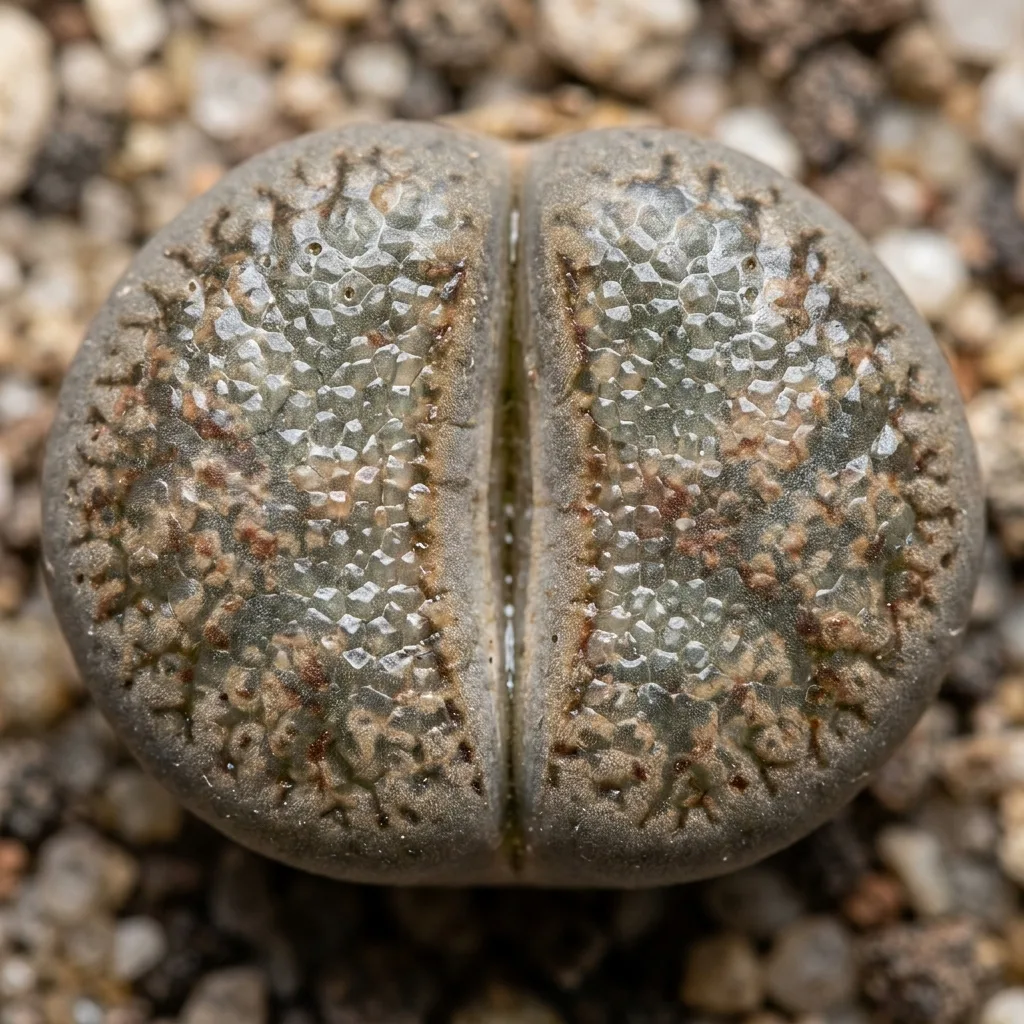
Lithops species (belonging to the family Aizoaceae) are extreme xerophytes governed by Crassulacean Acid Metabolism (CAM). Their stem is drastically reduced to a minute, subterranean plate of meristematic tissue situated immediately beneath the soil line where root and foliage unite. What appears above ground as an intact 'stone' is biologically a single pair of fleshy, coalesced leaves separated by a central fissure. The top horizontal plane of these leaves features species-specific, marbled patterns composed of translucent, chlorophyll-free epidermal windows (fenestrations). These cellular panes allow incoming sunlight to penetrate deep into the subterranean, chloroplast-rich mesophyll tissue like biological fiber-optic cables, simultaneously shielding the plant's delicate genetic blueprint from blistering surface UV radiation.
The single most critical physiological phase in the life cycle of a Lithops is the splitting (leaf renewal) stage. During winter, a fresh pair of leaves begins developing deep within the central fissure. Throughout this transition, the emerging leaves extract every drop of moisture and every vital nutrient exclusively from the older outer leaf pair. As the senescing outer leaves gradually shrivel into paper-thin, desiccated husks, the new pair assumes dominance. Introducing external water during this delicate window disrupts internal osmotic gradients, halts the digestive absorption of the outer foliage, triggers catastrophic epidermal rupture, and invites fatal opportunistic fungal infections at the cellular level.
2. Clinical Diagnosis and Visual Stress Indicators
Mastering Lithops husbandry hinges on accurately interpreting foliar morphology. Recognizing the subtle micro-signals telegraphed by the plant dictates whether to reach for moisture or leave the specimen in complete, undisturbed isolation:
- Genuine Dehydration (Watering Permitted): The top profile of the plant sinks inward slightly, the foliar apex yields gently under light fingertip pressure, and fine, horizontal micro-wrinkles develop along the lateral margins. If observed during mid-spring or early autumn, deep watering is completely safe.
- Physiological Satiety (Do Not Water): The upper face of the plant is rigidly convex, domed, and solid as granite to the touch. This indicates the vacuoles have achieved maximum internal turgor pressure.
- Onset of Splitting (Absolute Water Prohibition): The central fissure widens, revealing the vibrant apex of the emerging leaf pair within, while the outer leaves begin to deflate. This wrinkling is not dehydration; it represents active internal nutrient and moisture translocation.
- Etiolation (Severe Light Deficiency): The Lithops elongates upward into a columnar, cylindrical pillar, accompanied by chlorotic pigment loss. A thriving Lithops must consistently maintain a compressed, ground-hugging profile.
- Root Crown Asphyxiation (Incipient Rot): The basal tissue becomes watery, translucent, and turns to a gelatinous pulp when touched. This is the irreversible consequence of stagnant moisture paired with dense, organic potting media.
3. Step-by-Step Cultivation and Care Protocol
To cultivate robust, compact, and long-lived Lithops, adhere rigorously to the following horticultural guidelines:
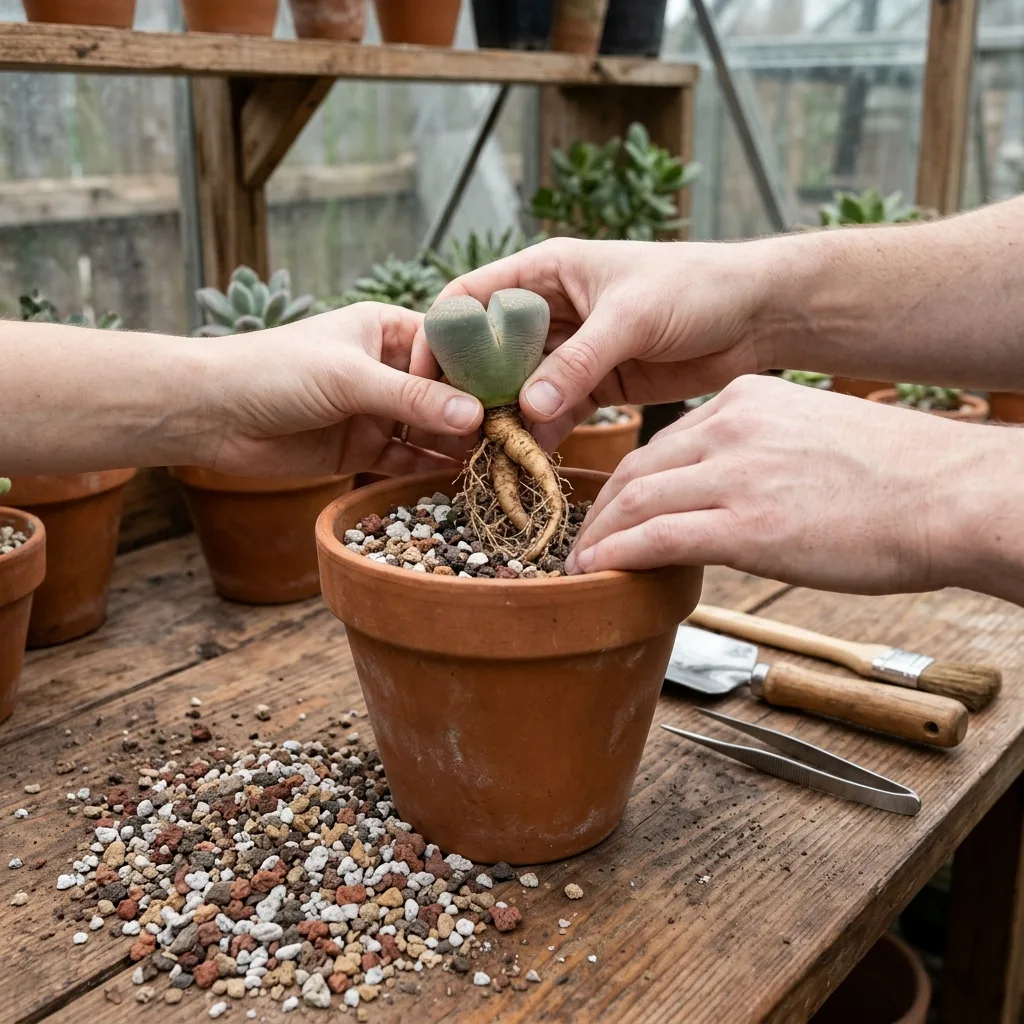
- Container Architecture and Depth: Despite their miniature above-ground stature, Lithops extend a persistent, vertical taproot system deep into the substrate. Avoid shallow dishes; instead, choose unglazed terracotta containers measuring at least 10–12 cm (4–5 inches) in depth with generous drainage apertures. Unglazed clay facilitates lateral moisture evaporation through its porous walls, actively safeguarding roots against oxygen starvation.
- Formulating an Inorganic Substrate: Conventional peat-based potting soils represent a definitive death sentence for Lithops. The potting medium must consist of at least 85%–90% coarse inorganic mineral aggregates by volume (pumice, crushed lava rock, zeolite, and coarse silica grit), balanced by merely 10%–15% fine organic matter, such as sieved worm castings or certified sterile cactus compost.
- Proper Potting and Positioning: Never bury the sensitive root-to-leaf junction (crown) in organic media. Position the taproot within the mineral core, and backfill the upper two-thirds of the leaf body exclusively with coarse (3–5 mm) pumice or crushed granite top-dressing. This inert top collar ensures the fleshy lateral walls remain isolated from lingering moisture.
- Photoperiod and Solar Acclimatization: Lithops demand an absolute minimum of 4 to 5 hours of direct, unfiltered morning or late afternoon sunlight daily. Inadequate irradiance quickly degrades their natural geometry. However, specimens emerging from dark winter rest must be acclimated incrementally over 7 to 10 days using sheer drapery to prevent severe foliar sunburn.
- Active Atmospheric Circulation: Desert plants thrive in dynamic, moving air. Maintain steady ventilation around your collection by opening adjacent windows or utilizing an oscillating micro-fan. Vigorous airflow ensures the mineral substrate dries rapidly following irrigation.
4. Essential Specifications, Materials, and Physiological Standards
The following reference table outlines the precise physicochemical parameters required to establish and sustain a thriving Lithops colony:
| Parameter / Component | Recommended Standard / Ratio | Physiological Rationale |
|---|---|---|
| Substrate Composition | 40% Pumice (2–4 mm) + 30% Volcanic Scoria + 15% Zeolite + 15% Lean Cactus Compost | Ensures zero perched water tables, maximizes rhizosphere gas exchange, and facilitates rapid dry-back. |
| Container Specifications | Unglazed porous terracotta, minimum depth 10–12 cm (4–5 in) | Accommodates unchecked taproot extension while clay porosity accelerates lateral moisture evaporation. |
| Luminous Intensity (Lux / PPFD) | 25,000–40,000 Lux / 4–6 hours direct sunlight daily | Maintains compact, low-profile growth and stimulates the expression of protective epidermal pigments. |
| Thermal Parameters | Active Growth: 18°C–28°C (64°F–82°F) / Winter Rest: 8°C–12°C (46°F–54°F) | Diurnal temperature differentials trigger CAM nocturnal stomatal opening; winter chill primes flower buds. |
| Irrigation Water Chemistry | Low EC rainwater, distilled water, or RO water | Prevents alkaline mineral salts and carbonates from encrusting the foliar windows and burning root tips. |
5. Five Critical Cultivation Mistakes and Recovery Pathways
- Mistake 1: Calendar-Driven Irrigation: Water according to an arbitrary weekly routine is lethal. Lithops must be watered solely based on foliar turgor cues. Recovery: Cease watering entirely. Provide moisture only when the top surfaces sink and wrinkle horizontally, and exclusively during peak spring or autumn growing seasons.
- Mistake 2: Watering During the Split: Irrigating when the outer leaves show signs of collapsing creates a condition known as 'stacking' (retaining multiple leaf sets). The emerging leaves become trapped within swollen outer foliage and succumb to rot. Recovery: Withhold water completely. Relocate the plant to a warm, sunlit, and well-ventilated spot. Do not provide a single drop for months until the outer husks are bone-dry.
- Mistake 3: Relying on Standard Commercial Succulent Soils: Pre-bagged succulent soils are heavily dominated by moisture-retentive peat moss, exposing delicate root hairs to aggressive soil-borne fungal pathogens like Fusarium and Pythium. Recovery: Unpot the specimen immediately, wash away all organic remnants, trim necrotic tissue, air-dry in partial shade for 48 hours, and repot into a 90% mineral matrix.
- Mistake 4: Deficient Light Exposure: Kept in dim rooms or north-facing window sills, Lithops stretch, lose their markings, and mutate into green columns. Recovery: Gradually transition the plant into direct sunlight or position it 15–20 cm beneath a dedicated full-spectrum LED grow light. While elongated leaves will not shrink back, the subsequent set emerging from the next split will regain its squat, natural geometry.
- Mistake 5: Excessive Fertilization: Nitrogen-rich fertilizers weaken structural cellular walls, disrupt internal hydrostatic equilibrium, and cause the plant body to rupture. Recovery: Lithops possess virtually negligible nutritional demands. At most, apply an ultra-dilute (1/4 strength), zero-nitrogen, high-potassium mineral supplement once per year in early autumn.
6. Seasonal Calendar and Long-Term Specimen Development
Cultivating Lithops is the art of synchronizing your home's microclimate with ancient Southern Hemisphere genetic adaptations. For sustained vigor, harmonize your regimen with the plant's seasonal rhythm:
- Spring (Awakening and Active Vegetative Growth): The splitting process draws to a close, and the old outer leaves have dried down to a papery husk. Administer the season's first thorough, drenching soak. Allow the substrate to dry completely between waterings (typically every 2 to 3 weeks).
- Summer (Semi-Dormancy / Aestivation): Under ambient temperatures exceeding 32°C (90°F), Lithops shut down active metabolic pathways to conserve moisture. Suspend heavy soakings during this heat wave. A light, surface-level misting or bottom sip delivered in the cool of the evening once a month will prevent the fine root hairs from desiccating entirely.
- Autumn (Flowering and Peak Metabolic Activity): This represents the plant's most dynamic phase. Golden-yellow or pristine white, daisy-like blossoms emerge from the central cleft. Water thoroughly whenever the foliar top demonstrates subtle collapse. Post-bloom, seed capsules may begin to mature.
- Winter (The Regenerative Split and Absolute Drought): As ambient temperatures plunge and day length contracts, suspend irrigation entirely—zero water. The newly forming internal leaves will spend the winter systematically absorbing the water reserves of the old pair. Maintain the plant in a bright, cool (10°C–15°C / 50°F–59°F), and exceptionally airy location.
By remaining faithful to this physiological calendar, a solitary stone pair will, over decades, divide at the crown to form a magnificent, multi-headed specimen colony. Observing this ancient, contemplative patience unfolds a profoundly grounding botanical tranquility amidst the hectic pace of modern life.


Reader Reviews & Comments 4 Reviews
Eleanor Vance
Marcus Thorne
David Sterling
Clara Higgins
Leave a Review & Rating
Share your plant care tips, experiences, or questions with our succulent community.