






Journeying from the semi-arid valleys of South Africa to the sun-drenched windowsills of our homes, the Elephant Bush (Portulacaria afra)—also affectionately known as Spekboom, Dwarf Jade, or Porkbush—stands as one of nature’s most resilient and forgiving botanical miracles. Serving in the wild as both a vital food staple and a shady haven for giant African elephants, this succulent shrub effortlessly transitions into a statuesque indoor bonsai tree or a lush, cascading emerald waterfall in a hanging basket. It is no surprise that growers frequently ask, 'How does this succulent multiply and spread so rapidly?' When provided with the right cellular conditions, Elephant Bush possesses an astonishing regenerative prowess and an innate eagerness to root.
Although plant enthusiasts frequently confuse it with the classic Jade Plant (Crassula ovata), the Elephant Bush is a distinct botanical masterpiece. It distinguishes itself through slender, pliable mahogany-red stems, dainty circular emerald leaves, and an extraordinary atmospheric carbon sequestration capacity. If you wish to begin with a modest single cutting and cultivate a dense miniature forest within months, understanding this plant's internal cellular rhythm and root shoot dynamics is your essential first step.
1. Botanical Identity and Morphological Adaptations
Classified under the family Didiereaceae, Portulacaria afra is an evergreen, semi-woody succulent shrub adapted to the challenging arid extremes of the Eastern Cape and Karoo regions. To thrive under severe environmental stress, it possesses a remarkable facultative photosynthetic capability: it seamlessly alternates between standard C3 carbon fixation and Crassulacean Acid Metabolism (CAM). During prolonged droughts, it seals its stomatal pores during daytime hours to reduce transpiration to zero, opening them only under the cool cover of night to absorb carbon dioxide. Once moisture returns, it switches back to C3 photosynthesis, triggering an explosive burst of vegetative growth.
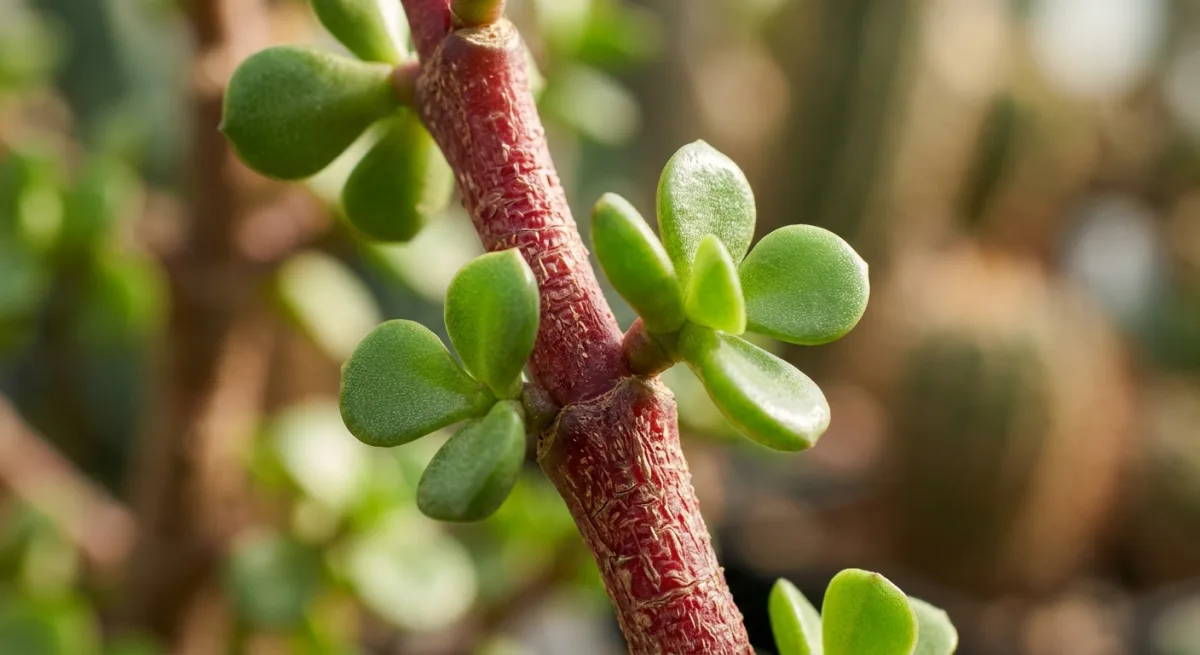
Morphologically, the leaves are arranged in opposite pairs along the stems. Each leaf is glabrous, glossy, and subtly fleshy. Juvenile stems exhibit a striking coral-red to rich burgundy hue, maintaining high flexibility. As the plant matures, secondary xylem development forms a rugged, corky, grey-brown bark resembling an ancient miniature tree trunk. This natural woody architecture makes Elephant Bush an exceptional candidate for structural pruning and traditional bonsai styling.
2. Lighting Requirements and Indoor Placement
Elephant Bush is an unabashed sun worshipper. When blessed with at least 5 to 6 hours of bright, unfiltered or lightly filtered sunlight daily, its leaf margins blush with an enchanting pinkish-red halo, and the internodal spacing remains tight and compact. In sub-optimal, low-light environments, the plant quickly exhibits severe etiolation: the stems stretch toward light sources, internodes lengthen, foliage pales, and the once-sturdy branches droop into a weak, spindly habit.
For indoor cultivation, south- or southwest-facing window exposures provide the premier microclimate. If your home lacks sufficient natural foot-candles, supplement with a full-spectrum LED grow light delivering balanced illumination for 10 to 12 hours daily. During late spring and summer, transitioning your specimen outdoors—following a gradual, two-week acclimatization to prevent epidermal sunburn—will easily double its seasonal growth rate.
3. Watering Discipline: The 'Soak and Dry' Protocol
The succulent tissues of Elephant Bush act as microscopic water reservoirs. Dousing your plant with frequent, shallow sips is not an act of kindness; it suffocates delicate capillary root hairs, induces anoxic conditions in the substrate, and practically invites root-destroying pathogens. The only reliable irrigation strategy is the time-tested horticultural 'soak and dry' method.
Before introducing moisture, verify that the substrate has dried out completely down to the bottom of the root ball. Insert a slim wooden dowel or moisture probe to the base of the container; if it emerges entirely clean and free of moisture, it is time to irrigate. Saturate the pot thoroughly until water streams freely from the drainage holes, ensuring every pocket of soil is replenished. Always discard any standing water collected in the saucer after 15 to 20 minutes. During the winter dormancy phase, lengthen your watering intervals to every 3 to 4 weeks, watering only when the foliage shows subtle visual signs of deflating.
4. Ideal Soil Substrate and Container Selection
The xylem tissue and hair roots of Portulacaria afra quickly succumb to opportunistic fungal infections if trapped in heavy, waterlogged peat or dense garden soil. To preserve root health, you must provide a highly porous, gritty, mineral-dominant potting blend that guarantees immediate hydraulic drainage and rapid gas exchange.
When selecting a vessel, unglazed terracotta pots reign supreme. The porous clay walls actively wick excess moisture away from the root ball, facilitating root oxygenation. If you opt for plastic, composite, or glazed ceramic pots, ensure they feature generous drainage openings and adjust your watering frequency to allow for slower substrate evaporation.
| Substrate Component | Ratio (%) | Horticultural Function |
|---|---|---|
| Coarse Pumice (3–6 mm) | 35% | Maximizes macroporosity, aerates root zone, and buffers moisture |
| Crushed Lava Rock (Scoria) | 20% | Provides physical ballast, steady mineral release, and rapid drainage |
| Clinoptilolite Zeolite | 15% | Improves cation-exchange capacity (CEC) and inhibits fungal pathogens |
| Coarse Horticultural Grit / Perlite | 10% | Prevents compaction and promotes rapid moisture runoff |
| Quality Coco Coir or Sifted Pine Bark | 20% | Supplies clean organic matrix for root anchoring without collapsing |
5. Step-by-Step Propagation Techniques
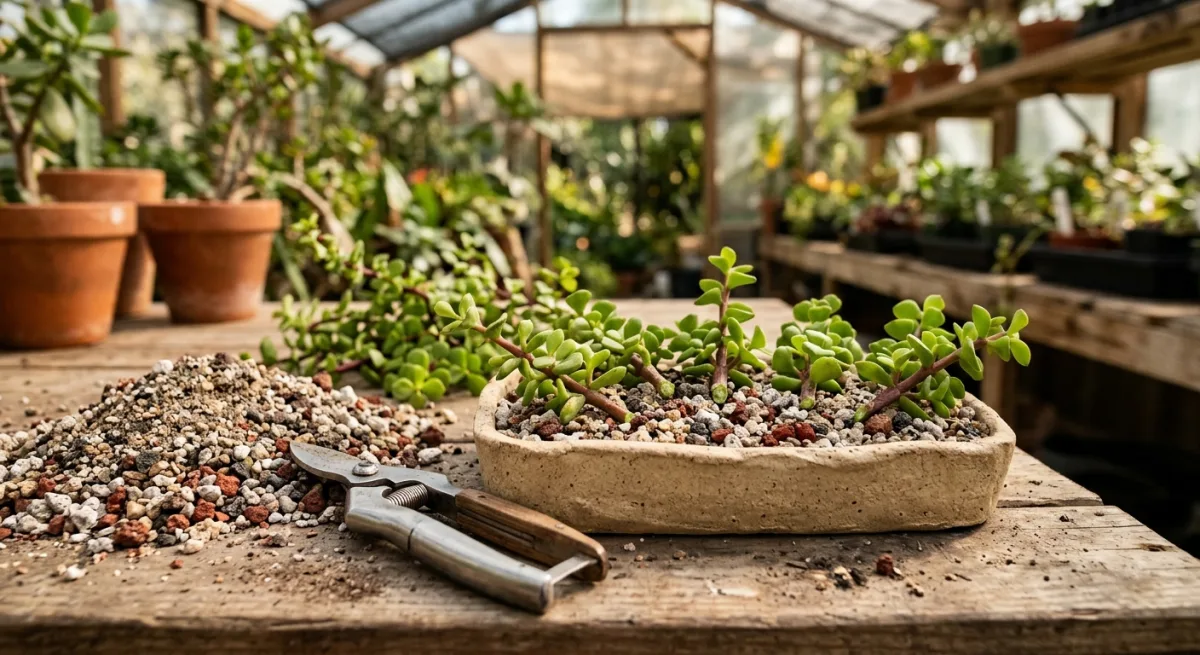
One of the most persistent inquiries from indoor gardeners is 'how to propagate and spread an Elephant Bush succulent'. The secret lies in the active meristematic cells concentrated at every single node. The most foolproof, rapid, and horticulturally sound method to multiply this plant is through stem cuttings.
Method 1: Rapid Rooting via Stem Cuttings (Recommended)
- Select Healthy Growth: Choose a vigorous, semi-woody stem (transitioning from coral-red to light bark) measuring roughly 8 to 15 cm (3 to 6 inches) in length, packed with firm, vibrant leaves.
- Make a Clean Cut: Using an isopropyl-sterilized, razor-sharp pruning shear or scalpel, execute a clean 45-degree angled cut approximately 0.5 cm below a leaf node.
- Strip Basal Leaves: Gently detach the leaves along the lower 3 to 4 cm of the cutting by rolling them off sideways. These exposed nodes are the exact cellular locations where adventitious roots will emerge.
- Callus Formation: Do not plant the fresh cutting immediately! Shield it from direct sun in a warm, dry, well-ventilated space for 3 to 5 days. Allow the raw cut surface to dry completely, forming a protective, matte callus barrier that blocks bacterial invasion.
- Potting and First Watering: Insert the callused cutting 2 to 3 cm deep into your pre-moistened, gritty mineral mix. Refrain from immediate irrigation; wait 3 to 4 days, then gently mist or lightly water the top layer. Within 2 to 3 weeks, give the stem a gentle upward tug. If you meet resistance, a vibrant new root network has taken hold.
Method 2: Water Rooting Method
Following proper callus formation, suspend stem cuttings in a clear glass vessel filled with filtered water, ensuring only the lower stem node touches the water while keeping all remaining leaves dry. Position the container in bright, indirect, warm light. Translucent white root filaments typically emerge within 10 to 14 days. Once the roots reach approximately 2 cm in length, transfer the cutting into a gritty mineral mix, keeping the substrate slightly damp for the first week to ease the cellular transition from water to soil.
Method 3: Ground Layering (Simple Stooling)
If you cultivate your Elephant Bush in a broad container or as an outdoor groundcover, locate a low-hanging, supple branch still attached to the mother plant. Gently scrape the cuticle off a lower node, press that section firmly against the substrate, and secure it with a horticultural U-pin or wire. The branch continues drawing nutrients from the parent system while driving roots into the soil over 3 to 4 weeks. Once firmly rooted, sever the connection with a sterilized blade to yield an established, self-sufficient plant.
6. Common Pests, Pathologies, and Curative Protocols
While Portulacaria afra is inherently resilient, poor air circulation and excessive moisture indoors can create vulnerabilities:
- Mealybugs (Pseudococcidae): Appearing as cottony white clumps clustered in leaf axils and beneath young shoots, these sap-sucking insects drain the plant’s vital sap, leading to distorted growth and leaf loss. Treatment: Dip a cotton swab in 70% isopropyl alcohol and physically remove visible colonies. For widespread infestations, spray with cold-pressed organic neem oil emulsified with mild horticultural soap.
- Root Rot (Phytophthora / Fusarium): Triggered by oversaturated soil and blocked drainage. The subterranean root filaments turn black, mushy, and necrotic. Above ground, stems wrinkle and lose turgor despite wet soil. Treatment: Unpot immediately. Slice away all compromised roots with a sterilized blade. Dust the healthy root cuts with sulfur powder or ground cinnamon, allow the root ball to dry exposed to the air for 48 hours, and repot in fresh, bone-dry mineral substrate.
- Sudden Leaf Drop: This is the most common defensive shock reaction of the Elephant Bush. Drastic relocations, cold drafts, air conditioning vents, or radical changes in watering schedules cause the plant to jettison its lower green leaves. Simply place the plant in a stable, bright environment and resume balanced watering. Within 2 to 3 weeks, dormant auxiliary buds will activate, producing pairs of fresh green leaves at every bare node.
7. Seasonal Maintenance Calendar and Cultivation Advice
- Spring (Awakening & Pruning): The commencement of active vegetative growth. This is the prime window to harvest propagation cuttings and perform structural pruning on the parent plant. Trimming terminal tips forces back-budding, doubling secondary branches and creating a denser, shrubby silhouette. Apply a balanced succulent fertilizer diluted to half-strength once every four weeks.
- Summer (Peak Photosynthesis): The period of maximum metabolic vigor. Move your plant outdoors if conditions permit. Hydrate deeply as soon as the potting mix dries out. Periodically rinse foliage with a fine spray in the early morning to clear away environmental dust and optimize carbon uptake.
- Autumn (Acclimatization): Before nighttime ambient temperatures dip below 10°C (50°F), transition outdoor plants back indoors to their winter quarters. Cease all fertilization completely and begin gradually widening the duration between waterings.
- Winter (Semi-Dormancy): The plant shifts primarily toward nocturnal CAM metabolism. Protect it from radiant heating vents, radiators, and chilly window drafts. Hydrate sparingly—only when foliage begins to lose turgor—typically once or twice a month at most.


Reader Reviews & Comments 4 Reviews
Eleanor Vance
Marcus Thorne
Clara Higgins
Julian Miller
Leave a Review & Rating
Share your plant care tips, experiences, or questions with our succulent community.