






From the peat-rich wetlands of North America to the misty, sloping valley floors of the Black Sea montane forests, the damp understory harbors one of the botanical world's most intoxicating aromatic wonders: the Swamp Azalea. While this distinct taxon appears to defy the universal horticultural maxim that 'waterlogged roots inevitably rot,' it does not thrive in stagnant, anaerobic mire; rather, it flourishes along constantly oxygenated, acidic, and organic-rich watercourses. With its delicate deciduous foliage, glandular-viscid early summer blooms, and an intoxicating spicy-clove fragrance, it completely sets itself apart from conventional evergreen azaleas.
Closely related to Rhododendron luteum (the Yellow Azalea or Honeysuckle Azalea native to Eurasian temperate valleys), Rhododendron viscosum (Swamp Azalea) accomplishes physiological marvels in low-pH substrates through an obligate ericoid mycorrhizal symbiosis. The profound cellular reverence that drought-hardy succulents show toward extreme arid intervals, the swamp azalea demonstrates toward consistently moist, highly acidic microclimates. In this comprehensive guide, we examine every physiological detail required to nurture this noble ericaceous shrub in sheltered courtyard corners or dappled garden margins without succumbing to chlorosis or root necrosis.
1. Botanical Identity and Morphological Characteristics
Swamp azalea (Rhododendron viscosum) is a deciduous, perennial woody shrub belonging to the family Ericaceae. The specific epithet 'viscosum' derives directly from the Latin for sticky or clammy, calling attention to the prominent glandular trichomes blanketing the floral corolla tubes and pedicels. These specialized glandular hairs serve a dual ecological function: they form a mechanical and chemical barrier against nectar-thieving crawling insects such as ants, while synthesizing volatile terpenoid oils that guide nocturnal sphingid moths—the plant's primary evolutionary pollinators.
In native Eurasian ecosystems, Rhododendron luteum occupies similar moist, high-elevation riverbanks and exhibits comparable root morphology. The most defining cellular feature of swamp azaleas is their total absence of root hairs (trichoblasts). Instead, the plant outsources the uptake of water, ammonium, and chelated minerals entirely to specialized fungal hyphae known as 'ericoid mycorrhizae.' The resulting root mass is exceptionally fine, fibrous, and shallow, colonizing primarily the uppermost 15 to 20 centimeters of the soil profile. Consequently, deep pots represent physiological traps; these shrubs demand wide, shallow rooting zones with generous surface area.
2. Light Requirements and Indoor/Patio Positioning
Accustomed in its wild habitat to the dappled margins of riparian alder stands and meandering streams, the swamp azalea suffers acute cellular chlorophyll degradation if subjected to harsh, unshielded midday sun. Because its leaf epidermal layer is notably thin compared to sclerophyllous shrubs, UV scorch rapidly manifests as marginal brown necrosis. Conversely, deep and sunless shade suppresses floral bud initiation entirely.
For optimal domestic and patio cultivation, observe these exposure parameters:
- Light Intensity: Filtered morning sun for approximately 3 to 4 hours followed by bright, dappled shade yields the highest floral bud density and structural health. North-facing or sheltered east-facing exposures—or positioning behind light garden screening—are ideal.
- Air Circulation: A bog or wetland environment in nature is dynamic, not stagnant. Constant, gentle ambient airflow is mandatory to prevent foliar fungal pathogens (most notably powdery mildew). However, harsh, dry drafts must be avoided to keep the shallow crown and topsoil from desiccating prematurely.

3. Irrigation Discipline: Moisture Without Stagnation
The cardinal rule of succulent culture—'allow the substrate to dry out bone-dry between waterings'—is an immediate death sentence for swamp azalea. Conversely, misinterpreting the common name 'swamp' by leaving the root ball submerged in a saucer of rank, stagnant water quickly suffocates the mycorrhizal mantle. The overarching mandate is: Continuously Moist Yet Fully Oxygenated in the rhizosphere.
Critical protocols for irrigation source and delivery include:
- Soft, Acidic Water Requirement: Domestic tap water loaded with calcium and magnesium carbonates will rapidly pull the soil chemistry toward neutral or alkaline thresholds. This immobilizes iron ions, inducing severe interveinal chlorosis. Always irrigate with harvested rainwater, reverse osmosis water, or pure water adjusted to pH 5.0–5.5.
- Application Technique: The moment the uppermost fibrous duff layer begins to lose surface cool-moisture, irrigate thoroughly until water drains freely from the base. Empty any runoff collected in the saucer after 20 minutes; never allow the fine root tier to sit in saturated sludge.
4. Ideal Soil Mixture and Container Selection
The root physiology of swamp azalea operates within strict chemical parameters: the substrate must maintain a pH between 4.5 and 5.5. Standard neutral potting soils or alkaline garden loam act as direct physiological inhibitors. The root medium must be loose, fibrous, intensely acidic, and structured to discharge gravitational water almost instantly while retaining capillary moisture.
The formulation below provides the optimal biological balance, maintaining acid-loving fungal symbionts without risking root anoxia:
| Component | Proportion (%) | Botanical Function |
|---|---|---|
| Baltic Sphagnum Peat Moss | 45% | Establishes natural low pH (3.5–4.5) and retains moisture within cellular fibers. |
| Fine Composted Pine Bark | 25% | Enhances structural porosity and nourishes indigenous ericoid mycorrhizae. |
| Coarse Pumice (3–6 mm) | 15% | Creates stable macropores for root oxygenation and rapid drainage. |
| Coarse Horticultural Perlite or Acidic Lava Rock | 10% | Prevents medium compaction, crusting, and soil slump. |
| Aged Conifer Needle Leaf Mold | 5% | Supplies beneficial humic compounds and stabilizes biological acidity. |
Container Selection: Avoid narrow, deep pots. Because the fibrous root network expands horizontally in the top layer of leaf litter, utilize broad, shallow containers (azalea pots) with multiple drainage holes. Unfinished, high-grade terracotta or breathable fabric pots are exceptional choices due to their lateral gas exchange capabilities.
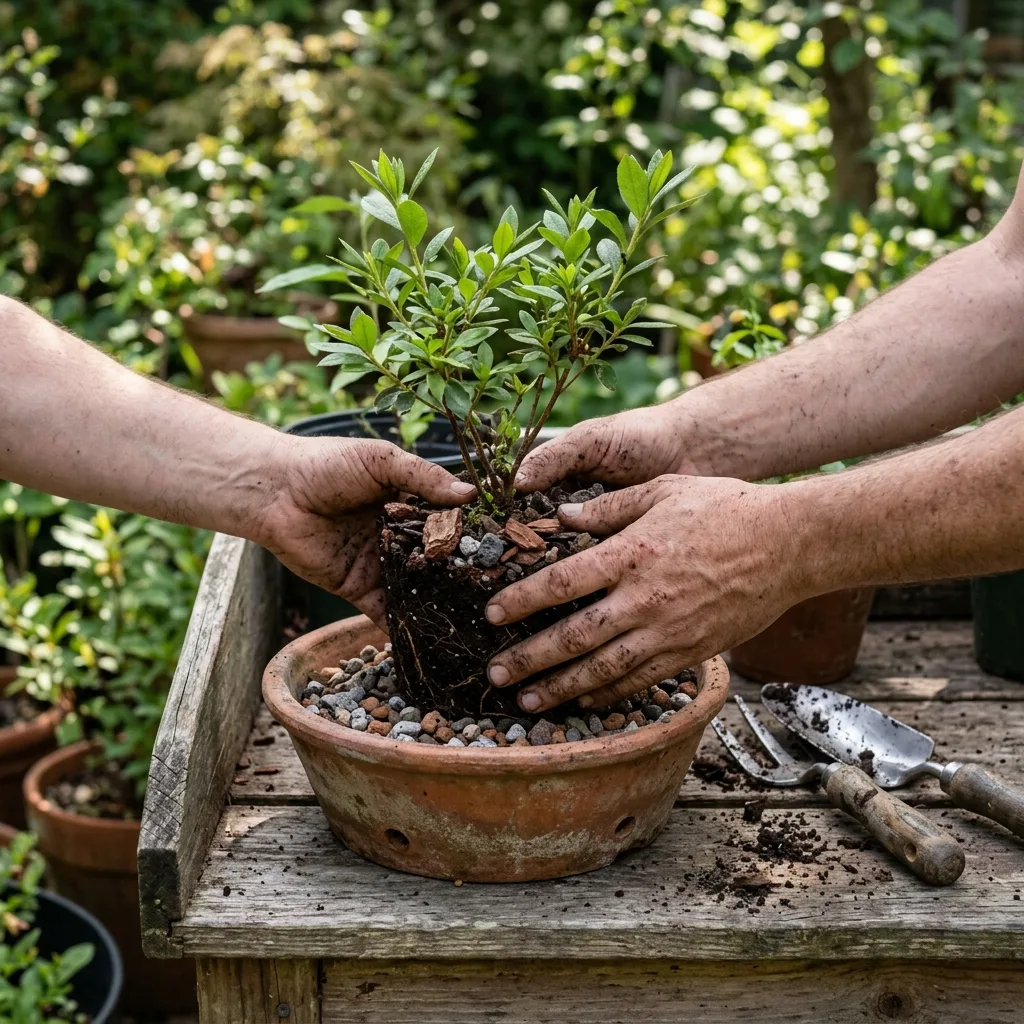
5. Step-by-Step Propagation Techniques
Propagating native deciduous azaleas from seed requires prolonged cold stratification and yields genetic variability. The most reliable method to produce true-to-type, vigorous specimens is through semi-ripe stem cuttings taken during the active vegetative season.
- Select the Optimal Window: Undertake propagation in mid-summer (early July to early August), when current-year shoots begin firming up at the base and turn from tender green to light brown.
- Sever the Cuttings: In the early morning while tissue turgor pressure is at its maximum, take 10–12 cm tip cuttings. Make a clean cut at a 45-degree angle directly below a nodal leaf junction using a sterilized scalpel.
- Foliage Reduction: Strip all leaves from the lower half of the cutting. Retain only 3 to 4 apical leaves, and trim those remaining leaf blades in half horizontally with clean shears to minimize transpirational surface area.
- Wounding and Hormone Application: Gently scrape a thin 1 cm strip of outer bark from the basal stem base to expose the cambium layer. Dip the wounded base into an acidic, talc-based IBA (Indole-3-butyric acid) rooting powder (0.4%–0.8%).
- Substrate and Humidity Chamber: Insert the cutting into a pre-moistened mixture of 60% sphagnum peat and 40% coarse perlite. Enclose the container in a clear propagation dome or poly-bag. Maintain ambient humidity near 85% and temperatures around 20–22°C (68–72°F) under bright, indirect light. Rooting typically establishes within 6 to 8 weeks.
6. Common Diseases, Pests, and Therapeutic Interventions
Most pathologies observed on swamp azalea trace back to physiological disruptions in the rhizosphere or unsuitable humidity levels. Prompt diagnosis allows for targeted, non-destructive remedies:
- Iron Chlorosis (Interveinal Yellowing): The leaf blade turns bright yellow while primary and secondary veins remain dark green. Causation: Substrate pH drift above 6.0 or high bicarbonate levels in irrigation water. Remedy: Acidify irrigation water to pH 5.0 and apply chelated iron in EDDHA or DTPA form directly to the substrate.
- Phytophthora Root Rot (Phytophthora cinnamomi): Induced by water stagnation in dense substrates lacking oxygen. Foliage rapidly dulls, curls, and turns brittle gray-brown. Remedy: Prune away all blackened, necrotic roots, repot into fresh porous acidic medium, and drench with a preventative systemic or copper-based bio-fungicide.
- Powdery Mildew (Microsphaera alni): Appears as a white, flour-like fungal dust across upper leaf surfaces during stagnant, warm late-summer spells. Remedy: Enhance air movement around the canopy, avoid wetting foliage during evening hours, and mist with a dilute cold-pressed neem oil or potassium bicarbonate solution.
- Azalea Lace Bug (Stephanitis pyrioides): Causes fine chlorotic stippling on the upper surface accompanied by resinous, tar-like fecal droplets on the lower leaf surface. Remedy: Wash the undersides of the leaves with high-pressure soft water and apply an organic insecticidal potassium soap spray.
7. Seasonal Maintenance Calendar and Expert Protocols
As an authentic temperate deciduous shrub, swamp azalea operates on a rigid physiological circadian and seasonal rhythm. Respecting its winter rest period (dormancy) is vital for long-term survival:
- Spring (Bud Break and Vegetative Surge): As terminal buds swell in early spring, apply a balanced, slow-release fertilizer formulated specifically for acid-loving ericaceous plants (containing ammonium sulfate rather than nitrate forms of nitrogen). Prune out any dead, winter-damaged, or crossing interior twigs.
- Summer (Anthesis and Moisture Stewardship): The shrub achieves full bloom. Never let the root ball go dry. Utilize gravel-and-water humidity trays beneath patio containers to elevate local atmospheric moisture. Perform gentle deadheading: snap off spent corollas at the base of the flower cluster before energy is diverted into seed capsule production.
- Autumn (Foliar Senescence and Hardening Off): Prior to leaf drop, foliage transitions into fiery shades of orange, copper, and bronze. Do not panic; this is normal seasonal senescence. Cease all nitrogenous feeding by late summer to ensure that tender new stems lignify and harden against oncoming frosts.
- Winter (Obligate Dormancy): Once fully defoliated, relocate containerized specimens to an unheated, sheltered cold frame, cool porch, or unheated glasshouse maintained between 0°C and 8°C (32°F–46°F). This period of cold accumulation (chilling requirement) is a biological requisite to break floral bud dormancy for the subsequent year. Diminish watering frequency significantly, but ensure the root core never dries out into a solid block.


Reader Reviews & Comments 3 Reviews
Eleanor Vance
Julian Hayes
Marcus Bennett
Leave a Review & Rating
Share your plant care tips, experiences, or questions with our succulent community.