






While traversing the arid, rocky expanse of South Africa's Great Karoo plateau, distinguishing a living plant from the scattered fragments of granite and quartzite beneath your feet is remarkably difficult. Shaped by millions of years of evolutionary pressure to escape grazing herbivores, Pleiospilos nelii has transformed itself into a living boulder. Widely celebrated as the Split Rock succulent, this extraordinary botanical marvel represents one of nature's most sophisticated examples of protective mimicry (crypsis).
Many indoor gardeners mistakenly confuse this botanical jewel with a Lithops (Living Stone). However, Pleiospilos nelii possesses entirely distinct structural morphology, cell architecture, and seasonal growth dynamics. Sitting quietly like a tactile mineral sculpture on your sunniest windowsill, this ancient perennial is intensely rewarding when respected—yet it quickly falls victim to 'smothering love' in the form of well-intentioned overwatering. With the proper understanding of its physiological cycles, you can cultivate this fascinating desert treasure successfully for decades.
1. Botanical Identity and Morphological Characteristics
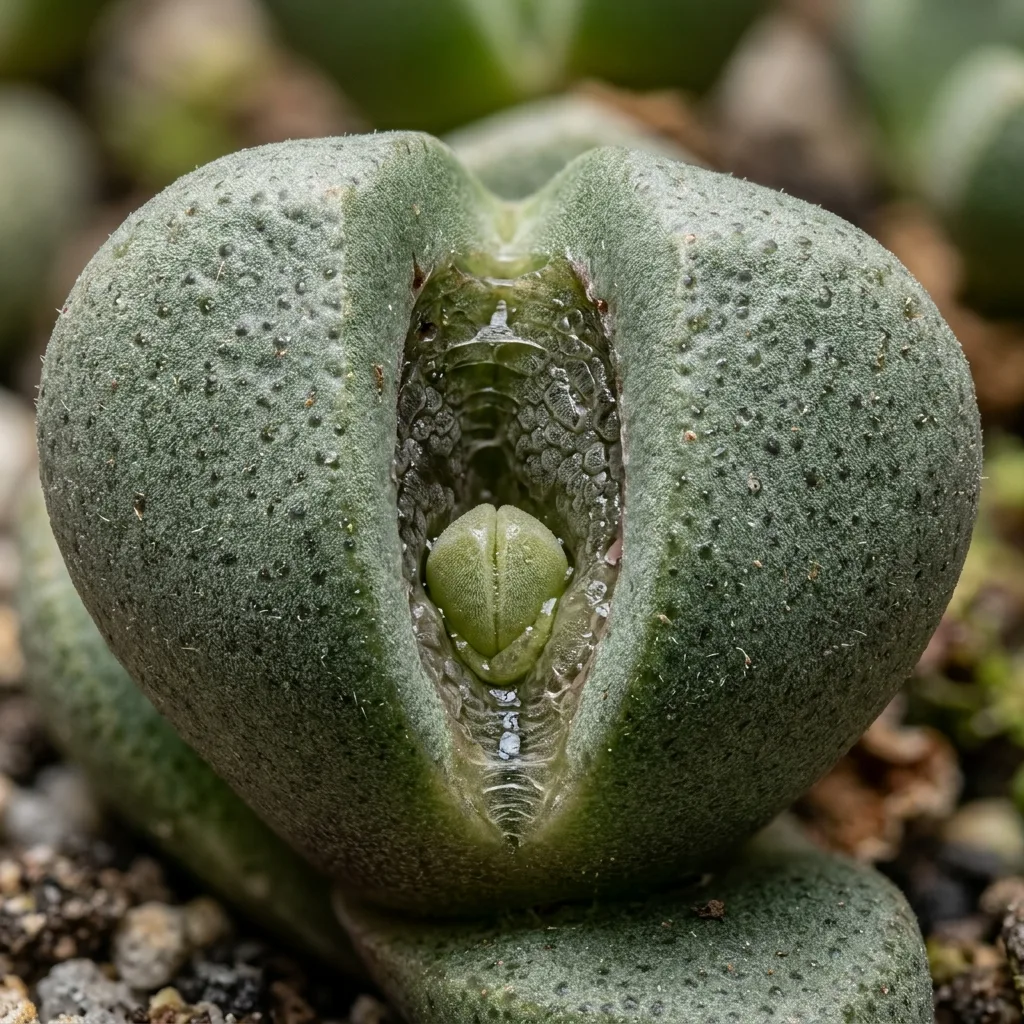
Pleiospilos nelii is a stemless, highly succulent perennial belonging to the ice plant family, Aizoaceae (subfamily Aizoonoideae). The specific epithet nelii honors the prominent South African botanist Gert Cornelius Nel. Structurally, the plant is anchored by a single hemispherical pair of opposite, fused leaves parted down the center by a deep fissure.
The leaf surfaces display subtle variations of chalky grey-green, bronze, or coppery undertones. A closer look with a hand lens reveals countless dark green or translucent dots scattered across the thick cuticle. These micro-structures are not superficial pigmentation marks; they are specialized leaf windows (epidermal fenestrations) and hydathode-like structures. In the scorching desert, these windows safely filter harsh solar radiation while channeling light deep into the internal water-storing parenchyma cells, driving Crassulacean Acid Metabolism (CAM) photosynthesis efficiently without compromising moisture retention.
The fundamental rule of Pleiospilos nelii biology is its strict leaf-pair balance: a healthy, mature plant should naturally support only one primary leaf pair and one emerging inner leaf pair (a maximum of two pairs at any given moment). When a specimen accumulates three, four, or more sets of swollen leaves stacked upon one another, it suffers from a condition known among botanists as 'stacking'. Stacking is the unmistakable hallmark of chronic overwatering and excessive nitrogen feeding.
2. Light Requirements and Indoor Positioning
In its native Karoo habitat, the Split Rock bakes under an unyielding, high-UV sun year-round. Consequently, this is not a plant that tolerates low-light compromises indoors. Deprived of sufficient solar intensity, Pleiospilos nelii undergoes irreversible etiolation: the central cleft elongates unnaturally, the compact stone silhouette distorts into an upright oval, and thinning cell walls leave the epidermal barrier defenseless against opportunistic fungal spores.
The ideal location in an indoor setting is directly against an unobstructed south- or southwest-facing window that delivers a minimum of 5 to 6 hours of unfiltered direct sunlight daily. During peak summer, if plants are kept behind enclosed double-pane glazing, maintain generous ambient air circulation to prevent heat pockets from cooking root tissues. In dimly lit apartments or overcast climates, install a full-spectrum LED horticultural light positioned 15–20 cm (6–8 inches) directly above the foliage for 12 to 14 hours per day to preserve its dense, ground-hugging form.
3. Watering Discipline: The 'Soak and Dry' Protocol
The single most destructive error in caring for a Split Rock is watering by the calendar. Frequently dampening the substrate suffocates the root hairs; xylem cells evolved specifically for drought dormancy collapse rapidly when exposed to sustained moisture, triggering bacterial liquefaction.
Instead of testing the soil, make watering decisions by physically evaluating the firmness of the inner and outer leaf pairs. During the seasonal regeneration phase (typically late winter to early spring), the central cleft expands as a new leaf pair emerges. Throughout this period, the older outer leaves naturally wrinkle, soften, and slowly sacrifice their moisture and micronutrient reserves to fuel the developing inner pair. Do not apply a single drop of water during this transitional phase! The plant must metabolize its own aged leaves until they shrivel into paper-thin, dry husks. Adding water while the old leaves are still plump disrupts this cycle, forcing the plant into lethal stacking and causing the central tissue to burst and rot.
4. Ideal Soil Formulation and Pot Selection
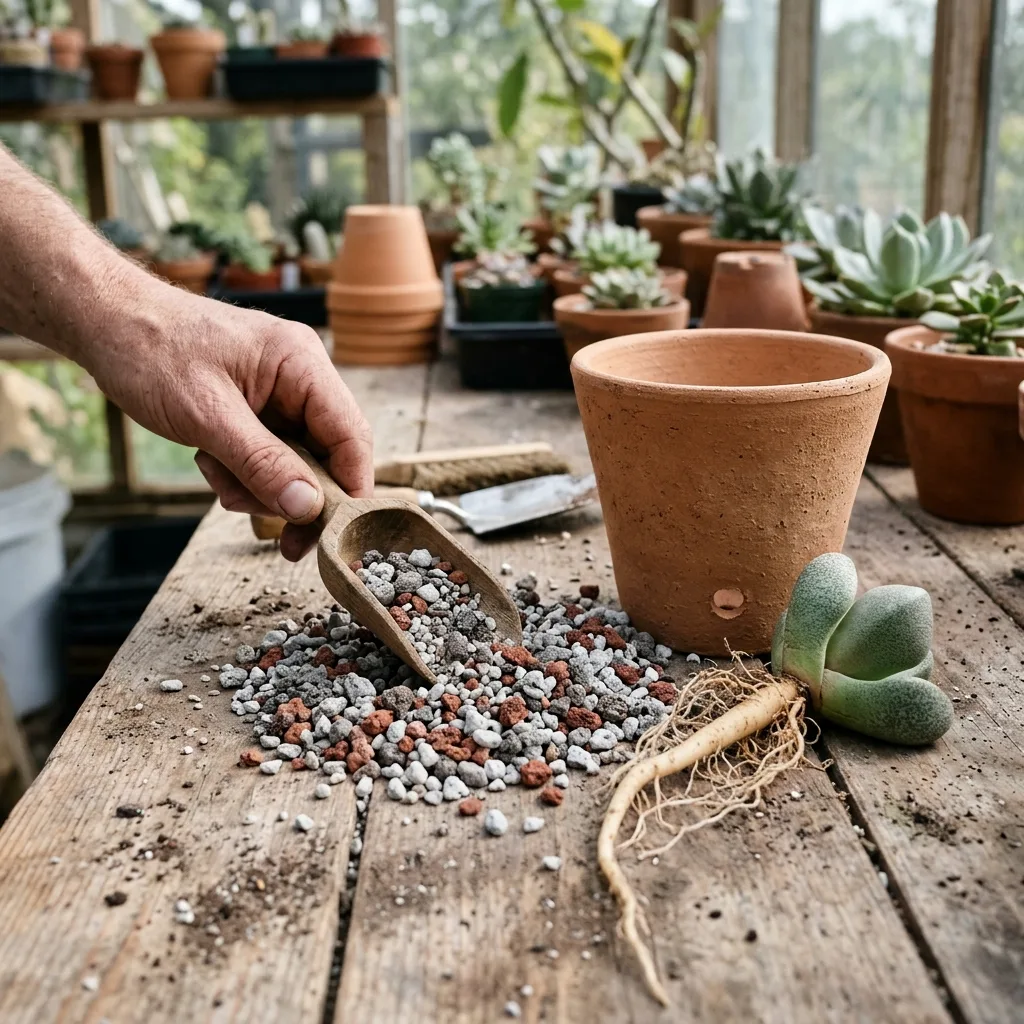
Standard potting soil, peat moss, or typical commercial cactus blends are disastrous for Pleiospilos nelii. The root zone demands a substrate engineered for instant gravitational drainage, high gas exchange, and virtually no organic moisture retention. Aim for an 85% to 90% purely inorganic mineral mix.
| Substrate Component | Ratio (%) | Functional Botanical Benefit |
|---|---|---|
| Horticultural Pumice (3–5 mm) | 40% | Maintains structural macroporosity, providing vital root oxygenation and preventing water pockets. |
| Lava Rock (Scoria) | 25% | Provides stable mineral anchorage, promotes fine root hair branching, and resists compaction. |
| Zeolite (Clinoptilolite) | 20% | Binds excess salts, buffers pH fluctuations, and helps inhibit fungal pathobiology. |
| Sterile Low-Peat Cactus Mix / Coir | 15% | Supplies a trace organic base that holds gentle root moisture for just a few hours post-watering. |
Container geometry is equally critical. While a Split Rock may look like a diminutive pebble above ground, it anchors itself through an elongated, fleshy taproot that reaches deep into the earth in search of subterranean moisture fissures. Avoid shallow succulent dishes. Plant instead in an unglazed terracotta pot at least 10–12 cm (4–5 inches) deep with generous drainage openings. Unglazed clay breathes through its sidewalls, facilitating rapid evaporation and keeping the root zone safely aerated.
5. Step-by-Step Propagation Techniques
Unlike Echeveria or Sedum, Pleiospilos nelii cannot be propagated via single leaf cuttings; severing an individual leaf destroys the central apical meristem, leading to fatal fungal decay. Propagation is achieved through two dedicated methods:
- Propagation by Seed: This is the most rewarding and genetically diverse route. In early autumn, scatter dust-fine seeds onto a moist substrate of 80% fine pumice and zeolite topped with a light dusting of coarse grit. Do not bury the seeds. Maintain ambient temperatures of 18–22°C (64–72°F) under bright, indirect light. Germination generally occurs within 7 to 14 days. Keep the seedlings slightly humid for their first 4 to 6 months before gradually transitioning them to the strict dry adult regimen.
- Clump Division (Multi-Headed Specimens): With significant age, rare specimens form auxiliary growth points, developing a multi-headed cluster. In early spring, gently unpot the specimen and examine the crown. Using a sterilized surgical scalpel, carefully split the heads, ensuring that each separate division retains an intact portion of the central taproot. Dust cut surfaces liberally with sulfur powder or ground cinnamon, allow the calluses to cure in dry shade for 4 to 5 days, and pot into completely dry mineral substrate.
6. Common Pests, Diseases, and Treatments
The primary existential threat to a Split Rock is root and collar rot induced by Fusarium, Pythium, or Phytophthora pathogens resulting from overhydration. If the base of the plant suddenly turns translucent, gelatinous, or charcoal-black, the decay has already compromised the vascular cylinder. At that stage, systemic recovery is nearly impossible; prevention via disciplined watering is your only reliable safeguard.
Regarding insect pests, mealybugs (Pseudococcidae) frequently settle deep within the sheltered recess of the central leaf fissure. When white cottony tufts appear inside the cleft, do not spray the plant with water or harsh soapy rinses, as trapped moisture inside the fissure invites immediate crown rot. Instead, dip a fine watercolor paintbrush into 70% isopropyl alcohol and carefully dab the pests away mechanically. In hot, bone-dry rooms, spider mites may cause rust-colored scarring across the leaf cuticle; maximizing natural room ventilation serves as the most effective preventative measure.
7. Seasonal Care Calendar and Expert Tips
Spring (March – May): The culmination of the leaf renewal cycle. Once the outer leaf pair has completely withered into a dry skin, provide the first thorough soak of the season. If the plant shows active vertical expansion, you may introduce a balanced, ultra-low-nitrogen cactus fertilizer diluted to one-quarter strength once.
Summer (June – August): When sustained temperatures exceed 32°C (90°F), Split Rocks enter a defensive semi-dormancy (aestivation) to prevent metabolic water loss. Reduce watering to absolute minimal levels. Only if the leaves show severe wrinkled distress should you offer a light hydration during a cool evening.
Autumn (September – November): This is the peak physiological growth and blooming period. As flower buds emerge from the cleft, continue a consistent soak-and-completely-dry routine. Once the blossom fades, clip away the dying flower stem cleanly near the cleft base unless you are deliberately cultivating a seed capsule.
Winter (December – February): Winter dormancy and leaf-bud initiation. Suspend all watering completely. Keep the plant in a bright, cool environment (8–12°C / 46–54°F), strictly shielded from freezing drafts and frost. The plant will begin drawing upon the water in its outer leaves to nourish the new emerging inner pair.


Reader Reviews & Comments 3 Reviews
Clara Higgins
Marcus Sterling
Julian Vance
Leave a Review & Rating
Share your plant care tips, experiences, or questions with our succulent community.