






Picture a desert cactus surviving for centuries within the limestone fissures of Mexico's scorching Chihuahuan Desert; its root system encounters water only a handful of times each year during fierce flash storms, drying out completely within minutes. Now imagine taking this fragile desert gem and placing it in a dim bathroom corner, subjected daily to hot steam and stagnant air. What actually happens? One of the most widespread misconceptions among indoor gardeners Is the Orange Snowball Cactus? Botanical Care Tips for Growing Rebutia">is the assumption that all cacti are indestructible living sculptures. In reality, bathrooms microclimatically mimic the floor of a tropical rainforest—an environment that spells slow suffocation for xerophytic desert species, yet serves as a welcome homecoming for forest-dwelling epiphytes.
1. Taxonomic Identity, Areole Morphology, and Spine Anatomy
Determining whether a cactus can thrive in a bathroom environment begins with deciphering its morphological and taxonomic lineage. Within the cactus family (Cactaceae), species diverge into two primary ecological categories regarding bathroom compatibility: xerophytic (desert-dwelling) cacti and epiphytic/lithophytic (rainforest-dwelling) cacti. Arid desert cacti (such as Echinocactus, Mammillaria, and Ferocactus) feature areoles densely populated with trichomes (hairs) and spine clusters. These spines serve not merely as physical defense against herbivores, but as micro-aerodynamic adaptations designed to reduce transpiration and funnel morning condensation toward the root crown. Furthermore, their epidermis is shielded by a thick, waxy cuticle and farina layer, engineered strictly to lock moisture inside.
In an enclosed bathroom where relative humidity routinely spikes to 70–90%, this hydrophobic wax coating and the porous areole recesses trap airborne steam, creating prime breeding pockets for pathogenic fungi. Conversely, epiphytic cacti hailing from Brazil's Atlantic Rainforest—such as Rhipsalis, Schlumbergera (Holiday Cactus), and Epiphyllum—cling to tree bark under a humid canopy. Equipped with modified flattened stems (cladodes) and reduced, vestigial spines, they absorb ambient humidity directly from the air. Their areoles do not rot in high vapor; on the contrary, they utilize ambient moisture to send out adventitious aerial roots and flourish vigorously.
2. Light Requirements, Solar Flux, and Airflow Dynamics
The primary barrier to keeping cacti in bathrooms is frequently not humidity alone, but rather the lethal pairing of insufficient light and stagnant air. To sustain metabolic and photosynthetic efficiency, desert cacti require an absolute minimum of 25,000 to 40,000 lux (equivalent to 5–6 hours of direct, unfiltered solar radiation daily). Standard frosted or privacy-glazed bathroom windows disperse and diminish incident sunlight down to a meager 1,500 to 3,000 lux—a shortfall that brings photosynthetic carbon assimilation to a virtual standstill.
When deep shade combines with relentless ambient humidity, cacti rapidly exhibit 'etiolation'—a desperate, spindly growth habit marked by pale, distorted stems stretching toward any light source. During etiolation, cellular wall synthesis is compromised, the cuticle thins drastically, and the plant's natural immune barriers collapse against airborne fungal spores. Unless your bathroom features an expansive, clear south- or west-facing window, long-term survival for desert cacti is biologically impossible without intervention. However, installing a dedicated full-spectrum horticultural grow light (delivering a minimum PPFD of 200 µmol/m²/s) alongside an active mechanical exhaust fan can effectively balance the bathroom's microclimate.

3. Watering Cycles and the Non-Negotiable Winter Dormancy Period
Cacti utilize Crassulacean Acid Metabolism (CAM) to breathe. To prevent catastrophic desiccation under arid heat, they keep their stomata tightly sealed during daylight hours, opening them exclusively in the cool of the night to capture carbon dioxide. In an environment saturated with water vapor, the plant's capacity to shed excess internal moisture through transpiration is severely inhibited. Cellular parenchyma tissues remain gorged with water, while the potting medium in the root zone stays damp for weeks due to persistent atmospheric condensation.
A dedicated winter rest period (dormancy), lasting from late autumn through early spring, is crucial for tissue lignification and subsequent flower bud induction. During this window, desert species demand temperatures between 8–12°C (46–54°F) and virtually dry conditions. A bathroom heated by hot daily showers to 24–26°C (75–79°F) and blanketed in steam disrupts this physiological cues; the plant's circadian clock falls out of sync, preventing dormancy and causing it to burn through internal nutrient reserves until it collapses mid-winter. When watering any cactus stationed in a bathroom, the standard rule of thumb—'water when the topsoil looks dry'—must be discarded. Never irrigate without verifying, via a deep soil probe or moisture meter, that the substrate is bone-dry straight to the bottom of the pot.
4. High-Mineral Substrate Formulation and Container Porosity
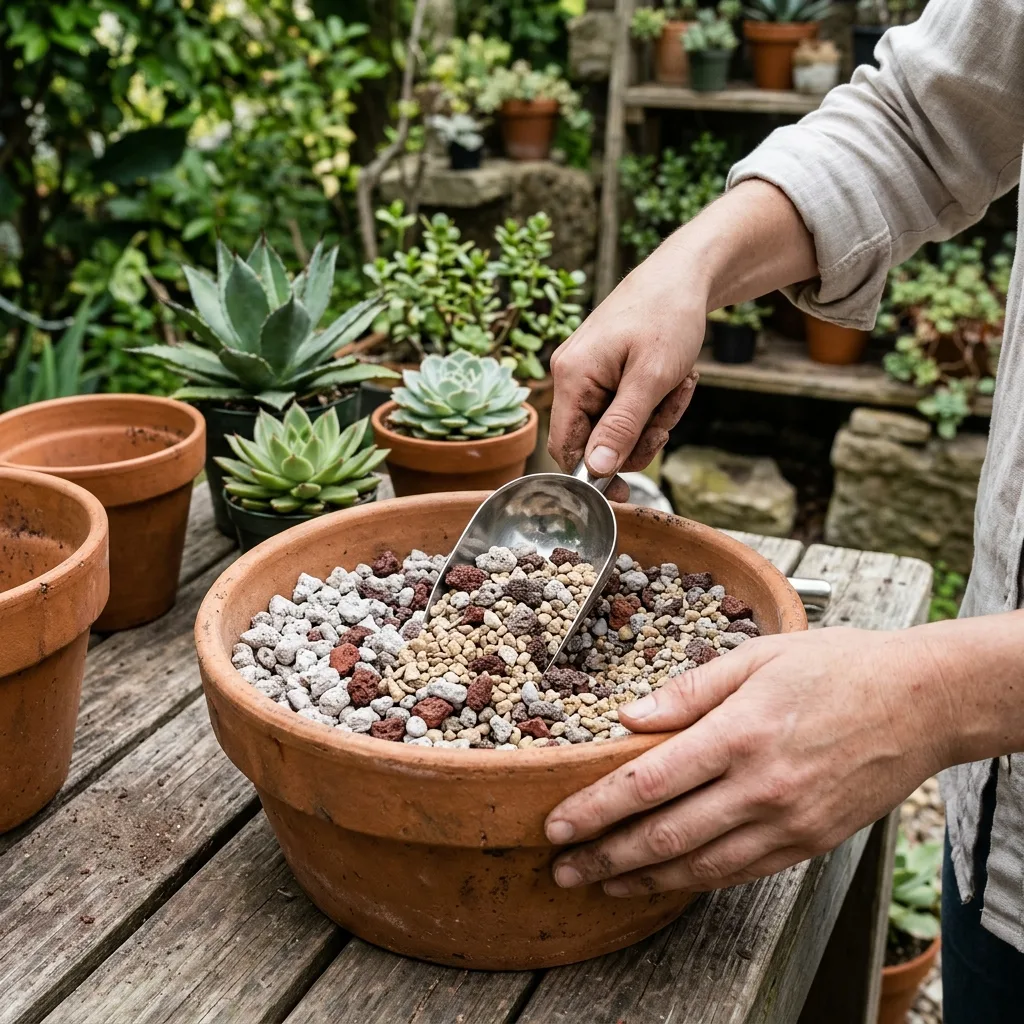
If you intend to cultivate cacti in a bathroom, standard peat-based potting mixes must be eliminated entirely. Peat moss and coconut coir act like moisture magnets, remaining soaked for weeks in a humid bathroom environment. What these plants require is a hyper-inorganic mineral matrix with minimal water retention and superior gas diffusion. Furthermore, glazed ceramics and non-porous plastic containers must be set aside in favor of unglazed, high-fired porous terracotta, which allows the root ball to transpire moisture laterally through its walls.
| Substrate Component | Bathroom / High-Humidity Ratio | Standard Living Room Ratio | Botanical Function |
|---|---|---|---|
| Pumice (3–6 mm) | 40% | 25% | Internal micro-pores optimize oxygen circulation and root aeration |
| Lava Rock / Red Scoria | 25% | 20% | Structural stability, iron supplementation, and rapid drainage channels |
| Clinoptilolite Zeolite | 15% | 10% | Binds toxic ammonium; buffers and wicks excess moisture away from roots |
| Coarse Quartz / River Sand | 10% | 15% | Accelerates percolation speed and prevents mechanical compaction |
| Sterilized Sifted Leaf Compost / Worm Castings | 10% | 30% | Provides trace organic nutrients while minimizing fungal proliferation |
5. Flowering Induction Protocols and Mineral Nutrition
Coaxing a cactus to bloom in a bathroom setting is exceptionally challenging due to the disruption of natural seasonal cycles. Flower bud initiation—particularly in genera such as Mammillaria and Rebutia—relies on a trigger of low winter temperatures coupled with a desiccated root system. Continuous indoor warmth and elevated humidity lock the plant into an unending vegetative state.
For epiphytic varieties such as the Holiday Cactus (Schlumbergera buckleyi), autumn bloom triggers depend on lengthening nocturnal darkness combined with temperatures around 15–18°C (59–64°F). Leaving bathroom lights on late into the evening can disrupt this photoperiodic cycle, preventing flower bud formation altogether. Regarding nutritional regimens, high-nitrogen fertilizers should strictly be avoided in humid rooms; excess nitrogen forces rapid, soft cell expansion, causing the epidermis to micro-fissure and inviting fungal pathogens inside. Instead, administer a chelated, low-nitrogen fertilizer balanced at 1:2:3 (N-P-K) containing trace minerals once a month starting in early spring, diluted to one-quarter of the manufacturer's recommended strength.
6. Propagation, Callusing, and Grafting Precautions
Propagating cacti inside a bathroom carries a substantial risk of wound rot due to ambient airborne moisture. When taking stem or cladode cuttings, the exposed parenchymal tissue must develop a tough, lignified callus layer. This biological sealing process demands a dry, warm, well-ventilated, and shaded setting. Leaving fresh cuttings inside a humid bathroom encourages mold spores to quickly colonize the damp wound.
Perform all cutting procedures in a dry, airy room. Coat the fresh cut surfaces with activated charcoal powder or elemental sulfur, then allow them to rest undisturbed for 7 to 10 days until a firm, grayish-white callous skin forms over the vascular bundle. Once sealed, place the cutting into completely dry, inorganic pumice. By contrast, cuttings from jungle epiphytes (like Rhipsalis) can leverage ambient humidity effectively, though the rooting substrate must be thoroughly sterile to prevent basal damping-off.
7. Defending Against Oomycete Infestation and Basal Rot
The primary mortality factors for bathroom cacti are soil-borne water molds and fungi, primarily Phytophthora, Fusarium oxysporum, and Pythium. The moment you spot a dark brown, water-soaked, softening lesion at the base of the stem, the infection has already breached the vascular cambium and xylem vessels. At this stage, structural failure progresses swiftly from the root collar upwards.
For early detection, gently test the stem base using a wooden probe; a loss of turgor pressure or a spongy texture is an urgent warning sign. Immediately remove the specimen from its container, wash away all saturated soil from the root zone, and excise all blackened, rotted roots using a flame-sterilized scalpel until clean, creamy-white vascular tissue is visible. Disinfect the trimmed surfaces with a copper sulfate solution or diluted 3% hydrogen peroxide. To maintain a safe environment moving forward, ensure your bathroom exhaust fan runs for at least 30 minutes following every shower, and position your cacti at least 2 meters (6 feet) away from shower enclosures directly along the room's natural airflow path.


Reader Reviews & Comments 3 Reviews
David Miller
Julian Vance
Emma Watson
Leave a Review & Rating
Share your plant care tips, experiences, or questions with our succulent community.