






Picture a relentless desert storm under a scorching sun, where every drop of moisture and shred of green foliage is weighed in gold. On one side stand majestic cacti, armored in razor-sharp spines guarding tons of vital water deep within their cells; on the other side roam camels, the ancient, unrivaled sovereigns of these arid wastes. If you have ever watched a nature documentary showing a camel casually chomping through a heavily armed cactus pad as if it were a crisp green apple, you know that instinctive jolt of vicarious pain. As a botanist and lifelong cactus devotee, this spectacle has fascinated me for decades—standing as one of the most sublime displays of evolutionary biology and adaptive arms races found in nature.
Over millions of years, cacti have refined their spine morphology into an impregnable defense to protect their precious cellular reservoirs. In response, camels developed anatomical wonders capable of neutralizing this lethal fortress. That modest spiny potted plant resting on your windowsill or office desk is the living heir to this brutal, unforgiving struggle for survival. So, how exactly do camels digest these needle-sharp barbs, and what biological truths do these desert wonders whisper about caring for them in our living rooms? Pour a fresh cup of coffee, breathe in the earthy calm of our greenhouse, and let us explore this botanical marvel together.
1. Taxonomic Identity, Areole Structure, and Spine Morphology
Members of the botanical family Cactaceae engineered an unprecedented morphological revolution within the plant kingdom. The primary taxonomic hallmark separating a true cactus from any other succulent-form fleshy plant is the presence of specialized vegetative bud organs known as 'areoles'. Areoles are condensed evolutionary nodes—the remnants of modified lateral branches and aborted leaves—from which spines, trichomes (woolly hairs), glochids (microscopic barbed prickles), lateral offsets, and floral blooms emerge.
Cactus spines are not mere superficial epidermal outgrowths like the thorns of a rose; they are true modified leaves. These spines are composed of densely lignified, highly hardened, non-living sclerenchyma fibers. Their ecological purpose extends far beyond repelling herbivores: they provide micro-shading across the epidermis, break laminar wind flow to drastically cut transpirational moisture loss, and funnel nighttime condensing dew directly down toward the root perimeter. In particular, the genus Opuntia (Prickly Pears) possesses glochids—hair-like, retrogradely barbed micro-spines that effortlessly dislodge upon contact, embedding tenaciously into flesh as an agonizing mechanical deterrent.
How, then, does a camel dismantle this formidable fortress? The inner cheeks and oral cavities of camels (notably Camelus dromedarius and Camelus bactrianus) are carpeted with rigid, cone-shaped, keratinized structures called buccal papillae. Sharing the exact structural protein found in our fingernails, these durable papillae orient the spines parallel to the chewing plane as the camel masticates. Rather than driving sharp tips perpendicularly into soft mucosal tissue, the chewing action snaps and fractures the lignified spines horizontally between flat, robust molar grinding surfaces. The pulverized needles are reduced to a harmless, wet fibrous mash before entering the esophagus.
2. Lighting, Solar Intensity, and Ventilation Standards
Desert cacti evolved under relentless skies, demanding an absolute minimum of 6 to 8 hours of unfiltered, direct sunlight each day to sustain their metabolic functions. Spine thickness, density, and areolar spacing correlate directly with ambient light levels. Deprived of sufficient illumination, a cactus succumbs to 'etiolation'—an unnatural elongation where the stem narrows into a pale, sickly growth habit and spine development becomes weak, fragile, and spaced widely apart.
Indoors, an unobstructed south- or southwest-facing window sill is indispensable. However, caution is warranted when transitioning plants out of a dark winter: sudden, violent exposure to intense midday UV rays can cause photochemical damage. The plant’s green epidermis loses chlorophyll under photo-oxidation, manifesting as unsightly, bleached or brownish-red sunburn patches. The natural farina layer—an epicuticular wax produced across the skin of many cacti—serves as their natural sunscreen and moisture shield; take special care never to rub this chalky coating off with fingers or cloths during maintenance.
Ventilation is every bit as critical as raw lumens. Stagnant, humid, uncirculated air stalls the cactus’s transpiration stream and encourages opportunistic pathogens. Cacti utilize Crassulacean Acid Metabolism (CAM) photosynthesis, sealing their stomata tightly during blistering daytime hours to conserve moisture, only opening them under the cool cover of night to absorb carbon dioxide. Consequently, continuous nighttime air circulation dramatically boosts respiratory efficiency and supports overall metabolic vigor.

3. Irrigation Cycles and the Crucial Dormancy Regime
The swiftest route to killing a cactus is killing it with misplaced affection. Pouring water over desert succulents on a rigid weekly calendar is not love; it is subterranean suffocation. Cactus root systems are predominantly shallow, fibrous mats designed to rapidly absorb fleeting desert flash floods before entering a completely dry, protracted rest period.
The golden doctrine of cactus hydration is the 'Soak and Dry' method. Check the potting mix right down to the drainage plate; never add water until the substrate is desiccated throughout. When you do irrigate, soak the pot thoroughly until water streams freely from the bottom drainage holes, and promptly discard any standing water that pools in the catchment saucer beneath.
4. High-Mineral Cactus Substrates and Container Physics
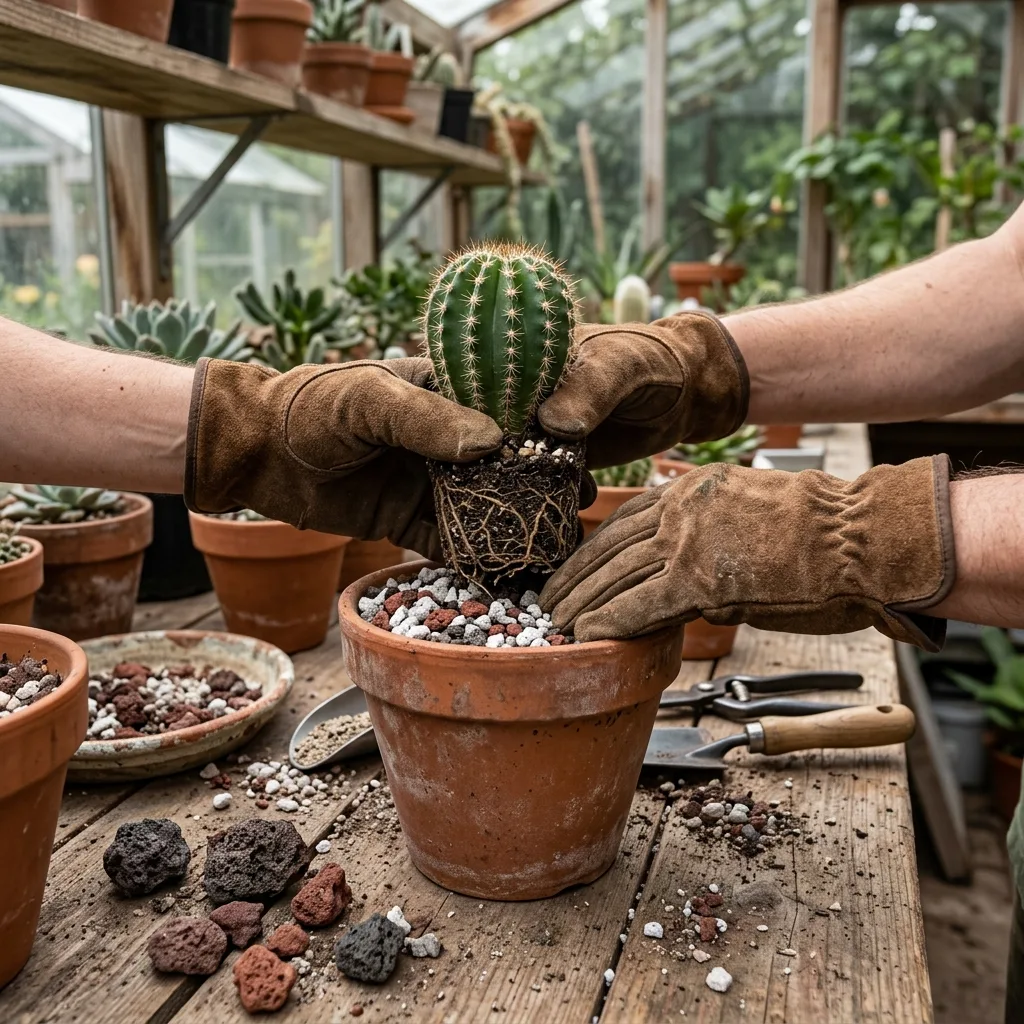
Cactus roots despise dense, peat-heavy, moisture-retentive commercial potting soils. Organic-rich potting soils act like soggy sponges, smothering tender root hairs and inviting anaerobic decay. Your cactus demands an open, rapidly draining, highly porous, mineral-dominated matrix that mimics fractured arid soils.
Regarding pots, unglazed terracotta remains the undisputed gold standard. Its micro-porous earthenware walls breathe, wicking surplus moisture out through the sides and allowing ambient air to reach the root zone. Ample drainage holes at the base are strictly mandatory.
| Component Category | Material Name | Mix Ratio (%) | Cultivation Role and Function |
|---|---|---|---|
| Inorganic Mineral | Horticultural Pumice (3–6 mm) | 35% | Superior porosity, structural air pockets, rapid drainage |
| Inorganic Mineral | Lava Rock (Scoria) / Zeolite | 25% | Anchorage, micro-nutrient exchange capacity, anti-compaction |
| Inorganic Grit | Coarse River Sand / Quartz Grit | 15% | Prevents silt packing and establishes vertical percolation channels |
| Organic Foundation | Sifted Coco Coir / Aged Leaf Mold | 20% | Minimal moisture buffering and mild organic anchoring base |
| Protective Additive | Crushed Horticultural Charcoal | 5% | Natural antifungal barrier, sweetens soil, filters contaminants |
5. Flower Induction Strategies and Nutritional Regimes
The mournful cry of many houseplant parents—'Why does my cactus never bloom?'—almost always stems from a failure to replicate the rhythms of nature. In cacti, floral bud morphogenesis requires two distinct seasonal triggers: a cold, bone-dry winter dormancy period followed by rising springtime temperatures, surging direct sunlight, and a targeted potassium supply.
As early spring signals the end of dormancy and you spot the first glistening new spines or fresh epidermal growth, gradually reintroduce watering. At this exact threshold, nutritional support becomes paramount. Never feed desert cacti standard, nitrogen-heavy houseplant fertilizers; excessive nitrogen forces soft, watery, bloated green tissue that splits easily, ruins structural aesthetics, and outright suppresses blooming.
Select a specialized cactus formulation low in nitrogen and fortified with phosphorus and potassium (such as an NPK 4-10-10 or 5-15-15). Apply it at half-strength once monthly during the active vegetative cycle of spring and early summer. By mid-autumn, cease all nutritional inputs entirely to let the plant harden off for winter rest.
6. Propagation: Stem Cuttings, Offsets, and Grafting
Propagating cacti is an art form rooted in surgical hygiene and botanical patience. The most dependable method involves taking stem cuttings or separating baseline offsets ('pups'). In nature, segments kicked or knocked loose by grazing camels fall to the ground and take root; you can replicate this survival dynamic right at home.
- Offsets and Stem Cuttings: Sever the offset cleanly using a sterilized scalpel. NEVER plant a freshly cut cactus piece directly into moist soil. The open wound must dry in a warm, shaded, well-ventilated space for 4 to 10 days until it forms a hard, silver-gray callus layer. Once callused, place the cutting upright on dry mineral grit; withhold water entirely for the first 2 to 3 weeks until adventitious roots sprout, offering only a gentle misting around the pot rim.
- Cactus Grafting: Mutant cultivars lacking photosynthetic chlorophyll (such as the bright ruby-red or neon-yellow Gymnocalycium mihanovichii forma rubra) cannot survive on their own root systems. They are grafted atop vigorous, disease-resistant rootstocks such as Hylocereus undatus or Trichocereus. Aligning the circular vascular cambium rings of both rootstock and scion, and binding them firmly with elastic bands for 10 to 14 days, permanently fuses their tissue pathways.
7. Defending Against Fungal Pathogens and Common Pests
The chief nemesis of any indoor cactus collection is the silent onset of fungal root and basal stem rot, triggered by pathogens such as Fusarium, Phytophthora, or Pythium. These organisms thrive in cold, waterlogged soils starved of oxygen. If the base of your cactus takes on a translucent yellow or brownish hue and yields with a soft, squishy give when gently pressed, rapid surgical triage is essential.
Unpot the afflicted plant immediately, shake loose the substrate, and slice away all darkened, necrotic tissue using a flaming-hot or alcohol-wiped blade until only pristine, healthy green flesh remains. Dust the exposed wound generously with micronized elemental sulfur or horticultural cinnamon—a potent natural antifungal. Let the wounded survivor dry bare-root in open air for at least a full week before repotting into completely fresh, pasteurized mineral media.
On the entomological front, the undisputed scourge is the mealybug (family Pseudococcidae). Clustering like sticky bits of white cotton deep inside areoles and between ribs, they feed with mouthparts as unyielding as a camel's palate, draining plant vitality and introducing secondary infections. Combat them by dabbing individuals directly with a cotton swab soaked in 70% isopropyl alcohol, followed by an evening application of cold-pressed neem oil or a targeted systemic insecticide for stubborn infestations.


Reader Reviews & Comments 4 Reviews
Eleanor Vance
Clara Higgins
Julian Thorne
Marcus Sterling
Leave a Review & Rating
Share your plant care tips, experiences, or questions with our succulent community.