






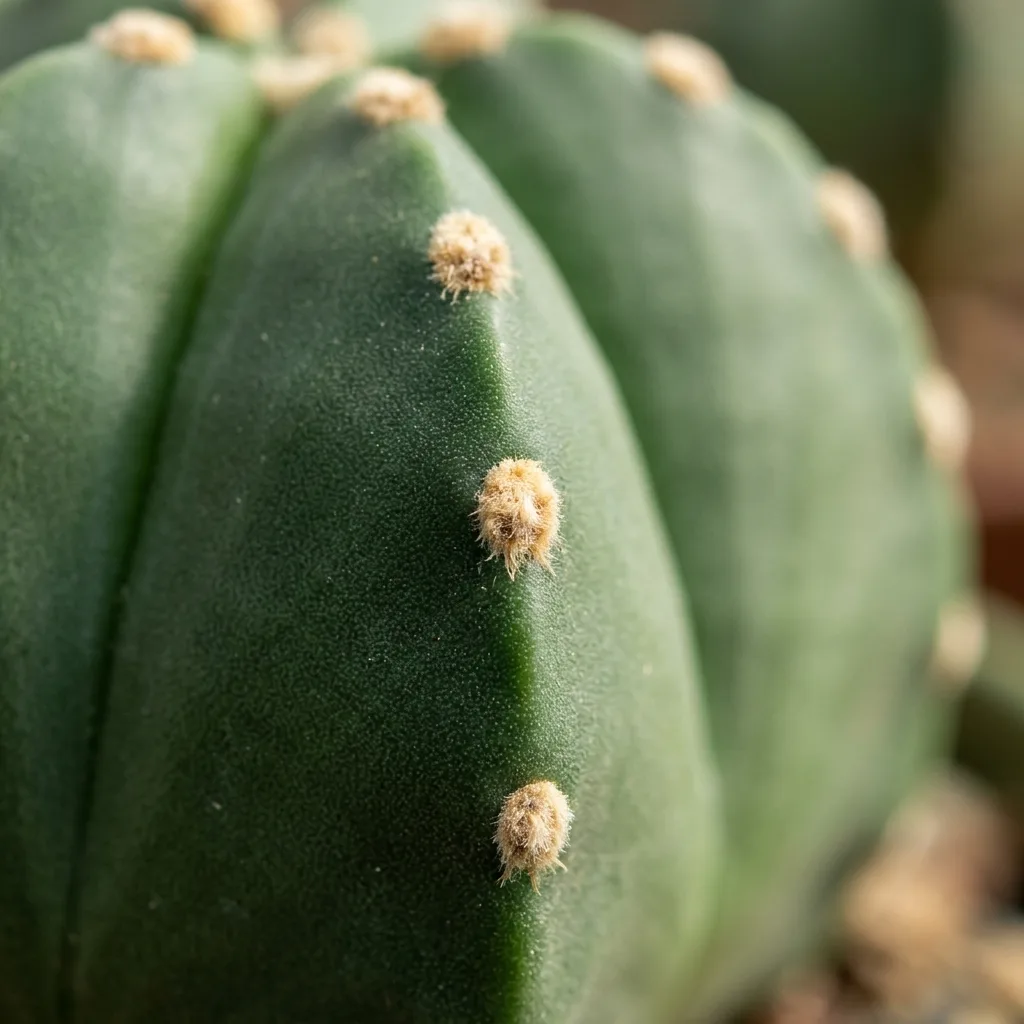
Across the scorched, limestone-strewn ridges of northern Mexico's Sierra Madre Oriental, nature has sculpted one of its most mesmerizing botanical masterpieces. While the wild type camouflages itself beneath thousands of flecked white trichomes, the exquisite 'var. nudum' variety presents a smooth, unblemished, deep-green epidermis shorn entirely of protective scales. Its symmetrically ribbed body echoes the angular lines of a liturgical headdress, elevating it in the eyes of devoted collectors to the status of a living jade sculpture.
Because of its fleshy, spineless ribs, casual beginners frequently mistake this species for a non-cactus succulent; in truth, it is one of the most distinguished and delicate members of the Cactaceae family. Introducing this naked marvel to your collection brings millions of years of evolutionary wisdom from the mineral-dense limestone canyons of Coahuila and San Luis Potosí straight onto your windowsill. However, because it lacks the natural solar shield provided by dense flocking, it requires a disciplined, highly nuanced cultivation strategy within indoor and greenhouse settings.
1. Taxonomic Identity, Areole Architecture, and Spine Morphology
Taxonomically defined as the glabrous, spineless form of Astrophytum myriostigma Lem., var. nudum lives up to its generic name, which translates directly from ancient Greek as 'star plant.' Viewed from above, specimens typically reveal a flawless five-ribbed pentagram (though juvenile seedlings occasionally display 3 or 4 ribs, while venerable mature specimens can develop 6 to 8). These ribs function like a living concertina: shrinking inward during severe droughts to minimize internal cell volume, and expanding smoothly without tissue tearing upon the arrival of monsoonal rains.
Defying common cactus conventions, the areoles perched along the rib ridges bear no defensive, piercing spines. Instead, the areoles produce only subtle, felted tufts of brownish or greyish wool during their earliest stages of development. The millions of microscopic white trichomes (trichome scales) that cloak standard A. myriostigma stems to reduce boundary-layer transpiration are genetically absent here. This smooth epidermis dramatically maximizes chlorophyll visibility, yielding an intoxicating, saturated emerald luster. The inevitable tradeoff, however, is that this naked skin is significantly more vulnerable to solar tissue scalding when exposed to direct, unfiltered midday sun.
2. Lighting Dynamics, Solar Thresholds, and Ventilation Protocols
Like many extreme desert xerophytes, Astrophytum species utilize Crassulacean Acid Metabolism (CAM) photosynthesis. Under this biochemical regime, the plant holds its stomata tightly closed throughout blistering daylight hours to curb vapor loss, opening them only under the cool night sky to sequester atmospheric carbon dioxide. Running this internal biological engine efficiently requires robust light levels coupled with a pronounced diurnal temperature swing between day and night.
Because the nudum morph lacks a reflective trichome barrier, direct midday sunlight magnified through window glass (particularly between 12:00 PM and 3:00 PM) can cause catastrophic epidermal sunburn, visible as reddish stress mottling or irreversible beige-white callousing. Aim for 6 to 8 hours of brilliant, bright indirect light daily, or unshielded early morning sun followed by filtered afternoon exposure using sheer drapery. If the apex of the cactus begins stretching into a pale, narrow cone, the plant is suffering from etiolation. Insufficient photon density will permanently ruin its prized geometric symmetry.
3. Irrigation Regimes and the Critical Winter Dormancy Period
Watering a Bishop's Cap cactus is never a calendar-driven chore; it is an observational discipline governed by cellular turgor pressure. During the active growth window of spring and summer, practice the classic 'soak and dry' technique. Apply water around the perimeter of the pot rather than directly over the apical meristem or root crown, allowing moisture to flush freely through the drainage apertures. Discard any residual water collected in the drip tray immediately. Never water again until the substrate has dried out completely—not merely on the top surface, but throughout the deep root zone at the bottom of the pot.
As autumn draws to a close and ambient temperatures dip below 15°C (59°F), taper watering frequencies drastically. From November through mid-March, enforce a strictly observed, absolute dry winter dormancy. Kept in a cool microclimate (ideally between 8°C and 12°C / 46°F and 54°F) without a single drop of water, the cactus safely concentrates cellular sap and sugars, naturally lowering its freezing point and warding off frost injury. This uninterrupted drought period is the precise physiological trigger needed to activate latent floral buds for the upcoming summer display.
4. High-Mineral Substrate Architecture and Pot Selection
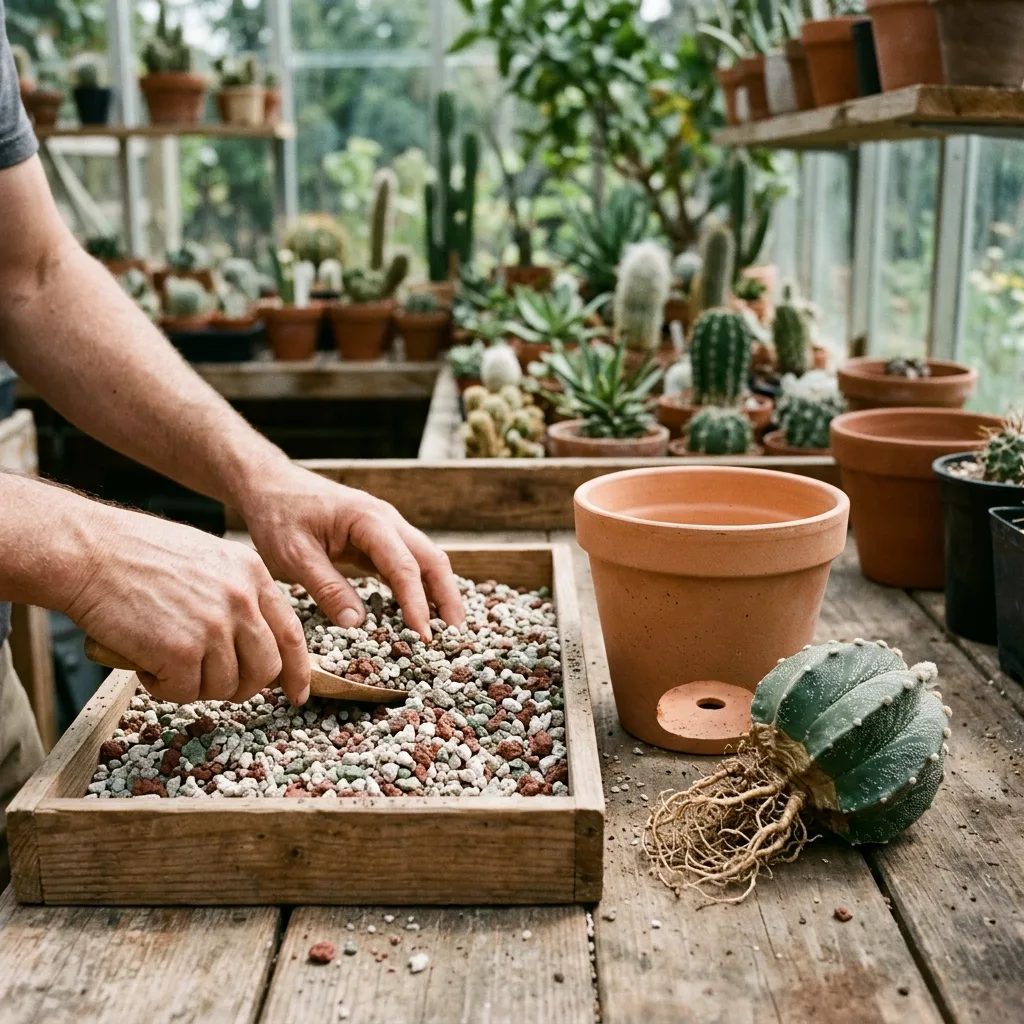
Having evolved in mineral clefts within calcareous mountain scree, Astrophytum myriostigma naturally despises peat-heavy commercial potting soils. Organic substrates act like waterlogged sponges, swiftly suffocating the delicate lateral root system. The ultimate potting medium must consist of 80% to 85% inorganic porous minerals, balanced with merely 15% to 20% well-sifted, fiber-free organic cactus soil.
| Mineral / Organic Component | Proportion (%) | Agronomic Function & Root-Zone Benefits |
|---|---|---|
| Horticultural Pumice (3–6 mm) | 35% | Maximizes pore porosity and aeration; retains structural matrix without compaction. |
| Crushed Lava Rock / Zeolite | 30% | Releases vital trace micronutrients and adds physical ballast to steady the specimen. |
| Crushed Limestone / Coarse River Sand (Washed) | 15% | Supplies essential calcium ions and preserves an alkaline root-zone pH balance. |
| Fine Coco Coir / Sifted Leaf Mould | 20% | Provides a lightweight, micro-dosed organic base for root anchor filaments. |
Pot selection is equally decisive. Glazed ceramic and plastic containers prevent lateral air exchange, locking moisture deep inside the soil mass for weeks. Porous, unglazed terracotta pots act as a vital safety valve, wicking away excessive hydration through their walls. Because Astrophytum develops a compact, fibrous root system rather than an enormous taproot, wide, relatively shallow containers with generous drainage holes are vastly superior to tall, narrow pots.
5. Blooming Strategies and Nutritional Supplements
An Astrophytum myriostigma var. nudum generally reaches sexual maturity at approximately 4 to 5 years of age, when the stem measures roughly 4 to 5 cm (1.5 to 2 inches) in diameter. After completing a dry, cool winter dormancy, fuzzy, deep-bronze buds begin to emerge from the areoles lining the crown in late spring. These develop into satiny, lemon-yellow blooms measuring 4 to 6 cm across, shimmering with a metallic sheen; some localized cultivars occasionally display an orange-red throat.
To support full flower emergence without bud abortion, feed the plant during its active vegetative cycle (May through August) using a specialized low-nitrogen, high-phosphorus, and high-potassium cactus fertilizer (such as an NPK 5-10-15 or 4-8-12 formulation). Excessive nitrogen prompts rapid, unnatural cellular elongation that splits the ribs and inhibits floral development. Always dilute fertilizer down to one-quarter (1/4) of the manufacturer's recommended strength and apply no more than once per month.
6. Propagation, Seed Rearing, and Grafting Dynamics
Unlike clustering cactus varieties that produce abundant offsets, Astrophytum myriostigma maintains a solitary, self-contained architecture. Consequently, stem cuttings are out of the question. Generative propagation via seed is the premier method. The seeds are notably large, helmet-shaped, and dark brown to glossy black; when sown on a mineral nursery mix under high humidity at 22°C to 26°C (72°F to 79°F), they germinate rapidly within 5 to 10 days.
Commercial growers frequently employ grafting to accelerate the naturally slow pace of nudum seedlings. By joining the vascular cambium of a tiny seedling onto vigorous rootstock such as Hylocereus undatus or Echinopsis, vegetative development accelerates four- to fivefold within a single season. The caveat is that grafted specimens often lose their flattened, squat stature, adopting an unnaturally swollen profile. In high-end botanical collections, slow-grown specimens cultivated on their own natural root systems command the highest horticultural esteem.
7. Defending Against Fungal Pathogens and Pests
The single greatest threat to Astrophytum is basal stem rot prompted by fungal complexes such as Fusarium and Phytophthora. If the collar of the plant rests continuously against moist organic soil, airborne or subterranean fungal spores will infiltrate the cellular tissue. The definitive preventive measure is applying a 1 to 2 cm top-dressing collar of coarse pumice, lava rock, or zeolite beneath the plant crown, keeping the delicate neck bone-dry.
Mealybugs (Pseudococcidae) might seem less likely to colonize a spineless surface, yet they routinely hide deep within the rib furrows and around the protected apical meristem. Inspect the crown regularly; infestations should be cleared using cotton swabs dipped in 70% isopropyl alcohol, followed by targeted applications of horticultural neem oil or systemic insecticides. Spider mites (Tetranychidae) can also scar the nudum epidermis, leaving dull, rust-colored patches that signal excessively dry, stagnant atmospheric conditions.


Reader Reviews & Comments 4 Reviews
Claire Montgomery
Julian Vance
Sophia Reynolds
Markus Lindner
Leave a Review & Rating
Share your plant care tips, experiences, or questions with our succulent community.