






Look out across the scorching horizons of the Sonoran, Atacama, or Chihuahuan deserts, and you will witness iconic cacti standing resolute against cracked crusts and dancing mirages. In these relentless biomes where annual rainfall is vanishingly scarce and daytime temperatures regularly eclipse 45°C (113°F), how can a single cactus draw tons of water from the earth during a brief, violent flash flood? The greatest misconception among houseplant lovers and succulent enthusiasts is that cacti either 'create water out of thin air' or require virtually none at all. The physiological truth is far more magnificent: cacti are endowed with the most sophisticated hydraulic pumps and intelligent cellular storage architectures ever conceived by nature.
A desert cactus’s water harvesting strategy cannot be chalked up to a single deep taproot. Rather, it is governed by an expansive, shallow web of 'rain roots' sprawling merely inches beneath the surface, paired with microscopic spine grooves engineered to funnel nocturnal fog directly to the stem. Let us delve into this extraordinary natural engineering at the cellular level and learn how to mirror these ancient survival mechanisms on your living room windowsill, rendering root rot a thing of the past.
1. Taxonomic Identity, Areole Architecture, and Spine Morphology
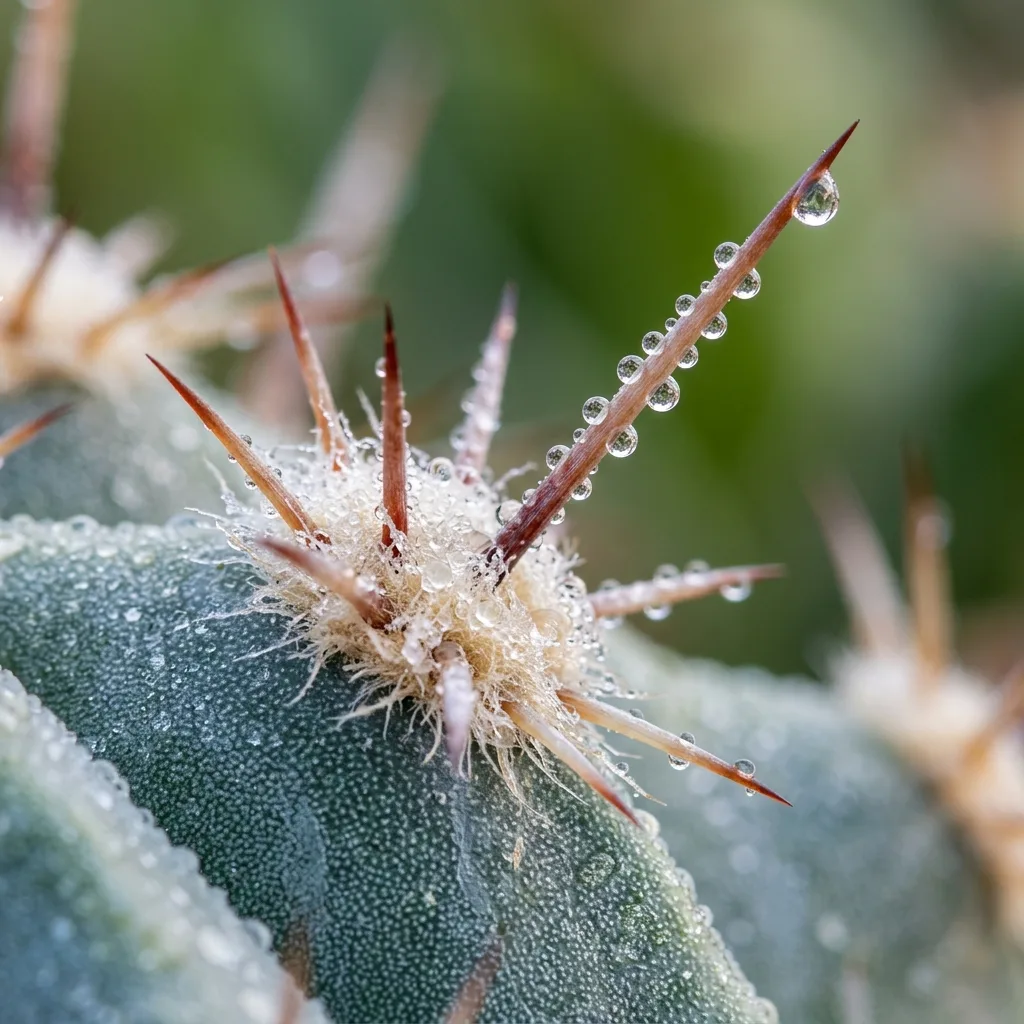
The definitive anatomical passport distinguishing members of the family Cactaceae from all other succulent plant groups is the areole—a highly condensed, specialized bud cushion. The first line of defense guarding a desert cactus's hydraulic balance is the array of spines emerging from these very areoles. Over evolutionary epochs, cacti completely discarded conventional leaves, reducing the catastrophic moisture loss caused by transpiration to absolute zero. Yet spines serve as far more than deterrents against desert herbivores; they operate as microscopic aerial water condensers.
When desert temperatures plummet at nightfall—often dipping to 10°C (50°F) or even down toward freezing—the relative humidity condenses onto the rough, conical spine tips as microscopic droplets of dew. Governed by a natural Laplace pressure gradient, these water beads spontaneously glide along microgrooves from the narrow tip down toward the spine base, arriving at the hygroscopic trichome hairs within the areole. While forest-dwelling epiphytic cacti (such as Schlumbergera or Epiphyllum) rely on collecting condensation within tropical tree canopies, true desert sovereigns like Carnegiea gigantea (the majestic Saguaro) or Echinocactus platyacanthus utilize pleated, accordion-like ribs to channel this intercepted moisture straight down to the root flare. Furthermore, the powdery farina coating and the thick waxy cuticle layering the epidermis serve as nature’s ultimate sunscreen; this protective barrier locks internal hydration within the storage parenchyma while deflecting harmful ultraviolet radiation.
2. Sunlight Intensity, CAM Photosynthesis, and Aeration Standards
A desert cactus’s ability to gather and store moisture within its tissues is inextricably linked to Crassulacean Acid Metabolism (CAM) photosynthesis. Conventional foliage plants open their stomata (microscopic breathing pores) during daylight hours to take in carbon dioxide, inadvertently squandering enormous amounts of water to evaporation. Cacti, by contrast, seal their stomata tightly during the blistering daytime heat to halt transpiration entirely. Only during the cool desert night do they open their pores, capturing CO2 and chemically stabilizing it in the form of malic acid within their vacuoles. Once the sun rises, they utilize this stored malic acid to complete the light-dependent reactions of photosynthesis without venting a single drop of water.
For this biological rhythm to operate properly within an indoor environment, cacti demand at least six hours of unfiltered, direct sunlight daily (ideally via an unobstructed south- or west-facing window). Deprived of adequate solar radiance, a cactus cannot break down accumulated malic acids, lose cellular turgor pressure, and succumbs to insidious etiolation (pale, spindly, distorted growth). Equally paramount is continuous ambient air circulation. In stagnant, stifling rooms, moisture lingers around the base, starving root zones of critical oxygen. Providing a gentle, persistent breeze replicates natural desert currents, strengthening epidermal cell walls and preserving optimal turgor.
3. The Wet-and-Dry Cycle and the Critical Winter Dormancy Period
Perhaps the most jaw-dropping hydraulic adaptation in the desert is the rapid genesis of 'transient rain roots.' When the desert floor is bone-dry, a cactus allows its microscopic hair roots to desiccate and slough off, hermetically sealing itself from the arid soil to prevent outward capillary water loss. When a torrential thunderstorm abruptly saturates the terrain, the cactus deploys billions of new absorbing root hairs in a mere 2 to 8 hours, sucking moisture from the gravel like a vacuum. As its parenchymal cells drink, the accordion ribs expand noticeably, laying down reserves calculated to endure long months of subsequent drought.
Replicating this natural phenomenon indoors comes down to one cardinal rule: the soak-and-dry watering method. Pampering a cactus with periodic, shallow spoonfuls of water is not kindness; it simply suffocates the root core while leaving active lower roots perpetually parched. You must saturate the entire pot until water drains freely from the base, and then permit the potting mix to dry out 100% from top to bottom before even considering the next watering.
4. High-Mineral Substrates and Breathable Planters
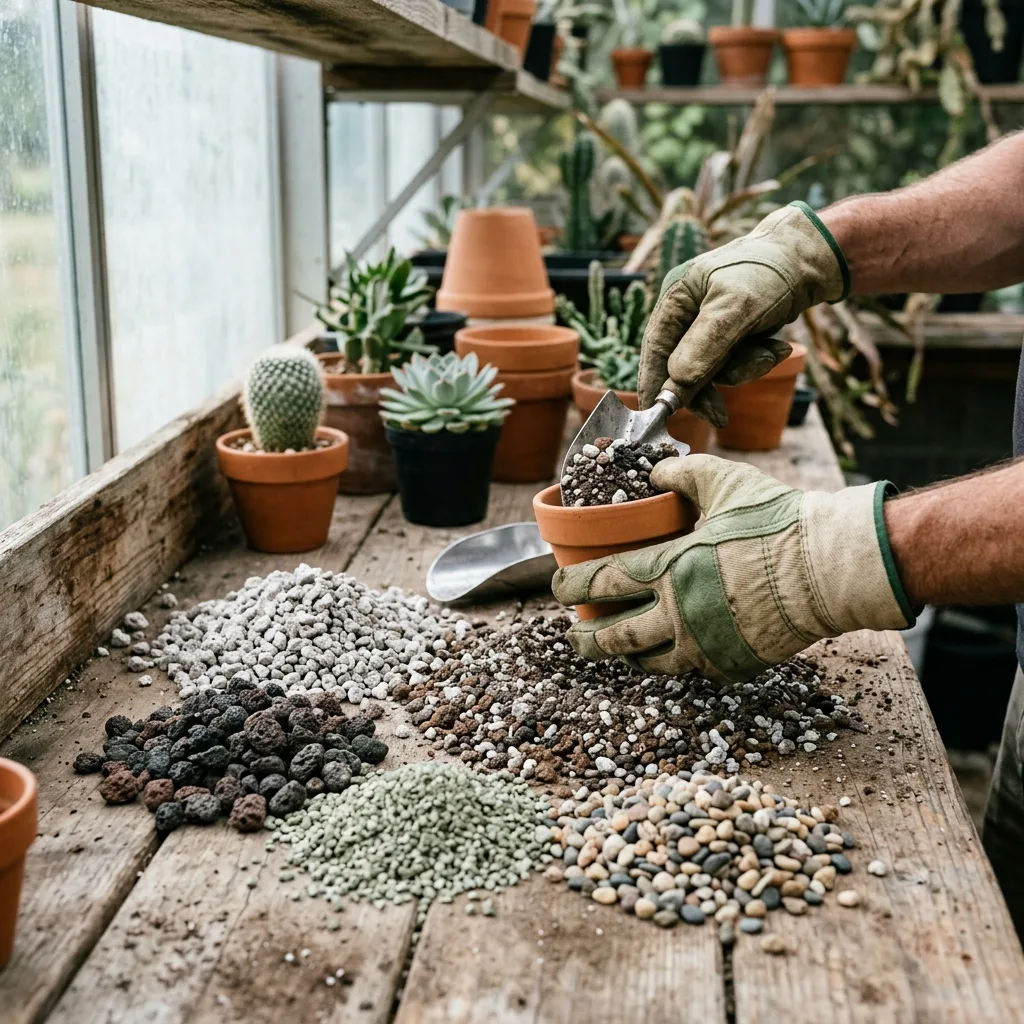
The roots of arid-zone cacti will quickly suffocate in traditional peat moss, heavy potting compost, or garden loam. In their wild habitats, they anchor within fractured granite, limestone crevices, porous volcanic strata, and coarse alluvial grit. Cactus roots do not crave lingering soil moisture; they need fleeting moisture surrounded by abundant atmospheric oxygen. Container selection is equally decisive: always prioritize unglazed terracotta pots equipped with generous drainage holes. Vitrified ceramic and non-porous plastic vessels trap moisture against the root perimeter, creating an ideal breeding ground for devastating root diseases.
The following substrate formulation accurately simulates the rapid-draining, mineral-dominant scree found in arid ecosystems:
| Substrate Component | Ratio (%) | Function & Botanical Benefit |
|---|---|---|
| Pumice (3–6 mm particle size) | 40% | Porous volcanic framework that prevents compaction and supplies roots with maximal oxygen. |
| Crushed Lava Rock / Zeolite | 25% | Delivers essential structural micro-nutrients while providing rigid, non-degrading drainage channels. |
| Coarse Washed Horticultural Grit / River Sand | 15% | Accelerates immediate water percolation through the upper soil matrix without clumping. |
| Sterile Low-Peat Cactus Mix / Sifted Leaf Mould | 15% | Supplies the minimal organic anchoring matrix and trace nutritional elements needed for root establishment. |
| Horticultural Activated Charcoal | 5% | Inhibits opportunistic bacterial and fungal proliferation while stabilizing substrate pH levels. |
5. Flowering Induction and Targeted Nutritional Support
Following their periodic desert soakings, cacti put on one of nature's most stunning displays: large, silky blooms in radiant jewel tones. Contrary to what many assume, a cactus does not bloom because it has been kept in luxurious, perpetual warmth; flowering is the triumphant celebration of having survived a rigorous winter dormancy. Cacti initiate floral primordia deep within their areoles during this exact phase of cold, dry rest.
As spring conditions climb consistently above 20°C (68°F) and the initial deep soaking is applied, the plant channels its recharged hydraulic stores straight into swelling flower buds. To sustain this energetic output throughout the active growing period (May to August), administer a specialized, low-nitrogen, high-phosphorus and potassium fertilizer (such as NPK 5-10-10 or 4-8-12) diluted to quarter-strength once a month. Excessive nitrogen softens cellular walls, promotes watery, bloated growth, and leaves the plant critically susceptible to rot and pest attacks.
6. Propagation, Callusing Dynamics, and Grafting Techniques
Working with the moisture-laden internal tissues of cacti requires strict aseptic technique during propagation. When harvesting offsets (pups) or taking stem cuttings, the severed tissue instantly weeps a viscous mucilage rich in stored water. Planting freshly cut, unhealed cactus flesh straight into damp potting mix is an open invitation for lethal fungal pathogens.
Any cutting must be kept in a dry, warm, and shaded spot with generous airflow for at least 5 to 10 days to form a firm, grayish-white callus layer (protective corking) over the wound. Only once fully callused should the cutting be rested on a totally dry, grit-rich substrate. Refrain from watering for 2 to 3 weeks until the first adventitious roots emerge, allowing environmental humidity alone to prompt root initiation. For chlorophyll-deficient cultivars—such as the vibrant neon-pink or crimson mutants of Gymnocalycium mihanovichii—propagation relies on apical grafting. Since these mutations cannot produce their own sugars via photosynthesis, their vascular cambium rings are aligned and bonded onto hardy green rootstocks (typically Hylocereus undatus).
7. Defending Against Internal Rot and Fungal Pathogens
The primary hazard facing container-grown desert cacti is not drought—it is overzealous hydration. When parenchymal cells absorb water beyond their structural capacity, internal cell walls rupture (edema), leaving open pathways for pathogens such as Fusarium or Phytophthora. What begins as a subtle discoloration at the subterranean soil line can turn the interior of an entire specimen to liquid mush in a matter of days.
Should you observe sudden yellowing, dulling of the epidermis, or squishiness at the base, immediate surgical intervention is imperative. Unpot the cactus immediately, wash away the soil, and excise all compromised, brown tissue with an ethanol-sterilized scalpel until only clean, healthy green and cream flesh remains. Dust the exposed wound generously with sulfur powder or ground cinnamon, allow it to dry and callus in a breezy setting for 7 to 10 days, and replant in a sterile, fresh pumice-based mix to foster root regeneration.


Reader Reviews & Comments 3 Reviews
Eleanor Vance
Marcus Sterling
Julian Thorne
Leave a Review & Rating
Share your plant care tips, experiences, or questions with our succulent community.