






Rising from the arid plateaus of Mexico, Agave salmiana (commonly known as the 'Giant Agave' or 'Maguey Pulquero' for its historical role in pulque production) stands as one of the most imposing and architecturally striking species in the succulent kingdom. Its thick, fleshy, curved leaves lined with prominent marginal teeth and an expansive rosette reaching toward the sky make this plant far more than an ordinary succulent—it serves as the commanding focal point of landscapes and expansive botanical collections.
Reaching heights of 2 to 3 meters and diameters of 3 to 4 meters in its native habitat, this monumental species has symbolized resilience in extreme climates and served as the source of a sacred fermented beverage since the Aztec era. What distinguishes Agave salmiana from other agaves is the sculptural imprint left on its foliage: as new leaves unfurl from the central core, they leave deep, embossed leaf-bud impressions along the outer foliage, resembling chiseled plates of natural armor.
Whether cultivated as a juvenile potted specimen indoors or grown directly in ground beds across Mediterranean and mild-winter regions, preserving the plant's robust, sculptural silhouette requires an uncompromising care regimen: unobstructed solar radiation, a highly aerated inorganic substrate, and disciplined moisture cycles. Crafted with field insights from botanical horticulturist Rıfat Özkan, this master guide examines the cellular mechanisms and professional care protocols needed to cultivate this desert marvel.
1. Botanical Identity and Morphological Characteristics
Classified under the family Agavaceae (incorporated into Asparagaceae under modern APG taxonomy), Agave salmiana is a classic monocarpic perennial. It flowers only once at the culmination of its lifecycle, channeling decades of accrued photosynthetic sugars and hydraulic reserves into an immense, candelabra-form inflorescence that can soar 7 to 10 meters into the air. Once seed dispersal concludes, the mother rosette naturally senesces and dies. However, this mortality is far from final; the plant ensures its survival by producing numerous basal offsets (pups) surrounding the parent base.
Morphologically, the leaves are obovate to lanceolate, remarkably thick at the base, widening through the midsection, and recurving gracefully before terminating in a formidable, dark reddish-brown to black apical spine. The foliar epidermis is coated with a substantial layer of epicuticular wax crystals, known as farina. This pale layer reflects excessive desert ultraviolet radiation and minimizes non-stomatal transpiration, giving the leaves their distinctive matte, grayish blue-green hue.
At the physiological level, Agave salmiana operates via CAM (Crassulacean Acid Metabolism). To eliminate daylight evaporative water loss under high thermal loads, the plant keeps its stomata hermetically sealed during the daytime, opening them strictly at night. The carbon dioxide sequestered after dusk is stored within large vacuoles as malic acid, which is decarboxylated and utilized in standard photosynthetic pathways once daylight returns. This metabolic pathway is the primary cellular engine enabling this giant succulent to thrive across prolonged months of absolute drought.
2. Light Requirements and Indoor Positioning
Agave salmiana is fundamentally photophilic, biologically dependent on intense, unfiltered direct sunlight. A minimum of 6 to 8 hours of direct solar exposure daily is imperative to sustain thick leaf cross-sections, rigid curvature, and compact rosette geometry. When deprived of sufficient irradiance, the plant quickly undergoes etiolation: foliar margins attenuate, the structural rosette loses its tension, foliage pales to a dull light green, and overall mechanical resistance declines sharply.
When overwintered indoors or cultivated within conservatories, it must be placed directly adjacent to unobstructed south- or southwest-facing glass exposures. Sheer curtains or low-emissivity window tints can reduce lux levels below the threshold needed for healthy CAM synthesis. On terraces and patios, position the specimen away from foot traffic to protect passersby from apical spines, ensuring ample atmospheric movement around the foliage.

3. Irrigation Discipline: The 'Soak and Dry' Protocol
Excessive irrigation and persistent substrate moisture are the primary causes of failure in cultivating Agave salmiana. Its specialized root system requires high oxygen diffusion rates within the pore space. Prolonged saturation surrounding root hair cells induces rapid anoxia (cellular suffocation), compromising root membranes and inviting opportunistic soil-borne fungal pathogens.
Watering must follow a strict 'Soak and Dry' cycle. Never irrigate while residual moisture remains within the root zone; verify complete dryness throughout the depth of the pot before reapplying water. During hydration, apply water generously and uniformly until it drains freely from the base, ensuring no pooled water remains in drainage trays longer than 10 minutes.
Irrigation frequency shifts dynamically across seasonal cycles: during the active vegetative window of spring and summer, watering once every 10 to 15 days is typically sufficient depending on ambient temperature. Extend this window through autumn; during winter dormancy, reduce hydration to a light monthly or bi-monthly application merely to prevent root hair desiccation.
4. Substrate Composition and Container Selection
In its native Mexican highlands, Agave salmiana inhabits rocky, limestone-rich soils characterized by low organic content and exceptional mineral drainage. When translating this species to container culture, the substrate must prioritize rapid gravitational drainage, structural longevity, and high capillary aeration over moisture retention.
Container material is equally vital. Unglazed, porous terracotta or thick, breathable cast-concrete pots are superior to glazed ceramics and plastics, which lock moisture inside and delay dry-out times. Given the sheer weight and outward leverage of mature foliage, choose containers with a wide base and low center of gravity to prevent structural tipping.
| Substrate Component | Ratio (%) | Botanical Function |
|---|---|---|
| Pumice (3-6 mm) | 35% | Provides sustained macroporosity, structural aeration, and root oxygenation. |
| Lava Rock / Scoria | 25% | Enhances root anchoring, contributes trace minerals, and prevents compaction. |
| Coarse River Sand / Crushed Granite | 15% | Promotes rapid drainage and keeps micro-capillary pathways open. |
| Coarse Perlite | 10% | Lightens the blend and creates micro-pockets of air around feeder roots. |
| Low-Humus Cactus Soil | 15% | Binds essential micronutrients while maintaining minimal base moisture retention. |
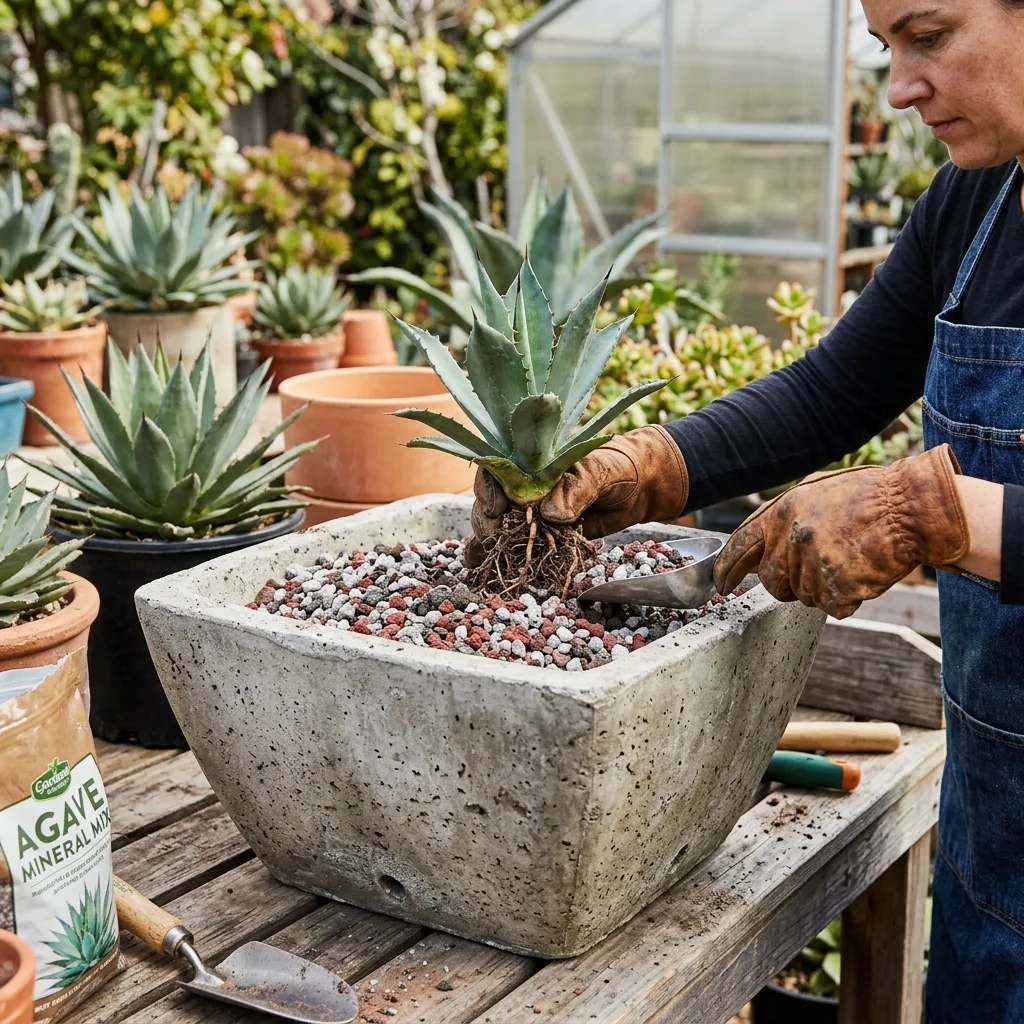
5. Step-by-Step Vegetative Propagation
While Agave salmiana can be propagated from seed, its monocarpic life cycle makes seed availability infrequent, and seed-grown specimens take years to exhibit mature architectural traits. The most practical, reliable, and clonal method of propagation is the separation of basal offsets (pups).
- Select the Optimal Season: Detach offsets during active vegetative growth in mid-spring to early summer when ambient warmth accelerates rapid adventitious rooting.
- Assess Pup Maturity: Ensure the pup has attained at least one-quarter to one-third the size of the mother plant and has begun forming its own nascent root system.
- Sever the Underground Stolon: Using a sterilized, razor-sharp pruning knife, make a clean, perpendicular incision through the subterranean stolon connecting the pup to the parent plant, taking care not to gouge the mother stem.
- Allow Callus Formation: Never pot fresh offsets immediately. Place the pup in a warm, dry, shaded area with good air circulation for 5 to 7 days until the cut surface forms a dry, corky callus. This biological seal prevents pathogenic fungi from penetrating open vascular tissues.
- Plant into Mineral Substrate: Set the callused pup into slightly damp, highly mineral agave substrate. Anchor firmly, and withhold water for the first 7 to 10 days to encourage roots to actively seek out moisture.
6. Common Pathogens, Pests, and Diagnostic Solutions
While remarkably robust against environmental adversity, Agave salmiana can fall victim to specific pests and physiological disorders when stressed:
- Agave Snout Weevil (Scyphophorus acupunctatus): The most devastating biological threat to agaves. Adult weevils puncture the leaf bases to oviposit, and the resulting grubs bore into the central stem tissue, causing sudden, irreversible collapse of the entire rosette. Preventive spring applications of a systemic insecticide are essential in endemic zones.
- Root and Crown Rot (Fusarium and Phytophthora): Fungal pathogens induced by overwatering and compacted soils. Symptoms include foliar softening, basal blackening, and a foul fermentation odor. In early stages, unpot the specimen, excise all necrotic tissue, treat root remnants with a systemic fungicide, and replant in completely dry, sterile substrate.
- Mealybugs and Scale Insects: These sap-sucking pests congregate deep within the protective crevices of lower leaf sheaths. Their feeding depletes sap reserves, distorts new growth, and excretes honeydew that fosters black sooty mold. Eradicate small colonies manually with 70% isopropyl alcohol on cotton swabs, or apply systemic horticultural controls for heavy infestations.
7. Seasonal Maintenance Calendar and Professional Cultivation Tips
Synchronize care routines with the plant's seasonal rhythm. During spring (March to May), the plant exits winter rest; progressively increase hydration and apply a single half-strength dose of a low-nitrogen, high-potassium-and-phosphorus succulent fertilizer. Throughout summer (June to August), sustain full sun exposure and reliable 'soak and dry' watering cycles.
As autumn arrives (September to November) and ambient temperatures drop, photosynthetic output decelerates. Cease all fertilization and widen the intervals between watering sessions. During winter (December to February), Agave salmiana exhibits impressive cold hardiness, withstanding brief dips to -6°C to -8°C (21°F to 18°F) only if the substrate is completely dry. Cold, damp roots are universally fatal. Potted specimens should be sheltered in a bright, frost-free space maintained between 5°C and 10°C (41°F to 50°F) with virtually dry soil.


Reader Reviews & Comments 3 Reviews
Marcus Sterling
Julian Vance
Clara Higgins
Leave a Review & Rating
Share your plant care tips, experiences, or questions with our succulent community.