






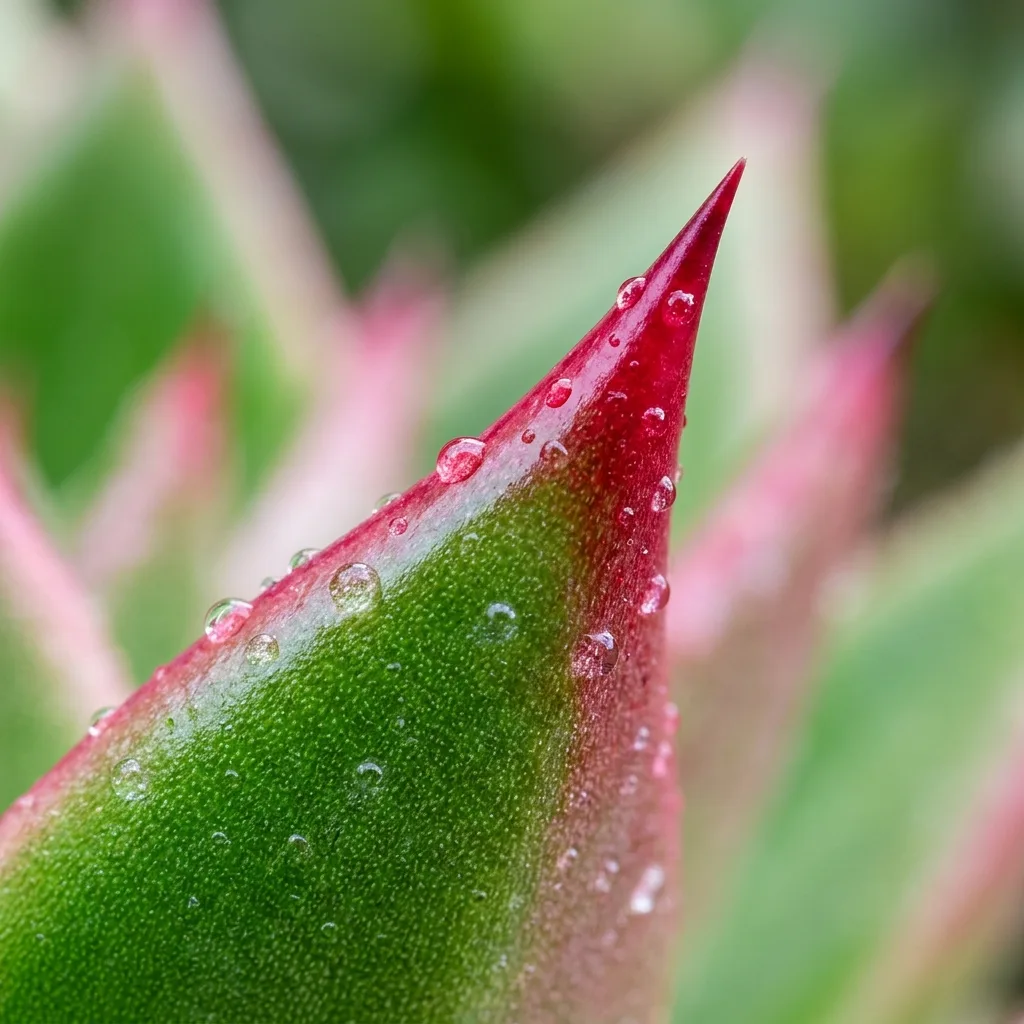
Defying fierce winds and relentless high-altitude sun along the sheer volcanic rock crevices of San Luis Potosí and Hidalgo, Mexico, Echeveria agavoides is widely revered in the succulent community as the 'Molded Wax Agave' or simply the 'Wax Succulent'. Unlike many of its cousins in the genus Echeveria that shield themselves behind a delicate, powdery epicuticular coating (farina), this species secretes a thick, hydrophobic, glossy cuticle that gives its foliage a polished, translucent sheen. This extraordinary morphological armor does far more than refract harsh ultraviolet radiation; it virtually halts cuticular transpiration, granting the plant near-impervious resilience in arid alpine environments.
When you place this architectural rosette on a windowsill or terrace, you welcome millions of years of arid evolutionary refinement into your home. Its rigid, fleshy, incurved leaves evoke the silhouette of a miniature agave, shifting from bright apple-green to vivid shades of vermilion, bronze, and ruby under proper solar stress. Yet sustaining this pristine geometry and lustrous wax in cultivation demands a keen understanding of the physics governing its natural niche. Substrate aeration, internal cellular turgor pressure, and specific light wavelengths represent the foundational triumvirate that ensures your wax succulent thrives for decades.
1. Botanical Identity and Morphological Characteristics
Echeveria agavoides is a hallmark acaulescent (stemless) or extremely short-stemmed rosette-forming perennial within the family Crassulaceae. At full botanical maturity, its solitary rosettes expand between 15 to 30 centimeters in diameter, exhibiting an exceptionally tight, mathematically precise spiraled geometry. Individual leaves measure 5 to 8 cm in length, broad at the base and tapering abruptly into sharply acute apexes. Each leaf tip is crowned with a rigid, mucronate spine-like point, giving the plant its distinct agave-like profile—a trait accurately captured by the specific epithet agavoides, meaning 'resembling an agave'.
The hallmark of this species lies within the specialized epidermal cells that continuously synthesize a thick, waxy lipid layer. This structural glaze reflects intense light wavelengths to shield deeper photosynthetic mesophyll tissues from photoinhibition while anchoring its Crassulacean Acid Metabolism (CAM) respiratory pathway. In late spring and early summer, slender, arching reddish inflorescences stretch 20 to 40 cm above the foliage. Bearing lantern-like, urn-shaped flowers in racemes, they display brilliant coral-pink to fiery red exteriors with contrasting, bright yellow-tipped reflexed petals.
2. Sunlight Dynamics and Indoor Placement
To preserve its compact form and fuel the synthesis of protective anthocyanin pigments that generate its legendary crimson margins, Echeveria agavoides requires an uncompromising volume of photosynthetically active radiation. In habitat, it flourishes under 6 to 8 hours of intense, unfiltered sunlight daily. Within an indoor setting, an unobstructed south-facing or direct west-facing exposure is essential. Deprived of adequate light intensity, the rosette quickly succumbs to etiolation: the internodes stretch, the leaves flatten and recurve downward to capture stray photons, and the vivid ruby tips fade into a dull, pale lime-green.
However, introducing a nursery-grown or shade-adapted specimen directly into blistering midsummer noon heat can overpower even this thick cuticle, producing permanent, unsightly patches of necrotic sunburn. Always implement an acclimatization protocol: start by offering 2 hours of gentle, early-morning sun during the first week, systematically advancing the direct exposure by one hour every three to four days until the plant is fully adapted to full-day illumination.
3. Watering Discipline: The 'Soak and Dry' Protocol
The single most destructive practice in succulent culture is adhering to a predetermined calendar schedule accompanied by timid sips of water. As a drought-adapted succulent endowed with water-storing parenchymal tissue and a transpiration-resistant wax barrier, Echeveria agavoides sustains itself on internal moisture reserves for weeks, sometimes months. The only physiologically sound approach Is the Orange Snowball Cactus? Botanical Care Tips for Growing Rebutia">is the classical 'Soak and Dry' protocol.
Before introducing any water, verify that the substrate has dried out completely through the entire depth of the root ball, not merely the top inch. Insert a slender wooden skewer to the base of the container; if it emerges with the slightest hint of damp soil particles, postpone watering. When moisture is indeed depleted, drench the container thoroughly until water flows freely from the drainage apertures, ensuring the entire root architecture is hydrated. Crucially, discard any drainage runoff accumulated in the saucer within fifteen minutes; roots left submerged in standing water quickly suffocate.
4. Substrate Composition and Container Dynamics
The fibrous root system of the wax succulent is engineered to anchor in fractured mineral substrates that deliver instant drainage and continuous oxygen exchange. Traditional peat-dominant potting soils retain capillary water far too long, starving the delicate root hairs of oxygen and providing an open door to soil-borne pathogens such as Pythium and Phytophthora. Your potting medium must prioritize sharp, coarse mineral aggregates.
Vessel selection is just as consequential. Unglazed terracotta containers are the premier horticultural choice: their micro-porous clay walls permit bidirectional air exchange, drawing excess moisture outward to evaporate evenly. If you utilize plastic or glazed ceramic pots, verify that they feature ample drainage holes and balance the setup by elevating the inorganic ratio of the soil.
| Substrate Component | Ratio (%) | Horticultural Function |
|---|---|---|
| Pumice (3-6 mm) | 35% | Imparts macroporosity, prevents soil compaction, promotes rapid drainage |
| Crushed Lava Rock / Zeolite | 25% | Enhances structural anchor points, balances cation exchange capacity (CEC) |
| Coarse Quartz Grit / Coarse Perlite | 15% | Maintains internal substrate aeration channels and hydraulic conductivity |
| Screened Cactus Peat / Coir Fiber | 25% | Provides essential organic buffer and holds trace micro-nutrients |

5. Step-by-Step Propagation Techniques
Propagating Echeveria agavoides requires slightly more surgical precision than multiplying fragile-leafed echeverias. Because its rigid leaves fuse tightly to the core stem tissue, stem cuttings and basal offsets deliver the highest rates of success.
- Basal Offset (Pup) Division: A robust, mature specimen naturally pushes miniature rosettes around its base during peak spring vigor. Once an offset reaches approximately one-third the size of the parent plant, carefully sever its connecting stolon using a sterilized scalpel. Rest the pup in a dry, shaded, well-ventilated spot for 3 to 5 days until a protective calloused barrier forms over the wound. Set it into dry, mineral-heavy substrate and withhold water for roughly two weeks until the first adventitious feeder roots emerge.
- Stem Beheading (Decapitation): For legacy specimens suffering from basal bareness or historical stretching, sever the upper crown with a clean cut, preserving a 3 to 4 cm clean stem segment. Dust the cut site with elemental sulfur or ground cinnamon, allow it to callous over for 5 to 7 days, and settle it into porous substrate. The beheaded crown establishes an independent root system within 3 to 4 weeks, while the remaining mother stump rapidly generates clusters of new offsets.
- Leaf Propagation: While challenging due to the thickness and broad attachment of the leaves, it remains viable if the leaf base retains its intact axillary meristem tissue. Gently wiggle the leaf side to side until it cleanly pops from the stem without tearing. Callous for 3 days, rest horizontally across dry gritty mix, and provide bright, indirect illumination until plantlets and micro-roots take shape.
6. Common Pests, Pathologies, and Interventions
Although the tough, waxy cuticle acts as an impenetrable shield against many superficial pests, cultural missteps can compromise the plant's defenses:
- Mealybugs (Pseudococcidae): The most pervasive nuisance for wax succulents. These insects nest deep within the tight recesses between leaf axils and beneath the root flare. At the first sign of white, cotton-like wax secretions, spot-treat the invaders with a cotton swab soaked in 70% isopropyl alcohol. In persistent infestations, apply an evening foliar mist of cold-pressed neem oil emulsion, avoiding direct sun the following morning to prevent leaf scalding.
- Root Rot: Triggered by oversaturated, airless substrates. The earliest physiological indicators are lower leaves turning semi-translucent, yellow, and mushy. Unpot the plant immediately, amputate all compromised, black, or threadbare root tissues with sterilized shears, allow the healthy crown to desiccate for 48 hours, and replant into a strictly inorganic mineral substrate.
- Fungal Leaf Spot: Evident as dark, sunken necrotic blemishes caused by lingering water drops on the foliage combined with stale air. Increase ambient ventilation and adjust watering protocols to keep the foliage entirely dry.
7. Seasonal Horticultural Calendar
To cultivate pristine form and intense seasonal pigmentation, harmonize your care routines with the plant's biological rhythms:
- Spring (Active Vegetative Growth): Metabolic rates surge. Transition the plant outdoors once the danger of frost has cleared. Reintroduce thorough 'soak and dry' watering and administer a balanced, low-nitrogen liquid succulent fertilizer diluted to quarter-strength once monthly.
- Summer (Heat Management and Aeration): When ambient temperatures exceed 35°C (95°F), the plant enters a semi-dormant, protective state to preserve moisture. Provide light overhead shade during punishing midday hours and ensure vigorous, open air circulation to prevent heat prostration.
- Autumn (Pigment Induction): Wide diurnal temperature fluctuations—cool nights shifting 10 to 12°C lower than sunny daytime highs—trigger dense anthocyanin production, turning the margins a fiery crimson. Cease all fertilization and stretch out watering intervals.
- Winter (Rest and Dormancy): Overwinter your wax agave in a cool (8-12°C / 46-54°F), exceptionally bright environment. Avoid placing it in dry, overheated indoor living rooms with poor light, which sparks unseasonal, weak growth. Water only if the lower leaves exhibit visible fine wrinkles and a slight loss of cellular firmness.


Reader Reviews & Comments 4 Reviews
Julian Vance
Clara Jenkins
Marcus Sterling
Eleanor Brooks
Leave a Review & Rating
Share your plant care tips, experiences, or questions with our succulent community.