






When you crave a soothing touch of nature amidst frantic work deadlines, glaring monitors, and towering stacks of paperwork, nature's most resilient architects are ready to claim a spot on your desk. Born from an evolutionary odyssey spanning millions of years—from the limestone crevices of Mexico to the high-altitude plateaus of Argentina—cacti are far more than mere decorative accents. They are miniature botanical powerhouses that conserve water at a cellular level and fix carbon dioxide under the night sky through Crassulacean Acid Metabolism (CAM photosynthesis). However, not every desert dweller can thrive in a confined workspace; the species you introduce to your office must remain naturally compact and retain their architectural symmetry even under limited indoor illumination.
The most frequent pitfall for desktop growers is treating an office cubicle either like a stagnant greenhouse with zero ventilation or assuming that 'because it is a cactus, it never needs a drop of water,' inadvertently desiccating the root system. On the contrary, desktop cactus cultivation is the fine art of engineering a balanced microclimate. In this comprehensive guide, we delve into 5 exceptional compact cactus species engineered for tight spaces, alongside the science-backed cultivation protocols necessary to keep them thriving for years to come.
1. Taxonomic Identity, Areole Architecture, and Spine Morphology
The definitive botanical hallmark distinguishing a true cactus from other stem-succulent plants is the presence of specialized structures known as 'areoles'—an evolutionary trait unique to the Cactaceae family. Areoles are highly condensed, modified lateral bud cushions situated along the ribs or tubercles of the stem; all spines, offsets (pups), and breathtaking floral blooms emerge exclusively from these precise meristematic nodes. Here are 5 outstanding compact species tailor-made for your desktop display:
- Gymnocalycium mihanovichii (Chin Cactus): Renowned for its pronounced, chin-like horizontal ridges between ribs and curved, non-aggressive spines arising from neat areoles. The flower buds are characteristically smooth, devoid of bristles or hairs (Gymnocalycium derives from the Greek for 'naked calyx').
- Mammillaria gracilis fragilis (Thimble Cactus): Possesses spiraling tubercles rather than continuous ribs. Each areole is adorned with intricate, star-like white radial spines resembling fine lace. Its fragile offsets detach at the slightest brush, readily creating an adorable desktop colony.
- Frailea castanea: A captivating dwarf gem featuring a flattened, disc-like silhouette in rich shades of chocolate bronze. With tiny, dark, appressed spines that hug the stem ribs, it occupies virtually no room and offers the aesthetic charm of a living river pebble.
- Rebutia heliosa: Densely cloaked in tiny, silvery-white pectinately arranged spines that lie comb-like against the epidermis. This microscopic reflective shield shields the plant tissues against intense radiation and excess heat stress.
- Astrophytum asterias (Star / Sand Dollar Cactus): Completely spineless! In place of sharp thorns, its areoles showcase prominent woolly white tufts (trichomes). Featuring an 8-ribbed, domed geometric symmetry, it looks remarkably like a piece of contemporary organic sculpture on an executive desk.
2. Lighting Thresholds, PAR Intensity, and Ventilation Standards
The single greatest hurdle of office cultivation is that standard fluorescent tubes and general ceiling LEDs fail to deliver adequate Photosynthetically Active Radiation (PAR). Positioned deep inside windowless offices without direct natural sun, cacti inevitably suffer from 'etiolation'—a physiological disorder where chlorophyll distribution falters, tissues turn pale, and the apical meristem stretches into a weak, spindly, pencil-thin growth seeking light. To maintain stout, healthy growth, position your desktop cactus no more than 1 to 1.5 meters (3 to 5 feet) away from a bright window that receives at least 4 to 6 hours of filtered or direct sunlight daily.
If your workstation lacks access to natural daylight, don't fret: installing an adjustable 15–20W desktop lamp fitted with a 6500 Kelvin (full daylight spectrum) LED bulb positioned 20–30 cm directly above the apex easily satisfies its photosynthetic requirements. Furthermore, stagnant indoor air invites moisture buildup around the stem base; ensuring periodic office ventilation or introducing subtle room airflow revitalizes cellular gas exchange and suppresses fungal spore colonization.

3. Irrigation Dynamics and the Critical Winter Dormancy Regime
Excessive affection is the number one killer of desktop cacti. Dousing succulents and cacti with water every few days is not an expression of care; it is an unintentional suffocation of their root zone. In an air-conditioned or climate-controlled office, water evaporation occurs far more sluggishly than outdoors. The rule of thumb is absolute: never apply water until the potting substrate has dried completely from top to bottom. Insert a slender wooden skewer down to the bottom of the pot; if it emerges bone dry and chalky with zero cool dampness, it is time for a thorough drench.
From November through late March, desert cacti naturally transition into seasonal winter dormancy. Even if central heating maintains your office at a cozy 22–25°C (72–77°F), the shortened diurnal photoperiod prompts the plant to dial down its metabolic rate. During this window, curtail irrigation to once every 4 to 6 weeks—just enough to keep the stem from severe shriveling. Cacti kept cool (10–14°C / 50–57°F) on a bright, chilly windowsill through winter with almost no moisture will reward you by erupting into stunning floral displays come spring.
4. High-Mineral Substrates and Planter Engineering
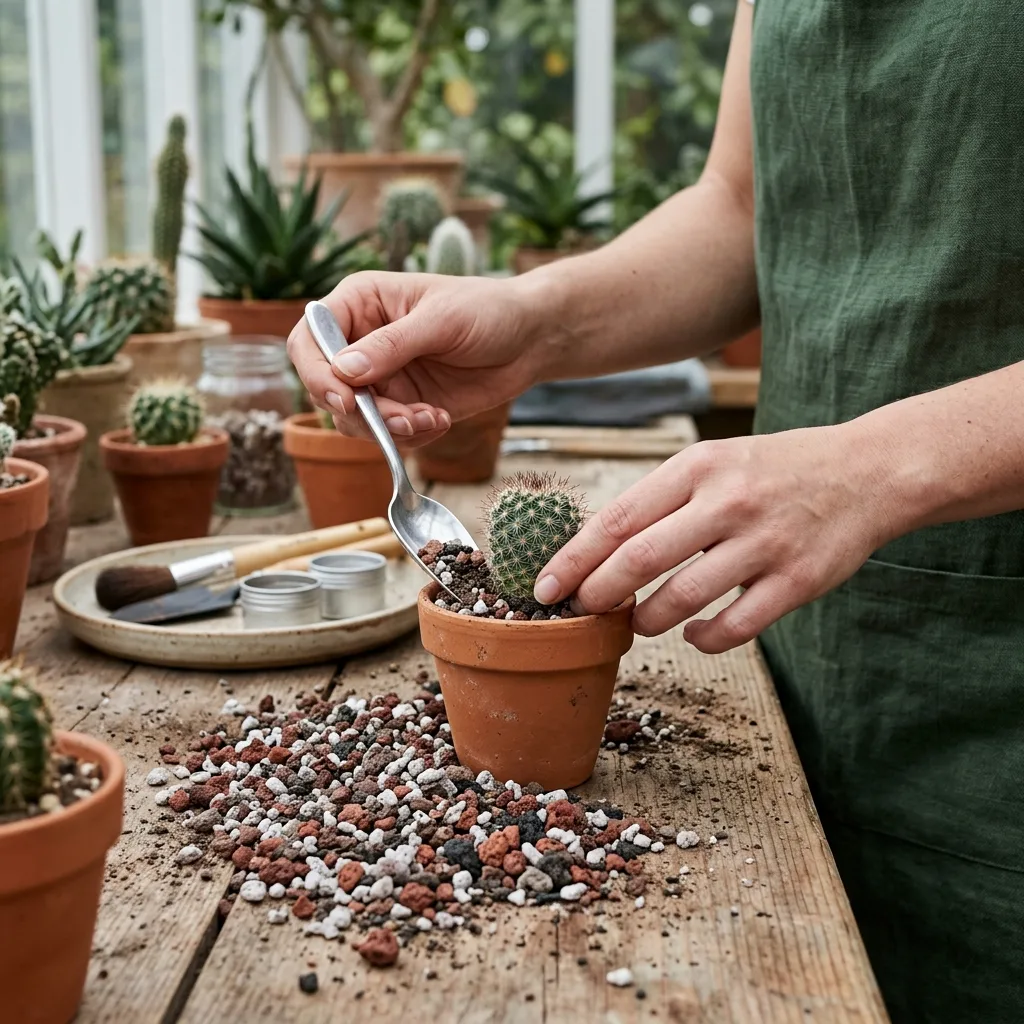
Using glazed mugs, sealed jars, or novelty cups without drainage holes is a death sentence for desktop cacti. Porous, unglazed terracotta pots remain unmatched for workspace settings because their breathable walls allow excess moisture to evaporate laterally. Select a container that snugly hugs the existing root ball without excessive depth. When it comes to substrate, skip off-the-shelf peat-heavy potting soils in favor of an airy, mineral-rich blend:
| Component | Proportion (%) | Botanical Function |
|---|---|---|
| Pumice (3-5 mm) | 40% | Porous structure ensures unmatched root zone oxygenation and moisture moderation. |
| Lava Rock (Scoria) / Zeolite | 25% | Releases vital trace minerals (calcium, iron, potassium) while resisting compaction. |
| Coarse River Sand / Graded Quartz | 15% | Accelerates gravitational water drainage and prevents soil caking. |
| Screened Coco Coir | 20% | Provides an airy organic anchor for feeder roots to uptake dissolved nutrients. |
5. Flowering Induction Tactics and Nutritional Supplementation
Watching a desktop Gymnocalycium or Rebutia unfurl neon pink, golden yellow, or fiery carmine blossoms is never a stroke of pure luck; it is the predictable outcome of an authentic cold-dry winter rest paired with precision nutrition. In early spring, as rising temperatures and sunlight awaken the areoles, feed your cacti with a specialized low-nitrogen, high-phosphorus, and high-potassium liquid fertilizer (such as an NPK 4-10-10 formulation). Apply this once a month at half-strength (diluted to 50% of the manufacturer's recommended dosage) alongside your regular watering cycle. Avoid general-purpose houseplant fertilizers rich in nitrogen; excess nitrogen prompts bloated, sponge-like tissue growth prone to epidermal cracking and fungal pathogen invasion.
6. Propagation, Offset Division, and Grafting Fundamentals
Many desktop favorites, most notably Mammillaria gracilis fragilis and select Gymnocalycium varieties, prolifically develop basal offsets or 'pups' surrounding the mother plant. Propagating these offsets is straightforward:
- Gently grasp the pup and twist it free, or sever it cleanly at the junction using a sterile scalpel or precision tweezers.
- Never plant a freshly detached pup directly into moist soil! Raw stem wounds exposed to moisture will succumb to bacterial decay almost immediately. Place the offset in a shaded, airy spot for 4 to 6 days to allow the cut surface to synthesize a protective, corky callus layer.
- Once fully callused, nestle the pup onto the dry, gritty mineral mix detailed above. Withhold all water for the first 10 days. After two weeks, lightly mist the substrate surface around the base to coax out new adventitious roots.
Those eye-catching neon yellow, magenta, or fiery red 'Moon Cacti' (Gymnocalycium mihanovichii f. variegata) commonly sold for desks lack chlorophyll entirely and cannot survive autotrophically on their own roots; they must be surgically grafted onto the vigorous green stalk of a host plant, typically Hylocereus, which handles photosynthesis on their behalf.
7. Defending Against Pest Pressures and Stem Rots
The two most common pests likely to infiltrate an indoor workspace environment are cottony mealybugs (Pseudococcidae) and microscopic spider mites. Mealybugs nestle deep within the crevices between ribs or at the spine bases, cloaking themselves in white, waxy secretions while piercing tissue to siphon out vascular sap. Dab isolated pests individually using a cotton swab dipped in 70% isopropyl alcohol; for wider infestations, administer a gentle cold-pressed neem oil formulation or horticultural soap wash during non-sunny hours.
If you detect a soft, squishy texture, yellowish discoloration, or dark water-soaked browning creeping upward from the soil line, root rot has already taken hold. Act immediately: unpot the cactus, strip away all substrate, excise all blackened, rotted root and stem tissue back to crisp, pristine green flesh with a sterilized blade, dust the exposed wound generously with sulfur powder or ground cinnamon for antimicrobial protection, and leave the rescued cutting to dry thoroughly before attempting rerooting in bone-dry pumice.


Reader Reviews & Comments 3 Reviews
Julian Hayes
Marcus Sterling
Eleanor Vance
Leave a Review & Rating
Share your plant care tips, experiences, or questions with our succulent community.