






We understand that subtle pang of heartbreak the moment your prized succulent suddenly trades its radiant, vibrant green for a dull, translucent yellow or a jelly-like texture overnight. Succulent care is an art that demands patience, but above all, an attentive eye for cellular detail. Adapted to the arid canyons of Mexico and the rocky slopes of South Africa's Karoo desert, these resilient specimens brought into our living spaces have evolved a flawless hydrostatic architecture to endure months of relentless drought. Yet when their leaves begin to pale and yellow on a windowsill, it serves as an unmistakable botanical warning that this ancient ecological harmony has been disrupted.
A succulent's yellowing foliage cannot be traced back to a single universal cause. The transition to yellow spans a wide biological spectrum—from ruptured cellular turgor pressure caused by overwatering to the breakdown of chlorophyll driven by nitrogen deficiency or insufficient photon flux. Determining whether this discoloration begins at the basal leaves or across tender apical growth, and assessing whether the foliage feels crisp or mushy, forms the cornerstone of accurate diagnosis. Let us decode your plant's cellular language together and restore it to vibrant health before structural tissue collapse sets in.
1. Botanical Identity and Morphological Characteristics
Succulents do not constitute a single taxonomic genus; rather, they represent a functional morphological group spanning dozens of botanical families (Crassulaceae, Aizoaceae, Asphodelaceae, and beyond) unified by specialized water-storage capabilities. The spongy parenchyma cells within their leaves harbor cavernous vacuoles designed to retain moisture reserves. They operate via Crassulacean Acid Metabolism (CAM), a specialized photosynthetic pathway where stomata remain tightly sealed during scorching daylight hours to curb transpiration, opening only under the cover of night to absorb and store carbon dioxide for daytime carbohydrate synthesis.
Despite this remarkable evolutionary resilience, succulent cell walls have strict elasticity limits. When exposed to chronic, saturated substrate conditions, the influx of water overwhelms internal turgor, causing cytoplasmic lysis (cellular membrane rupture). As these cells burst, photosynthetic chlorophyll pigments break down and degrade. The resulting yellow hue is the clinical manifestation of chlorosis: the green chlorophyll decomposes, unmasking the underlying yellow xanthophyll and carotenoid pigments embedded within the tissue.
2. Light Requirements and Indoor Positioning
Insufficient light intensity is one of the most insidious culprits behind succulent chlorosis. When a specimen receives an inadequate photon flux, it can no longer sustain chlorophyll density efficiently, prompting a gradual downregulation of pigment production that reveals a pale, washed-out lime-to-yellow hue. Furthermore, persistent light deprivation triggers etiolation—an unnatural elongation of the central stem characterized by widely spaced, weakened leaves as the plant expends stored reserves seeking light.
Most succulents thrive with a minimum of 5 to 6 hours of bright, filtered sunlight each day. South- or east-facing windowsills typically provide optimal exposure. During overcast winter months or within low-light rooms, supplementing ambient daylight with a full-spectrum LED grow light is essential to maintain metabolic equilibrium. Conversely, moving a light-starved succulent abruptly into scorching direct summer sun can cause severe thermal photodamage; these sunburns initially manifest as bleached, yellowish patches before turning into necrotic brown scars.
3. Watering Discipline: The 'Soak and Dry' Protocol
The leading cause of yellow succulent foliage remains excessive watering paired with non-draining containers. Dousing a succulent frequently is not an act of attentive care; it suffocates the subterranean root system by eliminating crucial pore space. Excessive soil moisture leads to root asphyxiation as available oxygen drops to zero. Deprived of oxygen, fragile feeder roots decay, causing the foliage above to engorge with excess moisture, turn translucent yellow, and drop at the slightest touch.
Conversely, severe dehydration can also induce yellowing, though its physical presentation is entirely distinct. Drought-induced chlorosis produces dry, wrinkled, papery leaves rather than squishy, translucent ones. In survival mode, the plant reallocates moisture and mobile macronutrients away from its oldest basal leaves (a natural senescence response) to preserve the emerging apical crown. To achieve the correct balance, always follow the 'Soak and Dry' method: hydrate the soil thoroughly until excess water drains freely from the base, and allow the potting mix to dry out completely down to the bottom of the container before watering again.
4. Substrate Formulation and Container Selection
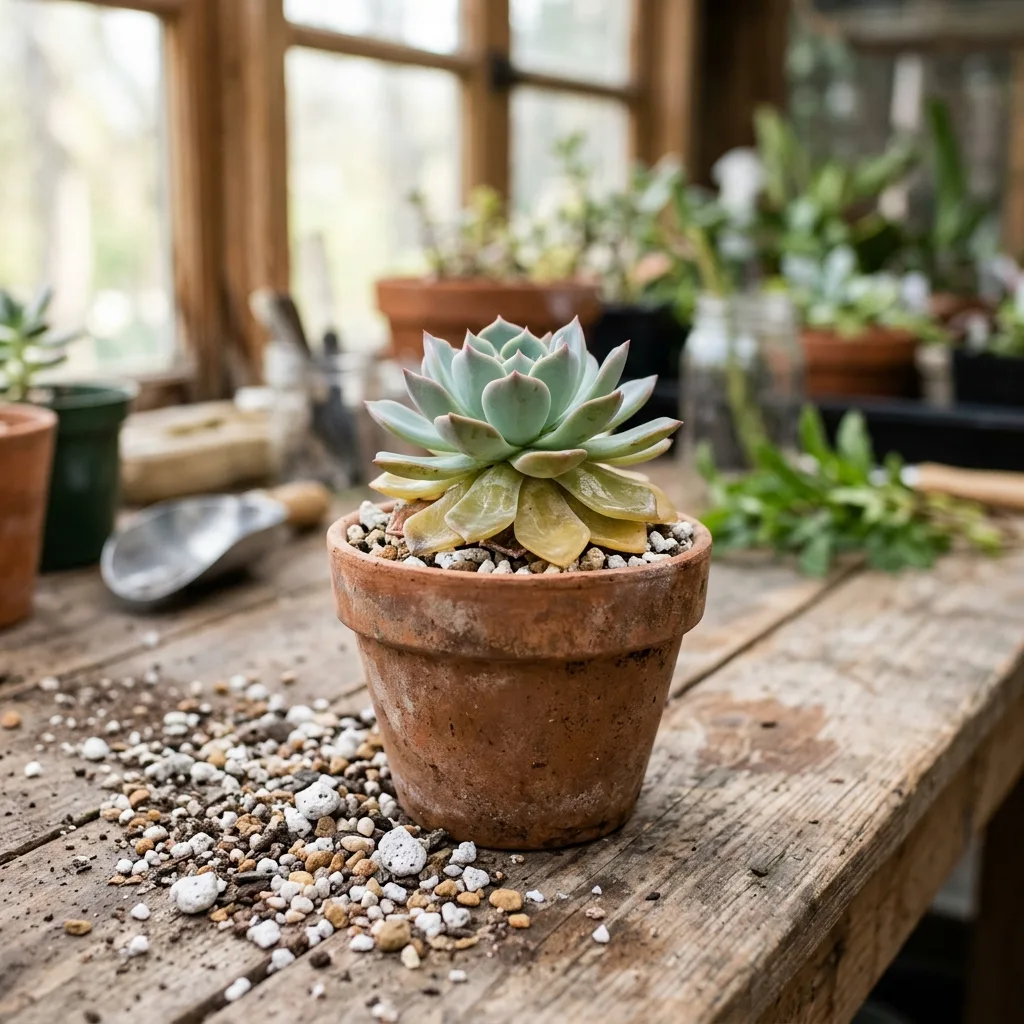
Curing Jade Plant (Crassula ovata) Care Guide: The Art of Growing, Pruning, and Propagating the Money Tree">Jade Plant (Crassula ovata): Causes and Botanical Recovery Guide">yellow leaves at the root level begins with substrate porosity. Off-the-shelf potting soils and dense peat-based mixes retain water far too long, creating an anaerobic environment that accelerates root pathogen proliferation. An optimal succulent substrate must integrate a dominant proportion of inorganic aggregates that allow water to flush through in seconds while preserving vital capillary air pockets.
| Component | Ratio (%) | Botanical Function & Benefit |
|---|---|---|
| Horticultural Pumice (3–6 mm) | 40% | Provides superior aeration and porous structure while preventing compaction. |
| Lava Rock / Zeolite | 25% | Supplies mineral buffering and naturally inhibits subterranean fungal pathogens. |
| Coarse River Sand / Perlite | 15% | Creates immediate drainage pathways, moving excess water rapidly to the base. |
| Sifted Coconut Coir (Coco Peat) | 20% | Offers safe organic root anchorage and gentle moisture retention without clumping. |
Regarding containers, unglazed terracotta pots equipped with generous drainage holes are the gold standard. Their breathable, microporous clay walls allow moisture to evaporate outward through the sides, whereas non-porous plastic or glazed ceramic containers trap humidity, effectively doubling the time required for the root ball to dry out.

5. Step-by-Step Propagation and Rescue Techniques
If yellowing and stem softening begin ascending toward the apex, harvesting the viable top growth or propagating healthy individual leaves is the most reliable way to save your plant:
- Apical Decapitation (Beheading): If soft rot has compromised the lower stem, use a sterilized scalpel or razor blade to slice through the firm stem at least 2 cm above the discolored, rotted tissue. Inspect the vascular ring inside the cut surface to ensure no brown or black vascular discoloration remains.
- Callus Formation: Never place a freshly cut stem cutting directly into moist potting mix. Rest the cutting in a warm, bright spot out of direct sunlight with steady airflow for 4 to 7 days until the cut seals over with a dry, protective callus.
- Dry Potting and Root Initiation: Insert the callused cutting into the dry mineral substrate described above. Withhold all water for the first 10 to 14 days; in the absence of root primordia, moisture only invites pathogen attack, while dry conditions actively stimulate new root growth.
- Leaf Propagation: Only plump, firm leaves that have not yet turned yellow or translucent can be used. Gently wiggle the leaf from side to side until it snaps cleanly away from the stem without tearing the basal node, then lay it horizontally on dry substrate to encourage miniature offsets.
6. Common Diseases, Pests, and Corrective Treatments
Parasitic infestations and fungal diseases can disrupt nutrient transport, manifesting as secondary leaf chlorosis. Common biological threats include:
- Root Mealybugs (Rhizoecus spp.): Operating beneath the soil surface, these pests feed on delicate root hairs, severing the plant's moisture and nutrient uptake channels. Affected foliage pales, wilts, and turns dull yellow. Wash all spent soil from the root ball, dispose of the contaminated substrate, and submerge the roots in a diluted neem oil or appropriate systemic insecticide solution.
- Fungal Pathogens (Fusarium and Pythium): Thriving in saturated, low-oxygen substrates, fungal hyphae colonize and occlude xylem vessels. This vascular blockage halts water movement, leading to blackened stems and sudden leaf drop. Excising infected tissue back to clean, healthy margins alongside a systemic fungicide drench is necessary to halt the infection.
- Nitrogen and Magnesium Deficiencies: When older basal foliage turns evenly pale yellow while remaining firm rather than mushy, the plant is typically experiencing nitrogen or magnesium starvation. Because these elements are mobile, the plant cannibalizes them to support new apical growth. Apply a balanced, low-nitrogen succulent fertilizer diluted to quarter-strength during active spring growth.
7. Seasonal Care Calendar and Horticultural Notes
Succulent metabolic rhythms shift in tandem with seasonal transitions:
- Spring: The period of awakening and vegetative growth. Minor post-winter chlorosis clears up rapidly with increasing daylight hours and a single monthly application of diluted, low-nitrogen liquid fertilizer.
- Summer: Under extreme summer heat, many genera (particularly Aeonium and some Haworthia) enter semi-dormancy. Overwatering a dormant succulent during intense heat causes rapid leaf drop and stem collapse. Scale back watering frequency and provide dappled shade during peak afternoon sun.
- Autumn: Widening day-night temperature fluctuations trigger the production of protective anthocyanin pigments, yielding rich reds, purples, and oranges. Reduce watering to encourage robust cellular walls ahead of winter.
- Winter: Cold shock and frost pose major risks. Succulents placed against cold windowpanes or left in unheated rooms experience thermal shock; freezing intracellular fluids rupture cell walls, leaving watery, yellow-brown sunken patches. Keep plants in locations above 8–10°C (46–50°F) and maintain a nearly bone-dry substrate.


Reader Reviews & Comments 3 Reviews
Eleanor Vance
Clara Higgins
Marcus Bennett
Leave a Review & Rating
Share your plant care tips, experiences, or questions with our succulent community.