






Across windswept landscapes stretching from the fiery red sands of the Sonoran Desert to the fog-shrouded elevations of the high Andes, one living form remains defiantly upright while all other vegetation succumbs to thirst: the cactus. Quietly resting in our living rooms or lining our sunniest windowsills, these spiny botanical sculptures are actually miracles of biological engineering. As the most resilient members of the succulent world, cacti are far more than just low-maintenance houseplant novelties; they are evolutionary titans that have transformed extreme aridity into an exquisite art form.
Most of us appreciate cacti simply because they tolerate neglect and survive on minimal moisture. However, the true mechanisms that make them unique are concealed deep within their microscopic stomata, their specialized mucilaginous water-storing parenchyma tissues, and their accordion-like geometric ribs. Once you grasp their fascinating physiology, you will do far more than merely keep them alive—you will witness their neon-bright, ephemeral blooms erupting with astonishing vigor every single spring. Let us explore the botanical secrets that render cacti nature's most sophisticated survivors, alongside the precise horticultural protocols we practice in our nursery greenhouses.
1. Taxonomic Identity, Areole Structure, and Spine Morphology
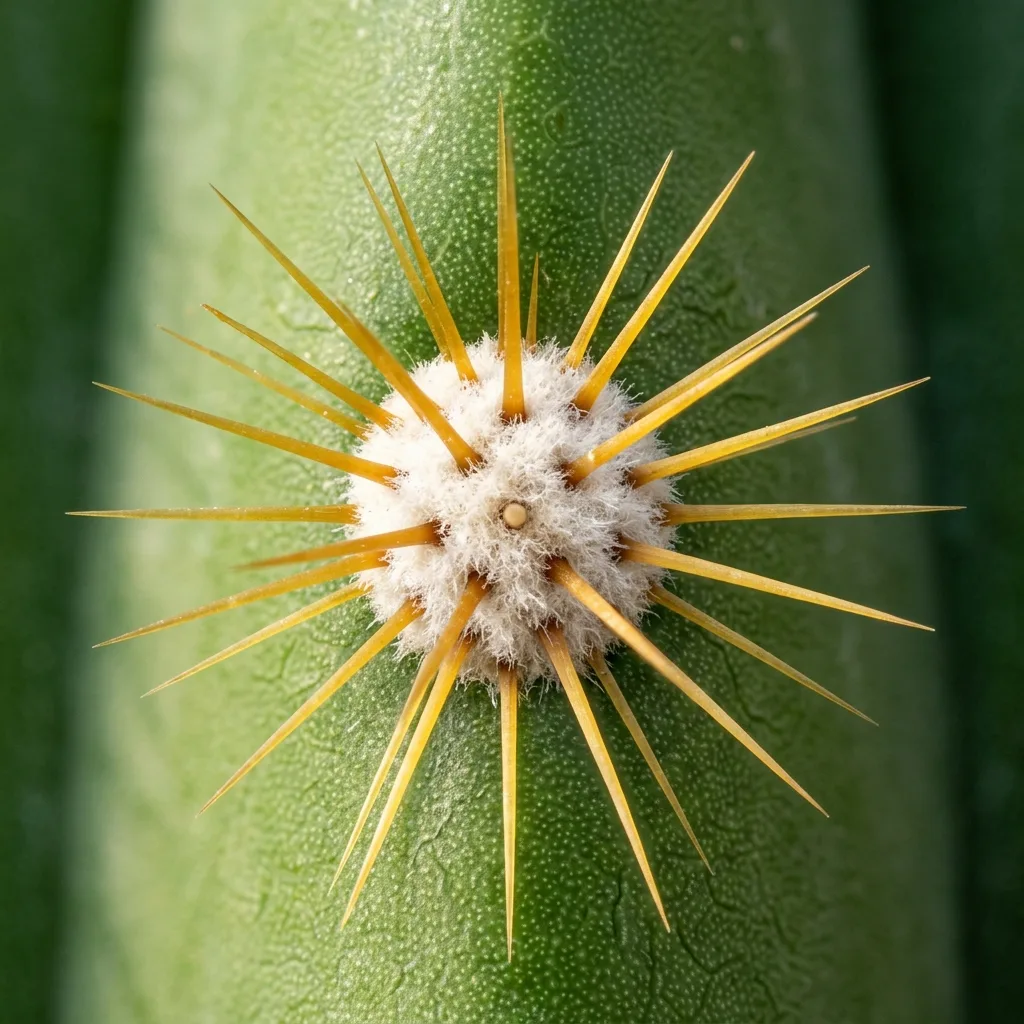
In the botanical realm, an essential rule applies: every cactus is a succulent, but not every succulent is a cactus. The definitive anatomical passport qualifying a specimen as a true member of the botanical family Cactaceae is the presence of specialized, highly modified axial bud cushions known as 'areoles'. If a plant lacks areoles—such as thorny African spurges (Euphorbia), whose spines emerge directly from the main cortical tissue—it is not a genuine cactus, regardless of how closely its silhouette mimics one through convergent evolution.
Areoles serve as the developmental nurseries for every vegetative and generative organ a cactus produces: spines, lateral offsets, cephalium structures, and those breathtakingly delicate blooms all emerge exclusively from these compact, felted cushions. And what about those formidable spines? Rather than conventional plant thorns or prickles, cactus spines are deeply reduced leaves modified over millions of evolutionary years to minimize transpirational moisture loss to virtually zero. Spines also serve multiple physiological roles: they deter foraging herbivores, shatter desiccating wind currents to create a calm microclimatic boundary layer over the epidermis, cast vital dappled shade, and act as passive dew condensers that funnel morning droplets directly toward the root collar.
2. Light Requirements, Solar Intensity, and Ventilation Dynamics
Among the most remarkable metabolic adaptations of cacti is Crassulacean Acid Metabolism (CAM) photosynthesis. Conventional C3 or C4 plants open their epidermal pores (stomata) during the blistering heat of the day to absorb carbon dioxide, losing tremendous volumes of precious water vapor in exchange. Cacti perform the opposite: they seal their stomata tightly throughout daytime solar peaks, opening them only under the cool cover of desert nights to sequester atmospheric CO2, which they store temporarily as malic acid within their vacuoles. Once the sun rises, they utilize stored solar photons to transform that cached acid into energizing carbohydrates behind locked doors.
For this metabolic engine to operate without faltering, indoor cacti demand high-lumen, unfiltered light exposure. A cactus deprived of adequate photoperiod or intensity experiences etiolation—stretching, blanching, and tapering into a fragile, pale cylinder as it desperately seeks radiant energy. South- or west-facing window exposures represent the gold standard indoors. Crucially, stagnant, solar-amplified heat trapped behind double-glazed glass can effectively scorch cellular tissue. Steady, gentle ambient air circulation is paramount to ensure the waxy epicuticular layer breathes cleanly and pest populations never find stagnant harbor.
3. The Soak-and-Dry Cycle and Critical Winter Dormancy
The most catastrophic misstep in cactus cultivation is adhering to rigid, calendar-driven regimens like 'a teaspoon of water every Sunday'. In their native desert habitats, cacti endure months of bone-dry baking, interrupted by brief, torrential cloudbursts that saturate the landscape. Replicating this dynamic indoors is achieved via the time-tested 'Soak and Dry' method.
Throughout their active spring and summer growth phases, drench the substrate completely until water flows freely and abundantly from the bottom drainage openings. Then, stay your hand until the potting mix has dried thoroughly—from the top root zone straight down to the base of the pot—before introducing moisture again. From late autumn (November) through early spring (March), cacti require a critical phase of cold dormancy. Move them to a bright, crisp location maintained between 8-12°C (46-54°F) and virtually suspend all watering (zero moisture for 6 to 8 weeks depending on the genus). A cactus forced through winter in an overheated, water-logged room never rests, disrupting its circadian cues and aborting its capacity to initiate flower buds.
4. High-Mineral Substrate Formulations and Terracotta Selection
Mass-market commercial potting soils labeled as 'cactus mix' are often predominantly peat moss or coco coir—the ultimate enemies of healthy cactus root systems. Peat becomes completely hydrophobic and cement-hard when dried, and once rewetted, it holds water like a sodden sponge for weeks on end, quickly suffocating root xylem tissues. Cacti require a coarse, gritty, rapidly draining, and heavily mineralized substrate matrix rich in interstitial air pockets.
The table below outlines our greenhouse-proven mineral potting mix, which yields consistent success even with rare, rot-prone desert species:
| Substrate Component | Ratio (%) | Botanical Function & Root Microdynamics |
|---|---|---|
| Coarse Pumice (3-6mm) | 40% | Provides supreme macroporosity and continuous aeration to delicate feeder roots. |
| Lava Rock (Scoria/Crushed Basalt) | 25% | Adds cellular structural stability, ballast, and a textured mineral surface for root anchorage. |
| Clinoptilolite Zeolite | 15% | Enhances Cation Exchange Capacity (CEC), locking in mobile nutrients and inhibiting bacterial decay. |
| Quartz Grit or Diatomite | 10% | Prevents compaction, accelerates downward drainage paths, and keeps air canals open. |
| Sifted Leaf Mold or Washed Coir | 10% | Supplies minimal organic fraction and trace moisture retention without retaining water. |
Regarding containers, unglazed terracotta remains unmatched. The microporous clay allows ambient gas exchange and lets moisture evaporate outward through the vessel's sidewalls, significantly lowering the risk of moisture retention around the root ball. Non-porous glazed ceramic, plastic, or decorative glass terrariums lock in standing moisture, drastically magnifying the threat of root asphyxiation.

5. Inducing Vibrant Blooms and Nutritional Management
A widespread misconception suggests that cacti rarely flower indoors, or only do so after decades of growth. In reality, flowering is an annual hormonal event triggered by precise seasonal environmental stresses. The absolute catalyst for a dazzling floral display is winter dormancy. Chilling conditions combined with skeletal watering initiate physiological stress cues, prompting the cactus to redirect its metabolic reserves into generative bud production as an evolutionary strategy to ensure genetic lineage continuity upon the return of warmth.
When plants awaken in early spring, avoid high-nitrogen fertilizers at all costs. Excess nitrogen creates bloated, watery tissues that are highly vulnerable to bacterial rot while actively suppressing bloom differentiation. Instead, choose a low-nitrogen, high-phosphorus, high-potassium balanced liquid fertilizer (such as an NPK 5-10-10 or 4-8-12 formulation). Apply this diluted to quarter- or half-strength only once a month during the active growing season, and cease feeding entirely by late summer.
6. Propagation: Stem Cuttings, Offsets, and Grafting Techniques
The biological tenacity of the cactus family is prominently demonstrated through vegetative propagation. A single detached offset ('pup') or a stem cutting cleanly excised with a sterilized scalpel possesses complete regenerative capabilities. However, success hinges entirely on one foundational phase: The Callusing Stage.
Never insert a freshly harvested cactus cutting into moist potting soil. An unhealed, damp vascular wound invites immediate colonization by soil-borne fungal pathogens, melting the cutting within days. Instead, set the excised cutting aside in a shaded, well-ventilated space for 4 to 10 days until the exposed tissue forms a firm, chalky, dry protective callus. Only then should you place it into completely dry, pumice-dominated rooting grit. Grafting, meanwhile, represents an ingenious horticultural practice: fusing a chlorophyll-deficient mutant scion (such as the bright scarlet Gymnocalycium mihanovichii f. variegata) onto a vigorous rootstock like Hylocereus undatus, serving as a testament to the remarkable developmental plasticity of cactus vascular cambium.
7. Combating Stem Rot and Persistent Sucking Pests
Despite their rugged, armor-plated exterior, cacti possess a sensitive vascular system. Their most devastating ailments stem from fungal pathogens such as Fusarium, Phytophthora, and Pythium, typically triggered by overwatering and compacted soils. Among insect pests, mealybugs (Pseudococcidae) pose the most pervasive threat, cloaking themselves in protective, cotton-like wax ribbons tucked deeply into the crevices of the areoles and ribs to siphon vital sap.
For localized mealybug outbreaks, dip a cotton swab in 70% isopropyl alcohol and apply it directly onto the pests to break down their protective waxy shells instantly. If root rot takes hold, rapid surgical intervention is the sole remedy: unpot the specimen, wash away the soil, and excise all blackened, compromised root and cortical tissue with a sterile blade until only healthy, emerald vascular bundles remain. Dust the clean incision with sulfur powder or ground cinnamon, allow a robust new callus to form in dry air, and reroot the specimen in fresh, sterile mineral grit.


Reader Reviews & Comments 3 Reviews
Julian Vance
Clara Higgins
Markus Gallagher
Leave a Review & Rating
Share your plant care tips, experiences, or questions with our succulent community.