






Harvested in the pale mist of early dawn before the sun's first rays can strike the moist earth, white asparagus represents one of the plant kingdom's most captivating morphological wonders. Unlike its vibrant green counterpart, whose spears eagerly dance with sunlight through photosynthesis, these shoots are nurtured in absolute subterranean darkness—sparing them from chlorophyll synthesis to yield plant tissue at its crispest, most delicate, and tender state. Tracing its lineage from the sandy, saline maritime soils of the Mediterranean basin to today's premier gourmet greenhouses, this geophytic spear is a botanical marvel sustained entirely by the fleshy, water-storing root reserves of the Asparagaceae family.
While many home gardeners mistakenly assume that white asparagus is a distinct botanical species, it is in fact an exquisite product of deliberate physiological manipulation: etiolation (the elongation of plant stems deprived of light). Shielded entirely from ultraviolet radiation, emerging subterranean shoots cannot synthesize chlorophyll a and b. As a direct consequence, cellular fiber content remains remarkably low, anthocyanin-derived bitterness never develops, and the spear accumulates concentrated natural sugars, forming an ivory-white, tender culinary masterpiece. In our greenhouse trials at Sukulentler.com—where we closely examine both ornamental Asparagus taxa and subterranean rhizome architectures—we have repeatedly witnessed how this mechanism showcases an extraordinary evolutionary strategy for preserving and directing vital storage reserves.
Join us as we explore the subterranean anatomy, the underground morphogenesis, and the precise horticultural techniques required to cultivate this aristocratic 'white gold'—whether in your open garden beds or within deep container systems.
1. Botanical Identity and Morphological Characteristics
In formal taxonomy, white asparagus belongs to the perennial monocot species Asparagus officinalis. Its subterranean foundation mirrors the architecture of many succulent geophytes, featuring a dense, crown-forming rhizome anchored by thick, fleshy, cylindrical storage roots. These specialized subterranean organs hold vital carbohydrate reserves throughout winter dormancy. Once springtime soil temperatures climb past the critical 10–12°C (50–54°F) threshold, apical buds break dormancy, sending sturdy vertical shoots racing toward the surface.
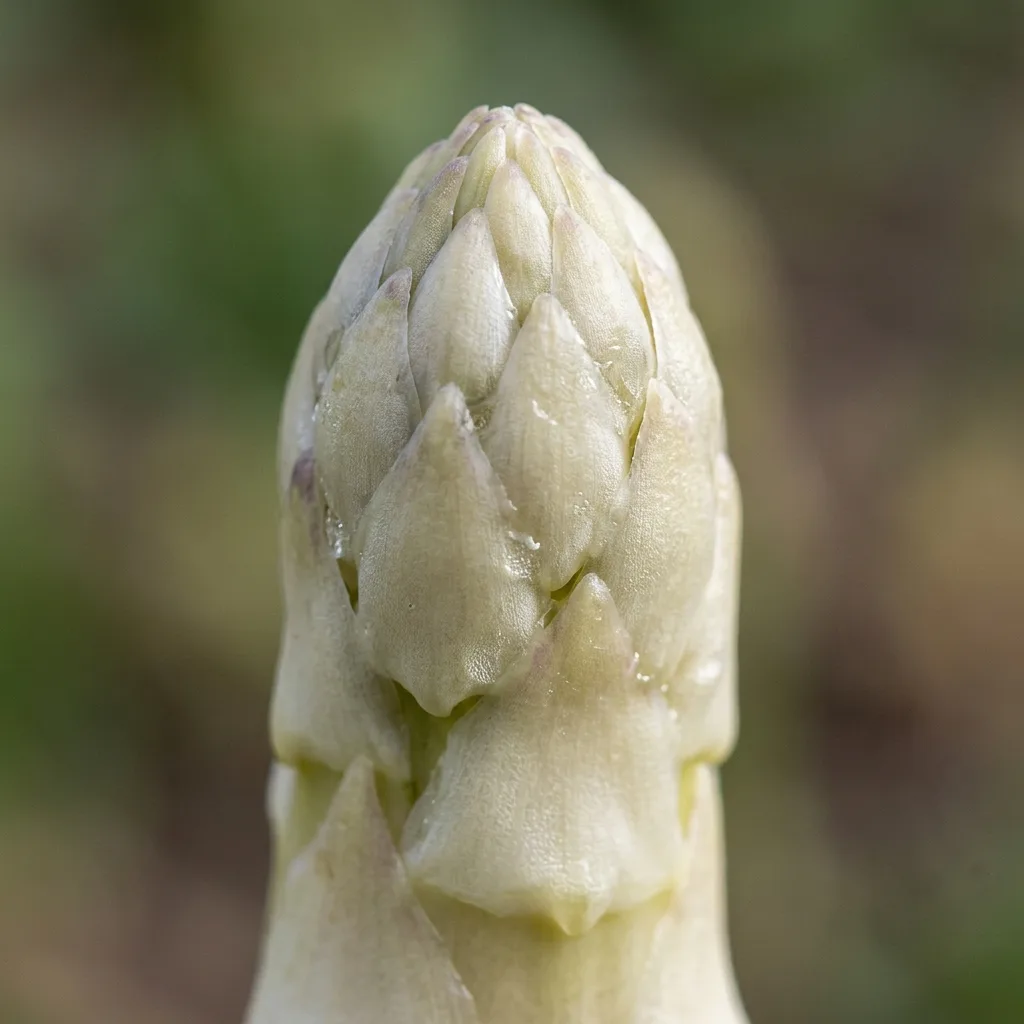
From a strict morphological standpoint, the delicate, feathery foliage commonly perceived as leaves consists of modified green photosynthetic stems known as cladodes. True leaves have evolved into tiny, papery, triangular scales that cling flatly along the spear's axis. In professional white asparagus cultivation, the ultimate objective is to harvest the subterranean shoot while its apical meristem remains tightly closed, long before these scales reflex or the branching cladodes have an opportunity to expand.
2. Light Dynamics and Seasonal Placement
Managing light in white asparagus cultivation involves navigating two sharply contrasting physiological phases. Throughout the active harvest window, the expanding crown and developing spears must be completely isolated from light via mounded soil ridges or UV-opaque mulch covers. For those cultivating in deep containers or raised planters, placing deep, opaque covers or black cylindrical hoods over the crowns will maintain this necessary blackout environment.
However, once the seasonal harvest concludes—typically by midsummer—the plant must undergo an essential photosynthetic restorative phase. All ridging must be dismantled to allow remaining shoots to unfold into lush, feathery green ferns. Position the plants where they receive generous, unfiltered direct sunlight for at least 6 to 8 hours daily. Depriving the crown of light during this critical vegetative stage severely diminishes its root starch reserves, directly resulting in spindly, unviable spears the following spring.
3. Watering Discipline: The 'Soak and Dry' Protocol
Much like thick succulent root networks, the storage roots of Asparagus officinalis are fleshy conduits highly vulnerable to sustained waterlogging and anaerobic compaction. Subterranean rhizomes starved of oxygen quickly succumb to lethal root decay caused by pathogens such as Fusarium oxysporum.
To safeguard root vitality, adopt the proven succulent standard: the 'Soak and Dry' method. During the active vegetative growing season, irrigate thoroughly until water penetrates the entire root profile, but always allow the upper 5 to 7 cm (2 to 3 inches) of substrate to dry out fully before re-watering. During the plant's winter dormancy, withhold water almost entirely, maintaining only the bare minimum ambient substrate moisture needed to prevent the fleshy storage roots from shriveling.
4. Ideal Substrate Blend and Container Architecture
To produce arrow-straight, thick, and perfectly smooth spears, the surrounding substrate must offer virtually zero mechanical resistance. Heavy clay or gravel-laden soils force the emerging shoot to curve and distort as it pushes upward. The growing medium must therefore be supremely loose, well-aerated, sandy, and rich in humus.
| Component | Ratio (%) | Botanical Function |
|---|---|---|
| Coarse Horticultural Sand (Silica/Quartz) | 35% | Eliminates mechanical impedance; enables straight spear development |
| Pumice (2–4 mm grain) | 25% | Ensures root aeration, structural porosity, and rapid drainage |
| Mature Organic Compost / Worm Castings | 25% | Supplies slow-release organic nutrients to replenish rhizome reserves |
| Coir Peat (Coconut Coir) | 15% | Maintains uniform, lightweight moisture retention without compaction |
When selecting containers, choose unglazed terracotta planters, fabric root bags, or deep wooden troughs that offer a minimum depth of 40 to 50 cm (16 to 20 inches) alongside generous drainage perforations. This depth is vital for building a 20 to 30 cm mounding layer required for proper etiolation.
5. Propagation and Step-by-Step Etiolation Techniques
While asparagus can be started from seed, this route demands exceptional patience, requiring 3 to 4 years of growth before initial harvest. Most growers establish plantings using robust 2- to 3-year-old crowns. Follow this detailed planting protocol:
- Trench or Deep Container Setup: Dig a trench or prepare a container 30 cm (12 inches) deep. Spread a 10 cm foundation layer of the coarse, well-draining mineral substrate described above along the base.
- The Octopus Placement Method: Position the crown centrally on a small mound of soil, spreading the fleshy storage roots outward and downward evenly like the arms of an octopus.
- Gradual Backfilling: Cover the crown with 5 to 7 cm (2 to 3 inches) of substrate and settle it in with an initial watering. As spears emerge and lengthen through their first seasons, gradually backfill the trench until level with the surrounding surface.
- The Blanched Mounding (Ridging) Phase: Beginning in the third spring, heap a loose ridge of sifted fine sand and peat (25 to 30 cm high) directly over the crown line, or secure an opaque, lightproof cover over the bed before the shoots break dormancy.
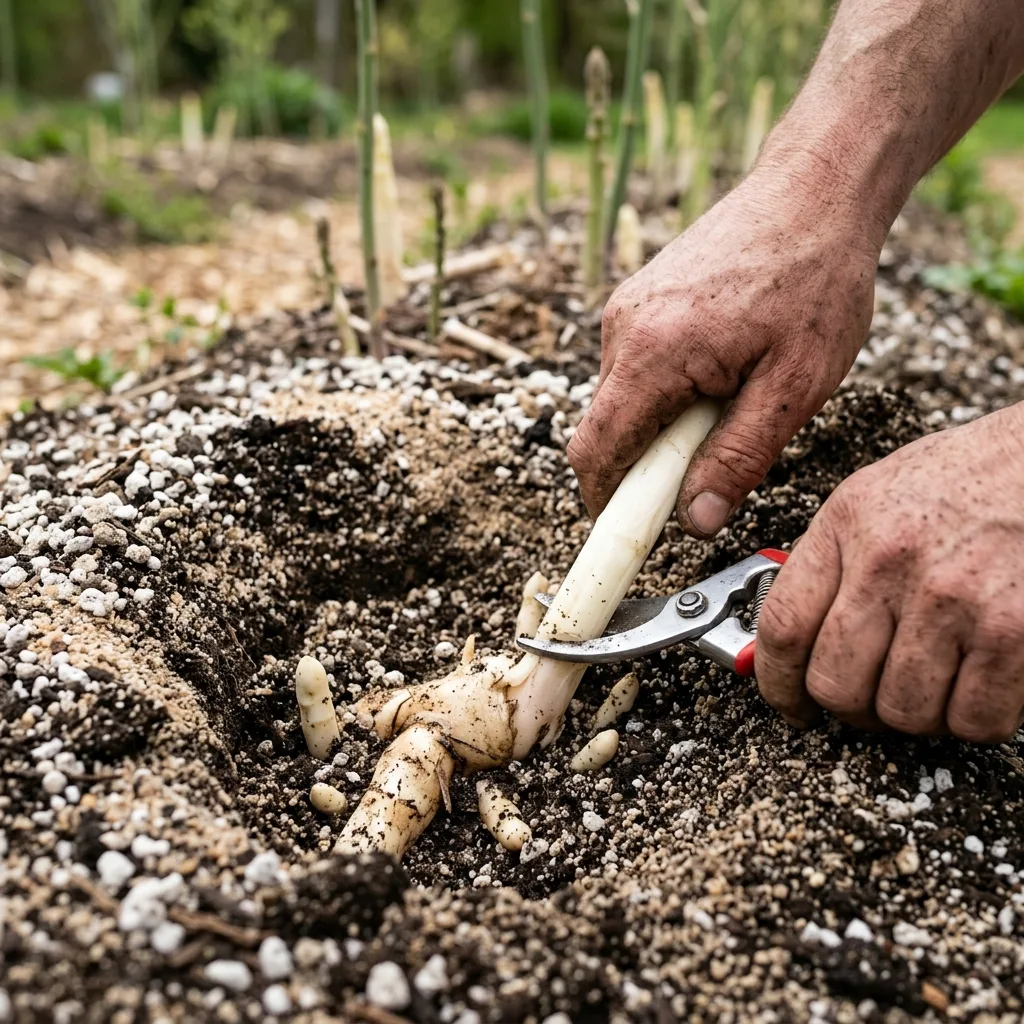
- Precise Harvesting: Watch for telltale star-shaped hairline cracks forming on the surface of the ridge. Gently clear away the sand by hand to expose the spear, sever it near the base using a specialized notched asparagus knife, and immediately re-cover the crown with sand to protect neighboring shoots from light exposure.
6. Common Pathogens, Pests, and Treatments
Subterranean spears and succulent crowns remain susceptible to specialized garden pests and environmental challenges:
- Fusarium Crown and Root Rot (Fusarium oxysporum): Symptoms appear as brown, water-soaked vascular staining throughout storage roots and declining vigor. Primarily caused by poorly drained soils; prevent by using fresh, highly porous substrates and pathogen-free planting stock.
- Asparagus Beetle (Crioceris asparagi): Feeds ravenously on expanding cladodes during midsummer. Handpick early arrivals or apply cold-pressed neem oil or potassium insecticidal soaps during early larval stages.
- Anthocyanin Purpling: Not an infectious disorder, but a clear sign of premature light exposure. It indicates that the soil ridge is settling or needs to be built higher. Add additional sifted sand promptly.
7. Seasonal Horticultural Calendar
Spring (March – May): Build soil ridges as ground temperatures warm. Harvest blanched white spears promptly as they emerge. Conclude all harvesting after 6 to 8 weeks to avoid exhausting the crown's storage capacity.
Summer (June – August): Level down the ridges. Allow remaining shoots to mature into tall, feathery vegetative fronds reaching up to 1.5 meters. Provide abundant sunlight and feed with a balanced, potassium- and phosphorus-rich organic fertilizer to replenish underground reserves.
Autumn (September – November): As cladodes transition to bronze and gold, they transfer stored carbohydrates back into the underground crown. Once stems dry out completely, cut them back to 5 cm above ground level and apply a protective winter mulch.
Winter (December – February): Plants remain dormant. Keep the soil predominantly dry; in severe freezing climates, insulate crowns with a thick layer of shredded bark or clean straw.


Reader Reviews & Comments 3 Reviews
Julian Vance
Clara Higgins
Arthur Pendelton
Leave a Review & Rating
Share your plant care tips, experiences, or questions with our succulent community.