






In the botanical world, the intersection of specialized leaf geometry and pigment mutations produces some of the most captivating specimens for discerning collectors. The descriptor often searched by enthusiasts—'green linear variegata cream and moss green succulent'—refers botanically to chimeric mutations found in elite taxa such as Senecio radicans variegata (Variegated String of Bananas), Crassula muscosa f. variegata (Variegated Princess Pine or Watch Chain), and rare linear forms of Peperomia ferreyrae variegata. These extraordinary plants carry histogenic L1 and L2 cell layer mutations that partially arrest chlorophyll synthesis along their narrow, cylindrical, linear foliar axes.
In their native habitats, clinging to arid rock crevices and semi-shaded canyon slopes, these morphological forms face a survival disadvantage compared to their monoculture green counterparts. Because albino (cream-white) tissues lacking chlorophyll cannot perform photosynthesis, the deep moss-green (forest moss green) segments must shoulder the metabolic energy requirements of the entire plant. This delicate genetic balance renders them both living botanical works of art and sensitive collector specimens requiring specialized horticultural oversight.
1. Taxonomy and Rare Morphological Characteristics
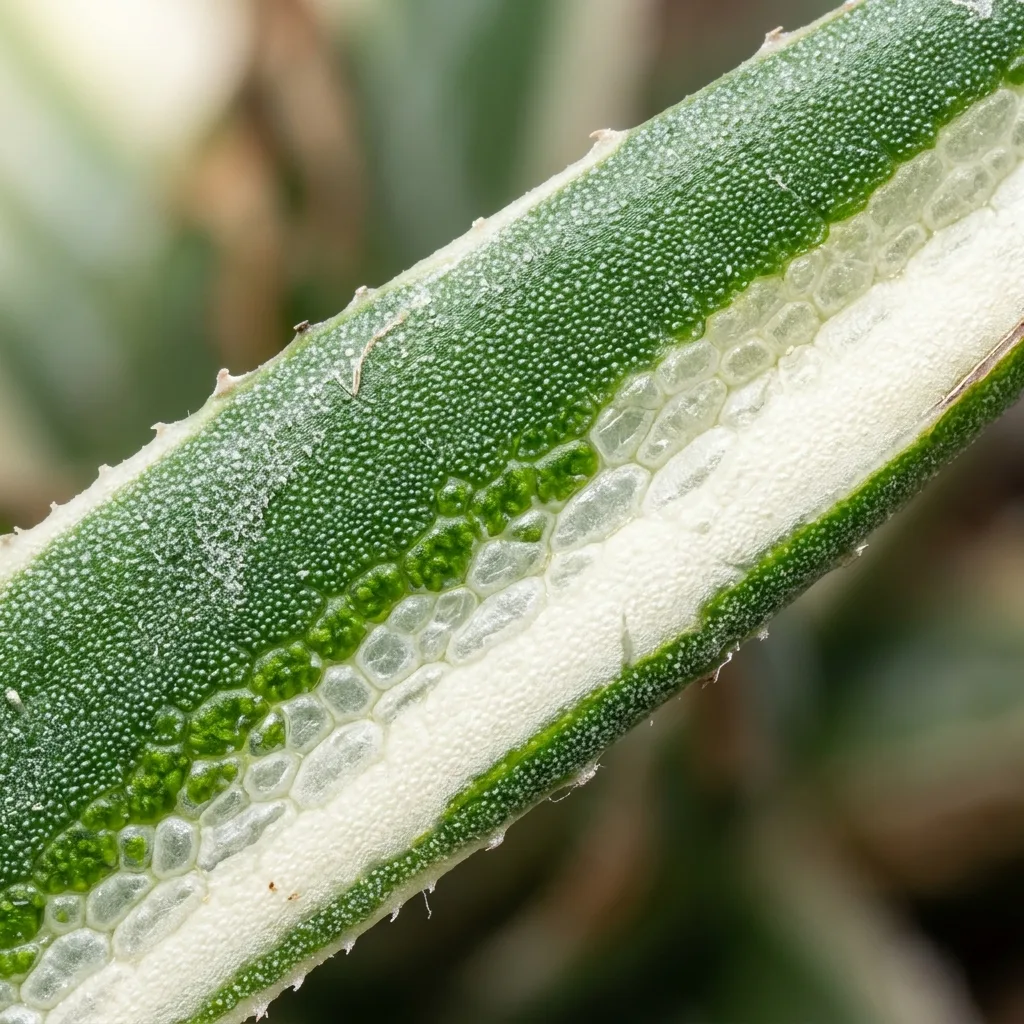
Linear variegated succulents are distinguished by their needle-like or crescent-shaped morphologies, evolved specifically to minimize leaf surface area and prevent transpirational water loss. At the cellular level, these plants are periclinal chimeras. The cream-colored regions lining the exterior margins or extending in longitudinal ribbons are entirely devoid of functioning chloroplast organelles. Conversely, the moss-green stripes contain densely packed palisade parenchyma with high concentrations of chlorophyll-a and chlorophyll-b.
The leaf epidermis is coated with a microscopic layer of crystalline epicuticular wax (farina), which drastically restricts transpiration. This protective waxy mantle imparts an understated, velvety sheen while shielding vulnerable cream tissues from ultraviolet-induced necrosis (sun scorch). Functioning via Crassulacean Acid Metabolism (CAM), these species open their stomata exclusively at night to sequester carbon dioxide as malic acid, concluding photosynthesis during daylight hours without expending precious internal moisture.
2. Exacting Light and Temperature Requirements
The photoperiodic requirements of variegated forms represent a razor's-edge equilibrium. In inadequate light, the plant suppresses its chimeric mutation by upregulating chlorophyll synthesis to survive, causing the foliage to revert to uniform green. Conversely, because the cream sectors lack a protective screen of photosynthetic pigments, exposure to unfiltered, blistering midday sun results in swift foliar scorching.
The ideal photoperiodic regime involves 3,000 to 4,500 lux of gentle morning sunlight or 14 to 16 hours beneath a high-CRI, full-spectrum LED grow light. Thermally, a range of 18°C to 26°C (64°F - 79°F) ensures peak metabolic efficiency. During winter dormancy, temperatures dropping below 8°C (46°F) risk cellular plasmolysis, causing variegated tissues to turn translucent and rapidly collapse into rot.
3. Root Sensitivity and Irrigation Discipline
The root architectures of linear-leaved succulents are fibrous, exceptionally fine, and heavily oxygen-dependent. Because their water reserves reside in the succulent internal foliar parenchyma, a constantly damp substrate precipitates rapid colonization by opportunistic fungal pathogens such as Fusarium and Phytophthora at the root collar.
Irrigation must never adhere to a rigid calendar schedule. Bottom-soaking (sub-irrigation) should only be administered after confirming that the substrate has dried completely down to the base drainage openings (verified using a wooden moisture probe). Careless overhead watering allows water droplets to lodge in the dense nodes between linear leaves, creating an ideal microclimate for the rot of cream tissues.
4. Specialized Collector Substrates and Mineral Composition
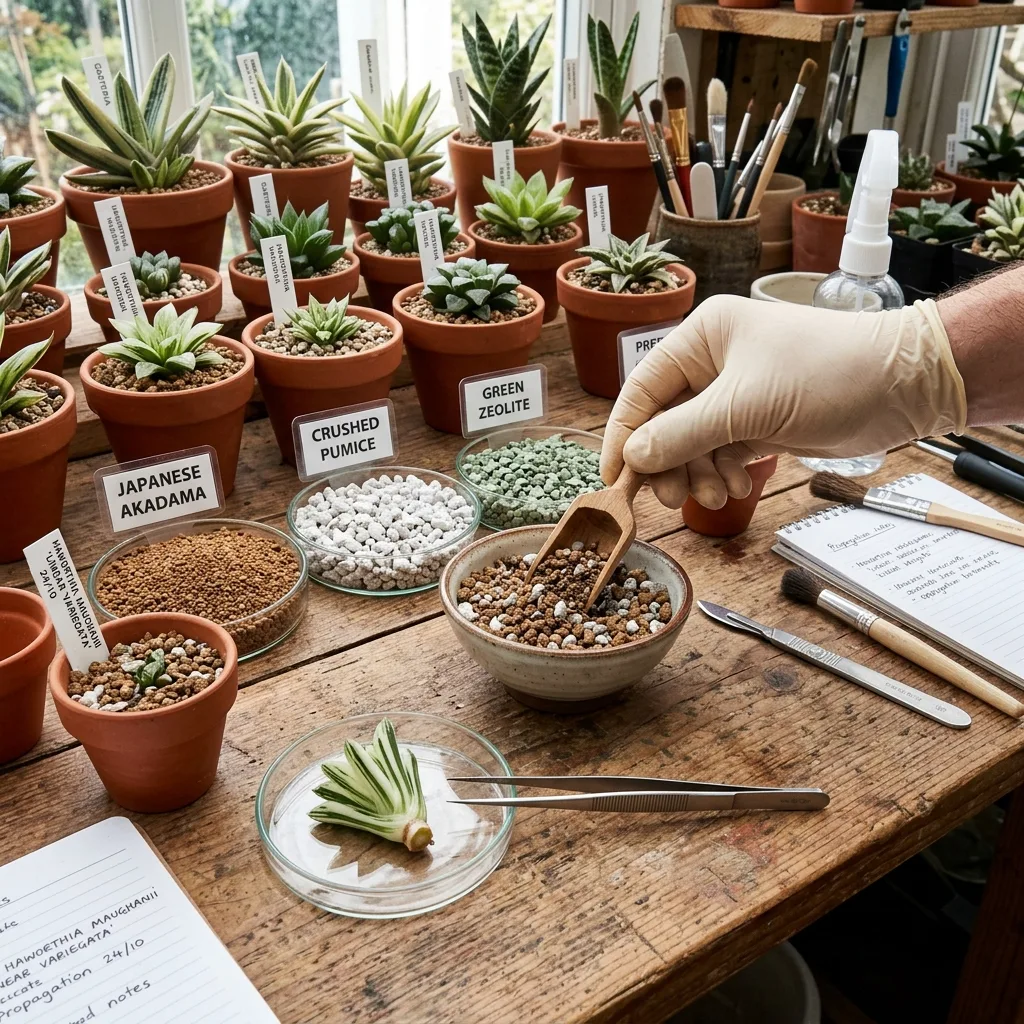
Soils high in organic peat are the chief hazard for these elite chimeric succulents. Slow-drying, dense soil matrices suffocate gas exchange in the rhizosphere. Consequently, master collectors rely on an inorganic, highly porous, structurally durable mineral mix with high Cation Exchange Capacity (CEC).
| Substrate Component | Volume Ratio (%) | Grain Size (mm) | Horticultural Function |
|---|---|---|---|
| Hard Akadama (Double-Fired) | 40% | 2.0 - 4.0 mm | Rhizosphere aeration and buffered moisture retention |
| Raw White Pumice | 30% | 3.0 - 5.0 mm | Macro-drainage and open aeration pockets |
| Green Clinoptilolite Zeolite | 15% | 2.0 - 3.5 mm | Heavy metal absorption and cation exchange buffering |
| Calcined Lava Rock (Scoria) | 10% | 2.0 - 4.0 mm | Structural matrix stability and trace iron release |
| Screened Coco Coir Dust | 5% | Screened fine | Minimal organic cling for fine root hair establishment |
5. Propagation Complexities and Reliable Techniques
Attempting to propagate linear variegated succulents via single leaf cuttings almost invariably ends in disappointment. Because chimeric mutations are strictly confined to specific meristematic cell layers, adventitious buds arising from a solitary leaf develop into reverted, solid green plants in over 90% of attempts—or emerge as completely albino plantlets that perish once detached. Thus, vegetative stem cuttings and careful offset division represent the only reliable methods.
Execute stem propagation according to the following protocol:
- Select a robust stem spanning at least 4 to 6 mature nodes that displays a balanced distribution of both cream and deep moss-green variegation.
- Using a sterile micro-scalpel, make a clean diagonal cut approximately 2 mm beneath a node.
- Dust the exposed wound with pure cinnamon powder or mycorrhizal spores, then allow the cutting to callous in a shaded, well-ventilated space for 72 hours.
- Insert the calloused cutting directly into a 100% mineral mix of pure pumice and zeolite; withhold all water for the initial 10 days to encourage the emergence of root primordia.
6. Long-Term Preservation and Specimen Security for Collectors
Rare variegated succulents represent foundational centerpieces in premier botanical collections. To safeguard their phenotypic integrity and market value, persistent air exchange is non-negotiable. Operating a continuous miniature oscillating fan in enclosed growing spaces or greenhouses hardens the protective epicuticular wax layer and virtually eliminates threats from mealybugs (Pseudococcidae).
Container selection should prioritize unglazed terracotta or high-fire, porous studio ceramics equipped with ample basal drainage apertures. Always select a vessel measuring merely 1 to 2 cm wider than the current root volume; oversized pots retain superfluous moisture in unoccupied substrate, inevitably suffocating sensitive root tips.


Reader Reviews & Comments 3 Reviews
Julian Vance
Clara Sterling
Marcus Thorne
Leave a Review & Rating
Share your plant care tips, experiences, or questions with our succulent community.