






The genus Ceropegia, classified within the subfamily Asclepiadoideae of the Apocynaceae (dogbane) family, represents one of evolutionary biology's most intricate and fascinating groups of succulent plants. Evolving primarily in the micro-endemic semi-arid rock crevices of South Africa, Madagascar, and Southeast Asia, this taxon has attained cult status among collectors thanks to its delicate trailing (liana-like) stems and the swollen hypocotyls and root tubers (caudices) it developed to survive prolonged drought periods.
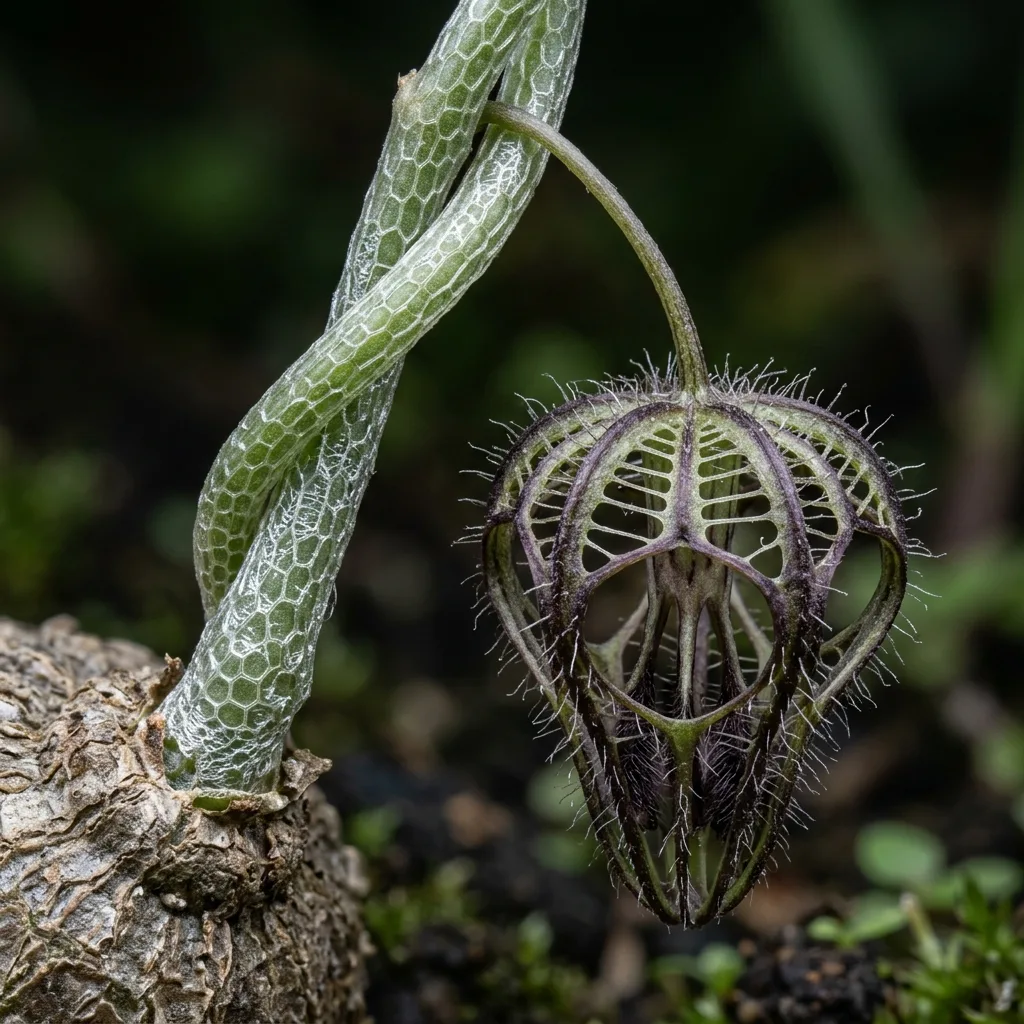
Beyond widely cultivated forms popularly known as the 'String of Hearts', rare forms such as Ceropegia ampliata, Ceropegia sandersonii, and mutationally chlorophyll-deprived selections like Ceropegia woodii f. variegata hold vulnerable conservation status in the botanical world due to habitat destruction and extensive collection pressure. The plant's pitfall-trap floral anatomy provides an extraordinary evolutionary mechanism, temporarily trapping and releasing small pollinating dipterans to secure cross-pollination.
A grower's true success with Ceropegia lies in mastering the physiological equilibrium between the delicate trailing aerial vines and the starch-filled tubers hidden subterraneanly. In this guide, we outline the scientific foundations necessary to sustain vigorous growth, establish a zero-rot mineral discipline, and achieve dense, competition-grade foliage clusters.
1. Taxonomy and Rare Morphological Characteristics
The defining hallmark of the genus Ceropegia is its combination of succulent leaves adapted to xerophytic conditions and tubular, cage-like, or lantern-shaped corollas termed 'synflorescences'. Examined at the cellular level, the foliar structures feature enlarged water-storing mesophyll layers buffered by a protective epicuticular wax that drastically limits transpirational water loss. Photosynthetic assimilation operates via the CAM (Crassulacean Acid Metabolism) pathway, opening stomata at night to store malic acid.
In rare variegated forms (such as pink and cream chimeral cultivars), foliar chimerism results in plastids that fail to synthesize chlorophyll. Because this decreases overall photosynthetic yield, the growth velocity of variegated specimens is substantially slower than that of ancestral green forms. Additionally, the pearl-like aerial tubers that spontaneously form at leaf axils serve a dual purpose: they act as vegetative cloning organs and function as auxiliary carbohydrate reservoirs sustaining the vines during severe dehydration cycles.
2. Precision Light and Temperature Requirements
When exposed to harsh, unmediated midday sun, Ceropegia foliage quickly succumbs to epidermal scorching and excessive anthocyanin accumulation. Conversely, insufficient irradiance prompts extended internodes (etiolation), foliar thinning, and the reversion of prized variegated chimeras back to plain green phenotypes.
The ideal lighting protocol comprises bright indirect light filtered through sheer curtains (a minimum of 2,500 to 3,500 lux) or roughly 2 to 3 hours of gentle direct morning sunlight. Regarding ambient thermal dynamics, an alternating diurnal shift—daytime temperatures between 20–26°C (68–79°F) paired with nocturnal drops to 15–18°C (59–64°F)—actively stimulates CAM metabolism and spurs caudex expansion. If ambient temperatures slip below 10°C (50°F), the plant retreats into systemic dormancy; temperatures dipping below 5°C (41°F) trigger intracellular freezing, causing irreversible liquefaction and tuber rot.
3. Root Sensitivity and Watering Discipline
The single most frequent cause of mortality in Ceropegia cultivation is tuber rot induced by overwatering (typically driven by opportunistic fungal pathogens like Fusarium and Phytophthora). The subterranean system consists of fine, fragile capillary rootlets emerging from a dense caudex. When subjected to prolonged substrate saturation, these delicate hair-roots suffer rapid hypoxia (oxygen deprivation) and subsequent collapse.
Cultivators must strictly follow a 'soak thoroughly and dry completely' cycle. To evaluate when watering is warranted, monitor foliar turgor pressure: if the leaves remain thick, rigid, and plump, withhold moisture. When the basal foliage shows slight tactile softness and gently flexes under light compression, perform a deep, saturating soak until water flushes freely from the drainage apertures, emptying any runoff saucer immediately. In winter or under low-temperature environments, widen the watering interval to once every 3 to 4 weeks.
4. Specialized Mineral Substrate Formulation
Commercial peat-dominated succulent mixes collapse under frequent watering and suffocate the root zone, failing to deliver the gas-exchange properties Ceropegia requires. A collection-tier substrate must consist predominantly of porous, non-compacting inorganic aggregates boasting high cation exchange capacity.
Target a substrate pH between 6.0 and 6.8. To maximize rhizosphere aeration while securing adequate nutrient retention, the following balanced mineral blend provides exceptional performance:
| Component | Ratio (%) | Grain Size | Function |
|---|---|---|---|
| Hard Japanese Akadama | 35% | 2 – 4 mm | Moisture buffering, micronutrient storage, root anchoring |
| Horticultural Pumice | 30% | 3 – 5 mm | Macroporosity, matrix aeration, prevents compaction |
| Clinoptilolite Zeolite | 15% | 2 – 3 mm | Toxin adsorption, cation stabilization |
| Volcanic Scoria (Lava Rock) | 10% | 2 – 4 mm | Structural weight, structural drainage, iron release |
| Sterile Coir Fibers (Coco Peat) | 10% | Fine Milled | Minimal organic moisture buffering without compaction |
5. Propagation Challenges and Reliable Techniques
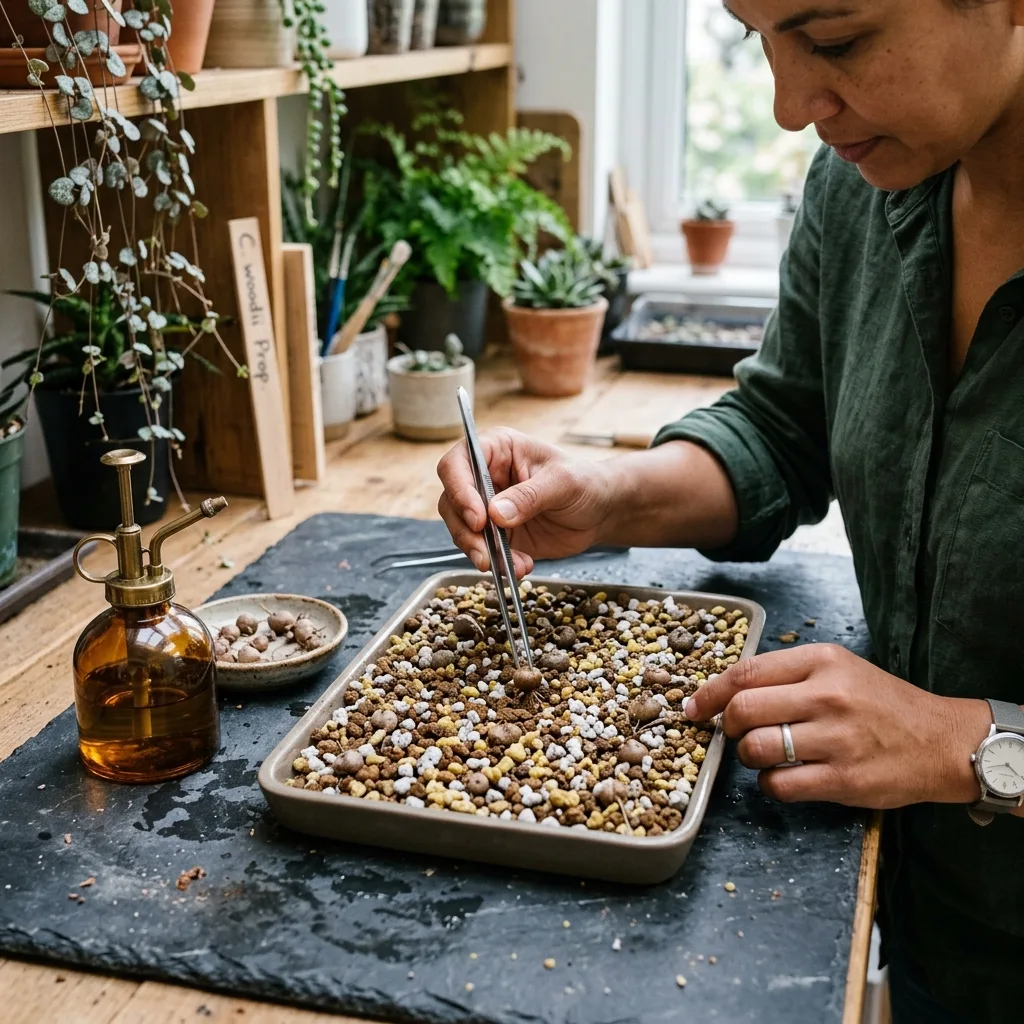
Cultivators rely on three foundational propagation methods for Ceropegia: rooting aerial tubers, standard stem cuttings, and the precise 'butterfly' technique. Among these, the butterfly method reliably produces the highest yield and survival rates.
- Butterfly Cutting: Using a sterilized scalpel, excise a single two-leaf node, retaining roughly 1 cm of stem tissue both above and below the junction.
- Callusing: Place the harvested cuttings in a shaded, well-ventilated, dry setting for 24 hours to encourage protective suberization (callus formation) over the wounds.
- Substrate Placement: Position the node horizontally atop moist pure pumice or rehydrated sphagnum moss, gently pressing down so the nodal axis makes firm contact with the medium.
- Micro-Greenhouse Incubation: Cover the propagation tray with a transparent ventilated dome to sustain 70% relative humidity at an ambient temperature of roughly 22°C (72°F). Within 14 to 21 days, adventitious roots and a nascent micro-tuber will develop directly from the node.
6. Preservation, Canopy Density, and Collector Maintenance
The horticultural and commercial merit of a specimen Ceropegia is judged by intermodal compactness, leaf variegation contrast, and the diameter of its anchoring caudex. To transform a sparse, leggy specimen into a dense curtain of growth, practice circinate layering: loop elongated hanging vines back onto the exposed substrate surface, ensuring that multiple active nodes touch the soil. Within 8 to 12 weeks, each pinned node forms an independent root system and supplementary tuber, multiplying overall canopy density and long-term vitality.
Regarding phytosanitary maintenance, mealybugs (Pseudococcidae) frequently hide within dense tangled vines and leaf axils. Performing a monthly preventive misting using an emulsified cold-pressed neem oil solution—combined with placing your pots in an airy location with gentle air circulation—will completely prevent pest infestations.


Reader Reviews & Comments 4 Reviews
Eleanor Vance
Julian Hayes
Clara Sterling
Marcus Bennett
Leave a Review & Rating
Share your plant care tips, experiences, or questions with our succulent community.