






From the limestone bluffs of Mexico and the sun-scorched dunes of the Sonoran Desert to the humid, epiphytic rainforests of Brazil, cacti represent the most remarkably resilient and captivating plant family on our planet. Armed with specialized drought-defying water storage parenchyma, thick waxy cuticles that arrest evaporative transpiration, and Crassulacean Acid Metabolism (CAM) photosynthesis that captures carbon dioxide beneath the cool night sky, these living desert sculptures have earned pride of place in our living rooms. Yet, nurturing a cactus indoors is never merely a matter of withholding water; it is a meticulous craft of recreating millions of years of evolutionary adaptation within the micro-ecosystem of a simple pot.
In this comprehensive guide, we delve into the 10 most sought-after cactus species cherished by passionate hobbyists and discerning collectors worldwide for their architectural silhouettes and enduring vigor. These species are celebrated not only for their structural elegance, but also for the breathtaking, vibrant floral displays they unfurl when provided with an authentic cultivation protocol. Let us peer through the botanical lens into the anatomy, physiology, and greenhouse secrets of these legendary houseplants.
1. Taxonomic Identity, Areole Architecture, and Spine Morphology
The definitive botanical hallmark distinguishing a true cactus from other succulent flora is the areole (areola). Areoles are highly condensed, specialized lateral bud meristems uniquely situated on the cactus stem; from these precise growth centers emerge spines, radial glochids, vegetative offsets, and vibrant blooms. Spines themselves are marvels of evolutionary adaptation: modified leaves that surrendered their photosynthetic duties to the green stem parenchyma to virtually eliminate transpiration while acting as thermal radiation shields that diffuse harsh ultraviolet light.
The ten most celebrated cactus species dominating windowsills and specialty glasshouses worldwide include:
- Echinocactus grusonii (Golden Barrel Cactus): Instantly recognizable by its ribbed globular form, brilliant golden radial spines, and a resilient solitary stem that thrives for decades.
- Mammillaria elongata (Ladyfinger / Gold Lace Cactus): Features clustering, slender cylindrical stems densely wrapped in interlaced, starburst-like clusters of golden-yellow to copper spines originating from prominent tubercles.
- Schlumbergera truncata (Thanksgiving / Holiday Cactus): An epiphytic rainforest native with flattened, spineless stem cladodes that produces zygomorphic, tubular blooms in dazzling hues throughout late autumn and winter.
- Opuntia microdasys (Bunny Ears Cactus): Free of conventional long central spines, this species produces flat paddle-like pads covered in dense, velvety cushions of barbed micro-spines known as glochids.
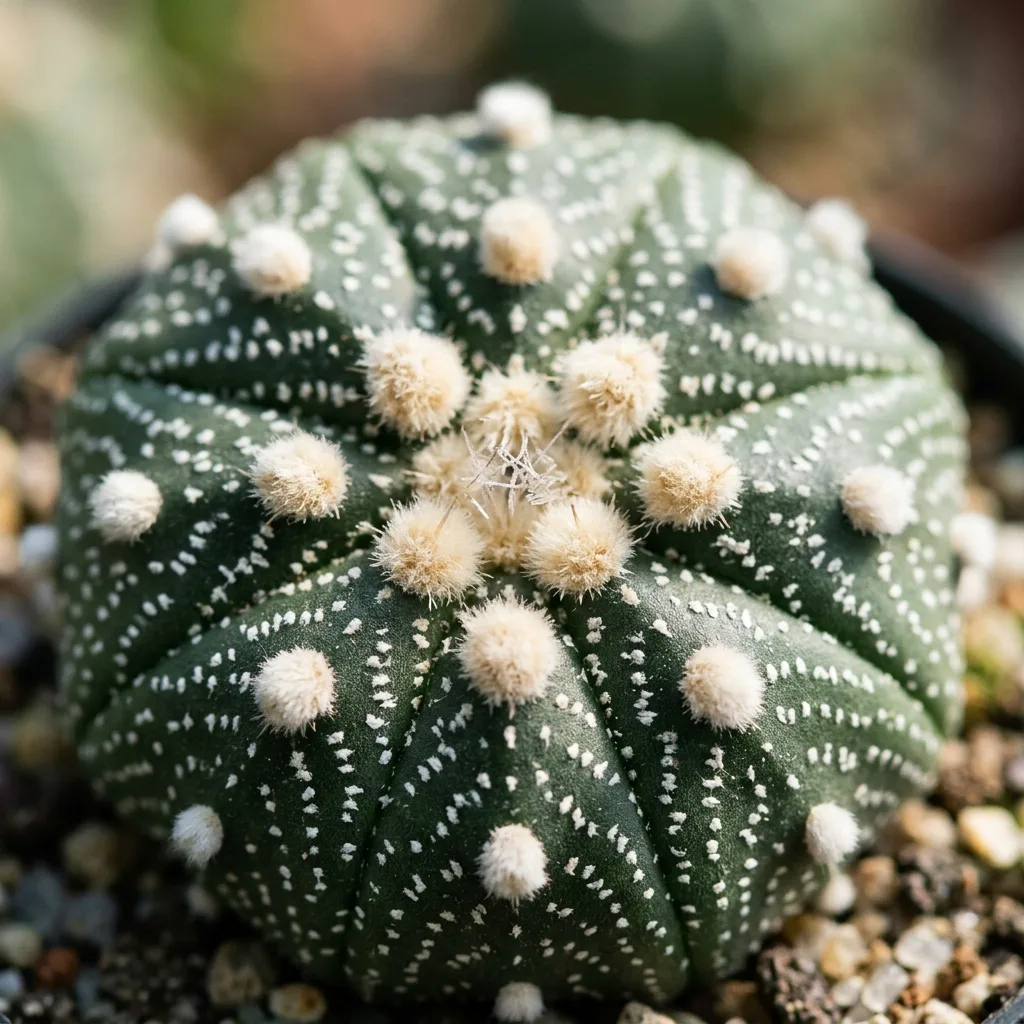
- Astrophytum asterias (Sand Dollar / Star Cactus): A geometrically flawless, spineless marvel displaying eight gently rounded ribs adorned with central felted areoles and thousands of minute white trichome flecks.
- Gymnocalycium mihanovichii (Moon Cactus / Chlorophyll-Deficient Form): While wild populations show cryptic grey-green bands, the vivid neon red, orange, and yellow mutant cultivars lack photosynthetic chlorophyll and must be grafted onto vigorous Hylocereus rootstocks to survive.
- Cereus peruvianus (Peruvian Apple / Columnar Cactus): Renowned for its towering, massive vertical stems, deep fluted ribs, and statuesque architectural presence, making it an anchor piece in modern interior design.
- Parodia magnifica (Ball Cactus): Characterized by glaucous blue-green globular stems lined with delicate, soft bristle-like yellow spines and woolly apical areoles.
- Rhipsalis baccifera (Mistletoe Cactus): A pendant epiphytic jungle cactus with slender, leafless branching stems that cascade like botanical waterfalls from hanging planters, perfectly adapted to indirect canopy light.
- Ferocactus latispinus (Crow’s Claw Cactus): Boasts flattened, broadly recurved, hook-shaped crimson spines that fiercely evoke the untamed spirit of arid Mexican scrublands.
- Mammillaria elongata (Ladyfinger Cactus): Forms captivating clumping clusters of slender cylindrical stems, intricately wrapped in radial, starlike golden-yellow spines.
2. Irradiance, Sunlight Intensity, and Ventilation Dynamics
The vast majority of desert cacti (such as Echinocactus, Ferocactus, and Opuntia) demand a minimum of 6 to 8 hours of intense, unfiltered direct solar radiation daily. When irradiance drops below optimal levels, the plant exhibits etiolation—a physiological stretching where the apex becomes pale, fragile, and unnaturally tapered. Etiolation does not merely ruin the symmetrical aesthetics; it thins cell wall lignification, leaving the epidermis critically vulnerable to opportunistic fungal spores.
However, essential exceptions exist within tropical climes. Because Schlumbergera and Rhipsalis evolved beneath dense rainforest canopies or nested within mossy tree forks, harsh midday sun will scorch their chlorophyll. They require bright, dappled, indirect illumination. Across all species, dynamic airflow is just as vital as photonic energy. Stagnant indoor air allows warm humidity to accumulate around the stem base, paving the way for rot. Consistent fresh air ventilation hardens the cuticular wax and preserves physiological balance.
3. Irrigation Dynamics and the Essential Winter Dormancy Protocol
The golden rule of cactus husbandry is simple: frequent watering is not a gesture of love, but a path to root hypoxia and asphyxiation. During the vigorous spring-through-summer vegetative cycle (typically April through September), desert species should be watered using the classic 'soak-and-dry' regimen. Saturate the root zone until water freely escapes the drainage aperture, then refrain completely until the entire mineral column has thoroughly dried out down to the bottom tier.
The defining season of cactus cultivation, however, is the winter rest period (dormancy). From late autumn until early spring, true desert cacti (such as Echinocactus, Astrophytum, Ferocactus, and Mammillaria) must be transferred to a bright, cool location held strictly between 8°C and 12°C (46°F–54°F). During this phase, irrigation must be entirely suspended, or limited to a sparse basal trickle once every 4 to 6 weeks. Kept in a warm, heated room and watered through winter, a cactus never enters metabolic stasis, fails to initiate floral primordia, and steadily exhausts its internal reserves.
4. High-Porosity Mineral Substrates and Container Physics
Dense, peat-heavy commercial potting soils are a death sentence for desert cacti. Dehydrated peat turns hydrophobic and hardens like concrete, yet once re-wetted, it holds water for weeks, creating an ideal breeding ground for pathogenic fungi. Desert cacti thrive exclusively in high-porosity volcanic substrates that allow excess water to drain within seconds, providing unhindered oxygen diffusion to root hairs.
Container selection is equally vital: always opt for unglazed terracotta pottery equipped with ample drainage holes. Unglazed baked clay is micro-porous, allowing moisture to evaporate through the container walls and ensuring rapid dry-down cycles.
| Substrate Component | Ratio (%) | Botanical & Structural Function |
|---|---|---|
| Horticultural Pumice (3–5 mm) | 35% | Creates macropores, prevents compaction, ensures immediate drainage |
| Crushed Lava Rock (Scoria) | 25% | Anchors taproots, provides slow-release micronutrients and iron |
| Zeolite or Coarse Perlite | 15% | High cation exchange capacity (CEC), buffers salts, improves aeration |
| Washed Coarse River Sand | 10% | Promotes fine root branching and uniform moisture percolation |
| Sterile Coir or Peat Fiber | 15% | Supplies the minimal organic fraction required for moisture delivery |

5. Inducing Vibrant Blooms and Nutritional Management
Witnessing a crown of vivid, luminous flowers unfurl atop a fiercely spined stem is the ultimate reward for any cactus grower. While Mammillaria encircles its crown in halos of pink blooms, Gymnocalycium and Parodia produce magnificent satiny cups of yellow, apricot, and scarlet. Eliciting this floral spectacle relies on two non-negotiable triggers:
- A Flawless Winter Rest: The physiological stress induced by cool temperatures and complete winter drought cues the plant's survival programming, prompting the differentiation of vegetative meristems into flower buds as days lengthen in spring.
- Low-Nitrogen, High-Potassium Nutrition: Never feed an awakening cactus with high-nitrogen houseplant fertilizers; excess nitrogen causes rapid, bloated tissue growth prone to epidermal bursting. Choose a dedicated cactus formulation featuring an N-P-K balance of 5-10-15 or 10-20-20. Apply at one-quarter strength once a month exclusively during active growth.
6. Propagation: Stem Offsets, Cuttings, and Grafting Dynamics
Vegetative propagation is one of the most rewarding aspects of keeping cacti. Species like Mammillaria elongata and Opuntia microdasys naturally generate basal clusters or lateral offsets ('pups'). Using a sterilized scalpel, cleanly sever the offset from the mother tissue. Never pot fresh cuttings immediately into damp soil; place them in a shaded, well-ventilated space for 4 to 7 days to form a firm, grayish-white protective callus over the wound. Once callused, place the cutting upright upon a dry mineral mix and lightly mist after 10 days to encourage adventitious root development.
Conversely, mutant, chlorophyll-deficient cultivars of Gymnocalycium mihanovichii (the iconic Moon Cactus) cannot synthesize carbohydrates and cannot live on their own roots. They are obligate parasites that must be grafted onto a photosynthetic host stock, typically Hylocereus undatus. Successful grafting requires aligning and pressing together the vascular cambium rings of both scion and rootstock until their internal vascular bundles fuse.
7. Mitigating Fungal Pathogens and Basal Collar Rot
The leading cause of cactus mortality indoors is basal and root rot triggered by fungal pathogens such as Fusarium oxysporum and Phytophthora cactorum. A healthy cactus stem should feel firm and turgid under gentle pressure. If you detect localized soft spots, yellow-translucent discoloration, or tissue that yields mushily under touch, act decisively:
- Unpot the specimen immediately and rinse all damp substrate from the root system.
- Using a flame-sterilized blade, excise all discolored, liquefied tissue until only pristine, translucent green flesh remains.
- Dust the exposed cutting margins with powdered sulfur or activated charcoal to inhibit latent spores.
- Allow the amputated plant to desiccate in warm, moving air for 1 to 2 weeks until a solid callus forms before re-rooting in dry pumice.
The world's most beloved cactus species are enduring monuments to nature's evolutionary patience. When provided with uncompromising sunlight, an open volcanic mineral substrate, and an authentic, cool winter rest, they will reward you with decades of living sculptural beauty and spectacular spring blossoms.


Reader Reviews & Comments 4 Reviews
Julian Vance
Eleanor Vance
Marcus Sterling
Clara Lindqvist
Leave a Review & Rating
Share your plant care tips, experiences, or questions with our succulent community.