






A captivating genus within the family Asphodelaceae, Haworthia represents an exquisite evolutionary triumph native to the arid and semi-arid Karoo basins of South Africa. Named in honor of the 19th-century British botanist Adrian Hardy Haworth, these succulents adapted to intense desert conditions by seeking refuge in rock crevices, beneath protective shrub canopies, and partially submerged beneath sandy soils. Their robust morphological structure and comparatively measured metabolic rate make them an indispensable centerpiece for indoor succulent collections.
What distinguishes Haworthia most vividly from other prominent succulent genera is its ability to flourish in soft, filtered lighting without demanding scorching direct sunlight. While light-hungry genera such as Echeveria rapidly lose their compact form and stretch (etiolation) when deprived of full sun, Haworthia species preserve their sculptural rosette architecture for years on moderate windowsills. In this comprehensive botanical guide, you will explore everything from Haworthia's cellular biology to root aeration, water metabolism, and vegetative offset propagation.
1. Botanical Identity and Morphological Characteristics
The genus Haworthia primarily encompasses acaulescent (stemless) or extremely short-stemmed evergreen succulents that develop dense rosettes from the base. Depending on the species, leaf surfaces are either thick, truncated, and fitted with glassy epidermal windows known as fenestrations (such as in Haworthia cooperi or Haworthia cymbiformis), or adorned with raised, white, calcified bands and tubercles (such as in Haworthia fasciata or Haworthia attenuata).
These specialized translucent leaf windows allow the plant to remain partially subterranean in habitat—shielding itself from blistering ambient heat and extreme UV radiation—while efficiently channeling and filtering light directly to the deeper chloroplast-rich layers within. Furthermore, Haworthias operate via Crassulacean Acid Metabolism (CAM). Under this physiological adaptation, stomata remain tightly sealed during the heat of the day to eliminate transpiration losses. Once darkness falls, stomata open to uptake carbon dioxide, storing it as malic acid until daylight reactivates the photosynthetic machinery. Consequently, active gas exchange and respiration peak during the cool nighttime hours.
2. Light Requirements and Indoor Positioning
Haworthias are not low-light plants; however, their epidermal tissues are susceptible to solar scorching from harsh, direct midday ultraviolet exposure. Because their native niche is situated under scrubby thickets and within shadowed rock crevices, their ideal photoperiod relies on bright, filtered indirect light or gentle early-morning direct sunlight.
Indoors, an unobstructed east-facing windowsill provides the perfect spectrum. For south- or west-facing exposures, diffuse the light using sheer curtains. Insufficient illumination causes the rosette to flatten and elongate irregularly, accompanied by a dulling of its vivid green coloration. Conversely, excessive solar exposure triggers elevated anthocyanin synthesis, shifting leaf pigmentation to defensive bronze, russet, or reddish tones. If this color change coincides with dry, deflated leaf tips, the plant is experiencing photodamage and should be promptly relocated to a more shaded microclimate.
3. Watering Discipline: The 'Soak and Dry' Method
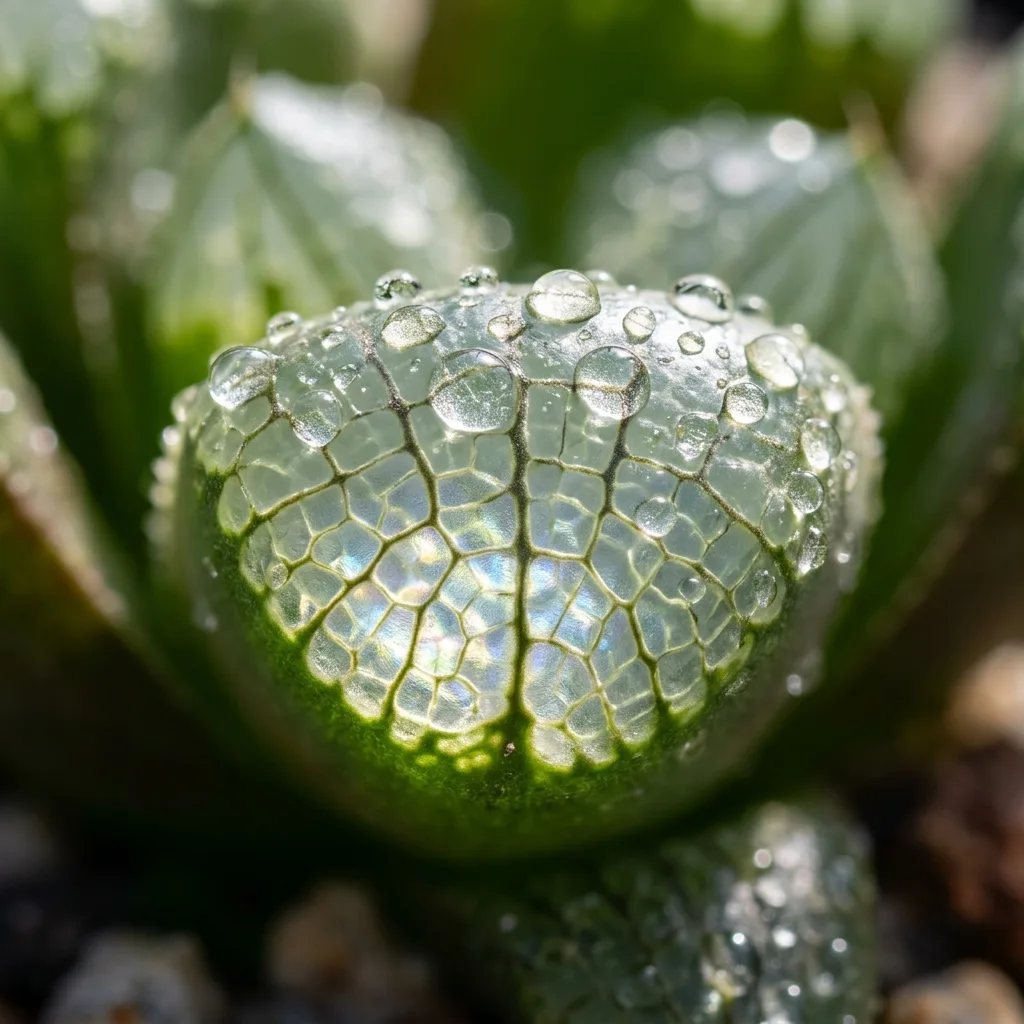
The most frequent pitfall in Haworthia cultivation is calendar-based, frequent shallow watering. The fleshy leaves and robust storage roots of these plants are anatomically engineered to withstand extended dry intervals. The gold standard of irrigation is the 'Soak and Dry' approach.
Before irrigating, confirm that the potting medium has thoroughly dried out from top to bottom. Gauge moisture by inserting a wooden probe deep into the root zone or by evaluating the container's weight by hand. When moisture is depleted, saturate the medium thoroughly until water drains freely from the base drainage holes. Discard any runoff collected in the saucer within 15 minutes; standing water suffocates oxygen-dependent root cells, creating an anaerobic breeding ground for pathogenic oomycetes and fungi (such as Fusarium and Pythium).
4. Ideal Soil Substrate and Container Selection
The thick, oxygen-hungry roots of Haworthia deteriorate swiftly in dense, peat-laden commercial potting soils that retain moisture over prolonged periods. An exceptional Haworthia mix is primarily gritty, porous, and formulated for rapid drainage.
| Substrate Component | Ideal Ratio (%) | Botanical Function |
|---|---|---|
| Pumice (3–6 mm) | 40% | Maximizes root-zone aeration and provides structural porosity without waterlogging. |
| Lava Rock / Zeolite | 20% | Microporous structure buffers excess moisture and stores trace minerals. |
| Coarse Perlite or Gritty River Sand | 15% | Prevents compaction and keeps vertical drainage paths permanently open. |
| Premium Coir (Coconut Peat) | 25% | Provides a lightweight organic anchor with balanced nutrient retention. |
Regarding containers, unglazed terracotta and breathable unglazed ceramics are ideal because their porous walls allow ambient moisture evaporation. Rigid plastic containers can be used provided they feature ample bottom drainage perforations. Because Haworthias produce vertical, deep-delving taproot-like structures, select pots with adequate depth (typically 8–12 cm) to accommodate unhindered root expansion.
5. Step-by-Step Propagation Techniques
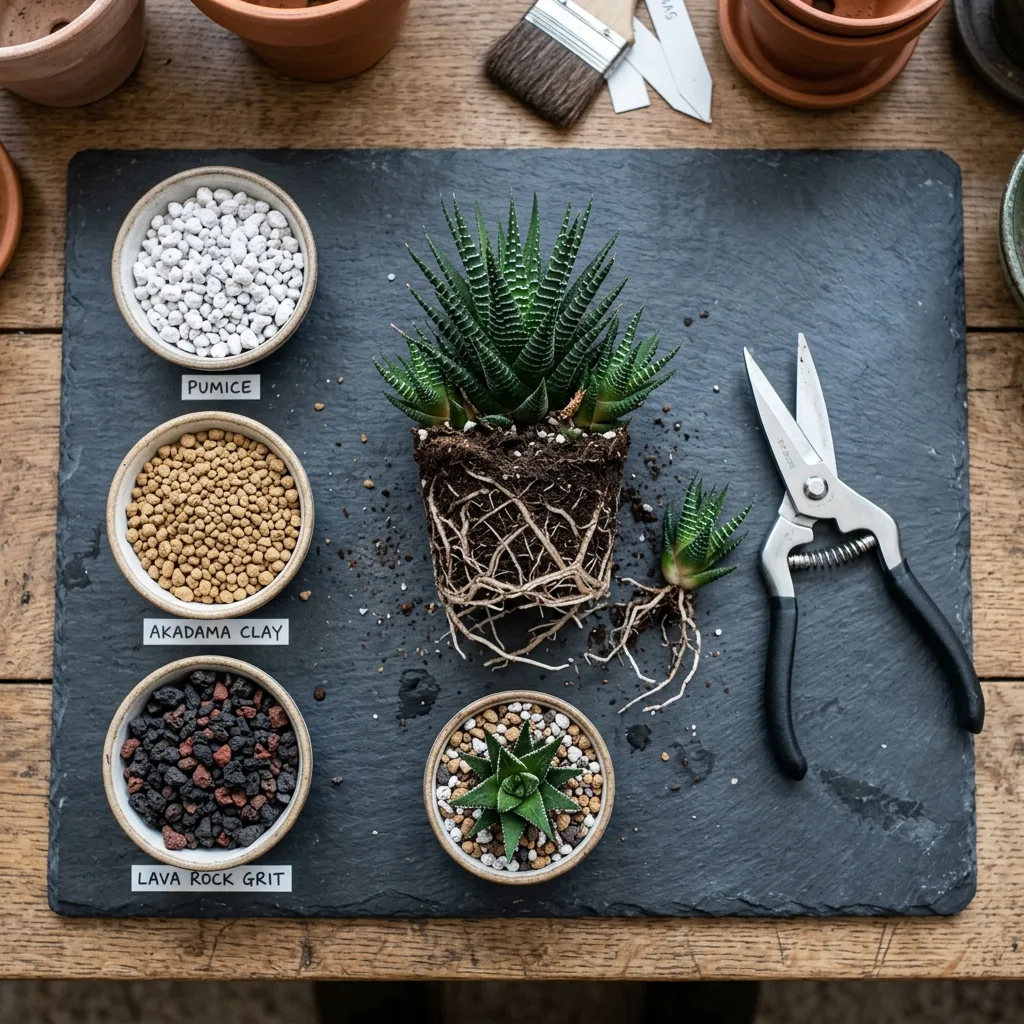
The most dependable propagation method with the highest success rate is the division of basal offsets (pups). Mature specimens naturally produce vegetative clones around the crown base during active growth periods.
- Timing: Schedule division during periods of vigorous metabolic activity, preferably early spring or early autumn.
- Offset Separation: Gently unpot the mother plant. Sever the basal tissue connecting the offset to the main crown using a sterile scalpel or precision shears. Offsets that already possess independent root filaments will establish far more rapidly.
- Callus Formation: Do not pot freshly severed divisions immediately. Allow the cut surface to dry in a shaded, ventilated room for 2 to 4 days until a firm, protective suberized callus forms over the wound to prevent fungal pathogens.
- Potting and Moisture Management: Plant the callused pup into a mineral-dominant substrate blend. Refrain from watering for the first 5 to 7 days; subsequently, apply light surface moisture around the perimeter to encourage new root emergence.
6. Common Pests, Pathogens, and Remediation
While fundamentally resilient, Haworthia specimens can succumb to specific physiological and pathological challenges when culture parameters decline:
- Root Rot: Rapid foliar yellowing, a spongy texture, and looseness in the substrate signal root loss. Unpot the plant, excise all necrotic brown or blackened roots with sterilized tools, dust the remaining healthy base with powdered sulfur or cinnamon, allow it to dry for 3 days, and repot into fresh, dry mineral substrate.
- Mealybugs: These pests manifest as white, cotton-like masses hidden within leaf junctions and around the root crown. Remove visible individuals using a cotton swab dipped in 70% isopropyl alcohol; severe infestations warrant a systemic horticultural insecticide treatment.
- Foliar Deflation and Curving: Extended dehydration causes leaves to lose turgor, shrink, and curl inward. If root structures remain intact, a comprehensive soak will restore cellular turgor pressure within 48 hours, returning the leaves to their plump profile.
7. Seasonal Care Calendar and Cultivation Advice
Unlike many summer-growing desert succulents, several Haworthia species slip into partial dormancy during the height of midsummer (July–August) to conserve moisture during intense heat waves. Their most vigorous vegetative flushes occur during the moderate temperatures of spring and autumn.
Spring (March – May): Active growth resumes. Step up watering as the substrate dries out completely. Every two months, apply a quarter-strength, balanced, low-nitrogen liquid succulent fertilizer.
Summer (June – August): High ambient temperatures induce a metabolic slowdown. Halt fertilizing completely, restrict watering to maintenance levels that prevent root dieback, and shield plants from intense afternoon rays.
Autumn (September – November): The secondary active growth window opens. This is an optimal phase for offset division, repotting, and general root-zone maintenance.
Winter (December – February): Plants should rest in a cool (10–15°C / 50–59°F), well-lit indoor location. Reduce watering frequency to once a month or less, and strictly protect the plant from freezing drafts and frost.


Reader Reviews & Comments 3 Reviews
Eleanor Vance
Julian Thorne
Clara Higgins
Leave a Review & Rating
Share your plant care tips, experiences, or questions with our succulent community.