






Across the shaded limestone slopes and chalky screes of Western and Southern Europe, there exists an extraordinary perennial that awakens in the dead of winter with theatrical vitality: Helleborus foetidus, widely known as the Stinking Hellebore, Bear's Foot, or Dungwort. While most temperate flora slumbers beneath frozen soil awaiting the tender warmth of spring, this evergreen jewel defiantly lifts clusters of pale pistachio-green, bell-shaped blossoms straight through frost and snow. Do not let its specific epithet foetidus ('stinking') deter you; the plant does not passively disperse foul aromas into the garden air. Instead, it holds an ancient biochemical shield, releasing sharp, pungent sulfur compounds and cardiac glycosides only when its leaves are bruised or damaged, effectively repelling herbivores and browsing deer.
Renowned among rare plant collectors, alpine enthusiasts, and shade landscapers, this evergreen specimen immediately commands attention with its striking architectural silhouette. Unlike familiar stemless (acaulescent) Helleborus orientalis hybrids, Helleborus foetidus features deep, narrow, pedate lobes that evoke miniature fan palms dressed in glossy, leathery deep forest green. Having evolved across the porous, alkaline limestone canyons and open oak woodlands of Europe, its roots demand perpetual access to cool moisture while fiercely rejecting stagnant, swampy soil. In a domestic garden or private container collection, treating it like an ordinary moisture-loving perennial will rapidly trigger fatal crown and root rot. Cultivating it to perfection requires replicating its native alpine crags: an airy, calcium-rich, fast-draining substrate that ensures breathability while protecting its sensitive root system.
1. Botanical Taxonomy and Rare Morphological Traits
A distinguished member of the buttercup family (Ranunculaceae), Helleborus foetidus possesses a profound biochemical lineage rich in kaurane diterpenoids and bufadienolide-derived cardiac glycosides (including helleborin and helleborein). These complex metabolites are unleashed during cellular disruption, producing the plant's characteristic bitter, musky aroma. Morphologically, the species adheres to a caulescent (stemmed) growth architecture. Unlike acaulescent hellebores whose foliage and flower scapes rise independently from an underground rhizome, Helleborus foetidus develops substantial biennial, above-ground vegetative stems that terminate in sprawling floral cymes.
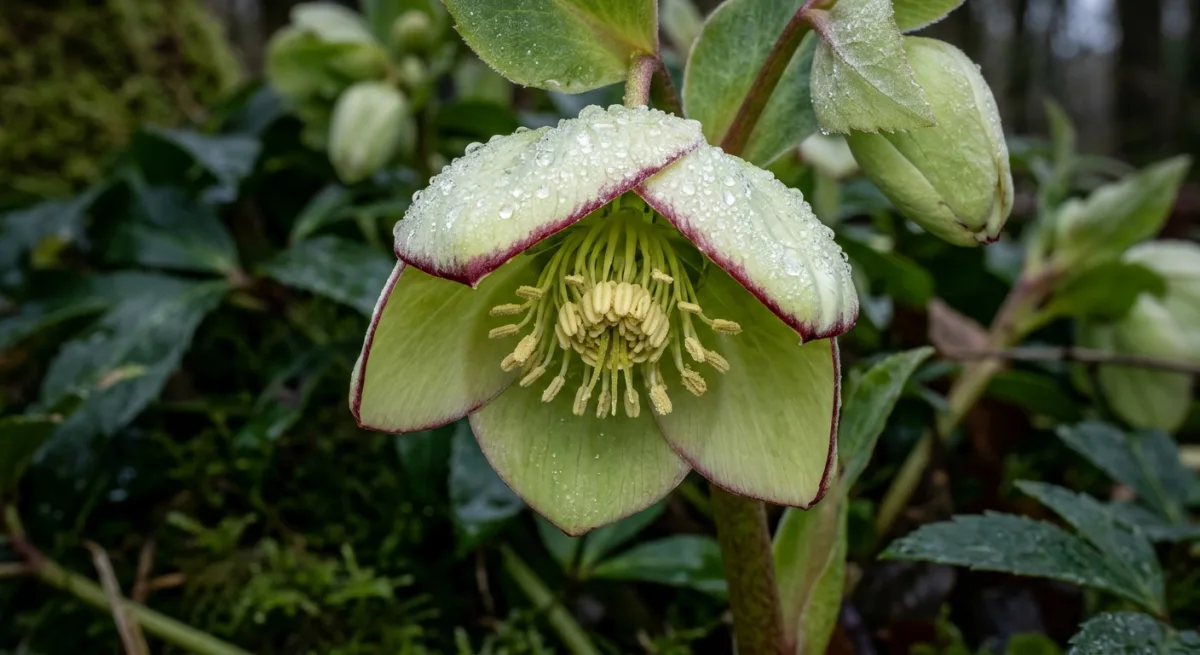
Its most mesmerizing visual hallmark is the winter-to-early-spring floral display. Drooping, chartreuse to pistachio-green campanulate (bell-shaped) blooms hang in dramatic nodding clusters, each sepal rimmed with a delicate, painted margin of deep maroon or burgundy. This pendulous habit is an elegant evolutionary adaptation designed to protect delicate reproductive organs, stamens, and nectar drops from winter rains and heavy snowfall. Below the inflorescence, the foliage exhibits a pedate structural anatomy divided into 7 to 11 narrow, serrated, lanceolate segments. The leaf surfaces are reinforced by a thick cuticular wax layer that grants outstanding resistance against sub-zero desiccation and cellular water loss.
2. Precision Light and Temperature Dynamics
Helleborus foetidus is exceptionally adapted to the shifting light dynamics of deciduous forest canopies. Throughout late autumn, winter, and early spring, when overhead deciduous trees drop their leaves, it capitalizes on filtered sunlight and soft direct rays to maximize photosynthesis and drive flower bud development. However, once summer arrives and the sun climbs higher in the sky, intense midday solar radiation and scorching ultraviolet waves can quickly scorch its dense chlorophyll tissue.
For optimal vitality, site your plant in an east- or northeast-facing morning sun aspect, or under the high, dappled canopy of deciduous trees. Complete, dense shade often causes the leaf petioles to stretch and flop, losing their sculptural integrity, while harsh afternoon summer sun causes severe necrotic brown margins along the leaf lobes. In terms of thermal tolerance, the stinking hellebore is a cold-hardy powerhouse, effortlessly withstanding severe frosts between -15°C and -20°C (USDA Zones 5–9). The plant concentrates soluble sugars and cryoprotective compounds within its cellular sap to prevent internal freezing damage. Conversely, during high summer, keeping the root rhizosphere cool (ideally below 26°C / 78°F) via organic mineral mulching is vital to prevent heat-induced root dormancy.
3. Root Physiology and Irrigation Discipline
The root system of Helleborus foetidus consists of brittle, fleshy primary anchor roots anchored by an intricate network of ultra-fine feeding capillarity roots. This delicate subterranean architecture is extraordinarily sensitive to moisture saturation and anaerobic conditions. The foundational rule of irrigation discipline here is clear: keeping the potting medium or soil continually waterlogged is not attentive care—it effectively asphyxiates the roots, cutting off critical dissolved oxygen.
During the primary growth and flowering phase (late autumn through early spring), irrigate deeply only after the top 3 to 4 cm (1.5 inches) of substrate has dried completely, always ensuring surplus water drains freely away from the pot base. In the heat of summer, the plant enters a semi-dormant metabolic rest period. Transpiration drops significantly; therefore, lengthen watering intervals considerably, supplying just enough moisture to prevent total desiccation of the root core. Furthermore, never irrigate late in the evening during freezing weather to prevent ice crystallization around the root crown.
4. Curated Substrate Architecture and Mineral Composition
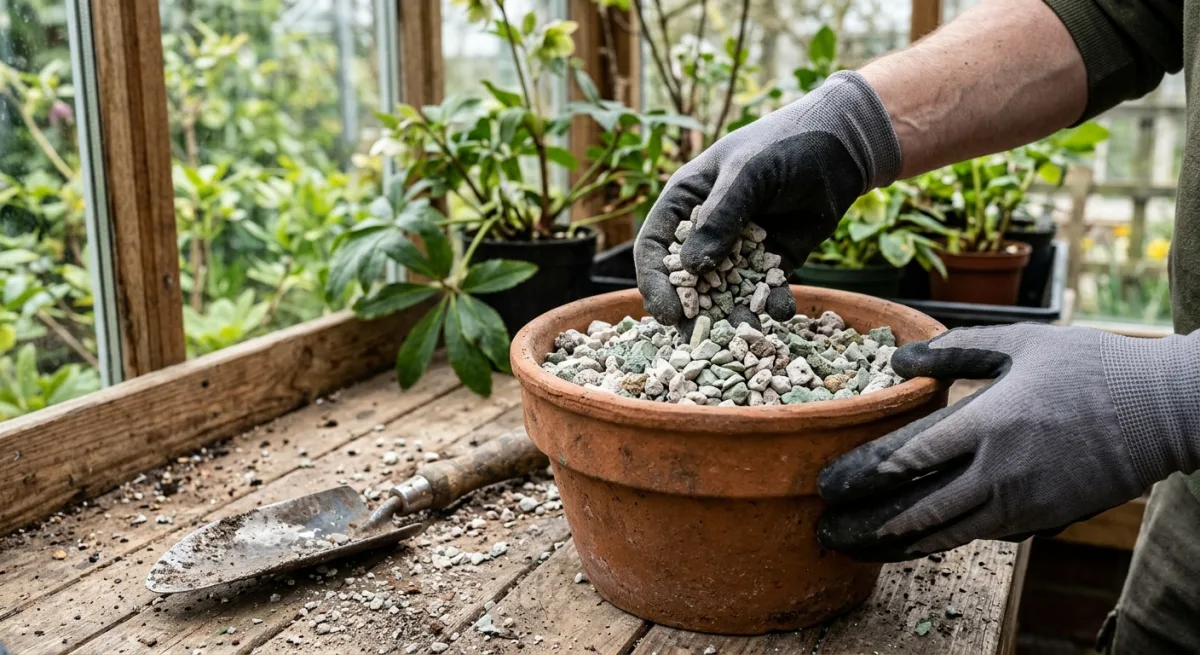
Hailing naturally from Jurassic limestones, dolomitic gravels, and alkaline woodland screes, Helleborus foetidus despises acidic, water-retentive peat blends. Standard commercial indoor potting mixes typically register an acidic pH of 5.5 to 6.0, which induces severe nutrient lockouts, microelement toxicity, and interveinal chlorosis in this species. To cultivate robust root networks and prevent basal crown rot, construct an open, mineral-dominant growing medium with a balanced alkaline pH between 6.8 and 7.8, abundant available calcium, and relentless macroscopic aeration.
| Substrate Component | Volume Ratio (%) | Particle Size | Functional Contribution |
|---|---|---|---|
| Crushed Limestone / Calcite Grit | 25% | 3 - 6 mm | Buffers substrate pH toward the alkaline spectrum and supplies vital calcium. |
| Horticultural Pumice | 25% | 4 - 8 mm | Provides high internal porosity and constant oxygen diffusion to root hairs. |
| Raw Zeolite (Clinoptilolite) | 15% | 2 - 5 mm | Elevates cation-exchange capacity (CEC), regulating salts and nitrogen uptake. |
| Coarse Volcanic Lava Rock | 15% | 3 - 6 mm | Delivers structural stability and prevents compaction in lower root horizons. |
| Aged Leaf Mold / Forest Humus | 20% | Fine-sifted | Creates a gentle organic matrix beneficial for symbiotic mycorrhizal fungi. |
When selecting containers, steer clear of glazed ceramic or non-breathable plastic pots. Opt instead for thick-walled, unglazed terracotta or cast stone vessels that promote gas exchange and rapid moisture evaporation through their porous walls. When potting, never bury the root crown too deeply; the junction where stems meet the root zone must sit flush with the substrate surface, crowned by a 1 cm layer of coarse pumice or crushed limestone gravel to keep damp soil away from the crown tissues.
5. Propagation Complexities and Safe Nursery Practice
One of the most frequent cultivation mistakes is attempting to divide Helleborus foetidus like common hybrid hellebores (Helleborus orientalis). Remember that H. foetidus is caulescent: it does not form broad, divisible underground rhizomatous networks, but rather a solitary, woody crown anchored by fragile roots. Dividing the crown with a knife or spade almost invariably causes irreversible structural shock and fatal rot.
The only reliable and biologically sound method of propagation is from seed:
- Seed Collection: Monitor the swollen follicular seed pods in late spring (May to June). The moment the suture lines begin to crack open, collect the glossy, jet-black seeds before they drop into the soil.
- Seed Freshness: Hellebore seeds slip rapidly into deep morphophysiological dormancy. While dried commercial seed packets may take up to 2 years to germinate, fresh seeds sown immediately after harvest offer exceptional germination rates.
- Double Stratification Cycle: Fresh seeds require a warm, moist phase for approximately 6 weeks at 18–20°C (64–68°F) for embryo maturation, followed by a cold stratification period of 8 to 10 weeks at 2–4°C (35–40°F) in a refrigerated moist medium to break chemical dormancy.
- Germination: After the cold period, move containers into cool ambient light at 12–15°C (54–59°F). Tiny seedlings will emerge. Do not prick out or disturb the seedlings while they possess only a fragile taproot; wait until they have developed at least two pairs of true leaves before potting on.
6. Collector Curation, Safety Protocols, and Specimen Maintenance
While Helleborus foetidus stands as an architectural triumph in the winter garden, its high concentration of phytotoxins demands prudent handling. All parts of the plant—most acutely the roots and seeds—are toxic to humans and household pets if ingested. When pruning foliage or harvesting seed heads, the cellular sap can induce severe contact dermatitis in sensitive skin. Wearing heavy-duty gardening gloves is an essential safety requirement, not an optional precaution.
To maintain specimen symmetry across seasons, carefully prune spent flower stalks down to the base using sharp, sterilized bypass pruners once the flowers fade in spring, taking care not to nick new vegetative shoots rising from the soil. This prevents the plant from exhausting its reserves on unwanted seed production, directing vitality into summer root establishment and future flower buds. Finally, ensure pristine air circulation around container plantings; stagnant air combined with cold, damp conditions can invite Botrytis cinerea (gray mold) or leaf blight. Never mist or sprinkle water directly over the foliage indoors or in sheltered cold frames.


Reader Reviews & Comments 3 Reviews
Eleanor Vance
Arthur Pendelton
Clara Higgins
Leave a Review & Rating
Share your plant care tips, experiences, or questions with our succulent community.