






Along the wind-battered Atlantic coastline of North America, amidst salt-sprayed sand dunes and calcareous bluffs, rises one of nature’s most commanding architectural silhouettes: Yucca gloriosa, colloquially known as the Spanish Dagger. With its rigid, lanceolate foliage held in an unyielding upright posture, needle-sharp terminal spines, and towering summer spikes of bell-shaped, creamy-white blossoms, this species reigns supreme across xeriphytic landscapes and sun-drenched interior spaces alike. Defying prolonged drought through its fibrous, water-storing caudex and succulent leaf blades, it stands as one of the exceptionally rare xerophytes capable of shrugging off sub-zero winter chills with total nonchalance.
Revered by botanical collectors and landscape designers for its sculptural symmetry and rugged constitution, the Spanish Dagger serves as a dramatic living focal point. Indoors, it transforms bright, sunlit rooms into tranquil conservatory-style retreats; outdoors on sun-baked terraces and rock gardens, it endures for decades with minimal intervention. Yet, its desert-warrior demeanor should never be mistaken for total invincibility. Supplying its subterranean crown with an open, highly porous substrate and honoring a disciplined watering regime remain the indispensable keys to preventing basal root compromise and unsightly foliar necrosis.
1. Botanical Profile and Morphological Adaptations
Classified within the family Asparagaceae and the subfamily Agavoideae, Yucca gloriosa is an evergreen, semi-woody shrub that gradually forms dense rosettes atop a sturdy, fibrous trunk. The lance-shaped leaves span between 30 and 90 cm in length, exhibiting a deep bluish-green hue, a leathery and stiff texture, and smooth margins. At the apex of each leaf rests a formidable, dark reddish-brown terminal spine—an evolutionary defensive adaptation engineered to deter grazing herbivores across its arid native range.
At the cellular level, the Spanish Dagger conserves moisture with profound efficiency, fortified by a remarkably thick foliar cuticle and water-retaining parenchymal tissue. This physiological makeup classifies it as a succulent-leaning xerophyte operating under Crassulacean Acid Metabolism (CAM) to curb diurnal transpiration. Upon reaching maturity in late summer to mid-autumn, the rosette launches a spectacular terminal panicle ascending 1 to 2 meters above the foliage. These pendulous, bell-shaped, sweetly scented blossoms emerge in shades of ivory and cream, often brushed with striking wine-red or purplish pigments along their exterior tepals.
2. Light Requirements and Indoor Spatial Placement
Accustomed to baking under unobstructed coastal skies, Yucca gloriosa is an intensely photophilic (light-loving) organism. To maintain sturdy leaf fibers and preserve its upright, spear-like form, it demands at least 6 hours of direct, unfiltered sunlight every day. Sub-optimal light conditions invariably trigger etiolation: the leaves lose their structural turgor, droop downward in a tired cascade, turn an anemic pale yellow, and the stem stretches awkwardly toward distant light sources.
When cultivated indoors or within an enclosed sunroom, placing the specimen directly before an unobstructed south- or west-facing window is paramount. Relocating your containerized Yucca outdoors to an open patio during late spring and summer will double its metabolic pace and vegetative vigor. However, specimens that have spent the winter sheltered indoors must never be thrust abruptly into blazing midday sun; this sudden shift induces photo-oxidative stress (solar necrosis). Always acclimatize the plant gradually over a 7-to-10-day period in dappled shade before exposing it to full sun.

3. Watering Discipline: The 'Soak and Complete Dry-Out' Method
The single most destructive pitfall among succulent enthusiasts is treating the Spanish Dagger like a conventional moisture-loving houseplant on a rigid calendar schedule. Frequent light waterings are not an expression of loving care; they systematically suffocate the subterranean roots by displacing vital pore oxygen. The vascular xylem tissues of Yucca gloriosa are evolutionarily ill-equipped to withstand prolonged anaerobic moisture.
The golden rule is the rigorous 'soak and dry' method: never introduce water until the potting medium has dried out entirely down to the bottom tier of the container. Insert a slender wooden skewer into the root zone to inspect subterranean moisture; only if it emerges completely dry and free of clung soil is it time to hydrate. When watering, saturate the substrate thoroughly until excess moisture pours freely from the base drainage holes, and empty any pooled water from the saucer within 15 minutes. During late autumn and winter dormancy, when the plant’s transpiration slows to a crawl, stretch intervals to once a month or even longer.
4. Substrate Optimization and Container Dynamics
An ideal substrate for the Spanish Dagger must replicate the fast-draining, gritty conditions of seaside dunes, characterized by outstanding mineral porosity and immediate hydraulic conductivity. Dense peat moss, standard all-purpose potting soils, and clay blends hold water far too long, creating an environment primed for root pathogens. Incorporating coarse volcanic rock, pumice, and grit ensures structural aeration and provides substantial physical ballast to anchor top-heavy specimens securely.
Regarding container selection, prioritize porous, unglazed terracotta or ceramic pots equipped with ample drainage holes over plastic pots. Because a mature Spanish Dagger produces a heavy, dense crown, lightweight plastic containers easily tip over in strong patio drafts or bustling household corridors; a heavy, broad-based clay vessel provides both physiological root breathability and physical stability.
| Substrate Component | Ratio (%) | Botanical Function & Horticultural Benefit |
|---|---|---|
| Coarse Horticultural Pumice | %35 | Maximizes macroporosity, supplies internal aeration, and facilitates rapid drainage |
| Crushed Lava Rock / Basalt Grit | %25 | Anchors top-heavy specimens, offers structural durability, and releases trace minerals |
| Coarse River Sand / Zeolite | %15 | Enhances micro-capillary air exchange around feeder roots and halts soil compaction |
| Fibrous Low-Peat Cactus Soil | %25 | Supplies moderate organic matter, micro-nutrients, and base moisture retention for growth |
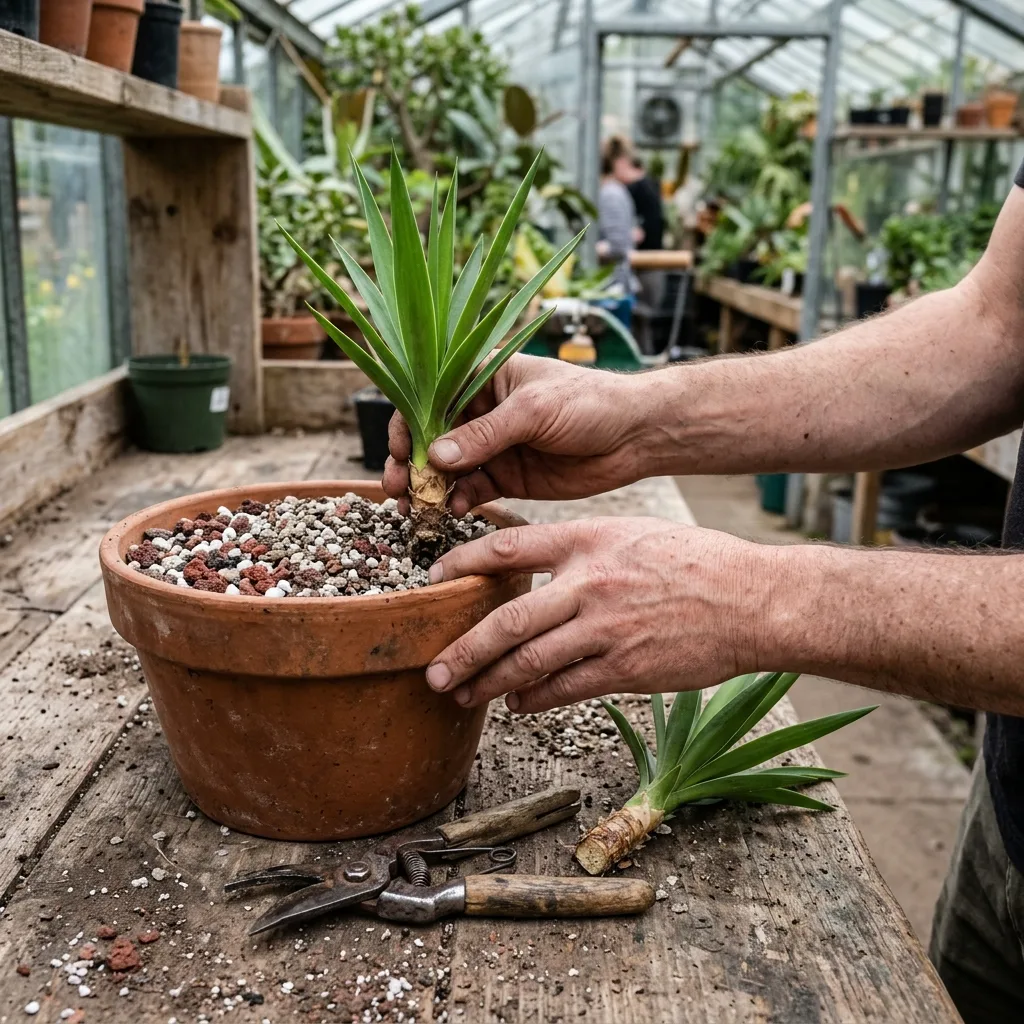
5. Step-by-Step Propagation Protocols
Multiplying Yucca gloriosa is a rewarding endeavor with an exceptionally high success rate. In native habitats, the plant expands through subterranean rhizomes to form majestic multi-stemmed colonies. In home and garden settings, you can reliably replicate this process using basal offsets or stem cuttings.
- 1. Basal Offsets (Pups): In mid-to-late spring, inspect the base of the primary stem for vigorous suckers measuring 15 to 20 cm in height. Using a sterilized bypass pruner or sharp knife, sever the offset cleanly at its junction with the parent trunk, preserving as many adventitious root fibers as possible. Crucially, do not pot the pup immediately; allow it to rest in a dry, ventilated, shaded spot for 3 to 4 days so the cut tissue develops a protective suberized callus. Once callused, insert it into a slightly moistened, gritty succulent mix.
- 2. Stem Sections (Truncheons): Mature specimens that have outgrown their space or grown leggy can be renewed via stem cuttings. Decapitate 15 to 30 cm sections of healthy, semi-woody trunk using a clean garden saw. Seal the exposed upper wound with melted candle wax to curb desiccation. Cure the cutting in a shaded, warm area for 5 to 7 days before inserting the bottom end 5 to 10 cm deep into a pumice-rich rooting medium. Roots and emerging vegetative buds typically develop within 4 to 6 weeks.
6. Common Pathogens, Pests, and Therapeutic Solutions
While inherently robust against most physiological ailments, suboptimal environmental conditions can render your Spanish Dagger susceptible to specific pests and pathogens:
- Concentric Leaf Spot (Coniothyrium concentricum): This fungal infection presents as circular, necrotic brown or black lesions encircled by bright chlorotic halos across the foliage. It is triggered by persistent overhead splashing and stagnant air. Excise heavily spotted leaves, relocate the container to an area with superior airflow, and apply a preventative copper-based bio-fungicide.
- Mealybugs (Pseudococcidae): These sap-sucking insects settle inside the tightly folded crevices at the leaf bases and stem junctions, concealing themselves under cottony white wax deposits. Eradicate small clusters manually with a cotton swab soaked in 70% isopropyl alcohol; for advanced infestations, apply cold-pressed neem oil or a systemic horticultural insecticide.
- Scale Insects (Coccoidea): Visible as small, brown, waxy shields anchored along the ventral and dorsal leaf planes, scale insects deplete internal fluids. Scrape them free using an old toothbrush dipped in dilute potassium horticultural soap solution, rinsing gently afterward.
7. Seasonal Stewardship Calendar and Expert Care Routine
Aligning your maintenance rituals with the natural phenological rhythm of the Spanish Dagger guarantees sustained vitality throughout the year:
- Spring (Awakening & Vegetative Push): The optimal window for repotting, root pruning, and taking vegetative cuttings. As new center spears begin unfolding, apply a half-strength, low-nitrogen, high-potassium liquid succulent fertilizer once a month.
- Summer (Peak Photosynthesis): Maximize direct sun exposure by moving containers out to patios, balconies, or garden beds. Water thoroughly as soon as the potting matrix dries out completely. Once the monumental floral panicle fades in late summer, prune the central flowering stalk down to its base to redirect energy into vegetative offsets.
- Autumn (Acclimatization & Hardening): Cease all fertilization completely to prevent soft, cold-sensitive tissue growth. Gradually taper watering intervals. If you reside in an area with prolonged hard freezes and your plant is potted, inspect foliage thoroughly for pests before bringing it indoors.
- Winter (Dormancy & Cold Hardiness): Mature specimens planted in ground beds can withstand short dips down to -15°C (5°F). However, container-grown roots lack geothermal buffering and can freeze solid if left unprotected below -7°C (20°F). Keep the potting substrate bone-dry throughout the cold season, wrap outdoor pots in protective burlap, and provide the brightest possible indoor ambient light.


Reader Reviews & Comments 3 Reviews
Marcus Vance
Eleanor Sterling
Julian Thorne
Leave a Review & Rating
Share your plant care tips, experiences, or questions with our succulent community.