






Across the sun-scorched limestone plateaus of the Chihuahuan Desert in northern Mexico and southern Texas, an ancient botanical treasure lies seamlessly hidden from plain sight: Ariocarpus fissuratus, affectionately known to enthusiasts as the Living Rock Cactus. Blending so flawlessly into its rocky terrain that it defies recognition as a living organism, this geophytic cactus withdraws entirely flush with or beneath the soil line during severe droughts. It stands as one of the botanical world's most exquisite triumphs of cryptic camouflage and evolutionary adaptation. Bringing an Ariocarpus into your personal collection or greenhouse is far more than growing an ordinary houseplant; it is curating a living geological sculpture that measures time across decades.
However, cultivating this living relic demands total reverence for its evolutionary memory. Having adapted to endure centuries-long cycles of extreme arid exposure, this rare treasure is ironically vulnerable to the perils of domestic 'over-care' and misplaced kindness. In late autumn and winter, when its metabolism comes to a near-total standstill, treating it like a typical indoor plant—or subjecting it to the dry heat of central radiators paired with low ambient light—can destroy its massive underground storage system through rapid, irreversible taproot rot in a matter of weeks.
1. Taxonomy and Rare Morphological Characteristics
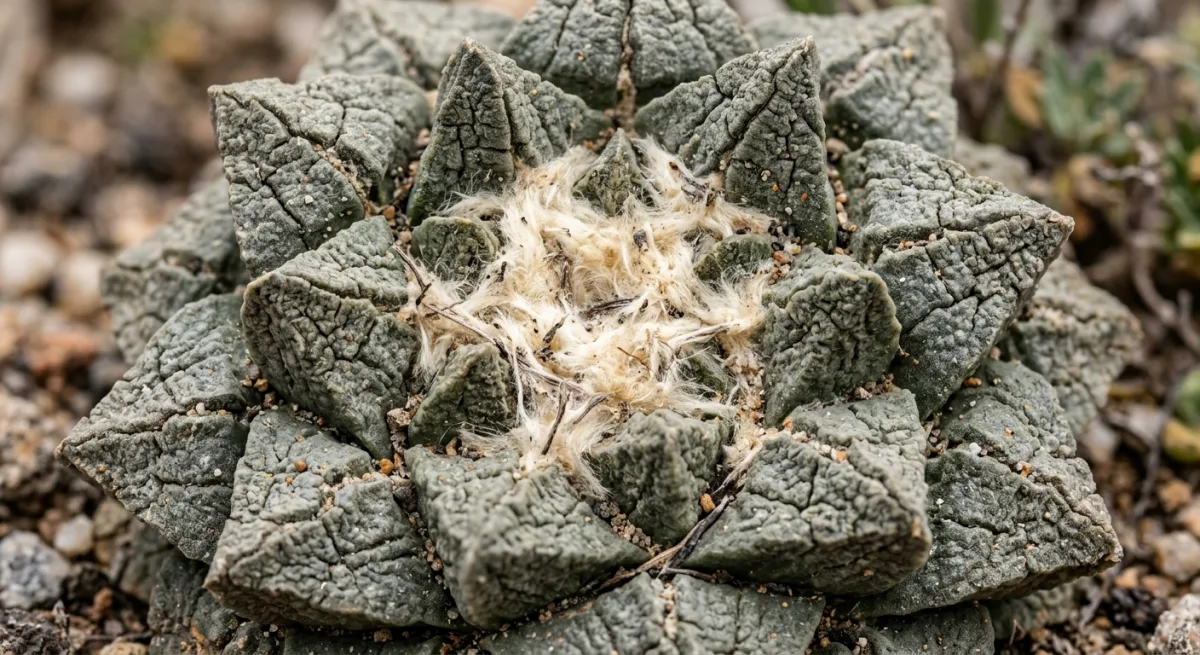
As one of the most distinctive members of the family Cactaceae, the genus Ariocarpus fundamentally challenges traditional perceptions of what a cactus should be. Upon inspecting a mature Ariocarpus fissuratus, you will not encounter classic spines or sharp needles. Over millions of years of selective pressure, its spines evolved away to deter herbivores and eliminate excessive transpiration, transforming instead into thick, rugose, fissured tubercles that mirror fractured sedimentary rock. Running directly through the center of these flattened, triangular tubercles are deep fissures lined with woolly trichomes—the defining morphological signature from which the species earns its epithet, fissuratus.
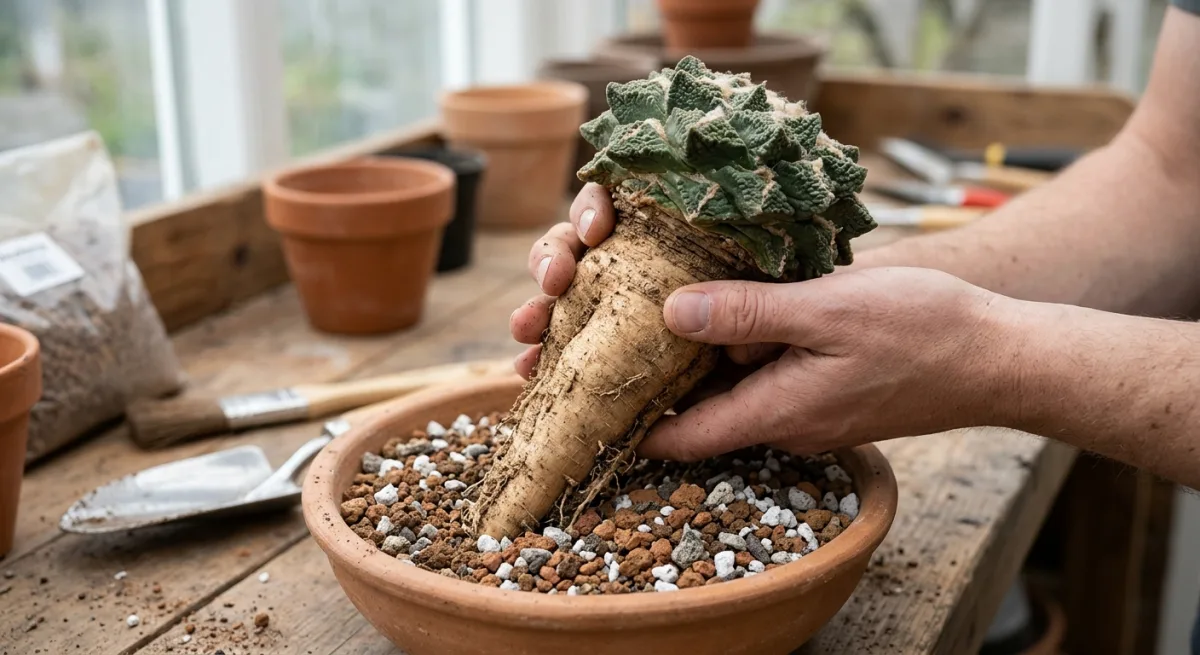
The compact, rosette-like body visible above the soil line represents merely a fraction of the plant's total biomass. Subterraneously, the plant relies on a massive, carrot-like tuberous taproot (napiform taproot) engineered for immense water and carbohydrate storage. During prolonged dry spells, this root contracts, pulling the photosynthetic crown below ground level to shield it from lethal desert solar radiation. You can verify the species' global botanical distribution and taxonomic verification via Kew Plants of the World Online. Tragically threatened in the wild by habitat destruction and illicit field collection, Ariocarpus fissuratus is safeguarded internationally under CITES Appendix I, making ethically propagated specimens the crown jewels of private collections.
2. Precise Light and Temperature Requirements
Ariocarpus fissuratus conducts its photosynthetic machinery via Crassulacean Acid Metabolism (CAM), an evolutionary adaptation that keeps stomata tightly sealed throughout blistering daytime heat. The plant opens its stomata exclusively under cool nighttime desert conditions to uptake and fix carbon dioxide. To support this specialized metabolic process, the Living Rock Cactus requires intense, direct sunlight or a dedicated high-output, full-spectrum LED cultivation setup with high Photosynthetically Active Radiation (PAR) values.
The greatest indoor hazard during the colder months is etiolation—abnormal stem elongation triggered by light starvation. When a collection is kept indoors at comfortable human temperatures (22–25°C / 72–77°F) while exposed to weak winter daylight, the plant receives contradictory biological signals. Misinterpreting the warmth as an active growing season without sufficient photons, its flat, stone-like geometric rosette stretches outward into a distorted, conical shape. This structural deformity is irreversible and permanently degrades the specimen's aesthetic and botanical value.
- Winter Dormancy Temperature: For an authentic, restorative dormancy, maintain ambient winter temperatures strictly between 8°C and 14°C (46°F–57°F). Provided its substrate remains bone dry, the plant can briefly tolerate dips toward 0°C (32°F); however, an unheated, brightly lit sunroom or a cool, draft-free windowsill isolated from interior heat sources provides the safest wintering zone.
- The Radiator Threat: Staging an Ariocarpus near forced-air heating vents or baseboard radiators forces cellular respiration to race ahead while roots are dormant, depleting internal water reserves and leading to sudden cellular collapse.
3. Root Sensitivity and Watering Discipline
Water management for the Living Rock Cactus is less about following a calendar and entirely about synchronizing with the plant's internal biological clock. The cortical tissues of the napiform taproot hold moisture with astonishing efficiency, but this hyper-specialized storage architecture leaves the root cells exceedingly vulnerable to hypoxia (oxygen deprivation) if surrounding soils stay damp.
As seasonal temperatures drop in late autumn (late October to early November), irrigation must be systematically tapered down until it is completely suspended throughout the winter dormancy period (November through late March). Do not offer a single drop of water for the entirety of winter. If you notice the tubercles shriveling slightly, wrinkling, or drawing closer to the mineral line, do not panic—this is a natural physical defense. The plant intentionally expels surplus water to concentrate cellular sugars and mineral salts, functioning as natural antifreeze.
When spring arrives in April and ambient night temperatures reliably exceed 15°C (59°F), introduce the first gentle awakening irrigation from below using lukewarm water. During active growth across late spring and summer, adopt a strict 'soak and dry' methodology. The substrate must become bone dry throughout the entire profile—all the way down to the base of the root zone—before another deep drenching is administered.
4. Specialized Mineral Substrate and Soil Composition
Standard commercial succulent potting mixes and peat-based mediums are an immediate death sentence for an Ariocarpus. Peat retains moisture far too long, hardens into a hydrophobic brick when dried out, suffocates delicate feeder rootlets, and refuses to evaporate during cool weather. In habitat, the Living Rock Cactus roots into calcareous fissures with near-zero organic content. In cultivation, you must provide a loose, highly porous, completely mineral substrate that prioritizes gas exchange.
| Substrate Component | Particle Size | Volume Ratio | Botanical Function |
|---|---|---|---|
| Hard Japanese Akadama (Double Red Line) | 3 – 6 mm | 30% | Provides controlled micro-moisture retention around rootlets and stimulates fine root branching. |
| High-Grade Pumice | 3 – 5 mm | 30% | Ensures macro-porosity and maximizes continuous oxygen circulation to the taproot. |
| Clinoptilolite Zeolite | 2 – 4 mm | 20% | Optimizes cation exchange capacity (CEC), regulates nutrient buffers, and exhibits natural anti-fungal properties. |
| Crushed Limestone or Volcanic Scoria | 2 – 5 mm | 15% | Replicates the native calcareous habitat, supports a slightly alkaline pH, and yields trace minerals. |
| Finely Screened Worm Castings Compost | Ultra-fine sifted | 5% | Delivers a conservative baseline of micronutrients and beneficial biology without moisture stagnation. |
When selecting containers, choose deep, unglazed terracotta pots or specialized Japanese plastic training pots featuring vertical ventilation slats that accommodate the expansive taproot. To preserve the vulnerable root neck (the transition zone where root joins stem), top-dress the substrate surface with a 1 cm (0.4 in) layer of coarse limestone or lava gravel.
5. Propagation Challenges and Safe Cultivation Methods
Ariocarpus fissuratus is renowned for its extraordinarily deliberate growth habit. Raising this species from seed requires meditative patience; a seed-grown specimen can take 4 to 8 years simply to reach 2 to 3 cm in diameter and express its classic tubercle geometry. This slow maturation is precisely why mature, seed-grown specimens command such high value among discerning collectors.
- Seed Propagation (Own-Roots): Sow viable seeds over a sterilized, finely graded mineral bed inside sealed humidity enclosures ('the baggie method') maintained at 25–28°C (77–82°F) under a 16-hour daily photoperiod. Seedlings must be shielded from mold using preventative ventilation once germinated. Plants cultivated on their own natural taproots represent the pinnacle of botanical authenticity and resilience.
- Grafting: Commercial producers often micro-graft young seedlings onto vigorous nurse stocks like Pereskiopsis, Echinopsis, or Hylocereus to accelerate tissue expansion. While grafted specimens can reach flowering maturity in 2 to 3 years, the influx of water and sap often causes the scion to bloat unnaturally, losing its iconic flat, rock-mimicking morphology. Advanced growers often later degraft the head, re-rooting the base directly into mineral substrate to restore its authentic habit.
6. Conservation, Pest Defense, and Value Preservation
Stewarding an Ariocarpus in your home means acting as an ambassador for endangered desert biodiversity. The foremost mandate of any ethical collector is simple: Never purchase wild-dug or habitat-collected plants. Insist exclusively on documented nursery-grown, CITES-certified, or captive seed-raised plants. Wild specimens stripped from the desert almost inevitably perish within twelve months indoors due to severe transplant shock and severed taproot vascular bundles.
Regarding pests, the most insidious threat is the root and wool mealybug (Pseudococcidae). These pests nest deep within the dense trichomes of the fissures or directly along the taproot neck, where their protective waxy secretions shield them from casual contact sprays. Because the plant cannot be watered in winter, systemic soil drenches cannot be absorbed during dormancy. Administer a preventative biological or systemic treatment at the conclusion of autumn, and inspect the crevices periodically under magnification.


Reader Reviews & Comments 1 Review
No comments yet. Be the first to share your succulent experience!
Leave a Review & Rating
Share your plant care tips, experiences, or questions with our succulent community.