






A crown jewel among caudiciform collectors, Kedrostis africana—commonly known as the Baboon Cucumber—stands as an evolutionary masterpiece of the Cucurbitaceae (gourd) family. Native to South Africa's Eastern Cape, the semi-arid Karoo regions, and extending into the parched plateaus of Namibia, this species developed a colossal hypocotyl-derived 'caudex' as an adaptation to survive prolonged, punishing droughts. In the wild, baboons and small mammals unearth and consume this subterranean water reservoir to quench their thirst, inspiring its curious common moniker.
Aesthetically, it represents a striking study in contrasts: from a swollen, fissured, rock-like base resembling petrified stone erupts a lush cascade of slender, climbing vines adorned with deeply lobed, heart-to-kidney-shaped foliage. Evoking the aura of a miniature baobab tree in indoor living rooms and succulent greenhouses, this species transforms into a generational living sculpture that gains girth, character, and sculptural presence over decades when given proper microclimatic conditions.
1. Botanical Profile and Morphological Features
Taxonomically, Kedrostis africana is a perennial caudiciform climber that is predominantly dioecious (bearing male and female flowers on separate individuals), though rarely monoecious specimens occur. The morphological focal point of the plant is its swollen caudex, which can span 50–60 cm in wild habitats and reach 25–30 cm under pot culture. This structure is composed largely of dense water-storage parenchyma cells, whose expansive central vacuoles retain enormous volumes of water and polysaccharides. The outer surface is cloaked in a thick, fissured cork layer enriched with suberin to drastically curb transpirational water loss.
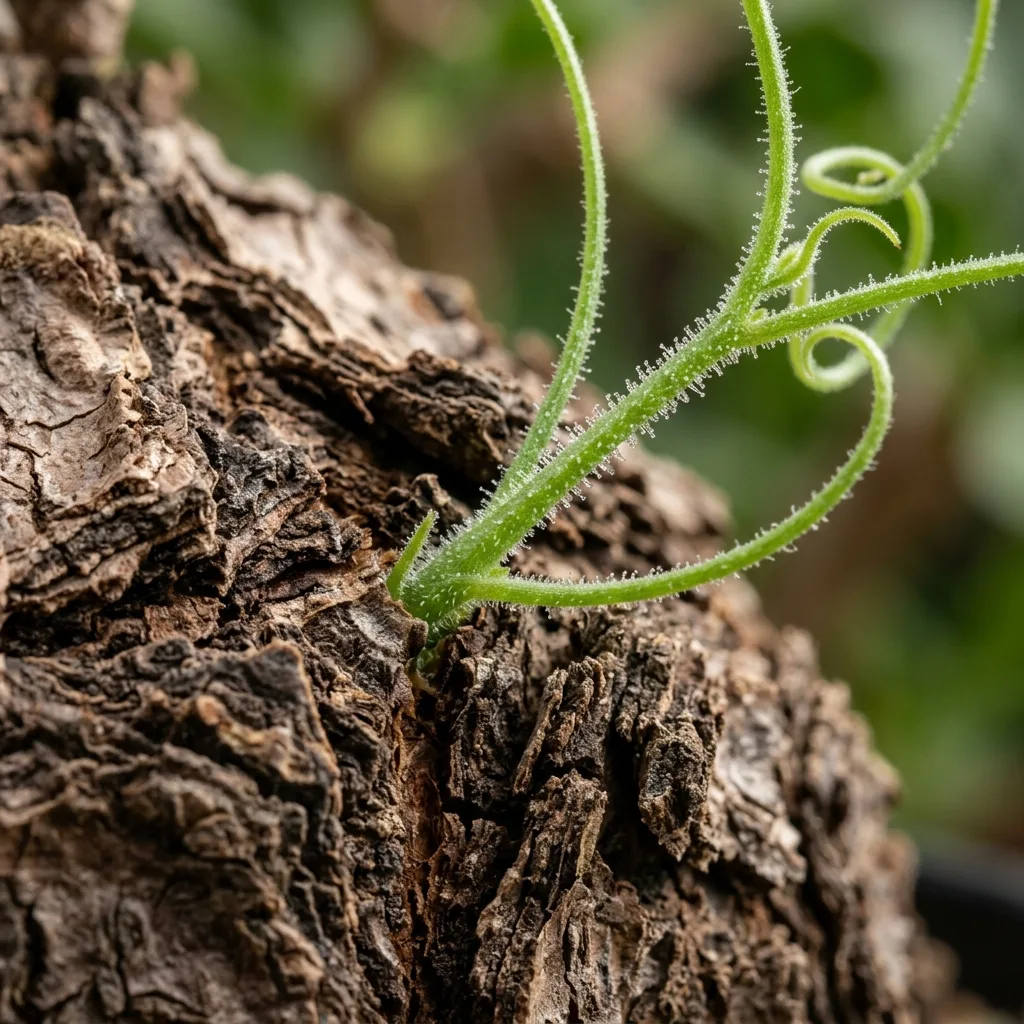
With the arrival of spring, vigorous shoots emerge from dormant meristematic buds atop the caudex, rapidly extending anywhere from 3 to 6 meters by latching onto nearby shrubbery or support structures via curling tendrils. The leaves are scabrid (coarsely textured), pubescent, and deeply lobed, equipped with micro-trichomes that mitigate desiccating airflow while maximizing photosynthetic surface area. Its small, yellowish-green blossoms are unassuming; following successful pollination, female specimens produce diminutive, bright orange-to-red squash-like fruits.
2. Light Requirements and Indoor Placement
In its native habitat, the caudex of Kedrostis africana typically rests in deep shade beneath scrub bushes, wedged among boulders, or entirely subterranean, shielded from intense radiant heat. Conversely, its photosynthetic vines clamber relentlessly upward into full canopy sunlight. This wild adaptation provides the fundamental blueprint for indoor positioning.
Exposing the caudex to harsh, direct midday sunlight—particularly when magnified through window glass—can scorch epidermal tissues, induce sunscald, and cause irreversible splits. The optimal arrangement is one where the caudex sits in bright, filtered light or behind a sheer curtain, while the climbing foliage basks in 4 to 6 hours of generous direct light, preferably gentle morning sun from an eastern or southwest-facing exposure. Inadequate light exposure leads to severe etiolation, characterized by abnormally stretched internodes and pale, fragile foliage.
3. Watering Protocols: The 'Soak and Dry' Discipline
Irrigation schedules for Kedrostis africana must be dictated exclusively by its phenological cycle: the Active Growth Season (Spring through Summer) and Dormancy (Late Autumn through Winter). During the active phase, the rapidly elongating vines require a steady supply of moisture, yet the root system remains exceptionally intolerant of stagnant, oxygen-deprived conditions.
Always employ the classic 'soak and dry' method. Water deeply until moisture runs freely from the drainage holes, and empty any accumulated runoff from the saucer within 15 minutes. Allow the substrate to dry out entirely (100%) down to the bottom of the container before watering again. Never pour water directly over the apical meristem or crown of the caudex; instead, distribute moisture evenly in a ring around the surrounding soil line.
4. Substrate Composition and Pot Selection
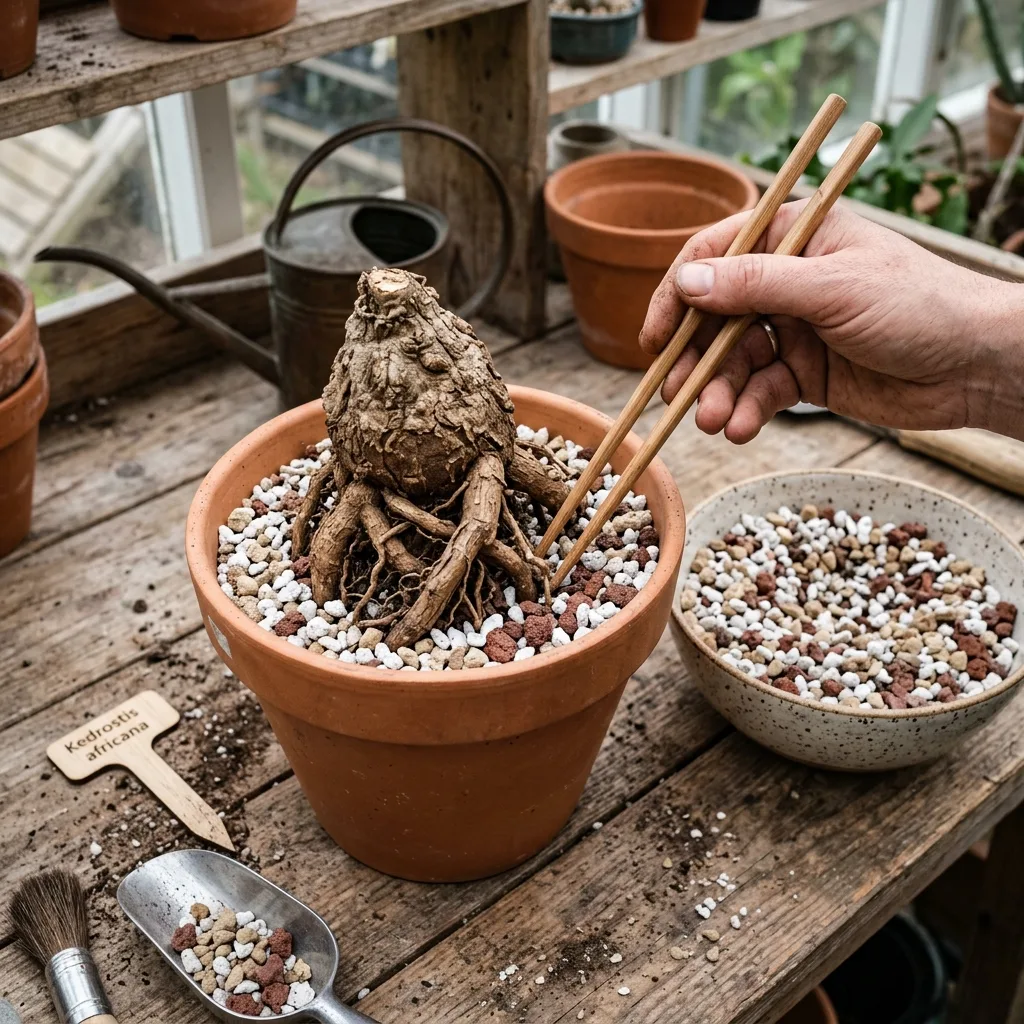
The root hairs of Kedrostis africana thrive in well-aerated, loose, and rapidly draining volcanic minerals. Standard peat-heavy potting mixes retain excess moisture and compact rapidly, presenting a lethal risk to this species. Cultivators should craft a predominantly inorganic potting mix that ensures rapid percolation.
| Component | Proportion (%) | Botanical Function & Benefit |
|---|---|---|
| Pumice (3–6 mm) | %40 | Maximizes root-zone gas exchange (aeration) and curbs pathogenic rot. |
| Crushed Lava Rock | %20 | Buffers excess moisture via micropores; releases beneficial trace minerals. |
| Coarse Perlite or Zeolite | %15 | Boosts cation-exchange capacity while maintaining a light, loose matrix. |
| Sterile Cactus/Succulent Soil | %25 | Provides organic fibrous matter for root anchoring and slow nutrient uptake. |
For container material, unglazed terracotta or porous ceramic pots with functional drainage holes are mandatory. Plastic and glazed ceramic vessels trap moisture within the root zone, prolonging drying intervals to hazardous lengths. Avoid overpotting; choose a pot that leaves a 3–5 cm margin around the caudex, providing ample depth to accommodate the plant's thick, downward-reaching taproot structure.
5. Step-by-Step Propagation Techniques
There are two primary methods for propagating Kedrostis africana: Seed Propagation (the only reliable method to produce a massive, symmetrical caudex) and Stem Cuttings.
Propagation from Seed (Recommended Method)
- Seed Preparation: Soak fresh seeds in lukewarm water for 12 hours before sowing. This softens the woody coat and leaches away germination inhibitors.
- Seedbed Preparation: Fill a seedling tray with a sterilized mixture of 70% fine pumice/zeolite and 30% sifted peat. Place the seeds on the surface and cover lightly with 2–3 mm of fine mineral grit.
- Temperature & Moisture: Maintain temperatures between 22–26°C (72–79°F). Cover with a transparent dome to preserve humidity, misting regularly to keep the surface lightly moist but never waterlogged.
- Post-Germination: Germination typically occurs within 7 to 21 days. Increase ventilation as soon as cotyledons emerge. Within 6 months, subterranean, hazelnut-sized caudices will begin developing beneath the soil line.
Propagation from Cuttings
Semi-hardwood green shoots taken during active spring growth can be callused for 2–3 days and struck in pure perlite. While cuttings will root and produce vigorous climbing vines, they generally fail to form the swollen, symmetrical, sculptural caudex characteristic of seed-grown plants, or will take decades to develop even a modest base.
6. Common Diseases, Pests, and Treatments
Despite its desert toughness, this plant's Achilles' heel is stagnant air coupled with excess moisture. Watch for these pathological and entomological issues:
- Caudex Rot (Fusarium and Pythium species): Manifests as softening, localized blackening, and a spongy depression at the base. Treatment: If caught early, unpot the specimen immediately. Excise all necrotic tissue with a sterile scalpel back to clean, firm flesh. Dust the wound generously with powdered sulfur or activated charcoal, allow it to dry in shade for 10 days, and repot in completely dry mineral substrate.
- Spider Mites (Tetranychidae): In dry, overheated indoor rooms, fine webbing and stippling appear on the undersides of the leaves, followed by leaf drop. Treatment: Increase ambient ventilation slightly, wipe the foliage clean with a damp sponge, and treat with a cold-pressed neem oil or horticultural soap solution.
- Mealybugs (Pseudococcidae): Cottony white masses congregate in the bark fissures and root crown. Treatment: Remove localized clusters with a cotton swab dipped in 70% isopropyl alcohol. For severe infestations, apply a systemic insecticide formulated for succulents during the active growing period.
7. Seasonal Care Calendar and Expert Protocols
- Spring (Awakening): Come April, tiny green vegetative buds emerge from the top of the caudex. Gradually resume regular watering. Feed once monthly with a balanced, low-nitrogen succulent fertilizer diluted to half-strength.
- Summer (Peak Growth): Vines grow vigorously. Provide bamboo stakes, a trellis, or wire hoops for support. Water thoroughly whenever the substrate dries out, and ensure good cross-ventilation during sweltering heatwaves.
- Autumn (Transition): Beginning in October, widen the intervals between waterings and halt fertilization entirely. As the foliage begins to yellow and dry up, avoid excessive moisture; let the plant naturally translocate stored starches into the caudex.
- Winter (Dormancy): Keep the dormant caudex in a cool (10–14°C / 50–57°F), dry room. Protect completely from freezing temperatures. Water with strict minimalism—just a few spoons monthly if severe shriveling threatens the base.


Reader Reviews & Comments 3 Reviews
Julian Vance
Charlotte Hayes
Marcus Sterling
Leave a Review & Rating
Share your plant care tips, experiences, or questions with our succulent community.