






If you walk across the sun-bleached quartz flats of southern Namibia and the Great Karoo of South Africa, you will witness how flawlessly nature blurs the boundary between mineral stone and living tissue. Lapidaria margaretae, affectionately known as the Karoo Rose, anchors itself into this punishing terrain like a precision-sculpted marble bud. Camouflaged against the baking desert floor, this living gemstone transitions into a piece of fine kinetic art the moment it enters our indoor plant collections.
Many botanical enthusiasts mistakenly group the Karoo rose with the famous 'living stones' (Lithops) upon first glance; indeed, it is an elite member of the stone-plant family Aizoaceae (the mesembs). However, unlike Lithops—which strictly restricts itself to a single functional pair of leaves at a time—Lapidaria is architecturally distinct. Under sound physiological conditions, it comfortably sustains two to four pairs of angular, faceted leaves simultaneously, unfurling like a geometric crystalline rose. In this comprehensive master guide, we explore the exacting botanical principles needed to cultivate this resilient yet moisture-sensitive desert jewel indoors without succumbing to rot, stretching, or loss of form.
1. Botanical Identity and Morphological Characteristics
Taxonomically, the genus Lapidaria is monotypic, embracing only one solitary species in the wild: Lapidaria margaretae. The species epithet honors Margarete Engler, wife of the renowned German botanical taxonomist Heinrich Gustav Adolf Engler. The generic name Lapidaria derives from the Latin lapis, translating to 'heap of stones' or 'quarry,' an explicit tribute to the plant's cryptic mimicry among broken quartz rocks in its native habitat.
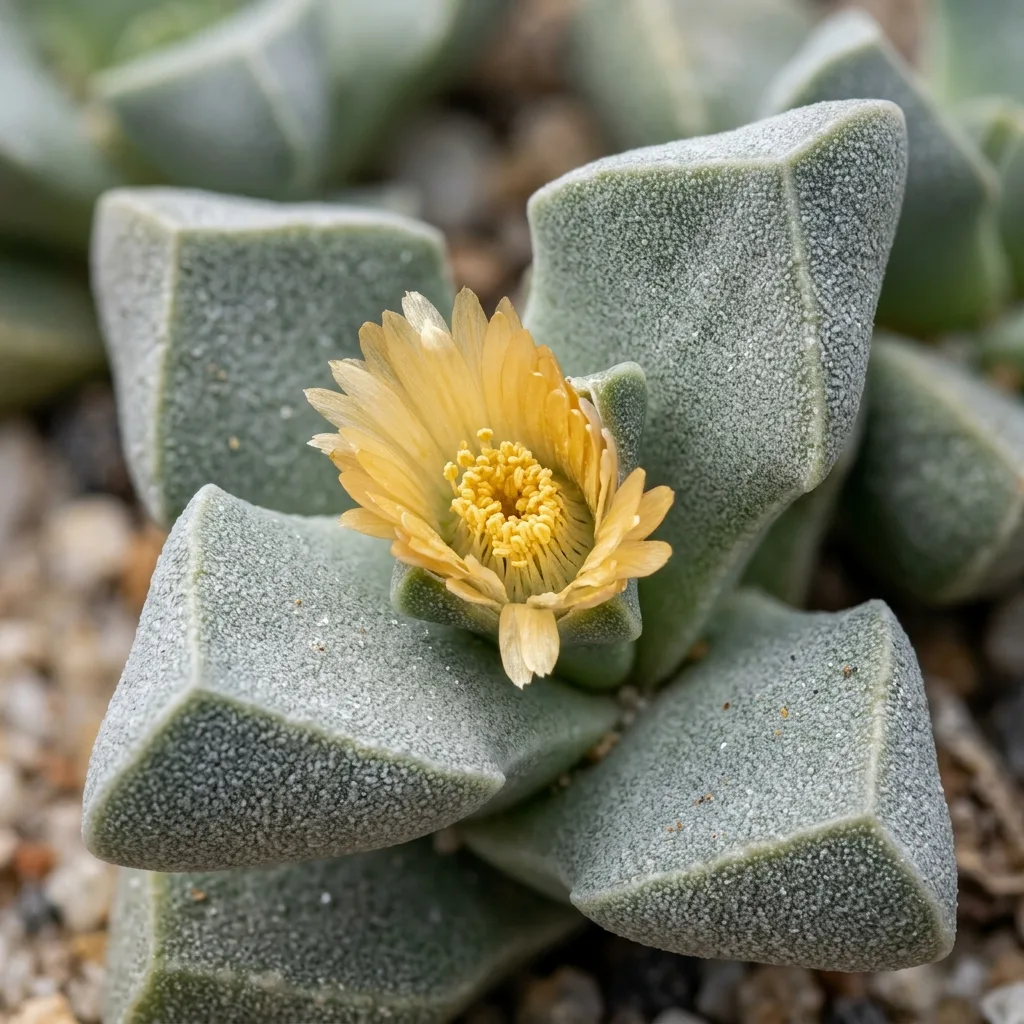
Morphologically, the Karoo rose exhibits an acaulescent (stemless), intensely succulent, and compact growth architecture. Its opposite leaves measure roughly 20 to 40 mm in length, anchored by swollen bases that taper toward razor-sharp, keel-like ridges. Leaf surfaces present an extraordinary palette of chalky porcelain, pale ivory, glaucous blue-grey, and—under intense photon exposure—soft lavender and rose tones. This pigmentation is no decorative accident; it represents an evolutionary survival mechanism driven by cellular epicuticular farina wax and exceptional albedo (solar reflectance), safeguarding inner parenchyma cells against the Karoo's blistering ultraviolet radiation.
As autumn arrives, a magnificent reward bursts forth from the deep central fissure: an expansive, dandelion-like golden-yellow blossom spanning up to 5 cm in diameter. Densely packed with slender petals surrounding clean white filaments, these silky flowers open wide in the bright warmth of the afternoon to beckon native desert pollinators, gently folding shut as the cool desert night descends.
2. Light Requirements and Indoor Positioning
The Karoo rose evolved not for partial shade, but for raw, unfiltered desert radiation. The cardinal rule of successful indoor cultivation is unyielding light intensity. Under insufficient illumination, Lapidaria rapidly suffers from etiolation: its sharp, geometric contours soften and stretch, the compact rosette distorts, and that chalky alabaster coat degenerates into a frail, washed-out green. Once cellular elongation occurs, these stretched leaves can never return to their squat form; your only remedy is waiting for new leaf pairs to emerge under restored lighting.
Indoors, position your specimen directly on an uncurtained south- or southwest-facing windowsill delivering at least 5 to 6 hours of direct solar exposure daily. Keep in mind that stagnant indoor glass can act as a thermal lens, trapping excessive radiant heat and risking localized tissue burns. Generous passive airflow or a gentle circulating fan is vital. If your living space lacks adequate direct sunlight, supplement with full-spectrum horticultural LED fixtures delivering at least 250–300 µmol/m²/s PPFD (photosynthetic photon flux density) on a 12-to-14-hour photoperiod.
3. Watering Discipline: The 'Soak and Dry' Strategy
The most fatal error indoor growers commit with the Karoo rose is equating love with water. In succulent care: frequent watering is never an expression of affection; it is the silent, oxygen-depriving suffocation of root hairs. Lapidaria margaretae operates on Crassulacean Acid Metabolism (CAM). It locks its stomata tightly during daylight to forestall transpiration, cracking them open exclusively in the cool of night to absorb carbon dioxide. This ultra-conservative metabolic pathway allows it to endure weeks, or even months, without a drop of rain.
Throw away calendar-based schedules and let the physical morphology of the plant dictate irrigation:
- Sign That Irrigation Is Needed: Look past the oldest bottom leaves. When the innermost, newest leaf pair exhibits fine vertical wrinkles along its flanks, loses its glossy turgor, and yields slightly to gentle lateral touch, the plant is signaling physiological thirst.
- Sign That Irrigation Must Be Withheld: If the leaves feel rock-solid, fully turgid, and plump, do not add water—even if the substrate has been bone-dry for weeks.
When you do water, employ the 'soak and dry' method thoroughly. Saturate the root zone until liquid escapes freely from the pot's drainage holes, and empty the drip saucer within 10 minutes. During the deep cold of winter and the sweltering heat waves of midsummer, Lapidaria enters semi-dormancy. Cease active watering in these periods, offering only a modest splash around the pot perimeter once a month to prevent fragile root hairs from desiccation.
4. Ideal Mineral Substrate and Container Selection
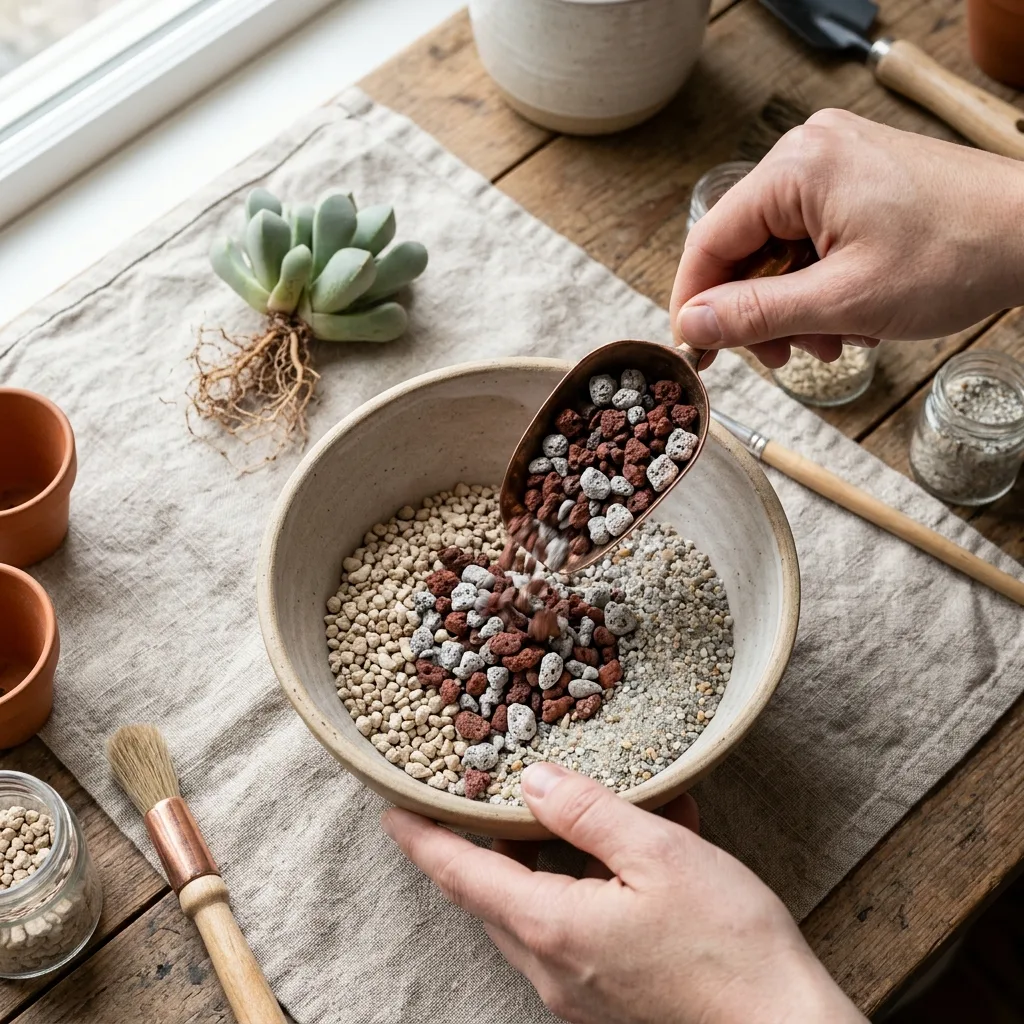
Thriving naturally within quartz scree and igneous rock fissures, the Karoo rose will swiftly rot in conventional peat-heavy potting soils. Humus-dense substrates act like dense sponges, cutting off subterranean air exchange and drowning delicate feeder roots. For Lapidaria, your growing medium must contain 80% to 90% inorganic, porous mineral aggregates by volume.
Use the following soil formulation to provide optimal porosity, rapid hydraulic drainage, and near-zero rot risk:
| Component | Ratio (%) | Botanical Function & Benefit |
|---|---|---|
| Pumice (2–4 mm) | 40% | Provides persistent internal microporosity and root-zone oxygenation without holding excess moisture. |
| Lava Rock / Scoria (2–5 mm) | 25% | Creates an angular macro-structure for root anchorage while leaching trace minerals and iron. |
| Clinoptilolite Zeolite | 15% | Buffers cation exchange capacity (CEC), regulates nutrient availability, and resists bacterial fouling. |
| Coarse Quartz / River Grit | 10% | Replicates natural desert scree and creates non-collapsible micro-drainage channels. |
| Sifted Fine Peat / Worm Castings | 10% | Provides a modest organic buffer strictly for trace micronutrient delivery; keep organic levels low. |
Regarding containers, choose unglazed terracotta pots without exception. Glazed ceramic, glass, and plastic retain ambient moisture, harboring pathogenic fungal spores around the base of the plant. Furthermore, despite its petite above-ground rosette, the Karoo rose produces an astonishingly long, fleshy taproot. Select containers at least 8 to 10 cm deep equipped with wide drainage holes rather than shallow succulent bowls.
5. Step-by-Step Propagation Methods
Propagating Lapidaria margaretae requires patience, care, and botanical precision. Unlike Sedum or Echeveria, it cannot be propagated from single detached leaves because the leaf base lacks active meristematic zones. Consequently, cultivation relies on two reliable methods: Seed Sowing and Basal Division.
Method 1: Germination from Seed
- Prepare the Seedbed: Fill a shallow propagation tray with thoroughly sifted pumice, zeolite, and fine perlite. Level the surface and moisten the substrate from below using purified water.
- Surface Sowing: Lapidaria seeds are tiny and dust-like. Scatter them evenly across the mineral bed. Do not bury them, as the seeds require ambient light to break dormancy (positive photoblastism).
- Maintain Humidity & Thermal Variance: Cover the tray with a transparent humidity dome. Target daytime temperatures of 20–22°C (68–72°F) and cooler nighttime drops of 12–15°C (54–59°F). This diurnal swing mimics desert day-night shifts, triggering rapid germination.
- Post-Emergence Care: Tiny green globules should emerge in 7 to 14 days. Crack the dome open gradually to introduce fresh airflow and prevent damping-off fungi.
Method 2: Division of Mature Rosettes
Over several seasons, a thriving Karoo rose will produce offset heads, forming a magnificent multi-headed clump. In early spring, gently unpot the cluster. Using a sterilized scalpel, divide the offsets, ensuring each separate head retains its own viable section of taproot tissue. Dust the clean cuts with ground sulfur or cinnamon powder, and allow the divisions to callous in an airy, shaded spot for 4 to 5 days. Pot them into the mineral substrate outlined above, waiting roughly 10 days before applying a very light inaugural watering.
6. Common Cultivation Issues, Pests, and Solutions
The primary hazard facing the Karoo rose is improper moisture management rather than insect activity. Nonetheless, indoor specimens can encounter several key disorders:
- Root and Crown Rot (Fusarium / Pythium): Identified by sudden translucency, mushy leaf texture, and dark, water-soaked tissue. Caused by stagnant, airless substrates and overwatering. If caught early, unpot the specimen, excise all necrotic root mass with a sterile blade, treat the healthy tissue with a systemic fungicide, and allow it to dry thoroughly before attempting re-rooting in dry pumice.
- Epidermal Rupturing (Leaf Bursting): Occurs when the plant absorbs water faster than its cellular walls can expand. While these scarring tears heal into permanent white fissures, they are not inherently fatal. Withhold all water immediately and increase ventilation to prevent fungal infection in the wound.
- Mealybugs (Pseudococcidae): These pests hide deep within the narrow fissures between leaf pairs and beneath the root crown, recognizable by small, cottony white deposits. Dip a precision cotton swab in 70% isopropyl alcohol and apply directly to dislodge them, followed by an application of cold-pressed neem oil or a systemic horticultural insecticide.
7. Seasonal Care Calendar and Horticultural Notes
Cultivating Lapidaria margaretae successfully means tuning in to its natural seasonal cycle. Follow this annual botanical roadmap for steady growth and dependable blooms:
- Spring (Awakening & Vegetative Growth): Rising temperatures awaken root activity. As a new leaf pair emerges from the center, the outermost older pair will begin to shrink, wrinkle, and dry out. Keep watering minimal until the oldest leaves turn paper-thin; the plant relies on those older tissues for water and mobile nutrients.
- Summer (Estivation / Semi-Dormancy): When ambient temperatures exceed 32°C (90°F), CAM efficiency drops and growth slows down. Withhold heavy watering; provide bright, filtered sunlight and maintain robust air circulation.
- Autumn (Flowering & Peak Activity): The crowning season for the Karoo rose. Crisp nights paired with mild, sunny days trigger bud formation. Water using the soak-and-dry method. A single application of low-nitrogen, high-potassium cactus fertilizer at one-quarter strength can be offered to support flowering.
- Winter (Deep Rest): Keep your plant cool—ideally between 8°C and 12°C (46–54°F)—in a brightly lit location safe from freezing drafts. In cold, low-light winter conditions, suspend watering completely.


Reader Reviews & Comments 3 Reviews
Eleanor Vance
Marcus Thorne
Julian Hayes
Leave a Review & Rating
Share your plant care tips, experiences, or questions with our succulent community.