






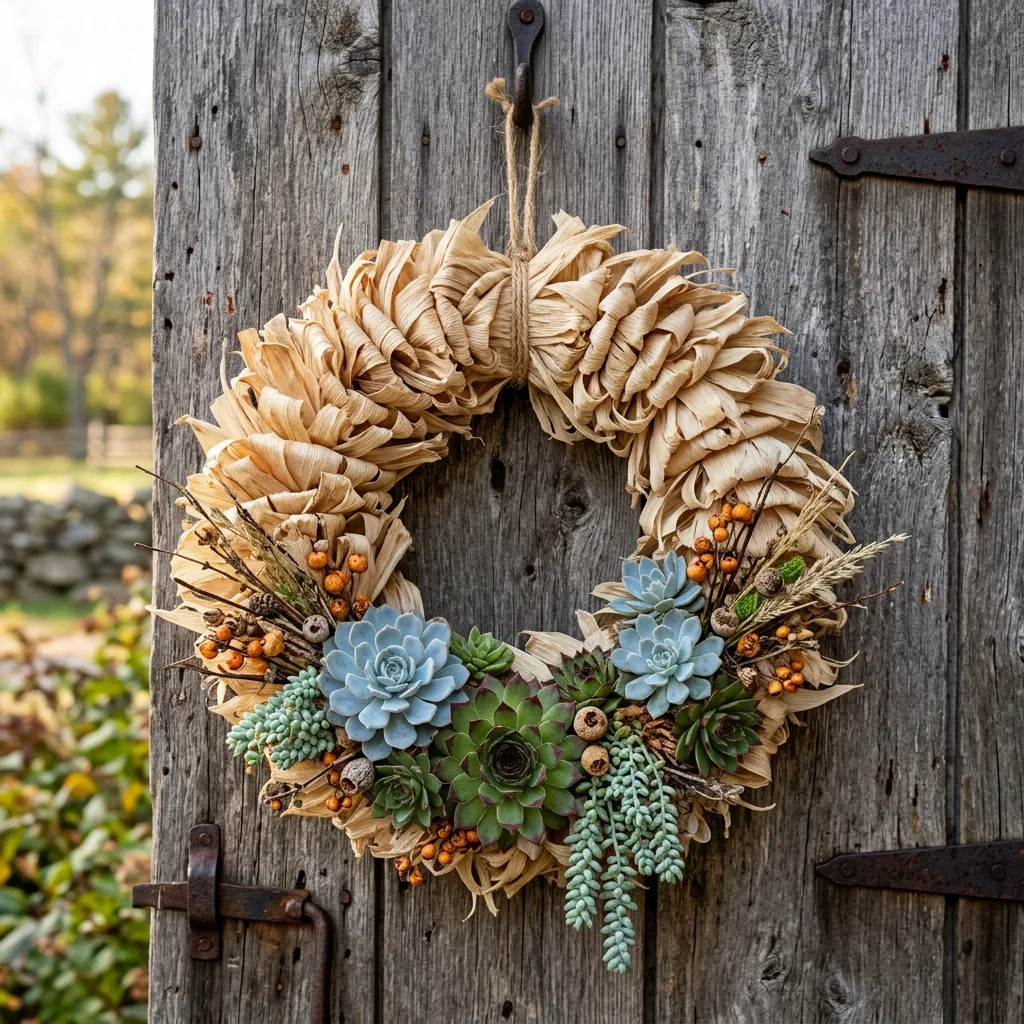
Harvested from sun-drenched autumn fields, dried corn ear leaves (botanically known as the floral bracts of Zea mays) represent one of the most durable, time-honored natural fibers in traditional craft horticulture. Endowed with a robust cellulosic microstructure, this organic material marries remarkable pliability with featherlight resilience. When coupled with the sculptural silhouettes of drought-adapted succulents, it metamorphoses into a living, breathing work of botanical art. Far beyond a fleeting seasonal ornament, this creation celebrates agricultural byproduct with refined elegance, delivering a self-contained, micro-ecological display for your living space.
Succulents, powered by their evolutionary Crassulacean Acid Metabolism (CAM photosynthesis) and exceptional parenchymal water storage, do not wilt like ordinary cut floral arrangements. Given balanced ambient light and mindful hydration, their adventitious root systems gradually anchor into the woven crevices and underlying moss pad, thriving for months—even years. Crafting your own living corn husk wreath is both a restorative, sustainable botanical design project and a timeless, organic greeting that imparts warmth to any threshold.
1. Botanical Identity and Morphological Characteristics
In designing a living corn husk wreath, you choreograph a relationship between two distinct biological elements: the supportive organic matrix of Zea mays husks and the succulent species that adapt to an epiphyte-like existence across its surface. Corn husks, when fully cured, preserve their structural tenacity through lignified cell walls; yet upon brief rehydration, they soften with astonishing flexibility. This unique mechanical property allows them to be folded, twisted, and layered into lush rosettes, ruffled petticoats, or tailored rustic pleats without fracturing.
Selecting the right succulent companions is paramount to the structural and physiological longevity of the wreath. Species with shallow rooting profiles, pronounced desiccation tolerance, and compact rosette habits are natural candidates for this vertical living medium:
- Sempervivum tectorum (Common Houseleek): Naturally adapted to alpine rock fissures with virtually zero substrate, this frost-hardy marvel anchors tenaciously into fibrous backing and endures significant climatic fluctuations.
- Echeveria elegans and Echeveria 'Lola': Renowned for their symmetrical geometry and dense layer of farina (an epicuticular, powdery wax coating), these cultivars cast a luminous, silvery-blue contrast against the straw-gold, neutral palette of dried husks.
- Graptopetalum paraguayense (Ghost Plant): Despite brittle-looking foliage, it vigorously casts adventitious aerial roots from its stems when suspended, clutching the organic fibers firmly over time.
- Sedum morganianum and Sedum album: These bring cascading, textural bead-like stems that spill gracefully from the lower curves of the wreath form.
2. Light Requirements and Indoor Positioning
Because your wreath is an assemblage of photosynthetic, living organisms, your lighting strategy determines whether the plants retain their compact symmetry or deteriorate. In inadequate illumination, succulents rapidly succumb to 'etiolation'—an adaptive elongation of the internodes where stems stretch aggressively toward light sources, distorting the sculptural geometry of your wreath in mere weeks.
Conversely, avoid placing the wreath directly behind untreated, south-facing glass panes under scorching midday summer heat. Extreme thermal buildup can make dried corn husks excessively brittle, while unventilated glass magnification risks thermal cell collapse and solar scorch on succulent leaves. The golden setting is an airy, covered front entryway receiving crisp morning sun, a bright veranda with filtered indirect rays, or a luminous, well-ventilated interior foyer.
3. Watering Discipline: The 'Soak and Complete Dry' Method
Misting succulents with a handheld spray bottle is not an act of care; it is perhaps the most widespread maintenance pitfall, starving internal root zones while introducing moisture pockets that trigger mold on organic fibers. Blasting water directly onto succulent heads leads to liquid accumulation in leaf axils, frequently sparking crown rot (apical decay).
The healthiest, professionally proven protocol is to thoroughly saturate the root bed through capillary action, followed by absolute desiccation before the next round. Execute the process with precision:
- Gently unhook the wreath from its display mount.
- Fill a wide, shallow basin or sink with 1.5 to 2 inches (3–5 cm) of room-temperature, dechlorinated water.
- Float and nestle the wreath back-side down, ensuring the root bed and sphagnum moss matrix contact the water while keeping the outer corn husk ruffles dry. Allow 10 to 15 minutes for capillary hydration.
- Lift the wreath out and set it vertically in a shaded, well-ventilated area for 1 to 2 hours, letting all gravitational water drain freely.
- Once the outer fibers and base are completely dry to the touch, rehang your wreath. Repeating this process once every 2 to 3 weeks (adjusted for ambient humidity and season) is fully sufficient.
4. Ideal Substrate Matrix and Frame Selection
Because we bypass traditional terra-cotta or plastic containers in favor of an artisanal husk armature, garden soil or standard potting dirt cannot be used. Dense potting soils turn dangerously heavy when wet and suffocate delicate root hairs. The ideal substrate is a lightweight, airy, and fibrous medium that cushions roots while releasing moisture predictably.
| Component | Ratio (%) | Horticultural Function and Benefit |
|---|---|---|
| Long-Fibered Sphagnum Moss | 45% | Wraps around the frame core, forming a pliable structural bed and a controlled moisture reservoir for emerging roots. |
| Fine Horticultural Pumice (2–4 mm) | 25% | Introduces vital macro-pores within the moss core to maximize root zone oxygenation and avert anaerobic rot. |
| Coco Coir | 15% | Supplies a sustainable, lightweight organic filler that lets fine root capillaries weave through the core unimpeded. |
| Zeolite (Clinoptilolite) | 15% | Buffers excess moisture and offers cation-exchange capacity, holding and gently releasing mineral nutrients. |
For the underlying chassis, a double-wire wreath frame measuring 10 to 14 inches (25 to 35 cm) in diameter provides the gold standard in structural integrity. This metal base bears the physical tension of wired husks while firmly securing the sphagnum core under vertical display pressures.
5. Step-by-Step Assembly and Propagation Techniques
Constructing a living corn husk wreath is also an inspiring propagation platform, turning harvested cuttings into a lush tapestry. Follow this rigorous step-by-step planting protocol:
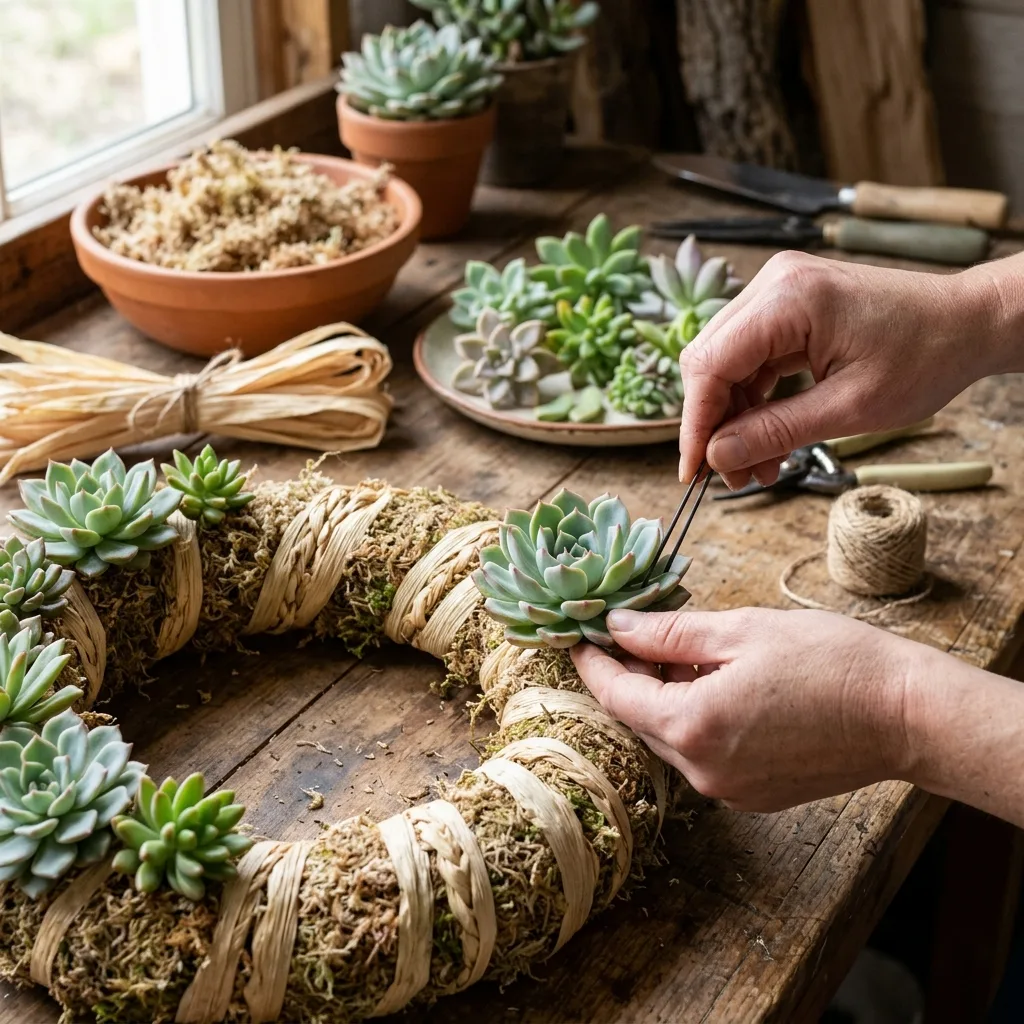
- Husk Conditioning: Submerge cured corn husks in a basin of warm water for 10 to 15 minutes until fully pliable. Pat them down with a clean towel. Fold them longitudinally or twist them into decorative loops, layered petal fans, or tailored bow accents.
- Frame Cladding: Working around the outer and inner rings of your wire frame, lash the softened corn husks securely using paddle wire or targeted dabs of floral adhesive (applied strictly to the dry base tips meeting the metal). Build a generous, ruffled structural skirt.
- Installing the Root Core: Pack the center trench of the frame with your pre-dampened sphagnum, pumice, and coir blend. Bind the moss bundle securely with green florist wire to produce a stable, cylindrical growing bolster.
- Preparing Succulent Cuttings: Harvest robust terminal rosettes (1.5 to 2.5 inches in diameter) from healthy stock plants with a sterilized blade. Store them in a dry, shaded room for 48 to 72 hours until a firm, protective callous forms across the wound. Inserting freshly cut, wet stems directly into damp moss invites bacterial and fungal decay.
- Insertion and Anchoring: Use a chopstick or floral awl to puncture a small channel into the moss cylinder. Slide the calloused stem into the opening. Anchor the rosette gently against the moss pad using U-shaped floral pins (greening pins) placed over the lowest outer stem junctions.
- Root Establishment Phase: Keep the completed wreath entirely dry and laid flat in a bright, indirectly lit location for the first 7 to 10 days. Scenting dryness, the succulent stems will proactively send out energetic adventitious roots to anchor within the sphagnum fibers.
6. Common Diseases, Pests, and Remediation
Living wreaths suspended in domestic spaces are vulnerable primarily to stagnant airflow and improper moisture retention:
- Corn Husk Mold (Botrytis cinerea): Appears as fuzzy gray or white patches deep within the husk folds. Remedy: Immediately relocate the wreath to a space with active cross-ventilation. Wipe affected bracts with a dilute hydrogen peroxide solution (1 tablespoon of 3% medical-grade H2O2 per quart of water) and increase the dry interval between waterings.
- Mealybugs (Pseudococcidae): Cryptic, cotton-like sap-suckers that nestle in leaf axils. Remedy: Spot-treat by touching the insects with a cotton swab dipped in 70% isopropyl alcohol. Avoid spraying whole-leaf insecticides across the wreath, as oily solutions can dissolve the delicate farina wax and stain dry husks.
- Translucent, Glassy Lower Leaves: A clear symptom of edema and vascular cell rupture caused by over-saturation. Suspend watering immediately, pluck off failing leaves with sterile tweezers, and verify that the moss pad drains completely after dipping.
7. Seasonal Care Calendar and Professional Tips
Aligning your maintenance cadence with the seasonal biological rhythms of your succulents ensures year-round vibrancy:
- Spring (Active Awakening): Introduce the wreath to gentle morning sunshine. Blend a quarter-strength balanced succulent liquid fertilizer into your soak water once a month to boost steady root growth and tight form.
- Summer (Heat Management & Dormancy): In blistering summer spells, many succulents initiate summer dormancy. Shield the wreath from harsh south-facing sun by placing it in bright shade with brisk airflow. Because evaporation accelerates, bottom-soaking may be needed every 10 to 12 days.
- Autumn (Color Climax): Crisp seasonal temperature differentials between day and night stimulate anthocyanin and carotenoid pigments within Echeveria and Sedum tissues, yielding magnificent blush, plum, and copper tones that complement the golden husk matrix.
- Winter (Dormancy and Frost Protection): Move the wreath indoors well before the first hard freeze, positioning it in a cool, bright sunroom, enclosed porch, or well-lit stairwell. Dormant succulents need minimal hydration; a modest bottom-soak once every 4 to 5 weeks is plenty.


Reader Reviews & Comments 3 Reviews
Eleanor Vance
Marcus Thornton
Clara Higgins
Leave a Review & Rating
Share your plant care tips, experiences, or questions with our succulent community.