






Succulents naturally anchoring into sheer canyon cliffs in Mexico or clinging to vertical basaltic lava crags in the Canary Islands possess an extraordinary morphology engineered to defy gravity. A living wall kit is a botanical micro-ecosystem that brings this ancient geological resilience right into the center of contemporary interior design. Vertical garden frames are not merely aesthetic wall art; they are a dynamic biological performance staged on your wall by nature's true masters of cellular water conservation.
For many plant lovers, acquiring a ready-made or DIY living wall kit is an exhilarating milestone; however, conventional horizontal potting habits quickly fail on vertical planes. The dynamics of downward gravitational water runoff, root collar aeration, and the capillary moisture transfer of sphagnum moss demand an entirely different standard of horticultural engineering. In this guide, we dive deep into the botanical mechanics of cultivating your vertical succulent display so it stays plump, vibrant, structurally sound, and rot-free for years to come.
1. Botanical Identity and Morphological Adaptations
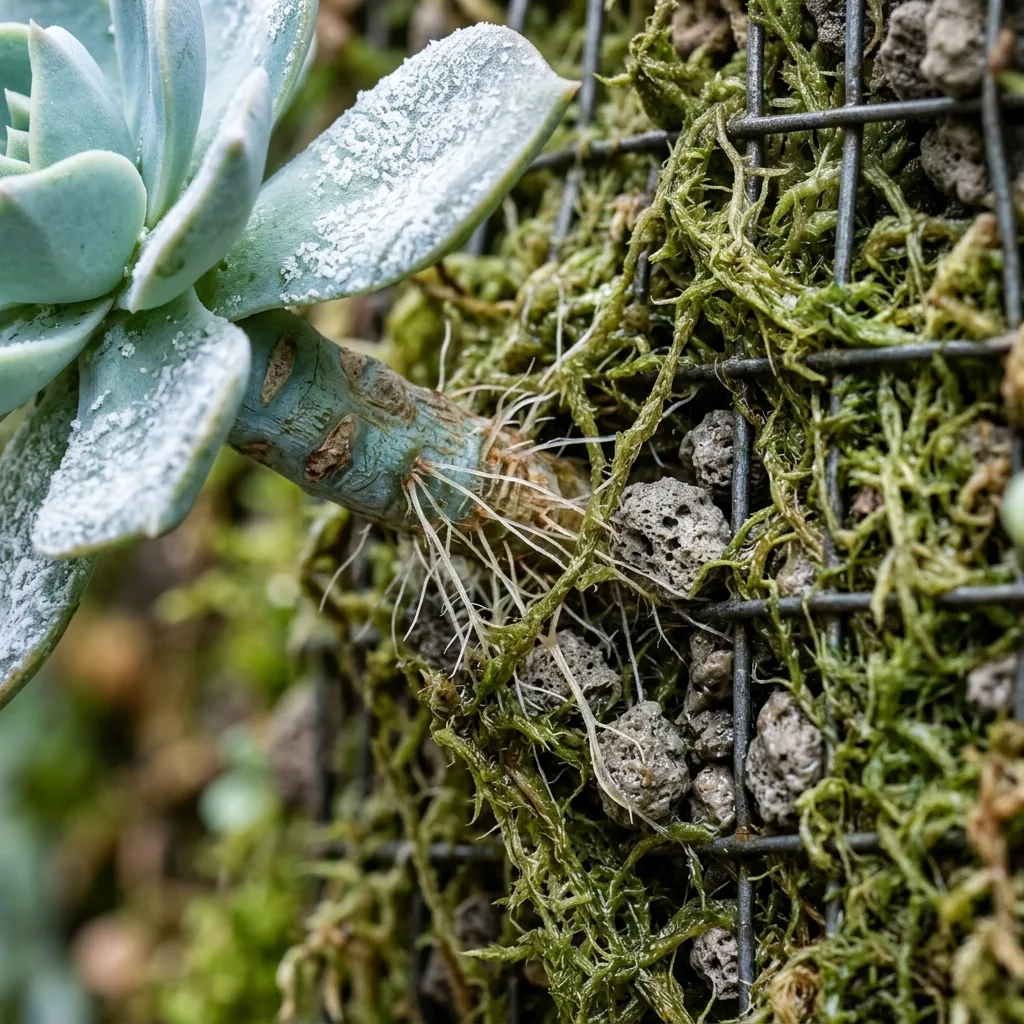
Vertical living wall kits diverge fundamentally from traditional container gardening in their root-zone dynamics. These kits typically feature a wooden or UV-stabilized polymer shadow box, stainless steel or coated wire mesh, moisture-retentive sphagnum moss, and a specialized granular succulent substrate. Succulents best suited to vertical living share distinctive morphological traits: shallow, fibrous root architectures, compact growth habits, and expansive cortical parenchyma tissues capable of enduring erratic hydration and relying on atmospheric moisture.
Not every succulent can thrive suspended against a wall. Species that form elongated, heavy stems or those that require deep taproots will inevitably disrupt the frame's center of gravity and sag outward. The most dependable candidates for a living wall kit are compact, rosette-forming varieties:
- Echeveria species (E. elegans, E. 'Lola', E. prolifica): Their balanced rosette symmetry and protective epicuticular farina wax allow them to regulate vertical transpiration effortlessly.
- Sempervivum (Hens and Chicks): Exceptionally cold-hardy perennials whose fibrous stolons grip into the moss substrate like talons, serving as the structural cornerstone of vertical arrangements.
- Sedum species (S. burrito, S. album, S. reflexum): Ideal textural trailers that soften the lower borders and frame edges.
- Crassula and Pachyphytum species: Their miniature, sculptural profiles and plump, jewel-like foliage introduce multi-dimensional depth across the panel.
2. Light Dynamics and Strategic Indoor Placement
Light angles function fundamentally differently on a vertical wall than on a horizontal windowsill. When natural light strikes a wall obliquely from an overhead skylight or adjacent window, rosettes in the upper tiers receive direct illumination while casting harsh shade over the lower rows. Over time, this light deficit compromises the CAM (Crassulacean Acid Metabolism) photosynthetic pathway of the shaded plants, triggering rapid etiolation (stretching) that distorts the geometric integrity of the living canvas.
When positioning your living wall, select an east- or west-facing interior wall that receives 4 to 6 hours of bright, filtered natural light daily. Avoid south-facing walls where raw midday sun passes through window glass; intense thermal radiation can bake the thin, shallow substrate volume within hours, causing irreversible epidermal sunburn. For windowless corridors, corporate lobbies, or dark living rooms, mount a full-spectrum (6500 Kelvin) LED grow spotlight 40 to 50 cm directly above the panel to maintain tight internodes and vibrant stress pigmentation.
3. Watering Discipline: The 'Submerge and Drip' Protocol
Attempting to hydrate a vertical living wall kit while it hangs on your wall using a watering can is a recipe for disaster. Water will channel into the central crowns of the top rosettes—sparking fungal crown rot—while cascading down the backboard without penetrating the dehydrated root balls below. The golden standard of vertical succulent care Is the Orange Snowball Cactus? Botanical Care Tips for Growing Rebutia">is the 'Unmount, Submerge, Drain, and Rehang' protocol.
Depending on ambient humidity, season, and panel dimensions, irrigation is typically required once every 10 to 15 days. Water only when the lowest leaves show slight wrinkling and a subtle loss of turgor pressure:
- Gently lift and unmount the frame from its wall brackets.
- Fill a wide, shallow vessel (such as a large utility tray or clean bathtub base) with 2 to 3 cm of room-temperature, dechlorinated water.
- Place the kit horizontally into the water, allowing moisture to wick upward through capillary action via the mesh and drainage holes for 15 to 20 minutes.
- Lift the kit out and let it drain horizontally or propped at a 45-degree angle over an open wire rack for 45 to 60 minutes, ensuring all gravitational water escapes.
- Once dripping has completely ceased and the rear protective membrane is dry to the touch, securely rehang the frame on the wall.
4. Ideal Substrate Formulation and Frame Anatomy
Living wall frames provide severely constrained soil volumes—typically only 5 to 8 cm deep. Filling this compressed space with ordinary potting soil or standard peat moss is fatal; standard soils compact into an anaerobic, airless block when wet and shrink into an impenetrable brick when dry. The vertical substrate must combine maximum inorganic macroporosity with featherlight aggregate density (2–4 mm particle size) so the frame remains lightweight when wet.
| Component | Ratio (%) | Botanical Function & Role in Vertical Panels |
|---|---|---|
| Coarse Horticultural Pumice (2–4 mm) | 35% | Creates stable macro-pores in the root zone without adding excess weight, ensuring rapid gas exchange. |
| Crushed Lava Rock / Volcanic Scoria | 20% | Releases trace minerals and interlocks mechanically with moss fibers, preventing soil fallout. |
| Sterilized Long-Fiber Sphagnum Moss (Chopped) | 25% | Acts as a flexible moisture buffer and forms a fibrous structural web behind the wire grid. |
| Zeolite (Clinoptilolite) | 10% | Boosts cation exchange capacity (CEC), buffering excess fertilizer salts and capturing toxins. |
| Fine Coco Coir | 10% | Provides minimal organic binding; its fine lignin fibers support early root hair establishment. |
When selecting or assembling a living wall kit, always choose models fitted with an integrated waterproof backing (such as an EPDM rubber membrane or marine-grade polycarbonate panel). This barrier protects your interior drywall from moisture damage while ensuring that water loss occurs solely through controlled foliar transpiration.
5. Step-by-Step Propagation Techniques
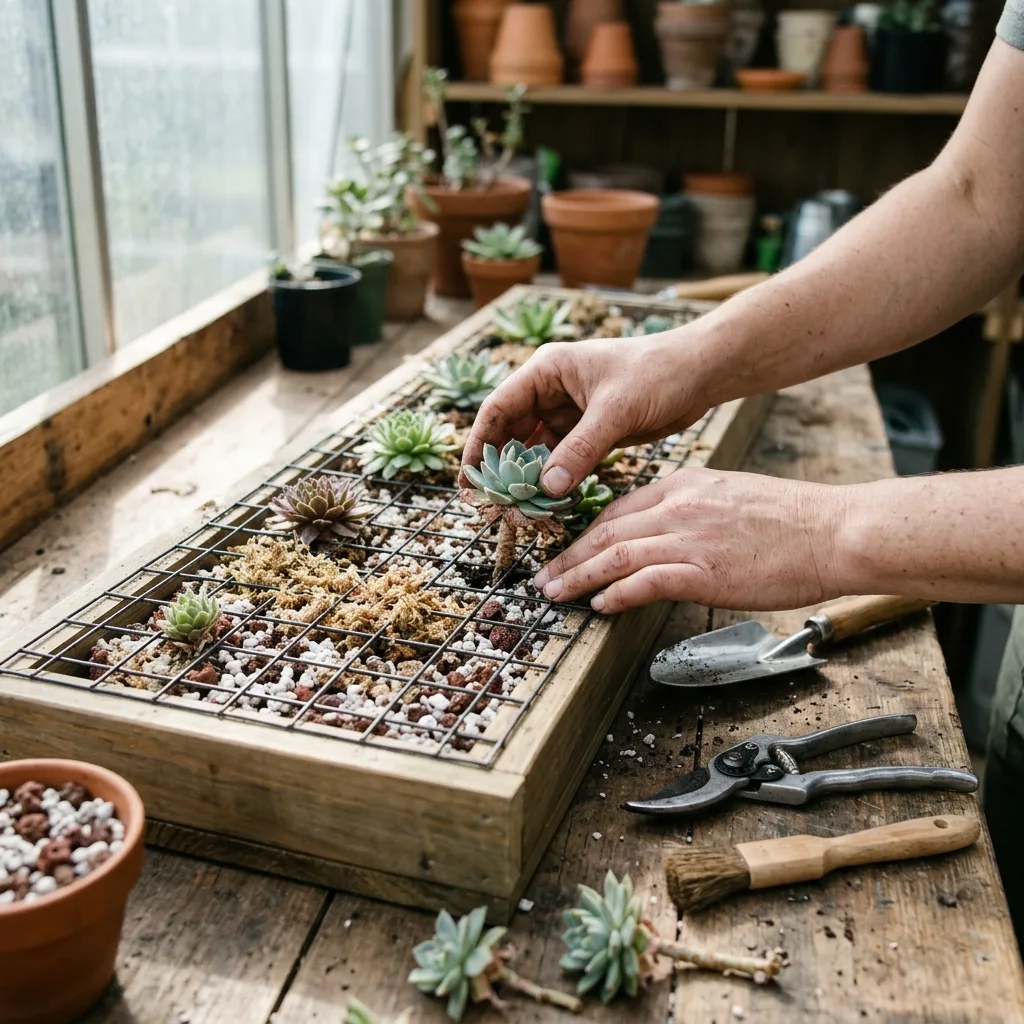
As your living wall matures, select rosettes will produce offsets while others may elongate. Pruning and replanting these shoots is the premier method to refresh bare patches and maintain a lush, seamless tapestry:
- Harvesting Offsets and Stolons: Using a sterilized scalpel, sever offsets produced by Sempervivum or Echeveria, retaining approximately 1.5 cm of stem tissue.
- Developing Callus Tissue: Lay the harvested cuttings in a dry, shaded location for 2 to 3 days. Allowing the cut wound to produce a suberized callus barrier is essential; uncallused wounds in moist moss rot rapidly upon contact with ambient microbes.
- Securing into the Wire Grid: Gently ease the callused stem through the wire mesh aperture directly into the moist sphagnum layer. If the cutting shifts under gravity, anchor it temporarily using a U-shaped floral pin.
- The Rooting Phase: Withhold all moisture for the first 7 days following insertion. Beginning on day 8, lightly moisten the localized moss area to stimulate adventitious root tips to anchor firmly into the substrate.
6. Common Pests, Pathologies, and Interventions
Vertical ecosystems present distinct physiological challenges due to high planting density and vertical microclimates:
- Mealybug Infestation (Pseudococcidae): Because rosettes grow in tight clusters, mealybugs find shelter beneath the leaf folds. Treatment: Dab visible cottony clusters individually with a cotton swab soaked in 70% isopropyl alcohol. For extensive infestations, unmount the frame, isolate it, and spray thoroughly with a diluted cold-pressed neem oil emulsion.
- Etiolation (Light-Starvation Stretching): Stems stretch outward, causing rosettes to lose their tight geometric form. Treatment: Behead the stretched rosettes, let the top cuttings callus and replant them into gaps. Leave the rooted base in the moss, as it will push out new pups. Relocate the living wall to a sunnier exposure or install dedicated LED grow lights.
- Stem and Root Rot (Rhizoctonia solani / Phytophthora): Excessive moisture retention in the moss causes lower leaves to turn translucent, mushy, and blackened. Treatment: Immediately extract the infected specimen with tweezers. Scrape away the surrounding contaminated moss, allow the frame to dry out completely, and extend the drying intervals between soakings.
7. Seasonal Care Calendar & Expert Advice
Spring (Awakening & Renovation): Active vegetative growth resumes. Prune back winter elongation, fill empty pockets with fresh callused offsets, and fortify the system by adding a quarter-strength (1/4) balanced, low-nitrogen succulent fertilizer to your soaking water.
Summer (Heat Stress & Climate Control): While evaporation accelerates, many succulents enter partial summer dormancy when temperatures exceed 30°C (86°F). Resist the urge to overwater; maintain strict moisture intervals and keep the frame clear of cold, drying drafts from air conditioning vents.
Autumn (Hardening Off): Prepare the colony for shorter photoperiods. Cease all fertilization. Re-evaluate lighting angles, as the lower autumn sun may require shifting the living wall closer to natural window exposure.
Winter (Quiescence & Micro-Dormancy): Succulent metabolic rates slow dramatically in winter. Lengthen watering intervals to 3 to 4 weeks. Ensure that cold, poorly insulated exterior walls do not transfer freezing temperatures through the backplate to the root systems.


Reader Reviews & Comments 3 Reviews
Sophia Bennett
Eleanor Vance
Marcus Sterling
Leave a Review & Rating
Share your plant care tips, experiences, or questions with our succulent community.