






What happens when you pluck a desert warrior—built to stand proud for centuries across the scorched expanses of the Sonoran Desert or along the limestone escarpments of Arizona—and lock it inside a narrow-mouthed glass bell jar or the stagnant, curtain-shielded corner of a modern living room? Behind the question most frequently asked by plant lovers visiting our greenhouse—'How long does an indoor cactus actually live?'—lies a quiet, fundamental clash between the wild desert winds and contemporary interior aesthetics. While curating a self-sustaining miniature ecosystem behind glass sounds poetic, millions of years of evolutionary programming demand an entirely different microclimate.
Cacti are not standard decorative houseplants; virtually every cellular matrix in their stems is engineered to endure prolonged drought and vigorous atmospheric turbulence. If a desert cactus is confined to a completely sealed, non-aerated glass vessel (a closed terrarium), its lifespan is tragically measured in months or even weeks—typically dissolving at the root collar within 1 to 4 months as an inevitable casualty of its own transpired humidity. However, when 'indoor setting' refers to a properly ventilated, sun-drenched windowsill, coupled with strategic species selection and science-based care, these resilient companions can flourish for 10 to 50 years, and in many instances become heirloom plants living for over a century across generations. Let us delve into the biological dynamics that dictate the indoor longevity of these ancient botanicals.
1. Taxonomic Identity, Areole Architecture, and Spine Morphology
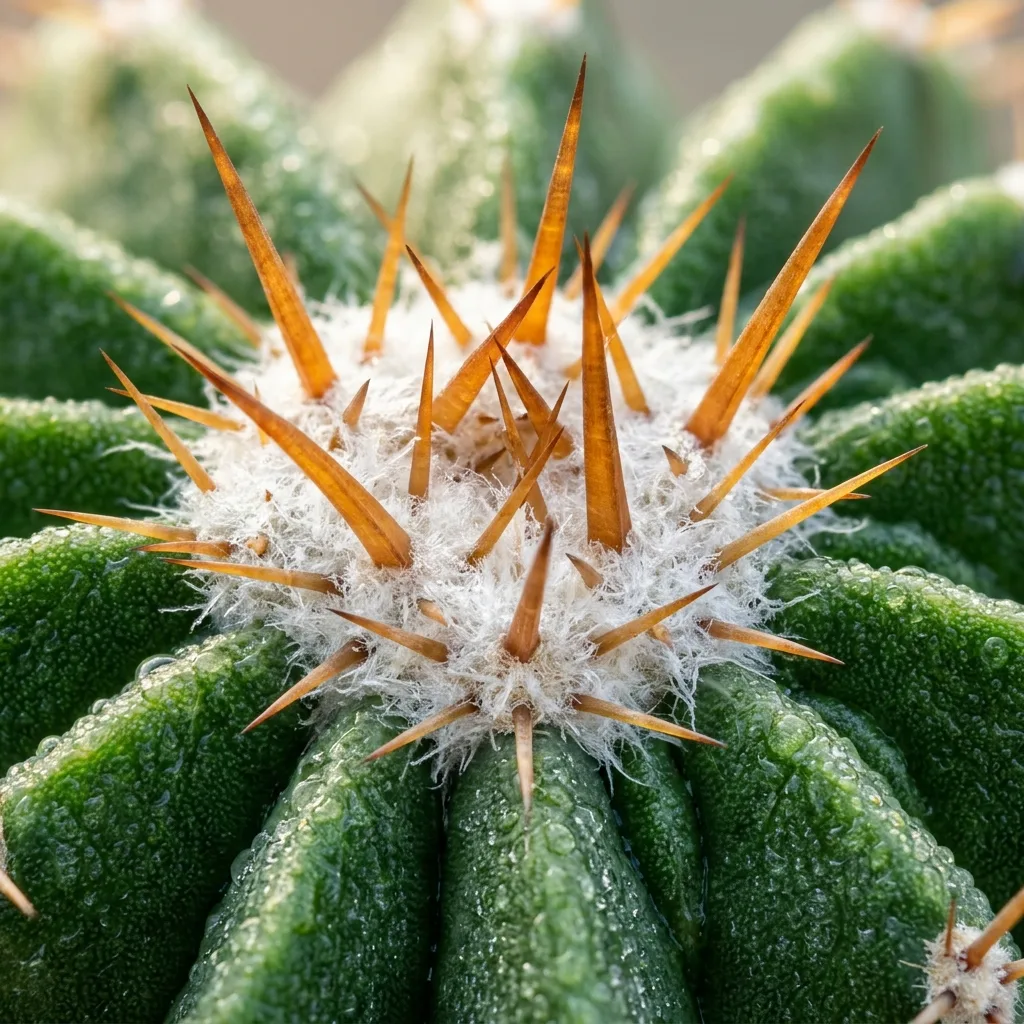
The definitive taxonomic hallmark separating members of the family Cactaceae from all other succulent plant groups is the 'areole'—a highly specialized, condensed lateral shoot center. Areoles function as the vital growth nodes responsible for producing spines, glochids, vegetative side branches, and radiant seasonal blooms. On a quintessential desert cactus (such as species within Echinocactus or Mammillaria), spines are far from mere ornamentation; they act as microscopic shade screens that diffuse scorching ultraviolet radiation, serve as condensation surfaces channeling nocturnal dew downward toward roots, and deliver primary mechanical defense against desert herbivores.
When a cactus is imprisoned in a sealed, poorly ventilated space, these architectural wonders turn against the plant. With zero air circulation weaving through the spination, areole depressions trap high relative humidity. Desert taxa open their epidermal stomata exclusively at night via Crassulacean Acid Metabolism (CAM). Inside an unvented chamber, the lack of ambient carbon dioxide exchange combined with persistent humidity creates a breeding ground where delicate meristematic tissues are swiftly colonized by virulent opportunistic fungal pathogens (notably Botrytis and Fusarium). Consequently, while heavily spined desert types suffer rapidly indoors, semi-tropical epiphytic cacti possessing more flexible, non-glaucous epidermal tissues (such as Rhipsalis or Schlumbergera) demonstrate substantially greater tolerance to ambient indoor conditions.
2. Illumination Dynamics, Sunlight Intensity, and Ventilation Baselines
The foremost biological pitfall cutting indoor cactus lifespans short is etiolation—the physiological stretching and mechanical deformation triggered by light starvation. In their natural habitat, cacti bask in 6 to 8 hours of unfiltered, direct UV light daily. Behind modern double-glazed architectural glass, the usable foot-candles and lux levels drop precipitously. Deprived of sufficient photons, a cactus exhausts its metabolic starch reserves, desperately stretching toward the nearest light source to produce spindly, pale green, structurally fragile growth.
Atmospheric airflow is equally vital. Natural desert breezes dissipate intense thermal energy build-up on the epidermis and accelerate evaporation throughout the rhizosphere. In closed indoor environments, the air remains dead and stagnant. To sustain a desert cactus indoors beyond a decade, adhere to these environmental rules:
- Position the plant directly on an unshaded south- or southwest-facing windowsill unobstructed by drapes or solar screens.
- Provide daily atmospheric turnover by ventilating the room with fresh outdoor air (ensuring the specimen is not subjected to direct, freezing air currents).
- For darker north-facing windows or sunless interiors, supplement daylight with high-output, full-spectrum LED horticultural grow lights positioned 8–12 inches above the crown for 12 to 14 hours daily.
3. Hydration Cycles and the Vital Winter Dormancy Protocol
What kills indoor cacti is rarely dehydration; it is almost universally excessive, ill-timed human affection. Equipped with massive central vacuoles, cacti efficiently sequester every drop of water from the substrate. Indoors, moisture evaporation occurs at a fraction—often three to four times slower—of the rate observed in outdoor environments. Saturating the soil before the container has fully dried out starves the root hairs of vital oxygen, inducing hypoxic collapse, root death, and subsequent vascular liquefaction.
The quintessential secret to achieving maximum indoor longevity is orchestrating a proper winter rest (dormancy). Between late autumn and early spring (November through March), desert cacti demand cool conditions (8–12°C / 46–54°F) alongside bone-dry soil:
- Active Vegetative Phase (Spring through Late Summer): Implement the rigorous 'soak-and-dry' protocol. Wait until the potting substrate has dried through to the drainage holes for 3 to 5 full days, then drench the root zone thoroughly until water flows freely from the bottom.
- Winter Rest Period (Late Autumn to Early Spring): Shift the specimen away from forced-air heat vents to a cool, bright window. Suspend watering almost entirely—offering mere droplets once a month for miniature pots, and zero water for mature, large-bodied specimens. Bypassing this chilling dormancy will cap your cactus's indoor lifespan at 2 to 3 years and permanently inhibit floral bud initiation.
4. Highly Mineralized Cactus Substrates and Container Physics
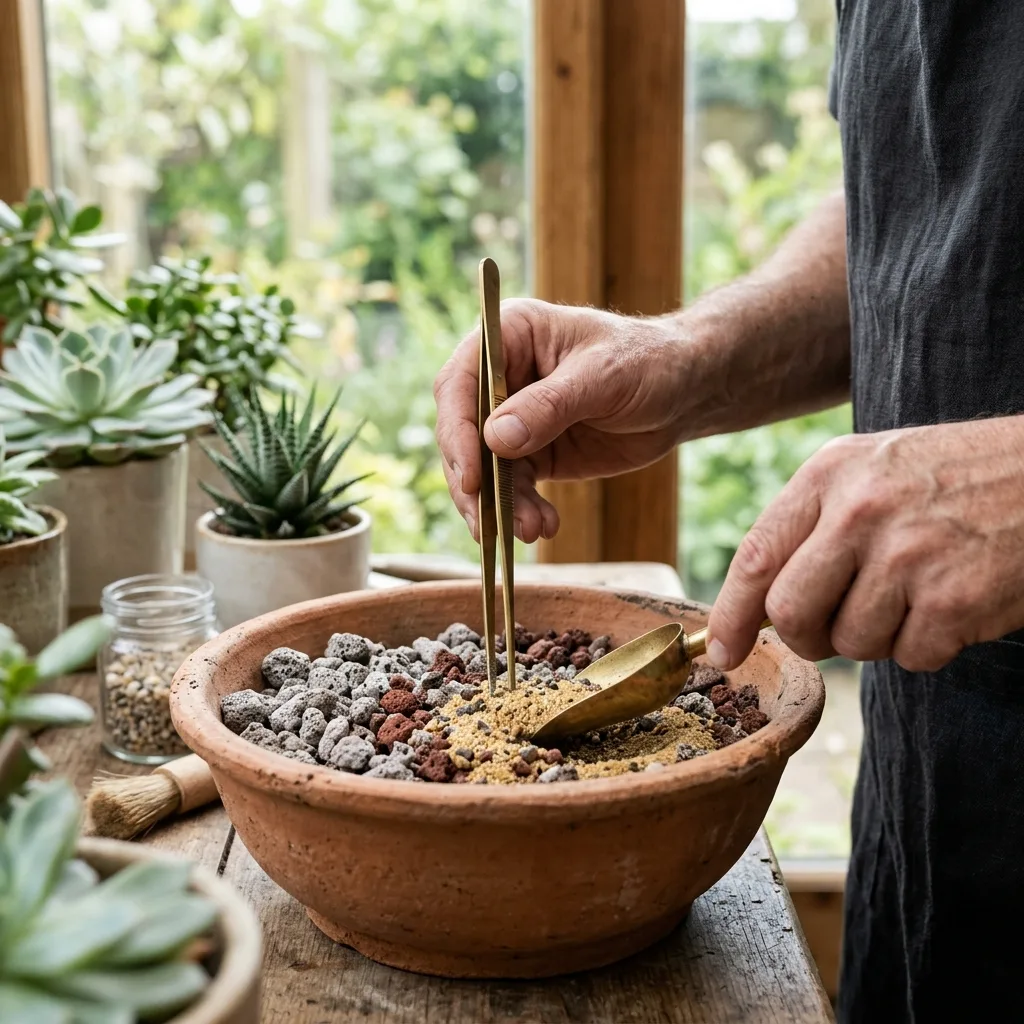
The potting medium under an indoor cactus requires an entirely different physical architecture than garden soils or standard houseplant blends. Typical peat moss-heavy commercial potting soils act like waterlogged sponges within indoor environments, rapidly asphyxiating desert root systems. A scientifically formulated indoor cactus substrate must be composed predominantly of sharp, porous inorganic aggregates that shed gravity water within seconds.
Furthermore, container material directly influences longevity. Unfinished, unglazed porous terracotta permits gaseous exchange across its sidewalls, drawing surplus moisture outward via evaporative wicking. In contrast, glazed ceramic, plastic, or unperforated glass vessels lack side-wall breathability, trapping standing water and drastically increasing the likelihood of root rot.
| Substrate Component | Ratio (%) | Functional Horticultural Role |
|---|---|---|
| Pumice (3–6 mm particle size) | 40% | Creates durable macropores, aerates the root architecture, and prevents water stagnation. |
| Crushed Lava Rock / Horticultural Zeolite | 30% | Supplies essential trace minerals and structural resistance against soil compaction. |
| Sterile Coarse River Sand / Coarse Perlite | 10% | Maximizes hydraulic conductivity and keeps deep drainage channels open. |
| Sifted Horticultural Peat or Coco Coir | 20% | Provides the minimum organic base necessary for root stabilization and cation exchange. |
5. Inducing Floral Blooms and Strategic Nutritional Regimens
The ultimate confirmation of a thriving indoor cactus and an indicator of its extended lifespan is the emergence of seasonal blooms. While many assume cacti flower only in arid wildernesses, dozens of desert varieties—such as Rebutia, Echinopsis, and Parodia—readily bloom year after year on an indoor windowsill when granted proper physiological cues.
The catalyst for blooming is the cold winter rest detailed above, which induces critical hormonal stress signaling and triggers the differentiation of dormant floral primordia. Once spring sunlight intensifies and growth resumes:
- Select low-nitrogen, high-phosphorus, and high-potassium mineral fertilizers formulated specifically for cacti (such as an NPK 4-10-10 or 5-10-10 ratio).
- Apply feed strictly during the active vegetative window (April through August), limiting applications to once monthly at half the manufacturer's suggested concentration mixed into normal irrigation water.
- Never apply fertilizer to a dormant plant or one shriveled from dehydration; concentrated mineral salts will instantly chemically scorch desiccated feeder roots.
6. Vegetative Propagation, Stem Cuttings, and Grafting
You can effectively grant your cactus genetic immortality indoors through vegetative reproduction. If a mature cactus becomes excessively woody at the base, exhibits unsightly scars, or suffers one-sided etiolation from inadequate lighting, taking clean cuttings allows you to rejuvenate the specimen and sustain its exact clone for decades more.
For species that produce offsets (such as clustering Mammillaria), cleanly detach the pup using an alcohol-sterilized scalpel without damaging the parent cortex. Dust the exposed wound with pure sulfur or horticultural cinnamon, allowing it to dry in a shaded, well-ventilated spot for 4 to 7 days until a firm, whitish-gray callus develops. Inserting an uncallused cutting into damp substrate will trigger fatal bacterial rot. Additionally, popular chlorophyll-deficient mutations like the 'Moon Cactus' (Gymnocalycium mihanovichii f. rubra) survive indoors solely because they are grafted onto a photosynthetic Hylocereus rootstock. Remember, however, that the lifespan of a grafted cactus is fundamentally governed by the rootstock, which typically lasts 3 to 5 years indoors before declining.
7. Defending Against Fungal Pathogens and Root Rot
Roughly 90% of all indoor cactus losses stem from fungal root rot pathogens (predominantly Phytophthora and Rhizoctonia) and secondary mealybug (Pseudococcidae) infestations. Stagnant indoor rooms provide an ideal breeding sanctuary for both. If you observe the base of your cactus turning yellow-brown and soft to the touch, pathogen invasion has breached the vascular bundles.
Immediate, clinical intervention can save the specimen:
- Unpot the cactus immediately and wash every remnant of wet substrate away from the root system.
- Using a razor-sharp, flame-sterilized blade, excise all discolored, softened tissue until you reveal completely clean, pristine green internal flesh.
- Treat the freshly cut wound with a systemic fungicide or powdered sulfur, leaving the plant exposed in a dry, ventilated room for an entire week to desiccate the wound.
- Replant into an entirely dry, highly mineralized aggregate blend, withholding all moisture for at least 10 to 14 days before introducing very light irrigation.


Reader Reviews & Comments 3 Reviews
Arthur Pendelton
Eleanor Vance
Marcus Sterling
Leave a Review & Rating
Share your plant care tips, experiences, or questions with our succulent community.