



Succulent Varieties

Heirloom Houseplants: The Ultimate Christmas Cactus (Schlumbergera) Care Guide

Passed down through generations and gracing family parlors for decades, the heirloom Christmas Cactus (Schlumbergera) is among the most resilient epiphytic succulents. Uncover its botanical identity, CAM metabolism, and seasonal triggers for prolific winter blooms in this comprehensive master guide.

Rıfat Özkan
Rıfat Özkan Fact-Checked This guide has been reviewed and verified according to scientific botanical literature and succulent research standards. 🐾 Pet-Safe This plant is non-toxic to cats and dogs and safe for pet-friendly homes.
Plant Care Specialist
23 Sep 2026 • 7 min read
Share: Pinterest
📌

Key Takeaways & Quick Summary

Key Takeaways
  • 🌿 Passed down through generations and gracing family parlors for decades, the heirloom Christmas Cactus (Schlumbergera) is among the most resilient epiphytic succulents.
  • 💡 Uncover its botanical identity, CAM metabolism, and seasonal triggers for prolific winter blooms in this comprehensive master guide.
  • 🌱 100% field-tested for beginners, hobbyists, and plant collectors alike.
Save Heirloom Houseplants: The Ultimate Christmas Cactus (Schlumbergera) Care Guide
Heirloom Houseplants: The Ultimate Christmas Cactus (Schlumbergera) Care Guide
Advertisement

Heirloom houseplants steeped in nostalgia—adoring our grandmothers' lace-draped consoles, cool winter verandas, and wooden side tables flanking cast-iron radiators—remain our most cherished living legacies. Chief among these enduring botanicals passed down as cuttings from generation to generation is the true heirloom Christmas Cactus (Schlumbergera bridgesii), a unique succulent whose ancestry traces back to the high forest canopies of tropical rainforests where it thrives as an epiphyte.

Unlike modern retail hybrids, vintage varieties are characterized by scalloped, rounded stem segments (cladodes) and gracefully arching, radially symmetrical magenta-pink pendulous blooms. In this master horticultural guide, we examine every scientific nuance and practical protocol of this iconic heritage succulent, from its cellular physiology to the exact triggers required to induce breathtaking flushes of winter flowers.

Advertisement

1. Botanical Identity and Morphological Characteristics

The genus Schlumbergera is endemic to the coastal Mata Atlântica biome of southeastern Brazil. Rather than baking in arid desert dunes, these plants thrive in the humid microclimates of cloud forests, growing epiphytically in the mossy forks of trees or lithophytically in shaded rock crevices. What appear to be fleshy foliage leaves are, in fact, photosynthetic modified stem segments known botanically as cladodes.

The genuine heirloom Christmas Cactus (S. bridgesii, often designated in trade as S. x buckleyi) exhibits distinct morphological differences from the commercially prevalent Thanksgiving Cactus (S. truncata): while S. truncata features sharp, claw-like projections along its cladode margins and zygomorphic blooms held horizontally, traditional S. bridgesii displays smoothly crenated, scalloped margins and pendulous, actinomorphic flowers. At the cellular level, the plant executes Crassulacean Acid Metabolism (CAM), tightly sealing its stomata during peak daylight to arrest transpirational water loss and sequestering ambient carbon dioxide overnight for carbohydrate synthesis.

2. Photoperiod Requirements and Indoor Placement

Hailing from shaded understories, this heritage epiphyte reacts immediately to harsh, direct midday sunlight by upregulating protective anthocyanin pigments, causing its stems to flush a stressed reddish-purple hue. Optimal vegetative performance is achieved under bright, filtered daylight or the gentle exposure of an unobstructed east-facing window.

Floral bud differentiation is strictly photoperiod-dependent, classified as an obligate short-day physiological response. During autumn (October through November), the specimen requires 12 to 14 hours of uninterrupted, absolute darkness alongside nocturnal temperatures maintained between 15°C and 18°C (59°F–64°F). Even incidental domestic artificial light can disrupt phytochrome signaling and completely abort bud set.
Expert Tip: The secret of our grandmothers' overflowing blooms was leaving the plants on cool, sheltered autumn porches. Provided temperatures stay safely above freezing (12–16°C / 54–61°F), subjecting the plant to a 4- to 6-week cool resting period induces so many flower buds that the foliage disappears beneath blossoms.
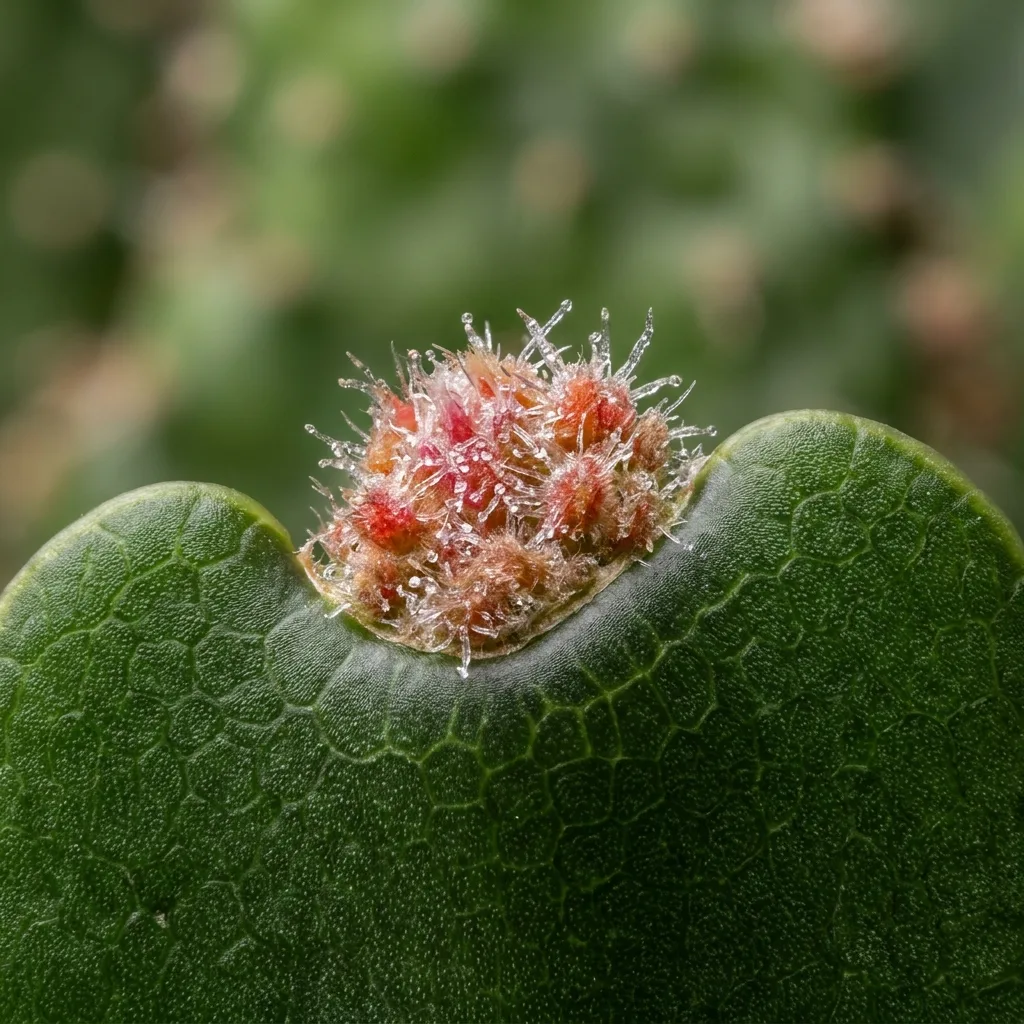
Heirloom Houseplants: The Ultimate Christmas Cactus (Schlumbergera) Care Guide - Botanical Detail and Leaf Morphology
🔍 Botanical Detail: Characteristic leaf form, surface texture, and morphological features.
Advertisement

3. Watering Protocols: The 'Soak and Partial-Dry' Regimen

Because Schlumbergera species are tropical forest succulents rather than xerophytic desert dwellers, sustained periods of drought trigger a critical drop in cellular turgor, causing the cladodes to shrivel and thin. Conversely, their delicate epiphytic root systems are hypersensitive to standing water; stagnant conditions rapidly suffocate root hairs, paving the way for opportunistic oomycete pathogens such as Pythium and Phytophthora.

Adopt the rigorous 'Soak and Partial-Dry' technique. Allow the upper 3 to 4 centimeters (1.5 inches) of substrate to dry out entirely before drenching the container with tepid, dechlorinated water until it flows freely from the base drainage holes. Always discard accumulated leachate from the collection saucer within 15 minutes. During flower bud development, maintain consistent moisture equilibrium, as acute water deficits will inevitably induce premature bud drop.

4. Substrate Engineering and Pot Selection

The hallmark of thriving heirloom parlor plants is a substrate mimicking the airy, organic matrix of the forest canopy floor. Dense, clay-heavy potting soils impede root respiration and lead to inevitable decline. The ideal growth medium provides optimal gas exchange through porous inorganics, counterbalanced by acidic humic constituents.

ComponentProportion (%)Horticultural Function
Natural Pumice (3–5 mm)30%Establishes permanent macroporosity and structural aeration channels.
Coarse Peat / Leaf Mold35%Sustains mildly acidic (pH 5.5–6.2) epiphytic nutrition and moisture balance.
Crushed Lava Rock Grit20%Enhances internal capillary drainage and resists medium compaction.
Perlite or Fine Pine Bark15%Simulates natural bark debris, encouraging adventitious root anchoring.

When selecting a planter, prioritize unglazed terracotta or perforated ceramic vessels that facilitate radial evaporation through pot walls. Because Schlumbergera thrives under moderate root restriction, select containers that exceed the root ball by no more than 2 to 3 cm in diameter; oversized vessels retain excessive moisture and delay drying cycles.

Heirloom Houseplants: The Ultimate Christmas Cactus (Schlumbergera) Care Guide - Care and Propagation Step
🌱 Care in Action: Healthy root development, repotting, and propagation steps.
Advertisement

5. Step-by-Step Propagation Protocols

The remarkable longevity of these vintage cultivars across multiple generations stems from their effortless vegetative propagation. Execute the following steps in late spring or early summer:

  1. Segment Selection: Identify a healthy, vigorous stem comprising at least 2 to 3 mature cladodes. Rather than using shears, firmly hold the segment base and twist gently clockwise; the junction will separate cleanly along natural abscission zones without tearing vascular tissue.
  2. Callus Formation: Avoid immediate planting. Position cuttings in a shaded, well-ventilated room for 24 to 48 hours, allowing the severed nodal boundary to form a dry suberized callus that shields against fungal infection.
  3. Rooting Substrate: Insert the cutting vertically into a pre-moistened blend of pumice, perlite, and fine peat, burying roughly half of the bottom cladode.
  4. Microclimate Maintenance: Position the cutting in bright, indirect light at 20–22°C (68–72°F), keeping the medium slightly damp. Prolific white adventitious roots will emerge from the basal areoles within 3 to 4 weeks.
Critical Warning: Never relocate or turn a Christmas Cactus once flower buds have formed. Sudden changes in ambient light angles or draft trajectories will trigger ethylene production, causing catastrophic bud drop (abscission) within 24 to 48 hours.

6. Pathogen Management, Pest Control, and Physiological Disorders

While heirloom selections exhibit exceptional vigor, sub-optimal cultural environments may foster several physiological and biological issues:

  • Cladode Shriveling with Dull Coloration: Counterintuitively, limp and dehydrated cladodes are frequently the symptom of root rot rather than drought. Dead roots can no longer absorb water. Remove the root ball, excise discolored, necrotic tissue with sterile shears, and repot in a fresh, gritty medium.
  • Mealybugs (Pseudococcidae): These sap-sucking pests congregate in the sheltered crevices between segments, appearing as white cottony deposits. Eradicate small colonies using a cotton swab saturated with 70% isopropyl alcohol, followed by a targeted application of cold-pressed neem oil.
  • Fungal Leaf Spots: Fusarium and Bipolaris can manifest as sunken brown lesions under excessive ambient humidity and stagnant air. Boost active room ventilation, avoid overhead wetting, and excise diseased segments immediately.

7. Annual Horticultural Calendar and Seasonal Rhythm

Spring (March – May): The vegetative recovery phase. Tender, pale-green cladode flushes emerge. Supply a balanced, low-nitrogen soluble fertilizer diluted to quarter-strength once monthly.

Summer (June – August): Vigorous vegetative synthesis. Maintain the specimen in an airy, shaded outdoor patio or well-lit indoor room, increasing irrigation to offset higher evaporation rates.

Autumn (September – November): The resting and floral induction period. Gradually reduce watering, ensure night temperatures hover around 13–16°C (55–60°F), and guarantee 12 hours of total nightly darkness to stimulate prolific bud initiation.

Winter (December – February): The blooming spectacle. Keep the plant in a stable, draft-free microclimate away from active heating vents, and marvel at its generational floral display.

Save on Pinterest

Follow us on Pinterest for daily succulent inspiration and plant care hacks.

Save
🎮

Mini Botanical Quiz: Test Your Knowledge!

Answer 3 quick questions to reinforce what you learned in this guide:

1

What plant organ did cactus spines actually evolve from?

2

What is the number one cause of root rot in succulents and cacti?

3

What is the term for a succulent stretching tall and thin due to insufficient sunlight?

Frequently Asked Questions

The most frequent cause is a failure to meet short-day and cool-temperature triggers in autumn. To initiate flower buds, the plant requires 12 to 14 hours of uninterrupted darkness alongside nighttime temperatures between 15°C and 17°C (59–63°F) for roughly six weeks. Exposure to artificial indoor lighting at night prevents budding.
Purplish or reddish discoloration is caused by the synthesis of anthocyanin pigments, which the plant produces as sunscreen when exposed to excessively intense direct sunlight. It can also indicate phosphorus deficiency or cold stress. Moving the plant to bright, filtered light will restore its natural deep green hue.
Although both are beloved heirloom plants, they belong to different genera and schedules. The Christmas Cactus (Schlumbergera) blooms in late autumn and winter with pendulous, multi-tiered flowers and scalloped cladodes. The Easter Cactus (Rhipsalidopsis gaertneri) blooms in spring, featuring star-shaped, symmetrical flowers and distinct bristly hairs along its segment margins.
Because these plants are epiphytes with naturally compact root systems, they perform best when somewhat root-bound. Young specimens benefit from repotting every 2 years, whereas massive, mature heirloom plants need repotting only every 3 to 4 years in early spring, shifting up just one pot size using a highly porous, pumice-rich mix.
Floral bud abscission is triggered by sudden environmental shocks. Moving the container, rotating it relative to the light source, exposing it to drafts or nearby heat radiators, or allowing the substrate to completely desiccate causes the plant to produce stress-induced ethylene, prompting it to cast off its buds.
Advertisement
Rıfat Özkan
Content Specialist & Author Plant Care Specialist

Rıfat Özkan

Botanical researcher and succulent enthusiast crafting science-backed, practical care and propagation guides to help your indoor plants thrive.

🧭 Keep Learning • Succulent Varieties

Gift Succulent Care Guide: How to Save & Grow Miniature Rosettes (Echeveria, Jade Plant & Zebra Haworthia)

Delicate succulents gifted on International Women's Day are enduring emblems of resilience and grace, yet suffocating decorative wrapping, dense peat, and undrained pots often doom these desert jewels to rapid rot. In this comprehensive botanical guide, discover the scientific steps required to rescue your gifted mini rosettes from desktop decay and cultivate them into lifelong, heirloom collection plants.

Reader Reviews & Comments

Reader Reviews & Comments 3 Reviews

4.7
★ ★ ★ ★ ★
Average Rating
Eleanor Vance 🌱

Eleanor Vance

Verified Reader
★ ★ ★ ★ ★
I inherited my great-grandmother's cactus which has been in our family since 1958. I never understood why the stems were purpling until reading your section on anthocyanins and sunlight. Moved it to gentle morning light and it has never looked healthier!
Marcus Thornton 🌱

Marcus Thornton

Verified Reader
★ ★ ★ ★ ★
The botanical explanation differentiating S. bridgesii from S. truncata is spot on. Retail centers almost exclusively sell Thanksgiving cacti labeled as Christmas cacti. The gritty pumice-leaf mold soil recipe worked wonders for my cutting propagation.
Clara Higgins 🌱

Clara Higgins

Verified Reader
★ ★ ★ ★ ★
Fantastic practical advice on photoperiods. Putting my cactus in the unheated guest bedroom every evening during October produced the most intense flower flush I have seen in fifteen years of growing it.
Continue Reading

Leave a Review & Rating

Share your plant care tips, experiences, or questions with our succulent community.

5 / 5 - Excellent!
Bot Verification Question

☀️ Do plants receive sunlight during day or night? (day / night)

Continue Reading

Related Articles

Gift Succulent Care Guide: How to Save & Grow Miniature Rosettes (Echeveria, Jade Plant & Zebra Haworthia) Succulent Varieties 10 min read
31 Oct 2026 • Rıfat Özkan Rıfat Özkan

Gift Succulent Care Guide: How to Save & Grow Miniature Rosettes (Echeveria, Jade Plant & Zebra Haworthia)

Delicate succulents gifted on International Women's Day are enduring emblems of resilience and grace, yet suffocating decorative wrapping, dense peat, and undrained pots often doom these desert jewels to rapid rot. In this comprehensive botanical guide, discover the scientific steps required to rescue your gifted mini rosettes from desktop decay and cultivate them into lifelong, heirloom collection plants.

Silky Feather Pelargonium (Pelargonium appendiculatum): Complete Care & Growing Guide Succulent Varieties 9 min read
13 Nov 2026 • Rıfat Özkan Rıfat Özkan

Silky Feather Pelargonium (Pelargonium appendiculatum): Complete Care & Growing Guide

Native to the arid winter-rainfall belt of South Africa, Pelargonium appendiculatum is an enchanting geophytic succulent prized for its gossamer, silk-fringed foliage and underground tuberous caudex. In this master guide, discover how to navigate its inverted seasonal cycle, optimize mineral substrate drainage, and unlock breathtaking spring blooms.

Dead Man's Fingers Cactus (Maihueniopsis clavarioides): Complete Care & Growing Guide Succulent Varieties 9 min read
12 Nov 2026 • Rıfat Özkan Rıfat Özkan

Dead Man's Fingers Cactus (Maihueniopsis clavarioides): Complete Care & Growing Guide

Braving the harsh cold and extreme aridity of the high Argentine Andes, Maihueniopsis clavarioides—affectionately known as 'Dead Man's Fingers'—is a prized gem among succulent collectors thanks to its massive subterranean taproot and curious cylindrical segments. In this definitive guide, we explore the environmental dynamics required to transition this extraordinary geophytic cactus from its alpine desert habitat to indoor cultivation, including mineral soil recipes and a disciplined watering protocol that prevents root rot.

Advertisement
Member Member Member Rıfat Özkan
Growing Together with 12,000+ Plant Lovers

Weekly Succulent Newsletter

Receive expert plant tips, watering schedules, and rare species care straight to your inbox.

🔒 Zero Spam • Once weekly digest • Unsubscribe with one click anytime.

🌱
Botanical Tip of the Day Verified Botanical Fact

When propagating leaves, keep them on dry soil and mist lightly only once roots emerge. 🌱