






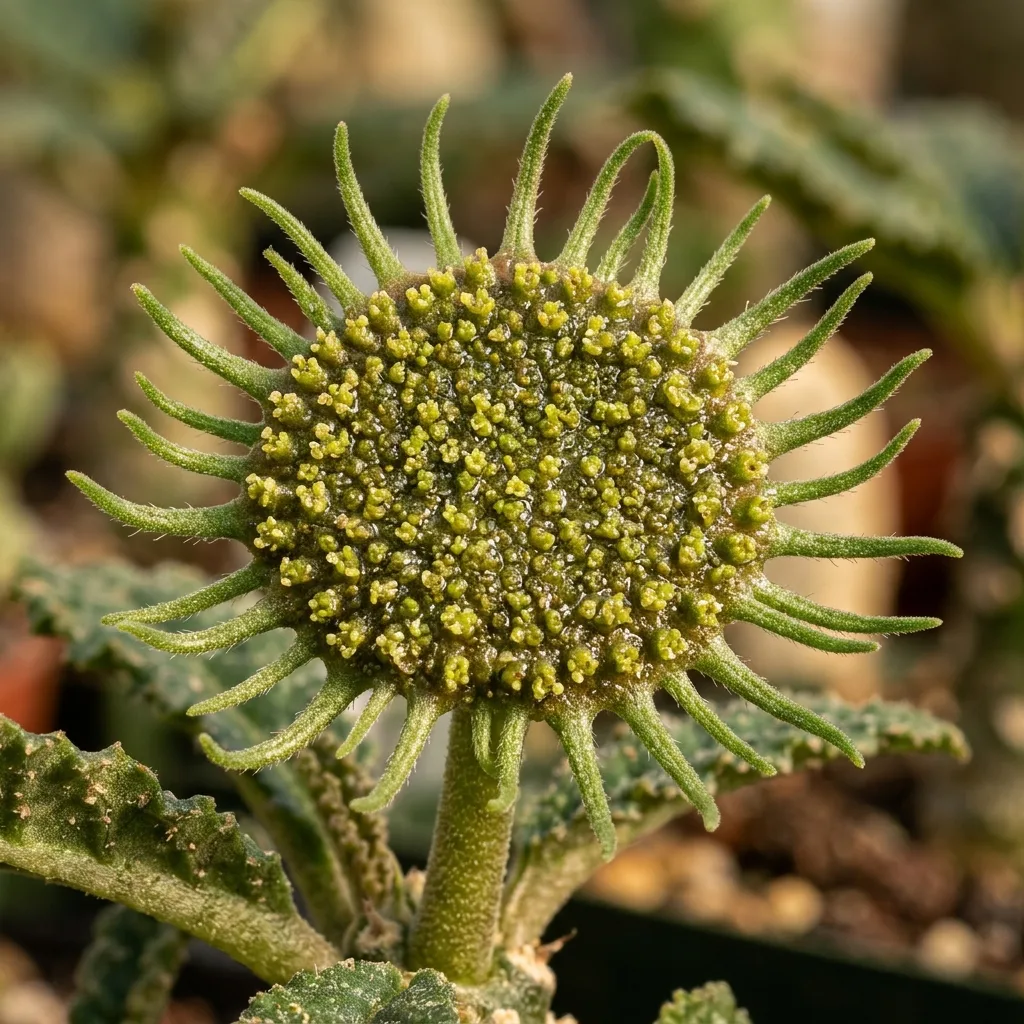
Hailing from the sun-scorched limestone cliffs of East Africa and the semi-arid thickets of Madagascar, the genus Dorstenia represents one of the most remarkable caudiciform wonders of the botanical world. Its fleshy, palm-like succulent caudex topped by bizarre, discoid floral structures (hypanthia) that resemble extraterrestrial shields makes this genus a prized centerpiece among serious collectors. Yet preserving this sculpted form indoors requires an intimate understanding of its cellular hydration strategies and root oxygen dynamics.
Far too many growers misjudge Dorstenia upon acquisition, treating it either as a bone-dry desert cactus—inducing chronic cellular desiccation—or mistaking it for a standard tropical ficus and causing fatal root asphyxiation through overwatering. In reality, Dorstenia is a miraculously succulentized offshoot of the mulberry family (Moraceae). It demands generous moisture and sustained nutrition throughout its active growth window, balanced by an uncompromising period of rest when ambient temperatures fall.
1. Botanical Biology and Physiological Foundations
Dorstenia species (most notably the collector favorites Dorstenia foetida, Dorstenia lavrani, and the monumental Dorstenia gigas) exhibit a distinct caudiciform growth architecture. The swollen base of the stem consists of specialized cortical and parenchymal tissue engineered to store massive reserves of water and complex polysaccharides. This structural reservoir serves as a biological buffer, preserving the integrity of vital vascular bundles through months of unforgiving equatorial drought.
The plant's most astonishing feature is its reproductive structure: an expanded, disc-shaped floral platform known botanically as a hypanthium. While typical members of the Moraceae family (such as common figs) enclose their inflorescences within a hollow, inward-facing receptacle (syconium), Dorstenia turns this anatomy inside out. The hypanthium flattens outward into an exposed, star-fringed or saucer-like plate embedded with microscopic male and female florets. As the seeds mature within this disc, dynamic hydrostatic turgor pressure builds up until the seeds are violently catapulted several meters into the surrounding terrain—a brilliant ecological dispersal mechanism known as ballistic seed discharge.
Below the soil line, Dorstenia roots have evolved to navigate porous, mineral-rich crevices packed with decomposed basalt, limestone, and volcanic grit. The root cortex requires continuous atmospheric gas exchange. In heavy, compacted, or moisture-logged soils, root hairs undergo cellular necrosis within 48 to 72 hours, creating an open pathway for opportunistic pathogens to ascend into the vulnerable caudex.
2. Diagnostic Indicators and Plant Requirements
Reading your Dorstenia's cellular signaling is vital for timely horticultural intervention. Learn to interpret its physical expressions with precision:
- Caudex Softening and Creasing: If the swollen stem yields to gentle finger pressure and feels spongy, immediately evaluate substrate moisture. If the soil is bone-dry, the plant has exhausted its cellular turgor reserves and requires immediate rehydration. Conversely, if the stem softens while the substrate is wet, this indicates an advanced vascular rot compromising xylem transport.
- Sudden Yellowing and Shedding of Lower Leaves: When ambient temperatures slip below 15°C (59°F), the plant downregulates photosynthetic activity and enters dormancy—a completely natural survival mechanism. However, if this occurs during midsummer, it warns of severe underwatering or extensive root hair collapse.
- Elongated, Spindly Growth (Etiolation): Dorstenia maintains its compressed, rugged, architectural caudex exclusively under high-lumen illumination. In insufficient light, internodes stretch rapidly upward like a weak vine, permanently arresting lateral caudex expansion.
- Desiccation and Dropping of Shield Buds: Immature hypanthia drying out or falling off before opening points directly to sharp drops in relative ambient humidity or harsh indoor convective drafts (such as direct air conditioning or furnace vents).
3. Step-by-Step Cultivation Protocol
To cultivate your Dorstenia into a living, miniature monument and trigger dozens of bizarre shield blossoms every spring, implement this step-by-step horticultural regimen:
- Light Management and Exposure: Dorstenia thrives under unfiltered morning sunlight. During harsh midsummer afternoons, provide bright, diffused light (filtered by sheer drapery or a 30% shade cloth) to protect tender apical tissues from scorching. Strive for at least 5 to 6 hours of vigorous illumination daily to encourage horizontal stem expansion.
- Formulating an Aerated, Mineral-Dominant Substrate: Conventional commercial potting soils and standard succulent mixes retain far too much moisture for long-term caudex health. Maintain an inorganic mineral ratio of approximately 70% to ensure unhindered gas exchange around the root zone.
- Irrigation Discipline During Active Growth: The active growing season spans from late spring through late summer. Once the top 3 to 4 centimeters (1.5 inches) of soil have dried out completely, saturate the root ball thoroughly until water flows freely from the drainage apertures. Never allow the container to sit in standing saucer water.
- Thermal Parameters and Humidity: Dorstenia is fundamentally thermophilic (heat-loving). Optimum metabolic efficiency is achieved between 24°C and 32°C (75°F - 90°F). When household temperatures slip below 18°C (64°F), scale back watering frequency decisively.
- Seed Harvesting and Containment: If you plan to harvest viable seeds from your shield blooms, tie a small pouch of fine tulle or bridal veil netting around the maturing hypanthium. Without this physical barrier, the ballistic mechanism will propel the seeds clear across your living space.
4. Essential Substrate, Equipment, and Physical Parameters
Long-term success with Dorstenia hinges upon selecting the correct container physics and substrate components. Minimizing the duration of moisture contact against root cellular walls prevents fungal decay cascades.
| Component / Parameter | Recommended Specification / Ratio | Botanical Justification |
|---|---|---|
| Inorganic Mineral Matrix | 40% Pumice (3-5 mm) + 20% Crushed Lava Grit + 10% Zeolite | Ensures uninhibited oxygen diffusion to the root cortex and prevents water retention pockets. |
| Organic Fraction | 30% Aged Coir Fiber or Coarse Leaf Peat | Supplies necessary cation exchange capacity and minimal microbial surface area for nutrient absorption. |
| Container Selection | Wide-mouthed, shallow, unglazed terracotta | Accommodates lateral root spreading; porous clay walls accelerate evaporation from the root zone. |
| Irrigation Water Temperature | 20°C - 24°C / 68°F - 75°F (Ambient Room Temp) | Cold tap water shocks thermophilic root cells, precipitating sudden foliar abscission and root hair death. |
| Nutritional Supplementation | Low-Nitrogen, High-Potassium formulation (e.g., 5-10-15) at 1/4 strength | Excess nitrogen causes tissue cracking and unnatural etiolation; potassium reinforces cellular wall density. |

5. Five Common Cultivation Mistakes and Recovery Tactics
- Mistake 1: Watering a Defoliated Plant in Winter.
Remedy: Leaf shedding in response to dropping temperatures is an innate physiological adaptation. Cease all watering immediately. If the substrate is wet, unpot the plant, gently pat the root system dry on unbleached paper towels, place it into dry grit, and keep it resting until spring warmth triggers new growth. - Mistake 2: Using Deep, Vertical Planters.
Remedy: Dorstenia roots spread laterally and horizontally rather than descending deep into the subsoil. Deep pots leave an anaerobic mud layer at the base even when the top feels dry. Transition your specimen into a wide, shallow terracotta bulb dish or bonsai-style planter. - Mistake 3: Overhead Misting Onto the Caudex.
Remedy: The convolutions of the caudex and the center of the leafy apical rosette trap standing water, fostering fungal lesions and stem rot. Always apply water directly to the substrate perimeter, keeping moisture away from the caudex crown. - Mistake 4: Heavy Fertilization Under Marginal Light.
Remedy: Supplying nutrients while light levels are inadequate produces weak, spindly, pale green tissue vulnerable to pathogens. Stop feeding immediately, prune away deformed growth if necessary, and gradually acclimate the plant to higher light levels. - Mistake 5: Failing to Recognize Early Collar Rot.
Remedy: If the base of the stem turns brown, discolored, and soft, act immediately. Using a sterile surgical scalpel, excise all necrotic tissue until only clean, pale green parenchyma remains. Dust the wound with sulfur powder or cinnamon, allow it to form a tough callus in a dry, shaded location for 10 days, and re-root on dry pumice.
6. Seasonal Cultivation Calendar and Long-Term Results
Aligning your cultural routine with Dorstenia's natural seasonal rhythms ensures longevity and vitality:
- Spring (The Awakening): Starting around April, as room temperatures consistently exceed 20°C (68°F), vivid green leaf tips emerge from the apex of the caudex. Reintroduce irrigation gradually with light applications. Apply a balanced, diluted cactus fertilizer once monthly.
- Summer (Peak Vegetative & Floral Activity): June through August represents maximum metabolic performance. The caudex produces numerous shield-like hypanthia and seeds continuously. Water deeply whenever the top layer of substrate dries out, and ensure vigorous fresh air circulation.
- Autumn (Metabolic Slowdown): As days shorten and nighttime temperatures descend in late September, lengthen intervals between waterings. The plant ceases flower development and redirects mobile photoassimilates back into the caudex core.
- Winter (Absolute Rest): Maintain the plant in a bright location between 12°C and 16°C (54°F - 61°F), completely safe from frost. Offer merely a few tablespoons of water once a month along the pot edge to prevent severe root hair desiccation.
By upholding this disciplined cultivation rhythm, your Dorstenia will accumulate successive structural layers year after year, transforming over decades into an irreplaceable, heirloom botanical sculpture.


Reader Reviews & Comments 4 Reviews
Julian Vance
Clara Sterling
Eleanor Brooks
Marcus Thorne
Leave a Review & Rating
Share your plant care tips, experiences, or questions with our succulent community.