






Shaped by millions of years of evolutionary isolation, the Socotra Archipelago harbors some of the most extraordinary plant morphologies on Earth. Among this isolated geography's undisputed crowned jewels is Dorstenia gigas, commonly known as the 'Socotran Fig Tree Succulent'—a magnificent pachycaul (fat-stemmed) specimen. Beloging to the Moraceae (mulberry/fig) family, this plant defies the standard succulent archetype with its massive, water-storing sculptural trunk and branching silhouette reminiscent of a miniature baobab. Yet confining such an elite botanical relic to standard plastic or glazed ceramic containers not only restricts its aesthetic potential but runs contrary to its delicate root biology.
The compact, rugged, and resilient nature of succulents provides an ideal foundation for creative do-it-yourself (DIY) planter designs. In species like Dorstenia gigas, which evolved exclusively in hyper-arid limestone clefts and wind-battered cliffs, a pot is far more than a simple receptacle—it serves as the epicentre of root respiration and microclimate stabilization. In this guide, we explore the step-by-step crafting of a breathable, handmade hypertufa rock vessel tailored to mimic Socotra's native habitat, alongside a comprehensive, science-based cultivation protocol.
1. Essential Materials, Tools, and Safety Precautions
Constructing a custom faux-stone planter and securing an irreplaceable specimen like Dorstenia gigas requires careful selection of materials from both mechanical and chemical standpoints. Working with cementitious binders carries airborne dust and caustic pH hazards, demanding proper protective equipment.
- Binder & Aggregates: 1 part Portland cement (preferably white or light gray), 1.5 parts sifted perlite or horticultural pumice powder, 1.5 parts finely screened coco peat.
- Drainage & Mineral Admixtures: 10% volume volcanic tuff sand and crushed lava rock (for micro-porosity and mineral buffering).
- Molding Essentials: Recycled rigid plastic utility containers, polystyrene foam blocks, or shapeable heavy-gauge builder's plastic.
- Tools: Stiff wire brush, concrete mixing trowel, 25-35 mm wooden dowel or PVC pipe segment for drainage conduit creation, misting spray bottle.
- Personal Protective Equipment (PPE): FFP2/FFP3 particulate respirator, nitrile-coated chemical-resistant gloves, and safety goggles. Wet cement is strongly alkaline; direct skin contact can lead to serious caustic burns.
2. Material Proportions and Dimensional Matrix
The following technical ratio delivers the structural ballast required to counterbalance the heavy trunk of Dorstenia gigas without tipping, while ensuring the elevated gaseous exchange essential for root health.
| Component / Parameter | Recommended Ratio / Dimension | Functional Purpose | Curing / Setting Duration |
|---|---|---|---|
| Portland Cement | 1 Part by Volume | Structural matrix and mechanical integrity | 28-day full hydraulic cure |
| Fine Pumice / Scoria (2-4 mm) | 1.5 Parts by Volume | Micro-drainage pathways, mass optimization | Instantaneous mixing |
| Coco Coir Peat (Washed) | 1.5 Parts by Volume | Organic weathering texture, moisture buffering | Instantaneous mixing |
| Drainage Aperture Diameter | At least 30-40 mm | Zero perched water table formation, rapid evacuation | Formed at mold stage |
| Alkaline Neutralization Bath | 5% Aqueous Vinegar Solution | Leaches free calcium hydroxide down to pH 6.5-7.0 | 72-hour submersion |
3. Step-by-Step Fabrication and Assembly
Employing hypertufa to recreate an authentic limestone cliff fissure is equal parts sculptural craft and rigorous chemical curing:
- Dry Homogenization: Blend the cement, sifted pumice, and coco peat in a tub until a completely uniform color is achieved without streaks.
- Water Addition & Consistency: Introduce water gradually. The target consistency resembles moist cookie dough: when squeezed firmly in a gloved hand, it holds its shape cleanly without releasing free runoff water. Excess water destroys hypertufa's microscopic pore matrix and triggers shrinkage cracks.
- Sculpting the Vessel: Place crushed polystyrene blocks inside a wide outer molding basin to establish organic crevice contours. Insert a lubricated PVC pipe upright in the center for the drainage outlet. Hand-pack the mortar, maintaining a base thickness of at least 4-5 cm and sidewalls of 3-4 cm.
- Initial Setting Stage: Seal the molded container airtight within a heavy-duty trash bag and store in a shaded, warm room for 48 hours to complete initial hydration.
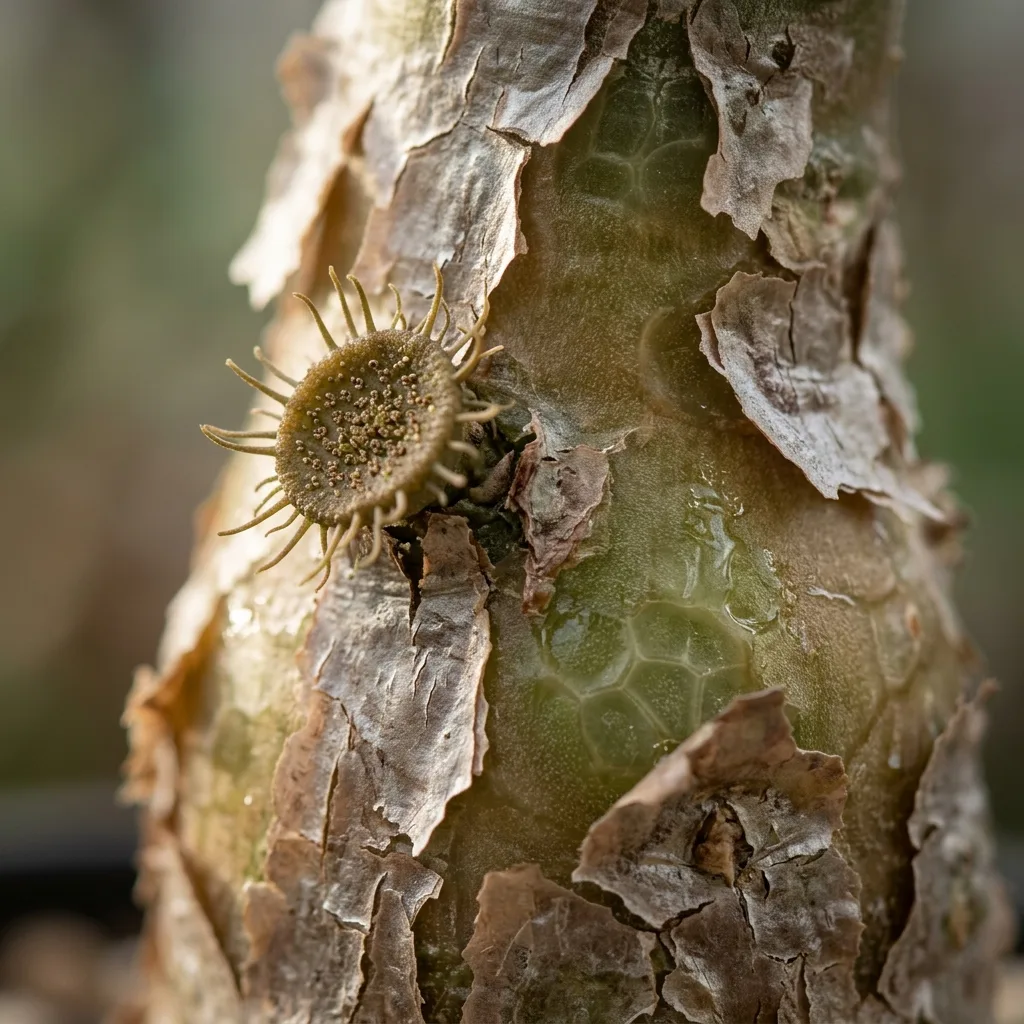
- Surface Distressing: At 48 hours, unmold the pot while it retains a cheese-like firmness. Firmly scour the exterior using a stiff wire brush and palette knife, abrading the glossy cement skin to expose the rough pumice aggregate and fibers, replicating natural, weathered limestone.
- Curing & Neutralization: Allow the pot to cure in the shade for 3 weeks, keeping it lightly dampened. Afterwards, submerge it in an acidic bath (water mixed with 5% white vinegar) for 72 hours to neutralize alkaline free lime, followed by a thorough flush with fresh water.
4. Planting and Stabilizing the Pachycaul Succulent
Dorstenia gigas reserves significant moisture within its dense pachycaul caudex; however, its root volume is disproportionately modest compared to its top-heavy aerial mass. Consequently, planting requires extreme precision:
Substrate Composition: Standard potting soil or peat blends are lethal to this species. Formulate a gritty root medium containing 40% pumice (3-6 mm), 20% volcanic lava scoria, 20% zeolite, and no more than 20% coarse, sterile organic material (such as unfertilized coco husk fiber). Zeolite significantly boosts cation-exchange capacity while suppressing opportunistic fungal pathogens in the root zone.
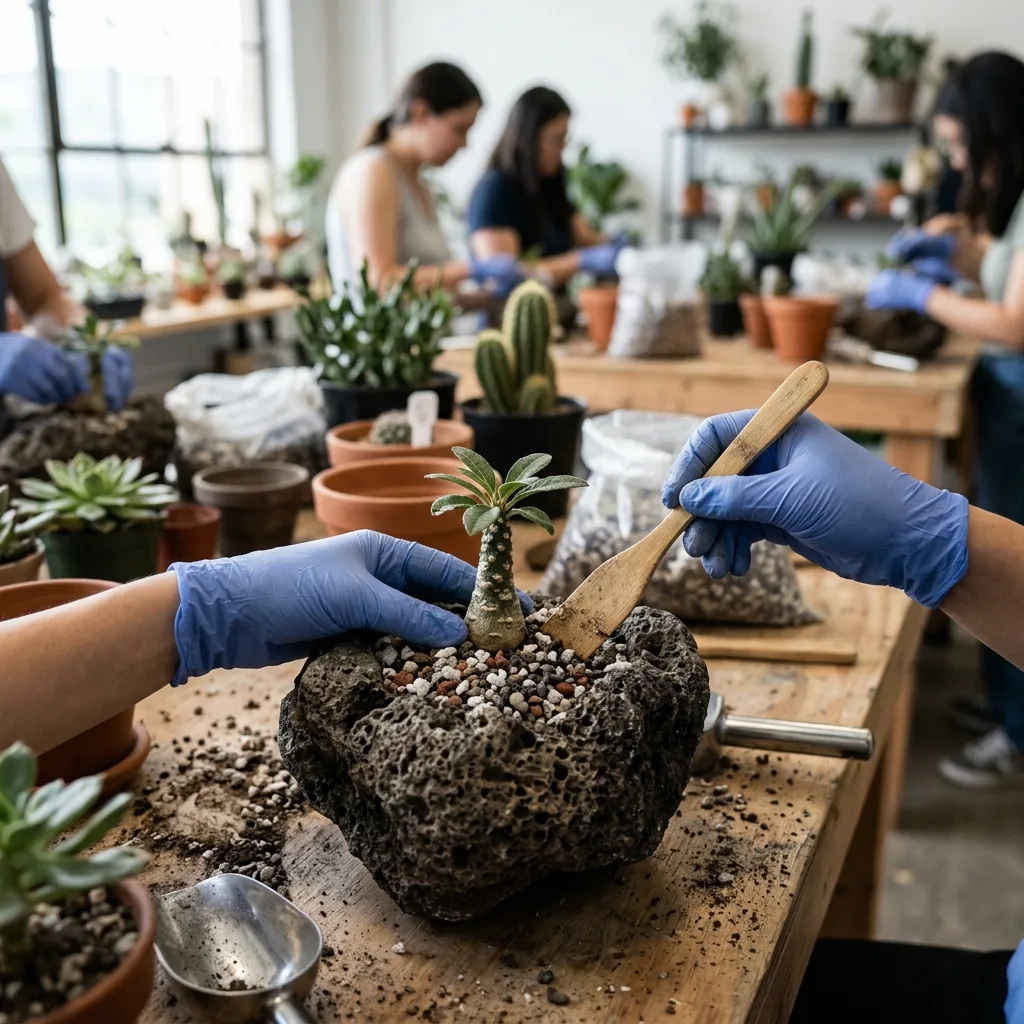
Trunk Positioning and Mechanical Anchoring: When setting the specimen into the hypertufa basin, ensure the root flare sits high. The succulent caudex must remain completely above ground; only primary anchoring roots and lateral feeder hairs should be covered by substrate. After positioning, stabilize the trunk by wedging substantial limestone rocks or smooth river pebbles around the base to prevent movement while roots establish.
5. Irrigation Dynamics and Cultivation Nuances in Porous Stone
A handcrafted hypertufa vessel naturally draws and transpires moisture through micro-capillaries, fundamentally shifting your watering routine for the better:
During its active growth window from late spring through late summer, Dorstenia gigas appreciates consistent, generous waterings once the medium dries. While many succulents lean heavily on nighttime CAM (Crassulacean Acid Metabolism), Dorstenia retains high day-time leaf transpiration rates under full growth. Saturate both the substrate and the porous hypertufa walls thoroughly; surface evaporative cooling through the stone container prevents summer heat stress within the root zone.
During winter dormancy, when the plant naturally sheds its foliage, restrict irrigation drastically. A few tablespoons of water once a month is sufficient to keep root hairs from desiccating entirely. If ambient temperatures hover near or below 15°C (59°F), maintain the potting substrate completely dry.
6. Longevity, Patina, and Structural Maintenance
As the months pass, your hypertufa rock pot evolves into a living micro-habitat. To encourage natural botanical patina and moss growth along the exterior contours, coat the outside with diluted yogurt or organic beer, maintaining gentle shade and humidity. If displayed outdoors, safeguard the vessel against freezing winter temperatures, as moisture trapped inside microscopic pores can expand upon freezing and cause structural fractures.
Adhere 1-cm thick dense rubber or cork pads to the underside of the vessel. This protects interior furniture finishes while keeping drainage holes elevated from saucers, promoting passive airflow and healthy bottom air-pruning of root tips.


Reader Reviews & Comments 3 Reviews
Julian Vance
Clara Higgins
Marcus Sterling
Leave a Review & Rating
Share your plant care tips, experiences, or questions with our succulent community.