






From the limestone cliffs of northern Mexico to the mineral-laden plateaus of the South African Karoo, the native habitats of cacti and succulents are never moist beds smothered in rich organic sludge. These resilient plants evolved in mineral paradises where sudden torrential rains drain away in seconds, where coarse gravel creates cavernous air pockets between roots, and where standing moisture never lingers for more than a heartbeat. The greatest disservice we do to indoor cacti is trapping their root systems in the dense, fibrous black peat sold in commercial supermarket bags. Dousing your succulents frequently is not an act of love; it is an unintentional suffocation of their root tissues. A properly balanced homemade potting mix, however, brings the resilient immune defenses of their native habitats straight into your living room.
Cactus roots simply cannot tolerate anaerobic (oxygen-deprived) conditions. When standard peat dries out, it hardens into a hydrophobic brick that deflects moisture; yet once re-wetted, it stays saturated like a wet sponge for weeks, surrendering fragile xylem vessels to destructive fungal pathogens. Formulating your own mineral-based cactus and succulent potting mix is the single most vital horticultural step you can take to safeguard cellular turgor pressure and eliminate root rot once and for all.
1. Taxonomic Identity, Areole Morphology, and Spine Biology
Members of the botanical family Cactaceae are distinguished from all other succulent plant families by a single unique anatomical structure: the areole. Areoles are specialized, cushion-like modified bud zones distributed across the ribbed or tubercular cactus stem. A cactus's spines, branches, lateral offsets, and breathtaking blooms emerge exclusively from these woolly pads. Spines themselves are evolutionary adaptations—leaves transformed into sharp, woody structures (spine-leaves) that have transferred the entire photosynthetic workload to the succulent green stem. Beyond defense, these spines cast micro-shadows that reduce destructive ultraviolet radiation, while channeling evening dew straight down to the areole base to drip directly into the root collar.
To anchor and nourish this heavy, moisture-laden succulent tissue, the plant produces a shallow, fibrous, and extensively branched root network. In their native habitats, following months of hyper-arid drought, the initial flash storm causes root tips to generate hygroscopic root hairs within mere hours. Yet the moment the floodwater recedes, these roots demand instantaneous drainage and gas exchange. The particle sizing of your homemade soil must maintain this exact aerodynamic porosity without collapsing the biological rhythm of the areoles and root hairs.
2. Light Demands, Solar Intensity, and Air Movement Standards
The true power of a homemade mineral substrate is unlocked when paired with balanced light and adequate ventilation. Desert cacti and high-light succulents such as Echeveria and Sedum demand at least 6 hours of direct, unfiltered sunlight daily. Insufficient lighting triggers etiolation—an unsightly condition where stems stretch, narrow, and lose chlorophyll density. The delicate, powdery silvery-blue coating observed on many succulent leaves is epicuticular wax, commonly known as farina. This coating acts as natural botanical sunscreen; avoid rubbing or touching leaves, as wiped surfaces become acutely susceptible to sunburn under intense rays.
Ambient air circulation is the unsung hero determining the evapotranspiration rate of your potting medium. In stagnant, humid room air, even the most porous substrate will retain residual moisture far too long. Opening windows to invite a fresh breeze or running a small fan to generate gentle convective currents significantly accelerates subterranean gas exchange, liberating roots from toxic metabolic gas build-up.

3. The Wet-and-Dry Hydration Cycle and Critical Winter Dormancy
Watering cacti and succulents cannot follow a rigid calendar; it must respond dynamically to environmental cues and internal physiological rhythm. The 'Soak and Dry' method is an immutable rule of succulent care. You must never irrigate until the entire subterranean soil profile has dried completely to the bottom of the container. Insert a slim wooden skewer straight down to the base of the pot: if it emerges cool and moist with clinging substrate particles, defer watering; if it comes out bone-dry and clean, it is safe to hydrate.
The trigger for robust bud initiation in most desert cacti is an authentic winter resting phase (dormancy). Between late autumn and early spring (typically November through March), as ambient temperatures cool to 8–12°C (46–54°F), cacti drastically downregulate their metabolic activity. During this period:
- Watering must be scaled back to near zero (at most once a month, or suspended entirely for cold-hardy desert specimens).
- The potting substrate must remain bone-dry; cold temperatures paired with root dampness will burst cell walls, resulting in rapid frost damage and black rot.
- As springtime temperatures climb, your first controlled, lukewarm watering serves as the biological awakening signal for the coming growth season.
4. High-Mineral Cactus Soil Formula and Container Specifications
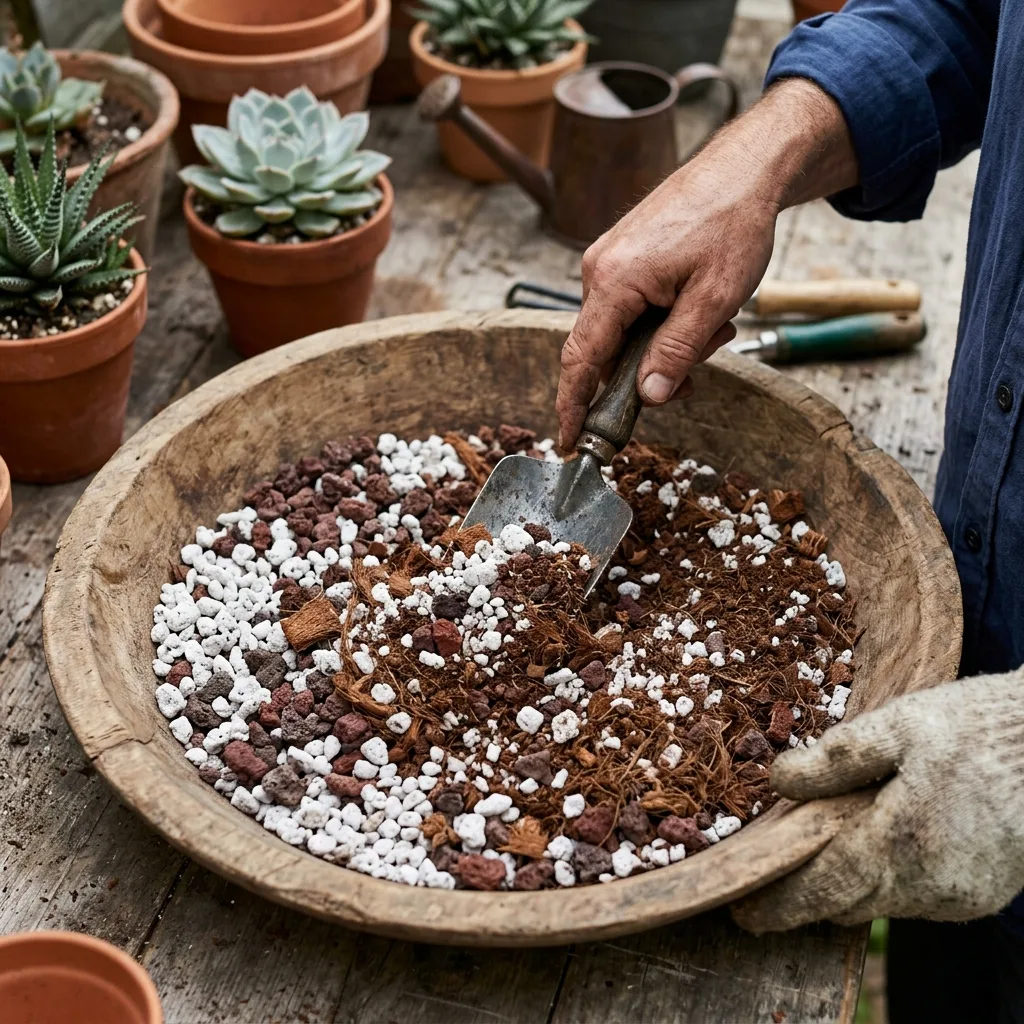
The fundamental goal of an artisanal cactus and succulent mix is to drive moisture retention to an absolute minimum while maximizing porous macro-voids through which root respiration can thrive. Ordinary garden topsoil or pure bagged peat is a death sentence for arid plants. The ideal substrate is an engineered balance of inorganic porous rock combined with a modest fraction of clean, fibrous organic matter.
The particle size of all constituent ingredients should consistently fall between 3 and 6 mm (1/8 to 1/4 inch). Powdery, silt-like dust will cement the mix and suffocate the roots, while oversized rocks prevent fine feeder root anchorage. Thoroughly screen all inorganic components—such as pumice, crushed lava, zeolite, and coarse sand—to eliminate fine silt before blending.
| Component Type | Material Specification | Horticultural Function & Botanical Benefit | Mix Ratio (by Volume) |
|---|---|---|---|
| Inorganic Mineral | Horticultural Pumice (3–5 mm) | Houses internal micropores that store pockets of air while rapidly shedding free water. | 35% |
| Inorganic Mineral | Crushed Volcanic Lava & Zeolite | Slowly releases trace micro-elements and structurally prevents substrate compaction. | 25% |
| Inorganic Mineral | Coarse Quartz River Sand / Grit | Sharp grit that boosts drainage channels and provides physical anchoring mass for taproots. | 10% |
| Organic Foundation | Low-Debris Peat Moss or Washed Coco Coir | Serves as a gentle base for primary root establishment and holds minimal background moisture. | 20% |
| Organic Nutrition | Aged Earthworm Castings (Vermicompost) | Supplies gentle, slow-release organic humic acids and beneficial mycorrhizal flora. | 10% |
Container selection is just as consequential as the substrate itself. Unglazed terracotta pots are the gold standard; their porous clay walls naturally wick residual dampness outward via evaporative cooling. If you choose plastic, resin, or glazed ceramic containers, you must ensure generous bottom drainage holes and increase the inorganic mineral ratio of the mix to roughly 80% to compensate for the lack of wall evaporation.
5. Inducing Desert Blooms and Nutrient Strategies
Abundant cactus flowers are the natural reward of a healthy, vigorous vascular system coupled with a clean winter dormancy. A plant that has rested in cool, dry conditions will respond to spring warmth by signaling its areoles to initiate floral buds rather than vegetative growth.
During active growth through spring and midsummer, nourish with a dedicated cactus fertilizer formula that is deliberately low in nitrogen and rich in phosphorus and potassium (such as an NPK 5-10-10 or 4-8-12). High-nitrogen fertilizers cause succulent tissues to swell too quickly, resulting in epidermal splitting, weak structural walls, and an absence of flower buds. Apply fertilizer at quarter-strength, blended into irrigation water once monthly. Halt all feeding completely during winter dormancy.
6. Propagation, Stem Cuttings, and Grafting Methodology
A sterile, fast-draining mineral substrate increases your vegetative propagation strike rates dramatically. When taking stem pads, offsets, or leaf cuttings, the single most crucial step is allowing the cut wound to form a thick protective scab (callus tissue). Never plant a freshly cut succulent directly into moist substrate. Set the cutting in a dry, shaded, well-ventilated spot for 3 to 7 days until the exposed vascular ring is completely sealed and callused over.
Once callused, insert or rest the cutting upright on the surface of your mineral mix. Avoid deep saturation until the first white root tips form; maintain minimal humidity by lightly misting only the surface around the plant collar. For chlorophyll-deficient mutant cultivars (such as vivid red or yellow 'Gymnocalycium' moon cacti) that cannot synthesize carbohydrates independently, apical scions must be surgically grafted onto a vigorous rootstock host, such as Hylocereus, aligning their vascular cambium layers for permanent nutrient transfer.
7. Guarding Against Rot and Combating Fungal Pathogens
Over 90% of specimen losses in cactus cultivation trace back to opportunistic waterborne fungi, notably species of Phytophthora, Pythium, and Fusarium. Classic indicators of systemic fungal invasion include basal softening, translucent yellow-to-brown lesions around the collar, and loose anchoring in the container. Note that if the base of an older cactus develops a brownish, tough, bark-like texture that remains rock-solid, this is normal corking (lignification). However, if the tissue indents or oozes fluid under gentle fingertip pressure, immediate surgical intervention is non-negotiable.
To save a rotting specimen, sterilize a razor-sharp scalpel and slice horizontally across the stem roughly 1 cm above the visible margin of rot. Inspect the cut face; you must slice away tissue until the central vascular ring is entirely pristine and free of any brown or black staining. Dust the healthy cut wound with natural antifungal sulfur, powdered activated charcoal, or pure ground cinnamon. Allow the decapitated cutting to produce a firm, concave callus over two weeks before attempting to reroot it in fresh, sterile mineral soil.


Reader Reviews & Comments 4 Reviews
Clara Sterling
Hannah Lindqvist
Julian Vance
Marcus Thorne
Leave a Review & Rating
Share your plant care tips, experiences, or questions with our succulent community.