






Originating in the arid highlands and sun-drenched rocky fissures of East Africa—predominantly northern Somalia—Cyanotis somaliensis captures the devotion of succulent enthusiasts with its compact, triangular, fleshy leaves cloaked in downy white silk. Affectionately known as 'Pussy Ears', this remarkable species is a true gem of the family Commelinaceae, uniquely specialized for survival in xeric environments. All too often, growers perceive this soft, silvery pelt merely as an ornamental trait; in truth, these microscopic hairs represent an ingenious evolutionary armor engineered to withstand relentless equatorial irradiance and acute transpiration stress.
The most common pitfall when introducing this botanical jewel into home interiors is treating it like a standard tropical vine, indulging it with frequent watering cycles and stifling, peat-heavy soils. In succulent horticulture, generous watering is never an expression of care—it is an unwitting suffocation of root tissues. Cyanotis somaliensis hoards ample moisture within its cauline stem tissues and foliar storage parenchyma; consequently, the greatest kindness you can offer is supreme substrate porosity paired with patient, cyclic drying intervals that honor its natural physiology.
1. Botanical Biology and Physiological Foundations
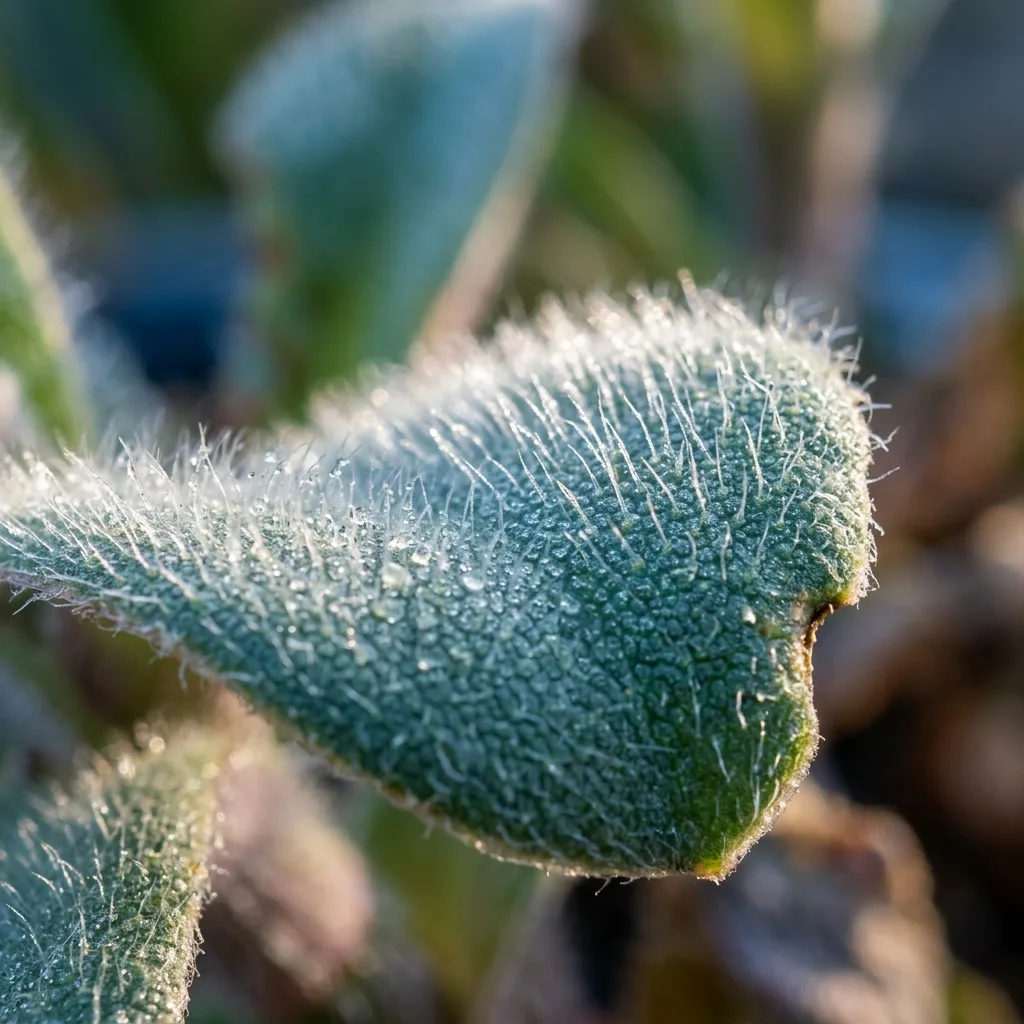
To master the cultivation requirements of Cyanotis somaliensis, we must first examine its cellular morphology. The glistening, silvery coat that envelops the leaf margins and epidermis consists of specialized botanical structures termed trichomes. These epidermal outgrowths create a boundary layer of still micro-air over the leaf surface, substantially curbing transpiration and convective moisture loss. Simultaneously, they diffuse and reflect intense ultraviolet radiation, shielding the chloroplasts within the mesophyll from photooxidative bleaching. In essence, this velvet coat operates as an endogenous sunshade and cellular moisture shield.
Beneath this defensive mantle lies specialized water-storage parenchyma characteristic of true xerophytes, capable of supporting turgor across extended dry spells. The root architecture, conversely, is shallow, fibrous, and exceptionally demanding of atmospheric oxygen. Conventional, peat-heavy indoor potting soils collapse around these delicate roots upon saturation, severely impairing rhizosphere gas exchange. Under prolonged hypoxia, root cells resort to anaerobic respiration, culminating in rapid cellular lysis and opportunistic infection by Fusarium or Pythium pathogens. Foliar etiolation or translucent, vitrified lower leaves dropping at the slightest touch are direct clinical manifestations of disrupted turgor mechanics caused by poor lighting and excessive root moisture.
2. Accurate Diagnosis and Stress Symptoms
Learning to read the morphological language of your specimen allows you to intervene before systemic decline sets in. Cyanotis somaliensis demonstrates distinct pathological responses when subjected to physiological stress:
- Overwatering and Rhizosphere Hypoxia: Basal leaves forego standard chlorosis and instead turn translucent, watery, and jelly-like with a dull yellowish-brown tint. The lower stem becomes soft and discolored. The silky trichomes appear matted and clumped together.
- Chronic Desiccation: Foliage forfeits its characteristic plumbness, cupping inward and developing fine longitudinal wrinkles. The stems feel limp and flexible. However, provided the fibrous root system remains intact, full cellular turgor will rebound within 24 hours of deep, thorough rehydration.
- Etiolation (Insufficient Irradiance): Internodal spacing elongates significantly, producing spindly, weakened runners. The vibrant emerald-and-silver contrast fades to an anemic, pale grass green, accompanied by a noticeable decline in trichome synthesis.
- Overhead Foliar Scorching: Water droplets trapped among the dense trichomes create a convex lens effect under direct sunlight, concentrating thermal rays and causing localized necrotic pitting. Furthermore, persistent moisture at the foliar axils provides prime germination conditions for fungal spores.
3. Step-by-Step Cultivation Protocol
To cultivate an exceptionally lush, compact, and trailing specimen of Cyanotis somaliensis, we adhere to the clinical protocol refined over years of propagation in our nursery:
- Container Architecture: Due to the shallow, lateral creeping habit of its fibrous roots, avoid deep, narrow containers. Select wide, shallow vessels equipped with generous drainage apertures. Unglazed terra cotta is optimal, as its microporous walls foster ambient evaporative drying throughout the entire root zone.
- Substrate Engineering: Lay a foundational bed of coarse inert grit at the pot base. Fill the container with a customized, hyper-porous mineral blend, keeping it loose, airy, and completely uncompacted to maintain expansive macro-pore spaces.
- Crown Positioning: Never bury the root collar—the transition point between stem and root system—deeply into the mix. Apply a 0.5 cm protective top-dressing of pure pumice, zeolite, or horticultural gravel to physically isolate the basal leaves from damp organic particles.
- Hydration Mechanics (The Soak-and-Dry Cycle): Verify that the substrate is thoroughly dry through its entire depth, not merely at the surface crust. Insert a dry wooden skewer down to the base; if it withdraws completely clean and dry, apply balanced, room-temperature water until it streams unhindered from the drainage holes. Discard all runoff from the saucer within 15 minutes.
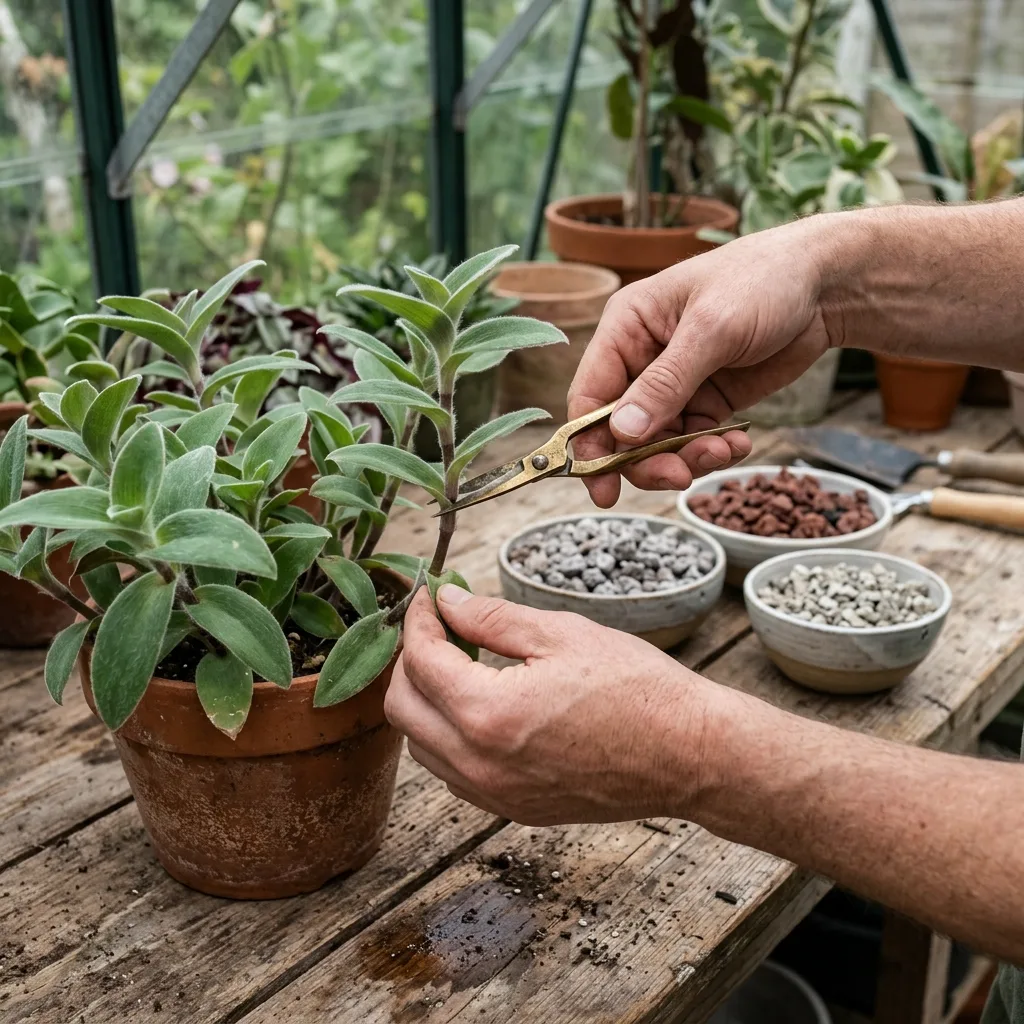
- Apical Pruning and Architectural Maintenance: Systematically prune terminal branch tips throughout the active spring and summer growth phases. This disrupts apical dominance, inducing lateral dormant buds to break along the stems, producing a mounded, cascading habit while yielding premium cutting stock for propagation.
4. Critical Substrate Specifications and Environmental Metrics
The optimal physicochemical parameters tailored to satisfy the unique root ecology of Cyanotis somaliensis are detailed below:
| Component / Parameter | Target Value / Ratio | Botanical Function & Justification |
|---|---|---|
| Coarse Pumice (3–6 mm) | 35% | Creates stable macro-pores, ensuring sustained gaseous diffusion to the xylem. |
| Red Lava Rock / Zeolite (2–4 mm) | 25% | Offers light cation exchange capacity while preventing structural compaction. |
| Fine Horticultural Coco Coir | 25% | Acts as an organic moisture buffer; provides fibrous anchor for micro-roots. |
| Coarse Quartz Sand or Perlite | 15% | Accelerates hydraulic conductivity, dropping free-drainage clearance to seconds. |
| Luminous Exposure | 15,000 – 25,000 Lux (Filtered Bright) | Maintains trichome density, suppresses internodal stretch, initiates inflorescence. |
| Thermal Range | 16°C – 28°C (Winter minimum: 10°C) | Sustains steady cellular enzymatic activity without inducing dormancy shock. |
| Hydration Frequency | 100% Substrate Dryness | Deprives pathogenic oomycetes and fungi of the anaerobic conditions needed to thrive. |
5. Five Critical Mistakes and Rescue Protocols
- Mistake 1: Utilizing Dense Peat or Unamended Garden Loam.
Rescue Protocol: Immediately decant the root ball. Gently rinse away compacted soil residues with lukewarm water, excise blackened or collapsed root filaments with sterilized shears, dust cuts with sulfur or cinnamon, and pot into the mineral mix detailed above. - Mistake 2: Overhead Misting Under the Guise of Humidity Control.
Rescue Protocol: Cease foliar spraying immediately. Place the affected plant in an airy space with active convective air movement to evaporate surface moisture. Remove decayed, mushy leaves at the stem nodes using fine, alcohol-sterilized forceps. - Mistake 3: Overwatering Under Suboptimal Light Levels.
Rescue Protocol: If basal stem rot has set in, discard the rotted root system. Harvest unaffected apical stem cuttings 5–7 cm in length, allow the cut tissues to suberize and form a firm callous in dry shade for 48 hours, and root them in dry pumice. - Mistake 4: Feeding Heavy Nitrogen During Winter Dormancy.
Rescue Protocol: Succulents drastically downregulate metabolic activity during cool, low-light months. Applying high-nitrogen fertilizers causes osmotic root burn and salt accumulation. Suspend all supplemental nutrition from late autumn until spring, resuming only with a balanced, highly diluted low-nitrogen formula. - Mistake 5: Planters Lacking Drainage Outlets.
Rescue Protocol: Sealed cachepots are fatal water traps. Transition the specimen immediately into a nursery pot or unglazed ceramic vessel featuring free-draining base apertures, utilizing decorative pots solely as loose outer sleeves.
6. Seasonal Phenology and Long-Term Specimen Management
Guided by an understanding of seasonal botanical rhythms, your Cyanotis somaliensis will mature over several seasons into a dense, cascading showpiece, rewarding you with clusters of miniature, fringed, violet-blue blossoms:
Spring (Vegetative Awakening): With rising photoperiods from March onward, cellular division restarts in earnest. Water uptake climbs proportionally with ambient evapotranspiration. Introduce a quarter-strength, low-nitrogen liquid fertilizer once monthly. This is the optimal window for terminal pruning, potting up, and stem propagation.
Summer (Maturation and Inflorescence): Foliar transpiration peaks during hot spells. Shield the plant behind sheer curtains during intense midday hours to preserve epidermal hydration. During this season, short-pedicelled cymes bearing vivid, three-petaled purple-blue flowers with tufted stamens emerge from the axils.
Autumn (Metabolic Deceleration): As ambient temperatures decline through October, systematically lengthen intervals between waterings. Apply a gentle potassium-dominant foliar supplement to bolster cellular membrane resilience ahead of cooler temperatures, and discontinue all nutritional inputs.
Winter (Quiescence and Rest): Maintain the plant in a bright, cool environment held between 12°C and 16°C. Restrict watering to monthly intervals or wait until the lower leaves exhibit mild elastomeric give. Retaining roots in damp, cold soil invariably triggers swift root system failure.


Reader Reviews & Comments 3 Reviews
Eleanor Vance
Julian Thorne
Clara Higgins
Leave a Review & Rating
Share your plant care tips, experiences, or questions with our succulent community.